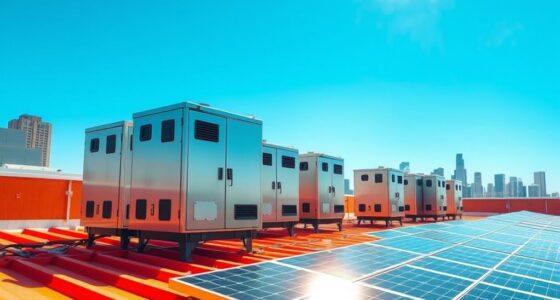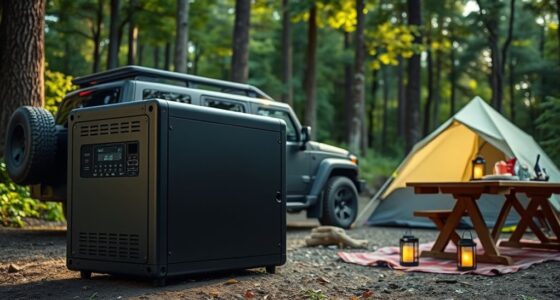
Yes, solar generators can power appliances, but you need to match their wattage and capacity to your devices’ needs. Smaller items like phones or LED lights require less power, while larger appliances like refrigerators or microwaves need higher wattage with enough battery capacity. You also need to take into account surge wattage for startup. To guarantee your appliances run smoothly, understanding these wattage requirements is key—stay tuned to learn how to get it just right.

Get backup power and energy gear delivered free with Prime
- Fast, free delivery on millions of items
- Prime Video, Amazon Music and more included
- Member-only deals all year
Key Takeaways
- Solar generators store energy in batteries measured in watt-hours (Wh), determining how long they can power appliances.
- The inverter size (watts) must match or exceed the total wattage and surge requirements of connected appliances.
- Smaller devices like smartphones need minimal wattage, while larger appliances require higher power and proper inverter capacity.
- Peak startup wattage, especially for appliances like refrigerators, must be within the generator’s inverter limits.
- Properly matched solar generator capacity and inverter size ensure safe, reliable power for various household appliances.

Solar generators have become an increasingly popular way to power appliances, especially during outages or outdoor activities. When considering if a solar generator can meet your power needs, understanding its battery capacity and inverter size is vital. Battery capacity determines how much energy the generator can store, usually measured in watt-hours (Wh). A higher capacity means you’ll be able to run your devices longer without recharging. For example, if you want to power a refrigerator or a laptop for several hours, you’ll need a generator with sufficient battery capacity to handle the cumulative wattage of those devices.
Higher battery capacity extends your solar generator’s runtime for essential appliances.
In addition to battery capacity, inverter size plays a key role in powering appliances. The inverter converts the DC power stored in the battery into AC power compatible with standard household outlets. Its size, measured in watts (W), indicates the maximum power it can deliver at once. For instance, if your fridge requires 600W to run and your blender needs 300W, you’ll want an inverter rated at least 900W to handle both devices simultaneously. Choosing an inverter with a wattage rating that comfortably exceeds your peak power needs helps prevent overloads and ensures reliable operation.
It’s important to match your appliances’ wattage requirements with the solar generator’s specifications. Small devices like smartphones and LED lights typically consume minimal power, making them easy to run on most solar generators. However, larger appliances such as refrigerators, microwaves, or power tools demand higher wattage and longer runtime. To determine whether your solar generator can power these appliances, you should check their starting (surge) wattage, which is often higher than their running wattage, and compare it with the inverter’s capacity. If the surge wattage exceeds the inverter’s limit, the device may not start properly or could cause the generator to shut down.
Furthermore, the duration you can run your appliances depends on both battery capacity and the power draw. For example, a generator with a 1,000Wh capacity can run a 100W device for approximately 10 hours, assuming no energy losses. Keep in mind that inverter efficiency, typically around 85-95%, affects overall runtime. It’s wise to select a solar generator with a larger capacity and inverter size than your minimum requirements to accommodate future needs or unexpected power surges.
solar generator with 1000Wh capacity
As an affiliate, we earn on qualifying purchases.
As an affiliate, we earn on qualifying purchases.
Frequently Asked Questions
Can Solar Generators Run High-Wattage Appliances Simultaneously?
Yes, solar generators can run high-wattage appliances simultaneously if their power capacity meets the total wattage needs. You need to check device compatibility to guarantee your appliances won’t overload the system. Be mindful of the generator’s continuous and surge wattage ratings, and avoid exceeding these limits. By choosing a solar generator with sufficient capacity, you’ll be able to power multiple high-wattage devices at once efficiently.
How Long Can a Solar Generator Power a Refrigerator?
Imagine your fridge as a hungry beast craving energy; with a well-chosen solar generator, you can keep it running for hours. Your solar efficiency and battery capacity determine how long it sustains your refrigerator. On average, a high-capacity generator can power a fridge for 8-12 hours, perfect for emergencies or outdoor adventures. The better your solar efficiency, the longer your fridge stays cool and your worries stay at bay.
Are Solar Generators Suitable for Outdoor Camping or Emergency Use?
Yes, solar generators are ideal for outdoor camping and emergency use because they’re portable and easy to carry. You should check their solar panel compatibility to guarantee efficient charging, especially in remote areas. Keep portability considerations in mind, such as weight and size, so you can easily transport and set up your generator. This makes them a reliable, eco-friendly power source when you need it most.
Do Solar Generators Require Backup Batteries or External Power Sources?
Did you know that over 60% of solar generators include built-in solar batteries? They often don’t require backup batteries or external power sources, but having a solar battery *improves* their efficiency. Some models offer grid integration, allowing you to connect to the main power grid for additional support. This setup ensures you have reliable power during outages, making your solar generator more versatile and dependable.
How Does Temperature Affect the Performance of Solar Generators?
Temperature considerably impacts your solar generator’s performance. When ambient temperature rises, solar panel efficiency tends to decrease because excessive heat reduces their ability to convert sunlight into electricity. Conversely, cooler temperatures generally boost efficiency. To maximize output, keep your solar generator in a shaded, well-ventilated area during hot days. Monitoring ambient temperature helps you understand potential shifts in power generation, ensuring your appliances stay powered reliably.
high wattage inverter for solar power
As an affiliate, we earn on qualifying purchases.
As an affiliate, we earn on qualifying purchases.
Conclusion
Now, picture your home as a bustling city powered by sunlight, with solar generators acting as your reliable energy source. Just like sunlight can illuminate a dark room, a properly sized solar generator can energize your essential appliances. But if your wattage needs exceed its capacity, it’s like trying to light a stadium with a flashlight—ineffective. Understanding wattage helps you harness the sun’s power efficiently, turning bright ideas into sustainable, steady energy for your everyday life.
portable solar power station for appliances
As an affiliate, we earn on qualifying purchases.
As an affiliate, we earn on qualifying purchases.
solar generator for refrigerator and microwave
As an affiliate, we earn on qualifying purchases.
As an affiliate, we earn on qualifying purchases.
Fall Picks
fall essentials
As an affiliate, we earn on qualifying purchases.