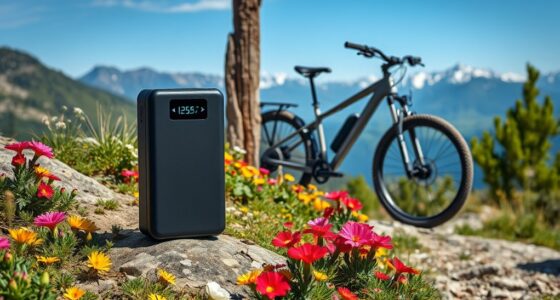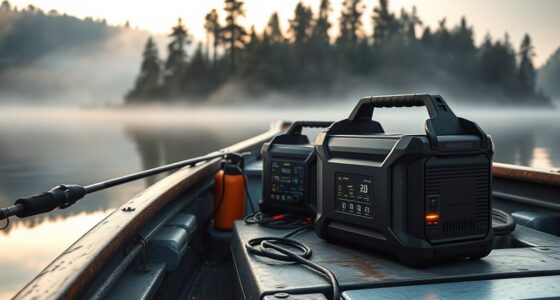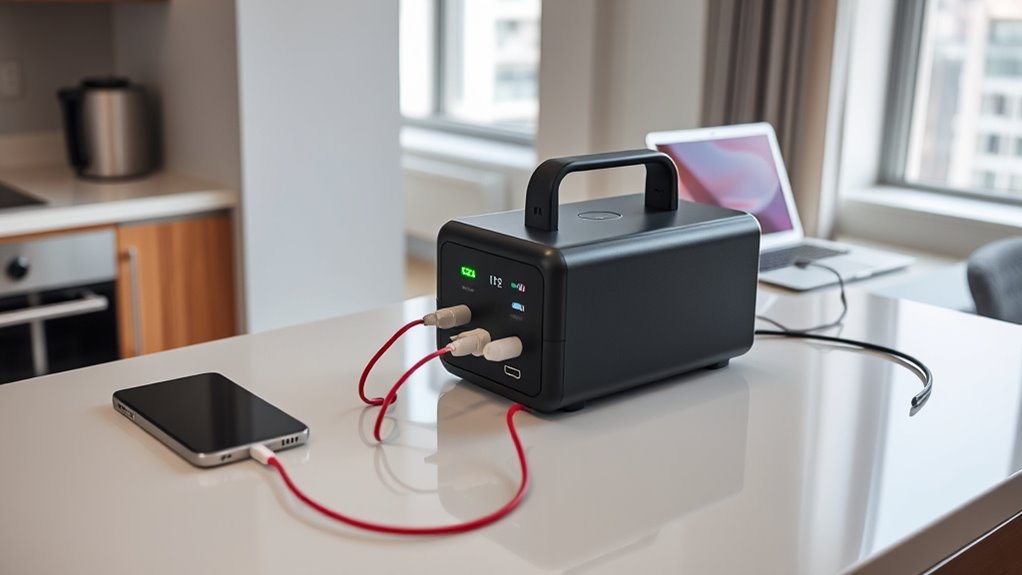

For most apartment dwellers, I’d start with the BLUETTI Elite 30 V2: its 288Wh LiFePO4 battery and 600W output balance everyday backup with a manageable footprint. The Jackery Explorer 300 is a straightforward small-unit pick, while the Jackery Explorer 1000 v2 suits longer outages and higher-wattage needs. The main tradeoff is capacity versus size: compact stations are easier to store but run fewer devices, while larger models add runtime and weight. I also weigh output limits, battery chemistry, charging options, and apartment-friendly storage. Read on for the full comparison and guidance on matching a station to your home and backup plan.

Get backup power and energy gear delivered free with Prime
- Fast, free delivery on millions of items
- Prime Video, Amazon Music and more included
- Member-only deals all year
Complete the kit


Key Takeaways
The BLUETTI Elite 30 V2 offers a useful middle ground: more output than the small 120W–300W options, without stepping up to a roughly 1kWh station.
Capacity and output solve different problems: a 1,000Wh-class unit can run devices longer, but its wattage limit still determines which appliances it can power.
Small stations are best for electronics, not whole-apartment backup. The 88Wh MARBERO and 120W HOWEASY prioritize portability over long runtimes and high-demand appliances.
LiFePO4 models appear across several sizes. The DaranEner, ALLWEI, BLUETTI, and BLUETTI Elite 100 Mini pair that battery chemistry with different output and capacity levels.
Bundles and duplicate entries need careful checking. The lineup lists the Jackery Explorer 1000 v2 twice, and the Jackery Solar Generator 300 bundle adds a 40W panel to a 292Wh station rather than changing its core output class.


| portable power station for apartment | Weight | Capacity | Dimensions |
|---|---|---|---|
| Portable Power Station 300W | 8.8 lb | 192Wh | 9.4 × 7.3 × 5.4 in |
| HOWEASY Portable Power Station | 2.3 lb | — | 6.6 × 3 × 4 in |
| Portable Power Station 500W | 18 lb | 519Wh | 11.57 × 7.95 × 7.95 in |
| Jackery Explorer 1000 v2 Porta | 23.8 lb | 1070Wh | 12.87 × 8.82 × 9.72 in |
| DaranEner Portable Power Stati | 5.73 lb | 192Wh | — |
| MARBERO Portable Power Station | 1.04 kg | 88Wh | 6.5 x 4.6 x 3.1 inches |
| ALLWEI Portable Power Station | 6.4 pounds | 256Wh | 9.25 x 5 x 6.8 inches |
| Jackery Explorer 1000 v2 Porta | 23.8 pounds | 1070Wh | 12.9 x 8.8 x 9.7 inches |
| BLUETTI Elite 30 V2 Portable P | 9.4 pounds | 288Wh | 9.8 x 7 x 6.6 inches |
| Westinghouse iGen400s 400 Watt | 5 pounds | 183Wh | 9.4 x 4.5 x 5.9 inches |
| GEYOTO N1000 Portable Power St | 25.6 lb | 1024Wh | 13.78 × 8.82 × 10.24 in |
| Jackery Explorer 300 Portable | 7.5 lb | 292Wh | 9.1 × 5.2 × 7.8 in |
| Anker SOLIX S2000 Portable Pow | 35.7 lb | 2010Wh | 8.2 × 11.1 × 12.7 in |
| Jackery Solar Generator 300 wi | 12.9 lb | 292Wh | 15.43 × 9.92 × 11.89 in |
| BLUETTI Elite 100 Mini Portabl | 23.59 lb | 1004.8Wh | 9.25 × 8.48 × 11.54 in |
More Details on Our Top Picks
Portable Power Station 300W, 600W Surge Solar Generator 192Wh
For apartment backup focused on keeping phones, a laptop, a router, or small electronics running, this model balances useful output with a manageable 8.8-pound body. Its 192Wh LiFePO4 battery and stated 4,000-plus charge cycles suit occasional outages as well as regular top-ups, while the UPS function is a useful distinction if you want supported equipment to stay powered during a changeover. It also recharges to 80% in a stated hour, which is more practical for short-notice use than relying on solar alone.
Compared with the lighter HOWEASY 120W, it can handle a wider range of modest loads; the DaranEner is smaller and lighter but has the same listed 300W output. The tradeoff is capacity: neither this unit nor the DaranEner is meant for high-wattage appliances, and its solar panel is separate.
Pros:- UPS function supports uninterrupted operation for compatible devices during a power changeover.
- LiFePO4 battery is rated for more than 4,000 charge cycles.
- AC, car, and solar charging options suit different apartment and backup routines.
- Compact body includes six outlets and an LED light.
Cons:- 192Wh capacity is suited to small electronics, not extended whole-apartment backup.
- Cannot power high-wattage appliances such as coffee makers or hair dryers.
- Solar panel is sold separately.
Best for: Apartment residents who want UPS support and enough output for a router, phones, and other modest essentials during short outages.
Not ideal for: Anyone planning to run a kettle, coffee maker, hair dryer, or several high-draw devices; its 192Wh capacity and 300W output are limiting.
- Surge output:600W
- Capacity:192Wh
- Battery:LiFePO4; 4,000+ charge cycles
- Weight:8.8 lb
- Dimensions:9.4 × 7.3 × 5.4 in
- Outlets:6
- Charging and features:AC, car, and solar charging; LED light; UPS; MPPT controller
Our verdict“Choose this for compact, UPS-capable backup of apartment electronics, but not for appliances or long outages.”
HOWEASY Portable Power Station, 120W (240W Peak) Solar Generator
When storage space and easy carrying matter more than runtime, the HOWEASY is the most apartment-friendly small pick here: at 2.3 pounds and 6.6 × 3 × 4 inches, it can be tucked away without giving up much shelf or closet space. Its 120W output is aimed at phones, laptops, lights, and other low-draw electronics, and the eight listed outlets make it flexible for charging several small devices. AC, car, and solar recharging also give it options when wall power is unavailable.
It is far easier to move than the 18-pound 519Wh model, but that larger station is the better choice for longer backup and higher loads. The HOWEASY’s listed runtime is about four hours at full load, and its 120W ceiling rules out many household appliances. I’d treat it as a device charger, not an apartment appliance backup unit.
Pros:- At 2.3 pounds, it is the easiest model in this batch to carry and store.
- Eight listed output ports accommodate several small devices.
- Supports AC, car, and solar recharging.
- Built-in LED light offers multiple modes.
Cons:- 120W output is too low for many household appliances.
- Approximate four-hour runtime is specified at full load, limiting extended backup.
- Solar panel is not included.
Best for: Apartment dwellers with very limited storage who mainly want a lightweight backup for phones, a laptop, and small electronics.
Not ideal for: Buyers who need multi-hour backup for several devices or power for appliances; its 120W output and approximate four-hour full-load runtime are restrictive.
- Output:120W running; 240W peak listed in product title
- Weight:2.3 lb
- Dimensions:6.6 × 3 × 4 in
- Total outlets:8
- Recharging:AC, car, and solar
- Listed runtime:Approximately 4 hours
- Cycle life:More than 1,500 cycles
- Additional feature:Built-in LED light with multiple modes
Our verdict“Pick the HOWEASY when compact storage and phone-or-laptop backup matter more than capacity or appliance support.”
Portable Power Station 500W, 519Wh Solar Generator Backup
The 519Wh capacity gives this station a meaningful runtime advantage over the 192Wh DaranEner and the 300W 192Wh model, making it a stronger fit for keeping several small electronics charged through a longer interruption. With 500W output, two AC outlets, and ten total output ports, it can serve a router, phones, and compatible low-draw equipment at once. Its 60W USB-C PD port also offers a faster charging path for supported laptops than the smaller HOWEASY provides.
That extra capacity comes with an 18-pound weight, so it is less convenient to move around a small apartment or carry downstairs. The 500W limit still excludes high-draw appliances, and the listed solar recharge time can reach nine hours in full sun. I’d favor it over the smaller picks for longer electronics backup, but not for appliance-heavy outage plans.
Pros:- 519Wh capacity exceeds the 192Wh stations in this batch for longer electronics backup.
- Ten output ports include two AC outlets and a 60W USB-C PD port.
- Can recharge from a wall outlet, car, or solar source.
- Battery Management System provides stated safety protections.
Cons:- At 18 pounds, it is substantially heavier than the compact options.
- Devices rated above 500W are outside its stated output limit.
- Solar charging can take up to nine hours in full sun.
Best for: Apartment residents who want more runtime for routers, laptops, phones, and other compatible electronics and can manage an 18-pound unit.
Not ideal for: People seeking a lightweight grab-and-go station or backup for appliances rated above 500W.
- Capacity:519Wh
- Battery:Lithium
- Weight:18 lb
- Dimensions:11.57 × 7.95 × 7.95 in
- Total output ports:10
- AC and USB-C:2 AC outlets; USB-C PD up to 60W
- Other outputs:3 USB-A ports, 2 DC ports, 12V/10A car port, 10W wireless charger
Our verdict“Choose this for longer backup of multiple modest electronics if capacity matters more than easy portability.”
Jackery Explorer 1000 v2 Portable Power Station, 1070Wh, 1500W
Among these five, the Jackery Explorer 1000 v2 is the clear choice when apartment backup needs extend beyond phones and networking gear. Its 1070Wh capacity and 1500W AC output offer much more headroom than the 519Wh, 500W station, so it can support a broader range of compatible devices and run them longer. The stated one-hour fast charge is also useful when a storm warning leaves limited time to prepare, while the LFP battery is described as having a lifespan of more than ten years.
The price of that capability is physical heft: at 23.8 pounds, it is less convenient to carry than every other option in this batch. Its stated 42-minute runtime applies at full load, not as a promise for every device, and a solar panel is not included; solar compatibility is limited to Jackery panels. This suits buyers prioritizing capacity over portability.
Pros:- 1070Wh capacity is the largest in this batch.
- 1500W AC output supports more compatible loads than the smaller stations here.
- Fast charging is stated to take one hour.
- LFP battery is described as having a lifespan of more than ten years.
Cons:- At 23.8 pounds, it is the heaviest option in this batch.
- Solar panel is not included and solar compatibility is limited to Jackery panels.
- The stated 42-minute runtime is at full load; actual runtime varies with connected devices.
Best for: Apartment residents who want substantial backup capacity and higher output for compatible devices, and have a stable place to store a 23.8-pound unit.
Not ideal for: People in walk-up apartments who need a light carry, or buyers expecting solar charging with panels from any brand.
- Capacity:1070Wh
- AC output:1500W running; 3000W starting
- Battery:LFP
- Weight:23.8 lb
- Dimensions:12.87 × 8.82 × 9.72 in
- Total outlets:7
- Power sources:Battery and solar
- Listed runtime:42 minutes at full load
Our verdict“Choose the Jackery for higher-output, longer apartment backup when capacity outweighs weight and brand-specific solar compatibility.”
DaranEner Portable Power Station, 192Wh LiFePO4 Battery Backup Solar Generator
The DaranEner makes sense for apartment residents who want a small battery backup they can lift easily and move between a desk, bedside table, or storage closet. Its 5.73-pound weight is notably lower than the 8.8-pound 300W station, while its 192Wh capacity and 300W pure sine wave inverter still target the same general class of small electronics. A 60W USB-C PD port can charge compatible devices, and the built-in light includes an SOS mode for outages.
Compared with the HOWEASY, it offers more listed AC output and a LiFePO4 battery rated for 3,500-plus cycles, but it is not as featherlight or compact. Its capacity remains modest, and the 300W ceiling rules out high-power appliances. Solar input tops out at 60W, with the panel and car charging cables sold separately, so this is a convenient small backup rather than a long-duration solution.
Pros:- 5.73-pound weight makes it easier to move than the 8.8-pound 300W model.
- LiFePO4 battery is rated for more than 3,500 cycles.
- 60W USB-C PD and two AC outlets cover several common charging needs.
- Four-mode LED light includes an SOS setting.
Cons:- 192Wh capacity limits runtime during extended outages.
- 300W output does not support high-power appliances.
- Solar panel and car charging cables are not included; solar input is limited to 60W.
Best for: Apartment residents who want a lightweight LiFePO4 station for phones, laptops, lights, and other devices under 300W.
Not ideal for: Buyers needing longer outage coverage or power for high-draw appliances such as kettles, coffee makers, or hair dryers.
- Capacity:192Wh
- AC output:300W; 600W peak
- Battery:LiFePO4; 3,500+ cycles
- Weight:5.73 lb
- AC outlets:2
- USB outputs:USB-C PD 60W; 2 USB-A ports up to 18W
- Charging input:AC, car, and solar up to 60W
- LED light:4 brightness modes, including SOS
Our verdict“Pick the DaranEner for a light, cycle-rated backup for small apartment electronics, not for appliances or extended outages.”
MARBERO Portable Power Station 88Wh, 120W Surge, Solar Generator 24,000mAh
The MARBERO is the smallest, lightest pick here, making it a sensible apartment backup for phones, a tablet, or a small light when storage space is tight. At 1.04 kg, it is easier to move or tuck away than the ALLWEI 300W, while its 88Wh capacity is far below that model’s 256Wh. That tradeoff matters: MARBERO is for keeping personal electronics going, not running a fridge, kettle, or other substantial appliance. Its mix of eight output ports and a flashlight gives it practical emergency uses, and the listed input time reaches 80% in two hours. The compact size comes at the cost of short runtime under heavier loads, and its 120W surge rating sharply limits what can be plugged into the AC outlet.
Pros:- Very light at 1.04 kg and compact enough for a small storage area
- Eight output ports offer several ways to charge personal devices
- Listed input charging time reaches 80% in two hours
- Built-in LED flashlight includes multiple brightness levels and SOS mode
Cons:- 88Wh capacity is unsuitable for extended backup or larger appliances
- 120W surge rating restricts AC-powered devices
- No built-in wireless charging
Best for: Apartment dwellers who want a lightweight emergency reserve for phones, tablets, small lights, and other low-power essentials.
Not ideal for: Buyers who need to power appliances or keep several devices running through a prolonged outage; the 88Wh capacity and 120W surge limit are too modest.
- Capacity:88Wh
- Surge power:120W
- Battery capacity:24,000mAh
- Weight:1.04 kg
- Dimensions:6.5 x 4.6 x 3.1 inches
- Input charging time:2 hours from 0% to 80%
- Output ports:8; AC, USB, USB-C, and DC
- Voltage and frequency:230V, 60Hz
Our verdict“Choose the MARBERO if compact storage and backup for personal electronics matter more than appliance support or long runtime.”
ALLWEI Portable Power Station 300W, 256Wh Solar Generator LiFePO4 Battery
The ALLWEI makes more sense than the MARBERO for apartment buyers who want backup beyond phones: its 256Wh capacity and 300W continuous output provide more headroom for several small electronics or a carefully chosen low-wattage device. At 6.4 pounds, it remains manageable to carry, though it is noticeably heavier than the MARBERO. The stated LiFePO4 battery life of 3,000 cycles is a useful distinction for buyers expecting to recharge it regularly, and AC, solar, and car charging give it flexible refill options. Its ceiling is still clear: 300W continuous power rules out many household appliances, and charging time can vary by method. Compared with the BLUETTI Elite 30 V2, it offers less output and lacks the listed 10ms UPS feature, but it provides a straightforward capacity step up from tiny emergency units.
Pros:- 256Wh capacity exceeds the MARBERO’s 88Wh for longer device backup
- 300W continuous output supports a broader range of small electronics
- LiFePO4 battery is specified for 3,000 cycles
- AC, solar, and car charging options provide flexible ways to recharge
Cons:- 300W continuous output cannot run many common household appliances
- Charging can take longer with some charging methods
- No built-in Wi-Fi or app connectivity
Best for: Apartment residents seeking a portable, rechargeable reserve for laptops, phones, routers, and other modest loads, with more capacity than pocket-size stations.
Not ideal for: Buyers who need automatic UPS backup, high-wattage appliance support, or app-based monitoring; the output is capped at 300W and no app connectivity is listed.
- Capacity:256Wh
- Continuous output:300W
- Starting wattage:600W
- Battery technology:LiFePO4
- Specified battery life:3,000 cycles
- Weight:6.4 pounds
- Dimensions:9.25 x 5 x 6.8 inches
- Charging options:AC, solar, and car
Our verdict“Pick the ALLWEI for a portable middle ground that offers substantially more backup capacity than a mini station without moving to a large unit.”
Jackery Explorer 1000 v2 Portable Power Station, 1070Wh, 1500W
For apartment buyers who need meaningful outage coverage rather than a phone-charging buffer, the Jackery Explorer 1000 v2 has the strongest capacity and output in this five-product group. Its 1070Wh battery and 1500W output give it far more scope than the ALLWEI 300W or BLUETTI Elite 30 V2 for running multiple devices and some higher-draw equipment, subject to each device’s power needs. The listed emergency charging mode can refill it in an hour, which is useful when outage warnings arrive late. That capability comes with a substantial size and weight jump: at 23.8 pounds, it is less convenient to move or store than the compact options. Solar input is limited to compatible Jackery panels, so buyers seeking broad panel compatibility should check that restriction before choosing it.
Pros:- 1070Wh capacity is the largest among these five products
- 1500W output offers far more appliance flexibility than the 300W ALLWEI
- Emergency mode is specified to charge in one hour
- LiFePO4 battery is described as having a lifespan of over 10 years
Cons:- At 23.8 pounds, it is substantially heavier than the other compact picks
- Solar input is restricted to compatible Jackery solar panels
- Some features may require app setup
Best for: Apartment residents preparing for longer outages who need high capacity and enough output for multiple devices or selected higher-wattage loads.
Not ideal for: People with little storage space or who want an easy-to-carry station for occasional phone charging; it is much heavier than the compact options and solar charging is limited to compatible Jackery panels.
- Capacity:1070Wh
- Output wattage:1500W
- Starting wattage:3000W
- Weight:23.8 pounds
- Dimensions:12.9 x 8.8 x 9.7 inches
- Voltage:120V
- Power source:Battery powered and solar powered
- Battery lifespan:Over 10 years, as described in the product data
Our verdict“Choose the Explorer 1000 v2 when outage coverage and higher output outweigh the need for a compact, lightweight station.”
BLUETTI Elite 30 V2 Portable Power Station 288Wh 600W LFP Solar Generator
The BLUETTI Elite 30 V2 stands out for apartment use when keeping sensitive electronics online matters: its 10ms UPS switch is designed to transfer backup power quickly during an outage, a feature not listed for the ALLWEI or MARBERO. Its 600W continuous output also gives it more room for demanding devices than either of those smaller-output choices, while the 288Wh capacity remains compact enough for occasional backup rather than whole-home coverage. At 9.4 pounds, it is heavier than the 6.4-pound ALLWEI despite offering only a modest capacity increase, so portability is not its strongest advantage. Fast wall charging and 140W PD charging can help reduce downtime between uses, but 288Wh still limits how long multiple devices can run, and solar recharging requires a separately acquired panel.
Pros:- 10ms UPS switch is useful for keeping supported electronics powered during an outage
- 600W continuous output is higher than the ALLWEI’s 300W
- 140W PD fast charging supports compatible devices
- 380W fast wall charging can shorten recharge time
Cons:- 288Wh capacity is limited for extended outages or multiple high-draw devices
- At 9.4 pounds, it is heavier than the ALLWEI despite a similar capacity class
- Solar panel is not included
Best for: Remote workers and apartment residents who want fast-switching backup for a router, modem, or other electronics, plus higher output for short-term use.
Not ideal for: Buyers needing several hours of high-wattage appliance operation or the lightest possible station; capacity is limited and the unit weighs 9.4 pounds.
- Capacity:288Wh
- Continuous output:600W
- Surge power:1500W
- Weight:9.4 pounds
- Dimensions:9.8 x 7 x 6.6 inches
- Battery technology:LFP
- Fast wall charging:380W
- UPS switch:10ms
- USB-PD charging:140W
Our verdict“Choose the BLUETTI Elite 30 V2 for short-term electronics backup where its fast UPS switching and 600W output matter more than capacity or low weight.”
Westinghouse iGen400s 400 Watt Portable Power Station and Solar Generator
The Westinghouse iGen400s is a practical apartment pick for buyers who prioritize low weight and lots of device connections over long runtimes. At 5 pounds, it is easier to shift between a closet, desk, or travel bag than the BLUETTI Elite 30 V2, and its nine outlets include three USB-C ports, one rated at 100W. That port mix suits a home with phones, tablets, and a compatible laptop, but the 183Wh capacity is the smallest among the larger options here and its AC output is listed at 200W. The 400W peak rating does not make it a sustained 400W supply. Compared with the MARBERO, it offers more listed output and USB-C variety, but it is not a better choice for extended backup. Fast charging also calls for an adapter that is not included.
Pros:- Five-pound weight makes it easy to store and move around an apartment
- Nine outlets include three USB-C ports, including a 100W port
- Quiet, fume-free operation suits indoor use
- Two-year warranty is specified
Cons:- 183Wh capacity limits runtime during outages
- 200W output is not suitable for many household appliances
- AC adapter for fast charging is not included
Best for: Apartment residents who want a five-pound station for everyday charging and brief backup for phones, tablets, and compatible USB-C laptops.
Not ideal for: Buyers who need long runtimes, sustained power above 200W, or ready-to-use fast AC charging without buying an adapter separately.
- Capacity:183Wh
- Output wattage:200W
- Peak wattage:400W
- Weight:5 pounds
- Dimensions:9.4 x 4.5 x 5.9 inches
- Number of outlets:9
- USB-C ports:3; includes 30W and 100W ports
- USB-A ports:2
- Warranty:2 years
Our verdict“Pick the iGen400s for lightweight indoor electronics charging, but choose the ALLWEI or BLUETTI if you need more backup capacity or output.”
GEYOTO N1000 Portable Power Station, 1024Wh, 1800W
For apartment buyers who want to keep more than phones and lights running during an outage, the GEYOTO N1000 offers a useful balance of 1024Wh capacity and 1800W rated output. That gives it a broader appliance range than the Jackery Explorer 300, whose 300W output is better reserved for smaller electronics. Its 25.6-pound weight is manageable to move between rooms, though it is not a featherweight choice for frequent carrying. Multiple outlets, wireless charging, and app control can make it easier to manage several devices in a compact home. The tradeoff is that the listed information gives little detail about compatible solar panels, so buyers planning to recharge from a balcony or window should check compatibility before relying on solar. I’d choose it for outage readiness, not minimalist portability.
Pros:- 1024Wh capacity offers substantially more stored energy than compact 292Wh options.
- 1800W rated output supports a wider range of household devices than the Jackery Explorer 300.
- App control and wireless charging add convenient ways to monitor and power devices.
- Impact-resistant silicone protection and overload protection are useful in a crowded apartment.
Cons:- At 25.6 pounds, it is less convenient to carry frequently than smaller stations.
- The supplied product details do not specify solar-panel compatibility.
- Its capacity and output may be more than needed for buyers backing up only phones and small electronics.
Best for: Apartment residents seeking enough stored energy and output to support several essential devices during a power interruption.
Not ideal for: Buyers who need a lightweight station for daily carrying or who want clearly documented solar-panel compatibility before purchase.
- Capacity:1024Wh
- Maximum engine power:3000W
- Outlets:18
- Battery type:LiFePO4
- Weight:25.6 lb
- Dimensions:13.78 × 8.82 × 10.24 in
- Features:App control, wireless charging, fast charging, overload protection
Our verdict“Choose the GEYOTO N1000 if apartment outage coverage matters more than carrying weight or clearly specified solar options.”
Jackery Explorer 300 Portable Power Station, 292Wh
The Jackery Explorer 300 suits apartment residents who want a small backup for communications and personal electronics, rather than a station for household appliances. At 7.5 pounds, it is the easiest model in this group to move between a desk, closet, and go-bag. Its 292Wh capacity and 300W output are a clear step down from the GEYOTO N1000 or BLUETTI Elite 100 Mini, but that smaller scale also makes it less cumbersome to store in a tight apartment. USB-C, USB-A, AC, and car outputs cover common device needs. The included data lists a four-hour charge time and solar compatibility, but no panel is included. I’d skip it if you need to run a high-draw appliance or want a longer backup window; its strength is convenient, low-footprint power.
Pros:- At 7.5 pounds, it is easy to carry and store in a small apartment.
- USB-C, USB-A, AC, and car outputs cover a practical mix of personal electronics.
- LiFePO4 battery chemistry is specified for more than 4,000 charge cycles.
- Solar compatibility offers a recharge option when paired with a suitable panel.
Cons:- The 300W output rules out many higher-draw household appliances.
- A 292Wh capacity provides less backup energy than the GEYOTO N1000 and BLUETTI Elite 100 Mini.
- A solar panel is not included.
Best for: Apartment dwellers who need a light, storable backup for phones, laptops, routers, and other modest-power electronics.
Not ideal for: Buyers who need to power kitchen appliances, space heaters, or multiple devices for an extended outage.
- Capacity:292Wh
- Output power:300W
- Weight:7.5 lb
- Dimensions:9.1 × 5.2 × 7.8 in
- AC outlets:2
- Other outputs:1 USB-C PD, 2 USB-A, 1 car port
- Battery chemistry:LiFePO4
- Listed charge time:4 hours
Our verdict“Pick the Explorer 300 for portable power for small electronics, but choose a larger model for meaningful appliance backup.”
Anker SOLIX S2000 Portable Power Station, 2010Wh, 1500W
Among these five, the Anker SOLIX S2000 has the largest stated battery, making it the strongest fit for apartment residents who value longer backup over easy carrying. Its 2010Wh capacity is nearly twice that of the GEYOTO N1000 and BLUETTI Elite 100 Mini, while its 1500W continuous output handles a useful range of essential devices. Solar input up to 400W gives buyers a defined path to replenishing it, unlike the less specific solar information for the GEYOTO. The catch is its 35.7-pound weight: moving it between rooms is possible, but carrying it downstairs or storing it overhead is less appealing. It also has no 12V DC port, which limits some device connections. I’d favor it for longer interruptions, not for a compact, frequently moved backup.
Pros:- 2010Wh capacity is the largest among the five products in this batch.
- 1500W continuous output supports more than small electronics and lighting.
- Solar input support up to 400W provides a specified recharging option.
- LiFePO4 battery chemistry and a stated five-year warranty support long-term ownership.
Cons:- At 35.7 pounds, it is heavier than the other options in this batch.
- No 12V DC port is listed.
- Eight outlets may be limiting when several devices need power at once.
Best for: Apartment residents who prioritize a larger energy reserve for extended outages and have a practical place to store a heavier unit.
Not ideal for: Buyers in very small apartments who need a light station to carry regularly or who rely on 12V DC devices.
- Capacity:2010Wh
- Continuous output:1500W
- Peak output:3000W
- Solar input:Up to 400W
- Outlets:8
- Battery type:LiFePO4
- Weight:35.7 lb
- Dimensions:8.2 × 11.1 × 12.7 in
- Warranty:5 years
Our verdict“Choose the SOLIX S2000 when a larger energy reserve matters more than a light, easy-to-store apartment backup.”
Jackery Solar Generator 300 with 40W Solar Panel, 292Wh, 300W AC
This Jackery bundle is the most straightforward choice here for apartment buyers who want a small station and a solar panel in the same package. The 40W panel gives it a ready-made solar component, unlike the standalone Explorer 300, though a modest panel does not turn its 292Wh capacity into a large outage reserve. Its 300W output is suited to electronics and small devices, not high-draw appliances; for that, the GEYOTO N1000 or Anker SOLIX S2000 is a better match. The listed 12.9-pound weight is notably higher than the standalone Explorer 300’s 7.5 pounds, so the bundle is less attractive if portability is the main goal. I’d choose it for a beginner who values a matched solar setup and accepts the limited output.
Pros:- Includes a 40W solar panel, unlike the standalone Jackery Explorer 300 listed here.
- AC, USB-C, USB-A, and car-port options accommodate common small devices.
- LiFePO4 chemistry is listed with more than 4,000 charge cycles.
- Compact power capacity is easier to fit into an apartment than larger backup stations.
Cons:- 300W output is not suited to many high-draw appliances.
- The 292Wh battery offers much less stored energy than the GEYOTO N1000 or Anker SOLIX S2000.
- At 12.9 pounds, it is heavier than the standalone Explorer 300 despite the same stated capacity.
Best for: First-time solar-power buyers who want a small battery and included 40W panel for charging modest devices.
Not ideal for: Apartment residents seeking long outage coverage, appliance-level output, or the lightest possible 292Wh station.
- Capacity:292Wh
- AC output:300W
- Included solar panel:40W
- Weight:12.9 lb
- Dimensions:15.43 × 9.92 × 11.89 in
- Outlets:3 listed
- Battery chemistry:LiFePO4
- Surge output:600W
Our verdict“Choose this bundle for a simple solar entry point for small devices, not for substantial apartment outage backup.”
BLUETTI Elite 100 Mini Portable Power Station, 1004.8Wh, 700W
The BLUETTI Elite 100 Mini is a middle ground for apartment residents who want more stored energy than a compact 292Wh station but do not need the Anker SOLIX S2000’s 2010Wh reserve. Its 1004.8Wh battery is close in capacity to the GEYOTO N1000, but the 700W continuous output is much lower than the GEYOTO’s 1800W rating. That makes the BLUETTI a better match for longer use of modest-power devices than for running demanding appliances. At 23.59 pounds, it is lighter than the Anker, and the listed 10ms UPS backup can help keep compatible critical equipment powered through an interruption. Fast charging and app control add convenience; the key compromise is limited output, with no wheels to ease moving it around.
Pros:- 1004.8Wh capacity provides far more stored energy than either 292Wh Jackery option.
- At 23.59 pounds, it weighs less than the 35.7-pound Anker SOLIX S2000.
- Listed 10ms UPS backup can help support compatible critical equipment during a power interruption.
- LiFePO4 battery is specified for more than 6,000 cycles, with app control and LED lighting.
Cons:- 700W continuous output is much lower than the GEYOTO N1000’s 1800W rating.
- No built-in wheels are listed, which makes regular movement less convenient.
- Its capacity may be excessive for phone-only backup while its output remains too low for some appliances.
Best for: Apartment residents who want about 1kWh of backup for electronics and modest loads, plus UPS support for compatible equipment.
Not ideal for: Buyers who need to run appliances above 700W or want the higher output and larger energy reserve of the Anker SOLIX S2000.
- Capacity:1004.8Wh
- Continuous output:700W
- Surge power:1400W
- AC outlets:3
- Battery technology:LiFePO4
- Battery cycles:6000+
- Weight:23.59 lb
- Dimensions:9.25 × 8.48 × 11.54 in
- Charging and backup features:80% charge in 1.5 hours; 10ms UPS backup; app control
Our verdict“Pick the Elite 100 Mini for a substantial battery reserve and UPS features when your apartment loads stay below 700W.”

How We Picked
I ranked these stations around the needs that matter inside an apartment: enough usable capacity for likely backup devices, sufficient output for their combined draw, practical size for indoor storage, and clear charging options. Battery chemistry and features such as USB-C power delivery also shaped the comparison, since they affect everyday usefulness and the kind of devices a station can support. I treated wattage and watt-hours as separate measures: output limits what can run at once, while capacity helps estimate how long it can run.
The order favors balanced apartment use over raw capacity alone. That puts a versatile mid-size model ahead of tiny electronics-focused stations and bulkier high-capacity choices, while still recognizing those models for buyers with different priorities. Product titles provide the listed capacities and output figures, but do not establish runtime under real loads, exact dimensions, noise, or included accessories beyond the named solar bundle. The Jackery Explorer 1000 v2 appears twice in the supplied list, so I treat it as one distinct model rather than implying two different options.
Factors to Consider When Choosing Portable Power Station For Apartment
I’d choose a station only after deciding what needs backup and where the unit will live. These checks help prevent the most common mismatch: buying capacity for a long outage but not enough output for the intended device, or choosing a large unit that is awkward to store in a small home.
Match Output to the Devices You Need to Run
List the devices you want to power, then check each one’s operating wattage and startup demand where relevant. Add the loads you might use at the same time and compare that total with the station’s AC output rating. A 1,000Wh battery does not automatically run a high-wattage appliance if the inverter’s output is too low. For apartment backup, prioritize essentials such as a router, phones, lights, and a laptop before planning around kitchen or heating appliances. Avoid assuming that every device with a standard plug is suitable for a portable station. When the load is close to the unit’s limit, leave headroom rather than planning to run everything at once.
Estimate Runtime From Capacity and Real Loads
Watt-hours describe stored energy, not a guaranteed number of hours for every device. A useful first estimate is battery capacity divided by the device’s watt draw, but conversion losses mean actual runtime is lower. Devices that cycle on and off can also draw differently from their stated maximum, so use manufacturer data or a plug-in power meter when possible. Small units such as 88Wh or 192Wh models can suit short electronics top-ups, while outages lasting overnight may call for substantially more capacity. Don’t size a station only around phone charging if your real concern is keeping a router or medical device running. Build your estimate around the longest likely outage and the devices you cannot do without.
Check Storage Space, Carrying Weight, and Placement
Apartment storage often matters as much as battery size: measure the shelf, closet, or floor space before choosing a large-capacity model. Check the product’s actual dimensions and weight, since the title’s watt-hours alone say little about how easy it is to move. A station kept near a bedroom may be less disruptive if its charging fans and operating noise are acceptable, but confirm noise information from the manufacturer rather than guessing from capacity. Keep ventilation openings clear and follow the manual’s guidance for indoor operation and storage. Don’t put a unit in a cramped cabinet simply to hide it. A smaller station that is easy to reach may be more useful than a larger one that is difficult to deploy.
Choose Battery Chemistry and Charging Features for Your Use
Battery chemistry can affect service life, weight, and the manufacturer’s care instructions, so compare the specific model details rather than treating all stations alike. Several options here identify their batteries as LiFePO4, including the DaranEner, ALLWEI, BLUETTI Elite 30 V2, and BLUETTI Elite 100 Mini. If you plan to charge laptops or other USB-C devices directly, check the port’s power delivery rating; the DaranEner listing specifies USB-C PD at 60W. Solar charging can add flexibility, but the station and panel must be compatible and panel output depends on placement and sunlight. A listed 40W panel bundle, such as the Jackery Solar Generator 300 package, is a modest charging input rather than a promise of rapid replenishment. Compare AC and vehicle charging too if solar will not be practical at your apartment.
Set Boundaries for Apartment Backup
A portable station is best treated as a source for selected devices, not a replacement for a building’s electrical system. It cannot safely feed power back into apartment outlets, and you should not connect it to home wiring unless a qualified professional and an approved setup specifically support that use. Follow local fire guidance and the product manual for indoor charging, storage, and clearance. If you rent, check building rules before placing solar panels on a balcony or exterior space. Plan how you will recharge the unit during an extended outage, since stored energy is finite. For medical equipment or other essential loads, confirm the device’s power requirements and seek advice from its provider before relying on a portable station.
Pay for Capacity You Can Use, Not Capacity You May Never Need
Moving up in capacity can add meaningful runtime, but it usually brings more bulk and may change how easily the unit fits into your living space. Start with an essentials list and estimate the energy those devices use over your target backup period. If you mainly want to keep phones and a router available for a short interruption, a compact model may be a better fit than a 1,000Wh-class station. If you need longer backup or several devices at once, the larger Jackery, N1000, or Anker options may better match that plan, subject to their output limits and physical dimensions. Compare included accessories carefully: a solar bundle can be convenient, but it does not necessarily offer enough panel input to recharge quickly. I’d pay for extra capacity only when it addresses a specific runtime need or future device plan.
Frequently Asked Questions
Can a portable power station run my apartment refrigerator?
It depends on the refrigerator’s running draw, startup surge, and the station’s AC output—not just its battery capacity. Check the appliance label or manual, and compare its startup requirement with the station’s surge rating. Then estimate how long it could run from the station’s watt-hours, allowing for conversion losses and cycling. The product titles here do not provide enough refrigerator-specific runtime information to promise a particular duration. If keeping food cold is your priority, verify the exact refrigerator and station specifications before buying, and plan for a backup charging method during a long outage.
Is a 1,000Wh power station too large for an apartment?
Not automatically, but the right choice depends on your storage space, intended runtime, and ability to move the unit. A roughly 1,000Wh model offers more stored energy than the compact 88Wh–300Wh choices, which can help with longer outages or several essential devices. It may be more capacity and bulk than you need if your plan is limited to phones, lights, and a router for a short interruption. Check the exact dimensions and weight before ordering, then decide where it will be stored and charged. Also remember that capacity does not raise the unit’s maximum output, so check both figures.
Should I choose a solar bundle or buy a power station on its own?
A bundle can simplify compatibility, but the included panel’s wattage affects how useful it will be for recharging. The Jackery Solar Generator 300 listing pairs a 292Wh station with a 40W panel, which adds a solar option but should not be mistaken for high-input charging. Apartment residents should also check whether they have a safe, permitted place with suitable sunlight for a panel. If the station will mostly be charged from a wall outlet, a bundle may add little practical value. Compare the station’s solar input limit and charging requirements with the panel’s output before deciding.
Can I leave a power station plugged in and ready for outages?
That depends on the specific model’s charging and storage instructions. Check whether the manufacturer permits pass-through use or long-term connection to AC power, and follow any recommended charge range or maintenance schedule. Keeping a unit at full charge continuously may not be the right approach for every battery design. Make a simple checkup routine so the station remains charged enough for an emergency without being stored against its manual’s guidance. Keep it in a ventilated location and avoid charging it where heat, moisture, or blocked vents could create a problem.
What is the safest way to use a power station during an apartment outage?
Connect devices directly to the station and stay within its listed output limits. Never plug the station into a wall outlet to energize apartment wiring; that setup can create dangerous backfeed. Follow the manual’s instructions for indoor use, ventilation, charging, and cable placement, and keep the unit away from heat or moisture. Prioritize lower-wattage essentials so you can stretch stored energy and avoid overloading the inverter. If you rely on powered medical equipment, confirm its requirements and backup plan with the device provider rather than relying on a general product listing.
Conclusion
For a single apartment-friendly pick, I’d choose the BLUETTI Elite 30 V2 as best overall for its middle-ground capacity and 600W output. The best value for a compact electronics backup is the Jackery Explorer 300, while the best premium choice for more stored energy is the Anker SOLIX S2000, provided its size and output profile fit your plan. For beginners, the Jackery Explorer 300 keeps the decision simpler than a large, high-capacity setup; the HOWEASY is another small option if its lower output suits your devices. For longer outages, compare the Jackery Explorer 1000 v2, N1000, and BLUETTI Elite 100 Mini against your runtime needs, appliance loads, and storage space. Before choosing, confirm exact dimensions, charging details, and device compatibility—the best station is the one that fits both your backup plan and your apartment.