TL;DR

Get backup power and energy gear delivered free with Prime
- Fast, free delivery on millions of items
- Prime Video, Amazon Music and more included
- Member-only deals all year
Fraunhofer ISE has set a new world record for solar module efficiency at 34.4%, using innovative III-V germanium cells and shingle-matrix technology. This breakthrough could impact solar energy performance and future deployment.
Fraunhofer ISE has set a new world record for solar module efficiency at 34.4%, using a novel combination of III-V germanium cells and shingle-matrix technology. This achievement marks a significant advance in photovoltaic performance, with potential implications for high-efficiency solar deployment worldwide.
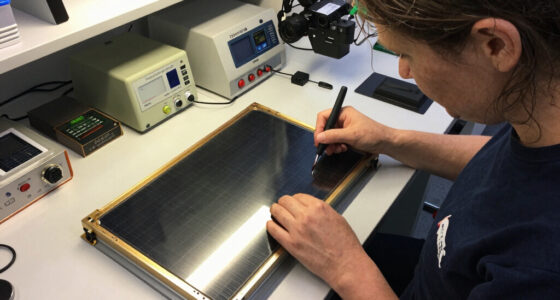
The record was achieved by the Fraunhofer Institute for Solar Energy Systems (ISE), which developed a module with triple III-V germanium cells, reaching an efficiency of 34.4 percent. The cells were produced by AZUR SPACE Solar Power, which adapted space-grade triple solar cell technology for terrestrial use. The module features a shingle-matrix interconnection approach, developed in collaboration with a German mechanical engineering partner, which allows for direct cell-to-cell contact, eliminating traditional soldered ribbons.
This architecture improves area utilization by avoiding shading caused by conventional interconnections, resulting in higher efficiency. The previous record, set earlier this year, was 34.2 percent, and the team has now surpassed it with this latest development. The new module was showcased at Intersolar / The Smarter E 2026, where it was displayed at Fraunhofer ISE’s booth.
Implications for Solar Technology and Energy Markets
This breakthrough demonstrates the potential for significantly higher efficiency in photovoltaic modules, which could lead to more power generation from smaller or less costly installations. The use of space-grade III-V germanium cells adapted for terrestrial use indicates a pathway toward next-generation solar technologies with higher performance metrics. If commercialized, such modules could accelerate the adoption of high-efficiency solar in both utility-scale and residential markets, contributing to global renewable energy targets.
As an affiliate, we earn on qualifying purchases.
Advances in High-Efficiency Solar Cell Technologies
Fraunhofer ISE has been actively pushing the boundaries of solar efficiency, with earlier records set in early 2026 using similar III-V germanium cell technology. The recent record builds on previous work, incorporating shingle-matrix interconnection methods that are already used in some German-made commercial modules. This approach addresses efficiency limitations caused by traditional interconnection methods, offering a promising avenue for future solar module design.
The development aligns with broader industry trends toward higher efficiency and better utilization of solar cell area, especially as the push for renewable energy intensifies globally. The collaboration with AZUR SPACE and the focus on space-adapted cell technology highlight ongoing cross-sector innovation in photovoltaics.
“The use of shingle-matrix technology allows us to maximize the active area of the cells and eliminate shading losses, which is key to achieving these record efficiencies.”
— an anonymous researcher
As an affiliate, we earn on qualifying purchases.
Uncertainties Around Commercial Scalability
It is not yet clear how soon this technology can be scaled for mass production or integrated into commercial solar modules. The current record was achieved in a research setting, and challenges related to manufacturing costs, durability, and supply chain logistics remain to be addressed before widespread deployment.
As an affiliate, we earn on qualifying purchases.
Path Toward Commercial Adoption and Further Innovation
Further research will focus on scaling the technology, testing long-term stability, and reducing costs. Industry stakeholders and manufacturers will monitor these developments closely, with potential pilot projects and pilot-scale production expected in the coming years. The industry will also evaluate how this record-setting technology compares with other emerging high-efficiency solutions.
As an affiliate, we earn on qualifying purchases.
Key Questions
What makes this solar module more efficient than previous ones?
The module uses triple III-V germanium cells and a shingle-matrix interconnection approach, which reduces shading and maximizes active cell area, leading to higher efficiency.
When might this technology become available for commercial use?
It is still in the research and development phase, with no specific timeline for commercialization. Scaling and cost reduction are necessary steps before market entry.
How does this record impact the future of solar energy?
This record demonstrates the potential for higher efficiency modules, which could improve energy yields and reduce costs, accelerating solar adoption worldwide.
Are there any challenges to implementing this technology widely?
Yes, challenges include manufacturing complexity, material costs, long-term durability, and integration into existing production lines.
What is the significance of using space-grade cells for terrestrial solar panels?
Space-grade cells are designed for high performance and durability in extreme conditions, which can translate into higher efficiency and longer lifespan for terrestrial applications, but they may also involve higher costs.
Source: CleanTechnica
Fall Picks
fall essentials
As an affiliate, we earn on qualifying purchases.