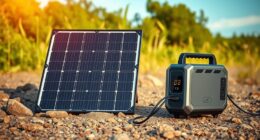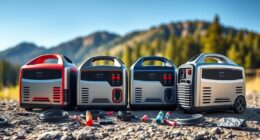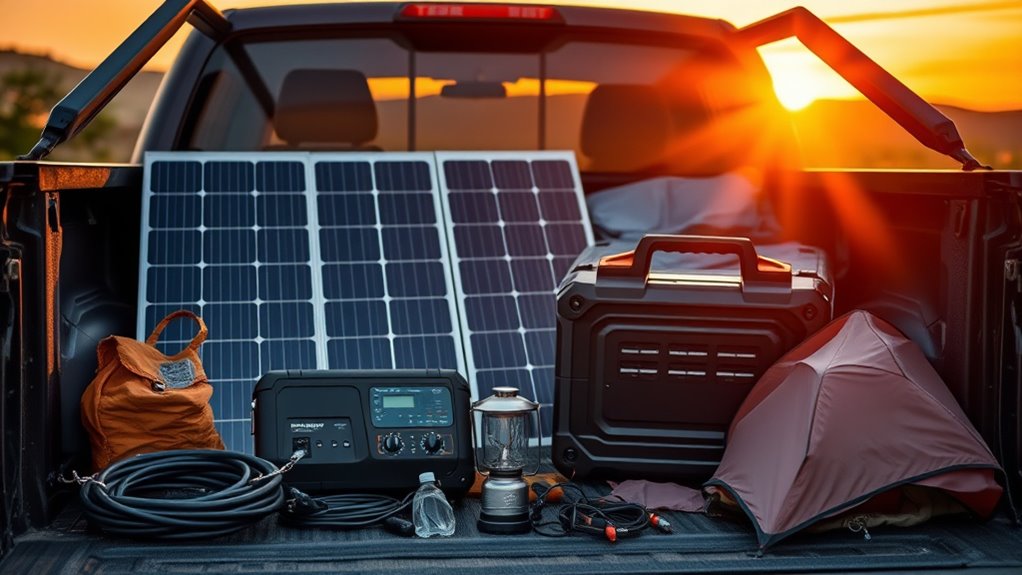

For truck campers who want a ready-to-use power setup, the BLUETTI Elite 200 V2 with two 200W panels is my best overall pick for its large capacity and substantial included solar array. The Jackery Explorer 2000 v2 bundle is a strong alternative for buyers prioritizing high AC output, while the Jackery 300 bundle suits lighter loads and shorter trips. The main tradeoff is between capacity and portability: larger systems can support more gear, but they take up more truck space and are heavier to move. Panel wattage, output limits, and the power needs of your appliances also shape how useful a bundle will be at camp. Read on for the full comparison and help matching a kit to your truck-camping setup.

Get backup power and energy gear delivered free — and shop member deals
- Fast, free delivery on millions of items
- Access to Prime Big Deal Days deals on October 6–7
- Prime Video, Amazon Music and more included
Complete the kit


Key Takeaways
- The highest-capacity bundles are not automatically the best fit. The BLUETTI Elite 200 V2 and Jackery Explorer 2000 v2 pair roughly 2kWh-class stations with two 200W panels, a strong match for longer stays and heavier loads, but their size and weight can be excessive for minimalist trips.
- Panel size varies sharply across the lineup. Several bundles include only 40W panels, while the larger BLUETTI and Jackery kits include 200W panels; that difference can change how practical solar replenishment is during a multi-day camp.
- Mid-capacity options make the most balanced truck-camping shortlist. The BLUETTI Elite 100 V2 and UDPOWER S1200 offer around 1kWh of storage, while the Anker SOLIX C800X is smaller at 768Wh and may suit campers who want to save cargo space.
- Small 300W-class kits are best treated as light-load power sources. The Jackery 300, DARAN 350W, and other 300W bundles can suit phones, lights, and modest electronics, but they are not substitutes for larger stations when running demanding appliances.
- Bundle contents matter as much as the station name. A 40W or 60W panel may help with daytime top-ups, but buyers planning to rely on solar should compare included panel wattage and supported input limits rather than choosing by battery capacity alone.




| solar generator bundle for truck camping | Battery capacity | Weight |
|---|---|---|
| BLUETTI Elite 200 V2 Solar Gen | 2073.6Wh | 53.4 lb |
| BLUETTI AC200PL Solar Generato | 2304Wh | — |
| Jackery Solar Generator 1000 v | 1070Wh | 23.8 lb |
| Portable Solar Generator | 220Wh | 5 lb |
| Portable Solar Generator 300W | — | — |
| Jackery Solar Generator 300 an | 292Wh | — |
| Jackery Explorer 2000 v2 with | 2,042Wh | — |
| BLAVOR 1600W Solar Generator w | 1,024Wh | 26 lb |
| BROWEY 1600W Portable Power St | 1,024Wh | 26 lb |
| 1000W Portable Power Station & | Not provided | Not provided |
| Portable Solar Generator with | 280Wh | — |
| BLUETTI Solar Generator Elite | 1,024Wh | — |
| UDPOWER S1200 1190Wh Solar Gen | 1,190Wh | 25.8lb |
| Anker SOLIX C800X Portable Pow | 768Wh | 24lb |
| DARAN 350W Portable Power Stat | 288Wh | 8.2lb |
More Details on Our Top Picks
BLUETTI Elite 200 V2 Solar Generator & 2x200W Solar Panels Included 2073.6Wh
I’d rank the BLUETTI Elite 200 V2 highest for truck campers who want substantial battery capacity and the ability to run demanding gear. Its 2073.6Wh capacity and 2600W AC output give it far more headroom than the Jackery Solar Generator 1000 v2, which is lighter and easier to move but stores about half as much energy. The included pair of 200W panels can help replenish the battery at camp, while AC, solar, and car charging offer flexibility between trips and stops.
The tradeoff is substantial: at 53.4 pounds, moving it between a truck and campsite takes more effort, and its four outlets are fewer than the 11 ports listed for the BLUETTI AC200PL. I’d choose it for power capacity, not for frequent carrying or a beginner-friendly setup.
Pros:- 2073.6Wh capacity provides more stored energy than the Jackery Solar Generator 1000 v2.
- 2600W AC output and 3900W power-lifting mode support demanding loads.
- Includes two 200W solar panels for campsite charging.
- LiFePO4 battery is specified for more than 6000 cycles.
Cons:- At 53.4 pounds, it is cumbersome to carry in and out of a truck.
- Four total outlets offer fewer connection options than the BLUETTI AC200PL’s 11 ports.
- The listed fast-charge and power-lifting features may add setup complexity for first-time users.
Best for: Truck campers running several devices or higher-demand appliances who can leave the unit in the vehicle or move it only occasionally.
Not ideal for: Solo campers who prioritize easy lifting, minimal setup, or a large number of direct device connections.
- Battery capacity:2073.6Wh
- AC output:2600W
- Power-lifting output:3900W
- Solar panels included:2 x 200W
- Battery chemistry:LiFePO4
- Battery cycle life:6000+ cycles
- Total outlets:4
- Weight:53.4 lb
Our verdict“Choose the Elite 200 V2 if campsite power capacity matters more than low carry weight and simple handling.”
BLUETTI AC200PL Solar Generator Kit with 200W Solar Panel
The BLUETTI AC200PL suits truck campers who can plug in between drives and want a large battery ready for the next stop. Its 2304Wh capacity is slightly higher than the Elite 200 V2’s listed capacity, and the stated AC recharge time reaches 80% in 60 minutes. That makes it a stronger fit for quick campground or home-base top-ups than relying on solar alone. The kit includes one 200W panel, and its 11 output ports give a group more ways to connect devices than the Elite 200 V2’s four outlets.
That flexibility comes with a solar limitation: the supplied panel may take 1.9–3.8 hours for a full charge under stated conditions, and actual output can vary with sunlight. Compared with the lighter Jackery Solar Generator 1000 v2, this is a much more substantial setup to transport, but it offers far more stored energy.
Pros:- 2304Wh battery capacity is the largest listed among these five products.
- AC charging is specified to reach 80% in 60 minutes.
- Eleven ports accommodate a broad mix of connected devices.
- Includes a 200W foldable solar panel and LiFePO4 battery.
Cons:- The 200W panel can make solar-only replenishment slow, depending on conditions.
- Its large-capacity setup is less suited to frequent carrying than the Jackery Solar Generator 1000 v2.
- The included panel and main unit may arrive separately.
Best for: Truck campers with room for a larger power station who can recharge from AC between trips and need connections for several people’s devices.
Not ideal for: Campers relying mainly on a small solar panel, or those who need a lightweight unit to move repeatedly between cab and campsite.
- Battery capacity:2304Wh
- Battery chemistry:LiFePO4
- AC output:2400W
- Solar panel included:200W foldable panel
- AC charging time:0–80% in 60 minutes
- Solar charging time:Full charge in 1.9–3.8 hours, as specified
- Number of ports:11
- Battery cycle life:3000+ cycles
Our verdict“Pick the AC200PL if you want a high-capacity truck-camping battery with fast AC recharging and many device ports.”
Jackery Solar Generator 1000 v2 and 200W Solar Panel, 1070Wh, 1500W AC
For truck campers who need a balance between usable power and manageable lifting, I’d put the Jackery Solar Generator 1000 v2 ahead of the heavier BLUETTI Elite 200 V2. At 23.8 pounds, it is considerably easier to move from the truck to a picnic table or tent, while its 1070Wh capacity and 1500W AC output suit many everyday camp devices. The included 200W panel adds a way to recharge away from hookups, and the three AC outlets plus USB and DC ports support a mixed loadout.
The compromise is runtime: it stores roughly half the energy of the Elite 200 V2 and has less AC output than either larger BLUETTI. Its one-hour full-charge mode also requires enabling emergency charging in the app; the default is 1.7 hours. I’d favor it for portability, not for running high-draw equipment for long stretches.
Pros:- 23.8-pound weight makes it easier to move than either large BLUETTI option.
- 1070Wh capacity and 1500W AC output suit a range of everyday camping needs.
- Includes a 200W solar panel for off-grid charging.
- Four-thousand-cycle LFP battery specification supports long-term use.
Cons:- Less than half the capacity of the BLUETTI AC200PL.
- The one-hour charge mode requires enabling emergency charging in the app.
- The panel and power station may ship separately.
Best for: Solo travelers or pairs who want a panel-equipped station they can lift easily and use for phones, lighting, laptops, and moderate camp loads.
Not ideal for: Groups or campers seeking long appliance runtimes, large battery reserves, or the higher output of the BLUETTI Elite 200 V2.
- Battery capacity:1070Wh
- AC output:1500W
- Surge output:3000W
- Solar panel included:200W
- Weight:23.8 lb
- AC outlets:3
- USB-C output:100W
- Battery cycle life:4000 cycles
Our verdict“Choose the Jackery 1000 v2 if you want a useful balance of output, solar charging, and carryable weight for truck camping.”
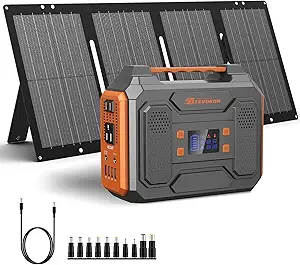
Portable Solar Generator, 300W Power Station with 40W Solar Panel
The 300W power station with 40W panel is the easiest option here to pack when space and lifting effort matter more than appliance power. At 5 pounds, it is far simpler to carry than the Jackery Solar Generator 1000 v2, though its 220Wh battery and 300W output also place it in a much smaller-use category. I’d treat it as a source for phones, lights, and other modest electronics, rather than as the main power supply for a truck-camping setup. Its mix of AC, USB-A, USB-C PD, and a car port helps with varied small devices.
The included 40W panel can extend use when sunlight cooperates, but it cannot quickly replace energy used at the station’s full 300W output. Compared with the 60W-panel bundle in this group, it has a smaller solar input; both remain far below the capacity and output of the BLUETTI models.
Pros:- Five-pound weight is the easiest in this group to carry and store.
- Includes a 40W solar panel for supplemental off-grid charging.
- Port selection includes AC, USB-A, USB-C PD, and a DC car port.
- Compact dimensions suit crowded truck storage.
Cons:- 220Wh capacity is small for overnight or multi-day truck-camping loads.
- 300W maximum output rules out many larger appliances.
- A 40W panel may replenish the battery slowly when usage is frequent.
Best for: Minimalist campers and day-trip travelers who need a light backup for phones, small electronics, and campsite lighting.
Not ideal for: Campers hoping to run a fridge, cooking appliance, or multiple higher-draw devices through an overnight stay.
- Battery capacity:220Wh
- Maximum output:300W
- Solar panel included:40W
- Weight:5 lb
- Dimensions:8.5 x 6.7 x 4.1 in
- AC outlets:2
- USB ports:3 USB-A and 2 USB-C PD
- DC car port:1
Our verdict“Choose this bundle for lightweight backup charging, not as a substitute for a higher-capacity camp power station.”
Portable Solar Generator 300W with 60W Solar Panel
This 300W solar generator bundle is a small-load choice for campers who want a foldable panel in the kit and a little more solar input than the 40W-panel option. The included 60W monocrystalline panel gives it an advantage for topping up phones, lights, and other modest electronics when conditions are favorable, while AC, car, and solar charging make it adaptable to different parts of a road trip. Compared with the 5-pound, 40W-panel station, its panel has higher rated wattage, though the supplied data does not list battery capacity or weight, so I can’t make a direct comparison on those points.
Its 300W output still sets a firm ceiling: this is not a replacement for the Jackery 1000 v2 or either large-capacity BLUETTI when running appliances or stretching power across multiple days. The panel junction box is also specified as non-waterproof, so it needs protection from rain and damp ground.
Pros:- Includes a foldable 60W monocrystalline solar panel.
- Supports solar, AC, and car charging.
- Multiple AC, DC, and USB outlets accommodate common small devices.
- Battery management and listed protection features address several electrical fault conditions.
Cons:- 300W output is unsuitable for higher-power appliances.
- The panel junction box is not waterproof and needs dry conditions.
- The supplied product data does not state battery capacity or unit weight.
Best for: Truck campers who mainly charge small electronics and want a compact solar bundle with AC, car, and panel charging options.
Not ideal for: Campers needing a stated large battery reserve, weather-exposed panel placement, or power for devices above 300W.
- Power output:300W
- Solar panel:60W foldable monocrystalline
- Charging methods:Solar, AC, and car
- AC outlets:2
- USB outlets:3 USB and 1 Quick Charge USB
- DC outlet:1
- Conversion efficiency:20.5%
- Protection features:Short circuit, over-current, over-voltage, overload, and overheating
Our verdict“Pick this bundle for small-device charging and a higher-rated included panel, but skip it if you need appliance power or a clearly specified large battery reserve.”
Jackery Solar Generator 300 and 40W Solar Panel, 292Wh, 300W AC
I’d pick this 7.5-pound Explorer 300 kit when cab and bed space matter more than running appliances for long stretches. Its 292Wh capacity and 300W output suit phones, cameras, laptops, and other modest loads, while the included 40W panel gives you a way to top up away from the truck. Compared with the BLAVOR 1600W, it is far easier to carry and store, but it cannot match that unit’s capacity or appliance headroom. The small panel is also a slow replenishment option: the supplied details estimate about 7.5 hours to reach 80% under stated conditions. I’d treat this as personal-device power for a short outing, not a refrigerator or multi-day camp setup. The listing also gives a 12.9-pound item weight, which conflicts with its 7.5-pound claim.
Pros:- Small 292Wh capacity and compact carry format fit tight truck storage better than the 1kWh options.
- 300W AC output and 600W surge support common personal electronics and modest loads.
- Includes a 40W solar panel, AC adapter, and car charging cable.
- LiFePO4 chemistry is listed with over 4,000 charge cycles.
Cons:- The 40W panel is a slow way to restore the battery during a short camp stop.
- Limited capacity is a poor fit for refrigerators and extended stays away from charging.
- Product information gives conflicting weights: 7.5 pounds in the description and 12.9 pounds in the specifications.
Best for: Solo truck campers taking short trips who mainly need to recharge phones, cameras, and a laptop without dedicating much cargo space.
Not ideal for: Campers who need overnight appliance power or several days of battery reserve; 292Wh and 300W limit runtime and load size, and the included 40W panel recharges slowly.
- Battery capacity:292Wh
- Peak output:600W
- Included solar panel:40W
- USB-C output:100W PD
- Battery chemistry:LiFePO4
- Listed item weight:12.9 lb; product description also claims 7.5 lb
Our verdict“Choose this Jackery for lightweight, short-trip device charging, but step up to the BLAVOR or BROWEY if you need meaningful appliance runtime.”
Jackery Explorer 2000 v2 with 2x200W Solar Panels, 2042Wh Portable Power Station with 2200W AC Output
For a truck build that needs to run more than personal electronics, this Jackery brings the lineup’s strongest combination of 2,042Wh capacity and 2,200W AC output. That gives it more room for sustained camp power than the BLAVOR and BROWEY, both of which are rated at 1,024Wh and 1,600W. The two included 200W panels make this a more complete solar bundle than compact kits with small panels, though actual recharge time depends on conditions; the listing’s six-hour solar estimate is described as optimal. The tradeoff is a listed 66.8-pound weight, a serious handling burden when loading or repositioning it in a truck. I’d favor it for a fixed camp setup or shared trips, not frequent carry-ins. Its size and capacity are overkill if your needs stop at phones and a laptop.
Pros:- 2,042Wh capacity provides substantially more stored energy than the 1,024Wh BLAVOR and BROWEY.
- 2,200W AC output supports larger loads than the 1,600W alternatives.
- Bundle includes two 200W solar panels for more substantial solar collection than the smaller-panel kits.
- LiFePO4 battery and fast-charging capability are listed.
Cons:- At 66.8 pounds, it is much less convenient to lift or reposition than the 26-pound BLAVOR and BROWEY.
- Solar recharge depends on strong conditions, with the supplied information citing six hours under optimal conditions.
- Its capacity and output may be unnecessary for campers charging only phones, cameras, and laptops.
Best for: Truck campers running higher-draw equipment or sharing power across several people, especially when the unit can stay secured in the vehicle.
Not ideal for: Solo campers who regularly lift their power station in and out of the truck or only charge small electronics; the 66.8-pound unit is heavy and its capacity may go unused.
- Battery capacity:2,042Wh
- AC output:2,200W
- Included solar panels:2 × 200W
- Battery chemistry:LiFePO4
- AC voltage:120V
- Frequency:60Hz
- Item weight:66.8 lb
- Dimensions:13.2 × 10.4 × 11.5 in
Our verdict“Pick the Explorer 2000 v2 when appliance headroom and included panel capacity matter more than easy handling.”
BLAVOR 1600W Solar Generator with 1024Wh LiFePO4 Battery and Built-In 40W Panel
The BLAVOR’s distinguishing feature is its built-in 40W solar panel: it can collect some energy without requiring a separate panel to be unpacked and positioned. For truck campers who value a self-contained setup, that is simpler than the BROWEY bundle’s separate foldable panel arrangement. Its 1,024Wh LiFePO4 battery and 1,600W rated output also offer far more capacity than the compact Jackery 300, enough to make it a more credible base for camp devices and selected appliances. The compromise is that the integrated 40W panel is best treated as a convenience or trickle input, not a fast way to refill a large battery. External solar input reaches 200W, so faster charging means bringing additional panels. At 26 pounds, it is manageable beside the 66.8-pound Explorer 2000 v2, but not a featherweight unit.
Pros:- 1,024Wh LiFePO4 battery offers much more reserve than the 292Wh Jackery 300.
- Built-in 40W panel allows basic solar collection without setting up a separate panel.
- 1,600W rated output and 3,200W peak output provide more load capacity than compact 300W units.
- Supports up to 200W of external solar input and offers four charging methods.
Cons:- The built-in 40W panel is slow for replenishing a 1,024Wh battery.
- Faster solar charging requires carrying and connecting external panels.
- At 26 pounds, it is less convenient to move than the compact Jackery 300.
Best for: Truck campers who want a mid-capacity power station with a built-in panel for convenient topping up and the option to add external solar.
Not ideal for: Campers expecting the built-in panel to quickly recharge the battery, or those unwilling to carry additional panels for faster solar charging.
- Battery capacity:1,024Wh
- Peak output:3,200W
- Battery chemistry:LiFePO4
- Charge cycles:4,000+
- Built-in solar panel:40W
- Maximum solar input:200W
- Weight:26 lb
Our verdict“Choose the BLAVOR if a built-in panel and mid-size battery simplify your truck setup, but plan on external solar for faster recovery.”
BROWEY 1600W Portable Power Station with 40W+120W Solar Panel
I’d place the BROWEY ahead of the BLAVOR for campers who want a more substantial panel setup included from the start. It pairs a 1,024Wh LiFePO4 battery with a foldable 40W panel and a connectable 120W panel, giving you more solar collection potential than the BLAVOR’s built-in 40W panel alone. The listing also states three hours to 80% charging, though it does not clarify the charging source or conditions, so I would not treat that figure as a guaranteed solar time. Its 1,600W continuous output is useful for many camp loads, but falls short of the 2,200W Jackery Explorer 2000 v2 for heavier equipment. At 26 pounds, it is easier to handle than that larger Jackery, yet still a substantial lift for frequent in-and-out use. The panel configuration also means more pieces to place and store.
Pros:- 1,024Wh LiFePO4 capacity provides a useful middle ground between compact units and the large Explorer 2000 v2.
- Bundle combines a foldable 40W panel with a connectable 120W panel.
- 100W USB-C PD output supports compatible laptops and other high-demand USB-C devices.
- Listed 3,200W peak output provides surge headroom above its 1,600W continuous rating.
Cons:- 1,600W continuous output is below the Explorer 2000 v2’s 2,200W rating.
- At 26 pounds, it is not as easy to carry as the Jackery 300.
- Separate panels take more storage space and setup effort than the BLAVOR’s built-in panel.
Best for: Truck campers who want around 1kWh of storage and a bundle with separate panels for greater solar collection than a small built-in panel provides.
Not ideal for: Campers who need to run equipment above 1,600W or want a single-piece setup; its solar accessories require space and setup, and its weight is still 26 pounds.
- Battery capacity:1,024Wh
- Continuous output:1,600W
- Peak output:3,200W
- Battery chemistry:LiFePO4
- Solar panels:40W foldable panel plus 120W connectable panel
- USB-C output:100W PD
- Weight:26 lb
- Listed charging time:3 hours to 80%; charging conditions not specified
Our verdict“Choose the BROWEY if you want a 1kWh-class station with a larger included solar arrangement, and skip it if high-wattage loads or minimal setup are priorities.”
1000W Portable Power Station & 200W Foldable Solar Panel Generator Kit
This kit’s clearest advantage for truck camping is the included 200W foldable panel: compared with the 40W panels supplied with the Jackery 300 and BLAVOR, it offers a stronger solar collection setup without needing to buy a larger panel separately. The power station is rated at 1,000W output, placing it below the 1,600W BLAVOR and BROWEY for load headroom but well above the 300W Jackery for running compatible camp equipment. Its compact listed dimensions may suit a truck bed or storage compartment, while the two AC outlets make the available AC connections more limited than a larger multi-outlet station. The product information does not give battery capacity or weight, so I can’t judge expected runtime or handling as confidently as I can for the other options. Wireless charging and an LED light add convenience, but do not replace capacity data.
Pros:- Included 200W foldable panel is a larger panel than the 40W kits from Jackery and BLAVOR.
- 1,000W output offers more headroom than the 300W Jackery 300.
- Wireless charging and built-in LED light add useful campsite conveniences.
- Listed compact dimensions may fit truck storage more easily than larger power stations.
Cons:- Battery capacity is not provided, making expected runtime difficult to compare.
- Only two AC outlets are listed, fewer connections than many larger power stations offer.
- Weight is not provided, leaving portability uncertain for loading into a truck.
Best for: Truck campers who want a 200W foldable panel included and need up to 1,000W output for a modest mix of camp gear.
Not ideal for: Buyers who need a known multi-day runtime, more than two AC outlets, or verified carrying weight; the supplied specifications omit battery capacity and weight.
- Included solar panel:200W foldable monocrystalline panel
- AC outlets:2
- Battery capacity:Not provided
- Wireless charging:Included
- Lighting:Built-in LED with SOS mode
- Dimensions:7.9 × 7.9 × 11.6 in
- Weight:Not provided
Our verdict“Consider this kit if the included 200W panel and 1,000W output fit your camp loads, but choose a model with disclosed capacity if runtime planning matters.”
Portable Solar Generator with Panel, 300W Power Station and 40W Foldable Solar Panel for Camping and Home Use
For truck campers who mainly need to keep phones, lights, and other small electronics running, this bundle pairs a 280Wh battery with a 40W foldable panel in a compact package. Its 300W output is a better fit for modest loads than the larger BLUETTI Elite 100 V2, which offers much more capacity and appliance headroom but is a bulkier choice for a simple weekend setup. The tradeoff here is limited reserve: the listed runtime is about seven hours under load, and the small panel may take time to replenish the battery when sunlight is limited. Devices drawing over 300W, including many coffee makers and hair dryers, are outside its reach. I’d choose it for basic camp electronics, not as the main power source for extended stays.
Pros:- Includes a foldable 40W solar panel for campsite recharging
- 280Wh capacity suits basic electronics and lighting
- 300W output supports small devices and accessories
- Four outlets provide options for connecting multiple devices
Cons:- 40W panel is a modest charging source for the battery capacity
- 300W output rules out many cooking and heating appliances
- Listed runtime is about seven hours under load, limiting longer stays
Best for: Truck campers who want a compact bundle for phones, lights, and other low-draw devices on short trips
Not ideal for: Campers relying on a refrigerator or higher-wattage appliances, or who need several days of power without frequent recharging
- Battery capacity:280Wh
- Surge wattage:550W
- Included solar panel:40W foldable panel
- Total power outlets:4
- Listed runtime:Approximately 7 hours
- Frequency:60Hz
Our verdict“Choose this bundle for simple, short truck-camping trips with small electronics; skip it if you need appliance power or a large energy reserve.”
BLUETTI Solar Generator Elite 100 V2 with 200W Solar Panel Included, 1024Wh
The 1,024Wh LiFePO₄ battery and 1,800W AC output make this the strongest all-rounder here for truck campers who want to run more than phones and lights. Compared with the Anker SOLIX C800X, it offers more stored energy and higher rated AC output, while its included 200W panel is substantially larger than the 40W panels bundled with the compact options. That added capability comes with a real vehicle-camping cost: the unit is described as heavy and bulky, so it may take up valuable cab or bed space. The panel is also only a starting point for solar replenishment, even though the station supports up to 1,000W solar input. I’d rank it above the smaller kits for multi-device trips, but not for campers prioritizing minimal weight.
Pros:- 1,024Wh LiFePO₄ battery provides substantially more reserve than the compact 280Wh-class bundles
- 1,800W rated AC output supports a broader range of camp appliances
- Included 200W solar panel is larger than the panels bundled with the smaller kits
- App control and quiet operation support campsite and indoor use
Cons:- Bulk and weight make it less convenient to move around a truck campsite
- Included 200W panel does not match the station’s maximum 1,000W solar input
- Higher capacity can be unnecessary for trips focused on small electronics
Best for: Truck campers who want enough capacity for several devices and moderate AC appliances over a multi-day trip
Not ideal for: Solo campers with tight vehicle storage or anyone whose needs are limited to charging phones and running small lights
- Battery capacity:1,024Wh
- Battery type:LiFePO₄
- AC surge output:2,700W
- Maximum solar input:1,000W
- Included solar panel:200W
- Battery life cycles:Over 4,000
- Noise level:30dB
Our verdict“Pick the Elite 100 V2 when stored energy and appliance support matter more than keeping your truck-camping kit light and compact.”
UDPOWER S1200 1190Wh Solar Generator Kit with 120W Panel, 1200W Power Station, for Home Backup RV Outdoor, Emergency Power Backup
The UDPOWER S1200 stands out for combining a 1,190Wh LiFePO₄ battery with a claimed sub-0.01-second UPS switchover, a feature aimed at keeping routers and other sensitive equipment powered through interruptions. For truck camping, that backup function matters most when the vehicle setup doubles as a mobile work or connectivity station. It also offers five AC outlets and two 100W USB-C ports, giving it more simultaneous connections than the compact 300W bundles. Compared with the BLUETTI Elite 100 V2, the S1200 has a slightly larger stated capacity but a lower 1,200W rated output; its included panel is also 120W rather than 200W. The unit weighs 25.8 pounds, and the station and panel ship separately, so it is a less tidy grab-and-go kit.
Pros:- 1,190Wh LiFePO₄ battery offers a substantial energy reserve
- Claimed sub-0.01-second UPS switchover suits sensitive electronics
- Two 100W USB-C ports and five AC outlets support multiple devices
- IP65-rated included panel is designed for outdoor use
Cons:- 25.8-pound station is heavy to move between truck and campsite
- Included 120W panel is smaller than the Elite 100 V2’s 200W panel
- Power station and solar panel ship separately
Best for: Truck campers who need backup for a router, CPAP, or other sensitive electronics and value multiple fast-charging ports
Not ideal for: Campers who prioritize light carry weight, a simple one-box bundle, or stronger included solar charging
- Battery capacity:1,190Wh
- Battery type:LiFePO₄
- Peak output:1,800W
- Included solar panel:120W foldable panel
- Weight:25.8lb
- AC outlets:5
- USB-C ports:2, up to 100W each
- UPS switchover claim:Less than 0.01 seconds
Our verdict“Choose the S1200 if sensitive electronics and port variety are priorities, but favor a lighter bundle if you move your power setup often.”
Anker SOLIX C800X Portable Power Station and 100W Solar Panel, 768Wh
The C800X takes a middle-ground approach: its 768Wh capacity gives a truck camper more reserve than the small 280–288Wh kits, while its 24-pound weight keeps it below the UDPOWER S1200’s listed 25.8 pounds. The 1,200W output is suited to more than basic USB charging, and built-in camping lights add a useful feature when setting up or moving around after dark. Compared with the BLUETTI Elite 100 V2, though, it has less capacity and lower rated output; its included 100W panel is also half the BLUETTI bundle’s panel wattage. That makes the Anker a sensible fit for moderate loads and campsite convenience rather than the strongest choice for extended off-grid power. Solar replenishment will depend on available sunlight.
Pros:- 768Wh capacity is a useful middle ground between compact and large stations
- 1,200W output supports more than small electronics
- Built-in camping lights can reduce the need for separate campsite lighting
- Included 100W water-resistant foldable panel supports solar charging
Cons:- 24-pound weight is substantial for frequent carrying
- Capacity and output are below the BLUETTI Elite 100 V2
- 100W included panel provides less solar input than the larger bundle options
Best for: Truck campers who want a mid-capacity station with built-in lighting and enough output for a mix of electronics and moderate appliances
Not ideal for: Campers who need the longest possible runtime, high appliance headroom, or a larger included solar panel
- Battery capacity:768Wh
- Included solar panel:100W foldable panel
- Total ports:10
- Weight:24lb
- Dimensions:14.61 × 8.07 × 9.96in
- Power source:Battery powered
Our verdict“Pick the C800X for a balance of campsite features and moderate power, not for the longest off-grid runtime or fastest solar replenishment.”
DARAN 350W Portable Power Station with 40W Solar Panel (600W Surge), 288Wh
At 8.2 pounds, the DARAN is the easiest station in this group to move from a truck cab to a campsite. Its 288Wh LiFePO₄ battery and 350W continuous output give it a slight capacity and output advantage over the 280Wh, 300W entry-level bundle, while the included 40W panel keeps the kit self-contained. That makes it a practical fit for phones, lights, and other modest loads when portability matters more than long runtime. The tradeoff is that 600W surge power still will not cover many demanding appliances, and the battery is small beside the Anker SOLIX C800X or larger BLUETTI option. Its stated runtime is about eight hours, but actual duration depends on the connected load.
Pros:- 8.2-pound weight is well suited to frequent carrying
- 288Wh battery is slightly larger than the 280Wh entry-level bundle
- 350W continuous output exceeds the 300W compact alternatives
- Includes a foldable 40W solar panel and LED light
Cons:- 288Wh capacity limits runtime for sustained or multiple loads
- 600W surge ceiling rules out many high-draw appliances
- 40W panel is a modest source for replenishing the battery
Best for: Truck campers who frequently carry their power station by hand and mainly charge small devices or run lights
Not ideal for: Campers who want to run larger appliances or need enough stored energy for extended off-grid stays
- Battery capacity:288Wh
- Battery type:LiFePO₄
- Surge output:600W
- Included solar panel:40W foldable panel
- Weight:8.2lb
- Total outlets:6
- Listed runtime:Approximately 8 hours
Our verdict“Choose the DARAN when light carry weight matters most and your truck-camping power needs stay modest.”
How We Picked
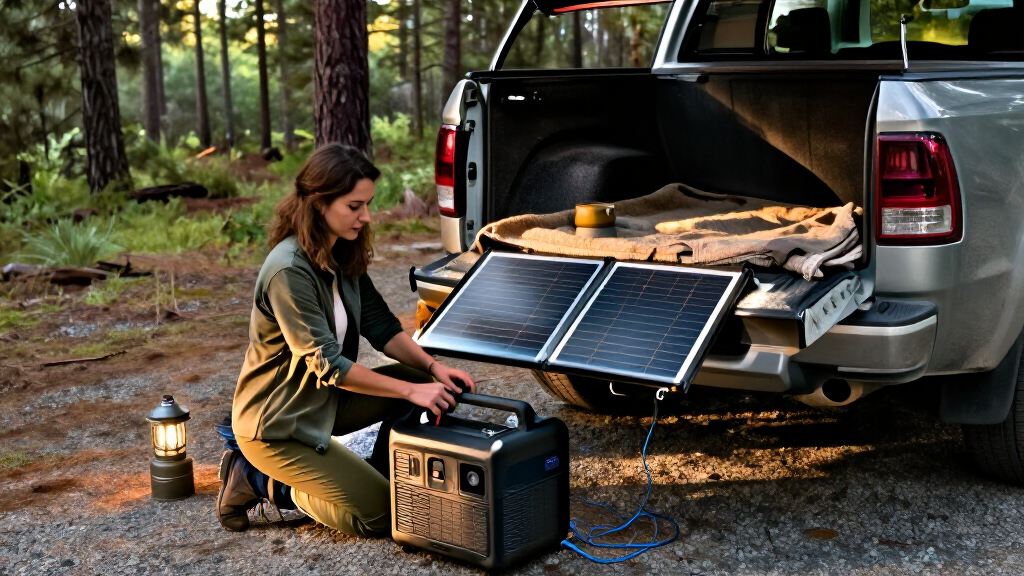
I ranked these solar generator bundles for truck camping by how well their included station and solar panel work together for real trip needs. I weighed battery capacity, AC output, panel wattage, and the practical gap between a small charging panel and an array that can meaningfully replenish a station during daylight. I also considered portability and cargo fit, since a large power station can crowd a truck bed or cab even when its capacity is appealing.
The ranking favors bundles that offer a useful mix of stored energy, output capability, and included solar charging, rather than the highest single spec. That puts the BLUETTI Elite 200 V2 and Jackery Explorer 2000 v2 near the top for extended or power-hungry trips, while smaller Jackery, DARAN, and generic 300W-class kits rank better for compact, light-load use. Product details vary, so I treat bundle names and listed specifications as the basis for comparison; buyers should check current panel compatibility, input limits, and outlet specifications before purchasing.
Factors to Consider When Choosing Solar Generator Bundle For Truck Camping
I would choose a truck-camping power bundle by planning around the devices and the trip, not by starting with the biggest battery. These factors help separate a useful camp setup from a kit that is either too limited to keep up or too bulky to justify its space.
Match Battery Capacity to Nights Away From Shore Power
Start by listing what you will charge or run and how often, then estimate daily energy use in watt-hours. Phones and LED lights draw relatively little, while a fridge, electric cooking appliance, or other sustained load can use a large share of a small station’s stored power. Add a buffer for cloudy weather and energy lost during conversion from the battery to an AC outlet. A 288Wh or 300Wh-class unit may be sensible for a short, low-demand outing, but it leaves less room for unexpected use than a roughly 1kWh or 2kWh station. Avoid sizing only by the number of devices: runtime depends on their wattage and how long they operate. If your needs vary, a larger station may offer flexibility, but only if you can carry and store it comfortably.
Check Continuous Output, Not Just Surge Output
Battery capacity indicates stored energy, while the AC output rating helps determine what equipment the station can run at once. Compare a device’s running wattage with the station’s continuous output, and check whether its startup demand is higher. A listed surge figure is not the same as permission to run an appliance continuously at that level. Truck campers often gain more from USB and 12V ports than from a high AC rating if their main loads are phones, lights, and vehicle accessories. If you expect to use an AC appliance, check its label and the station’s outlet and inverter specifications before buying. This can prevent paying for a large station whose output still does not match a particular appliance.
Treat the Included Solar Panel as a Starting Point
Bundled panel wattage is one of the clearest differences in this group: kits range from small 40W panels to bundles with two 200W panels. A small panel can help top up a station, but it may not replace much energy during a short winter day, cloudy conditions, or when the station is also powering devices. Actual production varies with sunlight, panel angle, shade, temperature, and the station’s solar-input limits. Before choosing a bundle, check whether the panel can connect directly to the unit and whether its output falls within the unit’s supported voltage and current range. Also ask whether you have a workable place to position panels while the truck is parked. A larger panel array can speed charging, but it adds setup space and gear to pack.
Balance Capacity Against Cargo Space and Handling
Truck-camping space is limited, and power stations compete with food, recovery gear, bedding, and other essentials. A 2kWh-class unit may support longer stays, but its footprint and weight can make loading and repositioning less convenient than carrying a compact 300Wh-class option. Think through where the station will ride, how you will secure it, and whether you need to move it between the truck and campsite. Panel storage matters too: folded panels still occupy room and need protection from damage. Do not assume that a compact-looking bundle is easy to use until you check the station and panel dimensions. The best size is the one that meets your power plan without displacing gear you need more.
Plan for Charging Between Camps and in Poor Weather
Solar is not the only part of a truck-camping charging plan. Consider whether you can recharge from a wall outlet before departure, from a vehicle while driving, or from another compatible source, and verify that the station supports the method you intend to use. Solar production can drop when trees, clouds, or camp orientation limit direct sun, so relying on one small panel can leave a station short after several cloudy days. A larger included array may reduce that risk, though it still needs suitable sun and setup time. Think about your schedule: a drive-heavy trip may offer charging opportunities that a stationary wilderness camp does not. Build a backup plan around your actual travel pattern rather than assuming the panel will refill the battery every day.
Verify Bundle Compatibility and the Loads You Expect to Run
Bundle titles can make a station and panel sound like a matched set, but you should still confirm the connections and electrical limits. Check the panel’s connector, voltage, and current against the station’s solar input, and verify whether adapters are included or sold separately. For a fridge or other device that needs continuous power, look at the station’s output options and any stated operating limits, not only its total watt-hours. Battery chemistry and cycle-life information can also help compare long-term use, but do not assume that a technology label alone predicts real trip performance. Read the included-items list closely so you know whether cables, a carrying case, or mounting accessories are part of the bundle. These checks matter especially for less familiar kits, where product naming may not answer every compatibility question.
Frequently Asked Questions
Is a 40W or 60W panel enough for a multi-day truck-camping trip?
It can help with daytime top-ups, but I would not count on a 40W or 60W panel to quickly refill a large station during a short camp day. Output varies with sun, shade, panel angle, and season, and the station may be using energy while it charges. For light use, such as keeping small electronics topped up, a modest panel can be a reasonable part of the setup. If you plan to run a fridge or use the station heavily over several days, compare bundles with larger panels or check whether the station accepts additional compatible solar input. Treat the panel rating as a maximum under favorable conditions, not a promise of daily energy.
Should I choose a 2kWh bundle or a smaller 1kWh-class station for truck camping?
I would choose a 2kWh-class bundle when the trip is long, the loads are substantial, or you want more stored energy between charging opportunities. The BLUETTI Elite 200 V2 and Jackery Explorer 2000 v2 bundles also include two 200W panels, which gives them a stronger solar setup than many smaller-panel kits in this lineup. A roughly 1kWh option can be easier to fit in a truck and may cover moderate electronics use without carrying as much capacity. The right choice depends on daily energy use and access to sun or other charging sources. If you have not estimated your loads, do that before paying the space and weight cost of a larger station.
Can a 300W-class solar generator run a camping fridge?
It depends on the fridge’s running and startup draw, the station’s continuous AC output, and how long the fridge needs to operate. A 300W-class station may handle some low-power devices, but its capacity can run down quickly if the fridge cycles through the day and night. Check the fridge’s specifications and compare both its wattage and estimated daily energy use with the station’s ratings. Also account for other loads, since lights and phones draw from the same stored energy. For dependable multi-day fridge use, I would compare larger-capacity stations and plan how they will recharge between days.
What should I check before adding a larger solar panel to one of these bundles?
Check the power station’s maximum solar-input wattage, voltage range, current limit, and connector type before buying another panel. A panel can have a higher wattage rating than the station can accept, so the station may not use its full output. Confirm whether the existing panel can be connected at the same time and whether the manufacturer permits the proposed configuration. You will also need to consider panel placement, cable length, and safe storage while driving. If those details are unclear, use the station’s official compatibility information rather than assuming that panels with similar plugs will work together.
Is a larger battery more useful than a larger included solar panel?
They solve different problems: a larger battery stores more energy for nighttime and cloudy periods, while a larger panel can collect more energy when the sun is available. For a short trip or one with little direct sunlight, added battery capacity may be more useful because panel output could be limited. For a longer stay with good sun and regular daytime charging, a stronger panel array can help restore energy between nights. The best balance depends on your daily load and how often you can expose panels to direct sun. In this roundup, bundles such as the Elite 200 V2 and Explorer 2000 v2 pair high capacity with two 200W panels, while several compact kits offer much smaller panels that are better viewed as supplementary charging.
Conclusion
My best overall choice is the BLUETTI Elite 200 V2 bundle for campers who want substantial capacity paired with two 200W panels. For a premium, high-output setup, the Jackery Explorer 2000 v2 bundle is a strong fit for longer trips and heavier AC needs, while the BLUETTI AC200PL kit is another large-station option to compare. The best value depends on your load: the Jackery 1000 v2 bundle offers a middle ground between compact kits and 2kWh-class systems, while the BLUETTI Elite 100 V2 and UDPOWER S1200 are worth a look for buyers seeking around 1kWh of capacity. For beginners with light loads, the Jackery 300 bundle is a straightforward smaller-capacity choice; the DARAN 350W and other 300W-class kits also suit basic electronics if their panel and output limits match your needs. Choose the Anker SOLIX C800X if you want a smaller-capacity alternative, and consider the BLAVOR or BROWEY bundles when their listed panel and output details align with your planned loads. Before deciding, check the actual device wattages, panel compatibility, and storage space available in your truck.
Halloween Picks
halloween
As an affiliate, we earn on qualifying purchases.