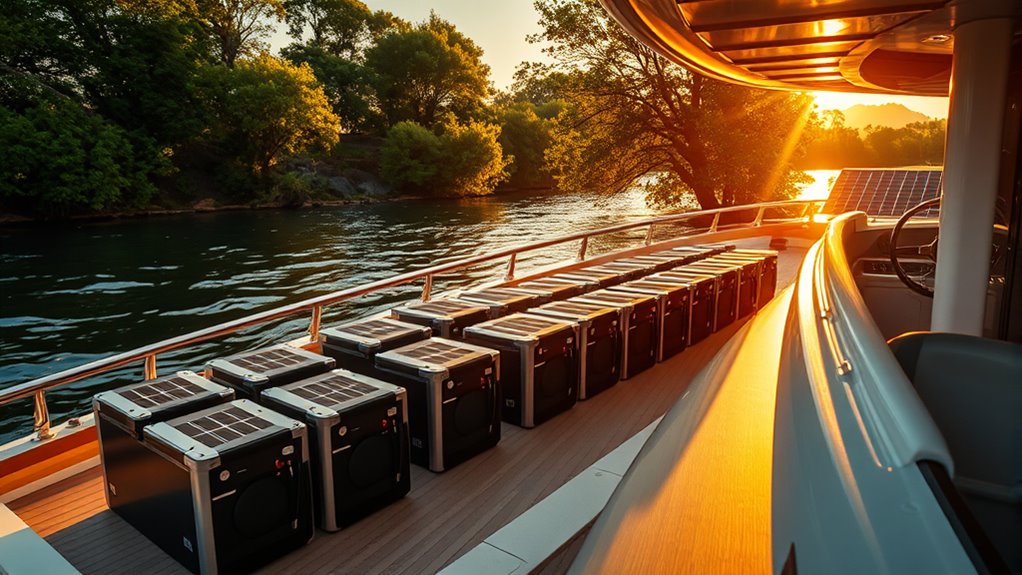

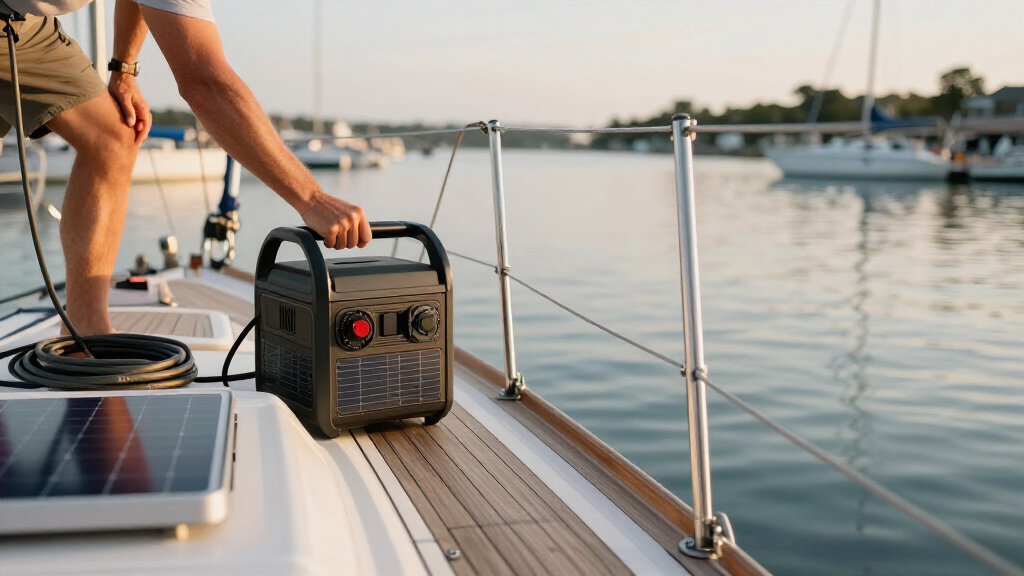
A solar generator bundle for a boat should match your onboard loads, available storage space, and time between charging opportunities. My best overall pick is the OUPES Mega 1, pairing a 1,024Wh LiFePO4 battery and 2,000W output with an included 240W panel. The Jackery Solar Generator 1000 v2 is a more portable mid-capacity choice, while the OSCAL PowerMax 6000 is aimed at buyers with unusually large power demands and room for a substantial system. The main tradeoffs are capacity versus weight, panel size versus usable deck space, and high output versus the simpler needs of lights and small electronics. Continue reading for the full comparison and guidance on choosing a bundle that fits your boat.

Get backup power and energy gear delivered free — and shop member deals
- Fast, free delivery on millions of items
- Access to Prime Big Deal Days deals on October 6–7
- Prime Video, Amazon Music and more included
Complete the kit


Key Takeaways
- OUPES Mega 1 is the strongest all-around match: its 1,024Wh LiFePO4 battery and 2,000W output offer a more capable balance for boat use than the 300W-class bundles.
- Jackery 1000 v2 prioritizes portability: it provides 1,070Wh capacity and 1,500W AC output with a 200W panel, making it a more manageable alternative to the much larger OSCAL and PowerMax systems.
- The high-output models are not automatically better onboard: OSCAL PowerMax 6000, PowerMax 3600W, and EBL 2400W suit larger loads, but their output can be excessive for basic electronics and requires more space and careful load planning.
- Small bundles are best for narrow jobs: the 150–300W options and compact panels suit phones, lights, and other modest loads, but their capacity limits make them poor substitutes for a larger system during extended trips.
- Panel wattage does not settle the choice: the listed bundles range from 30W to three 400W panels, so buyers need to match expected solar harvest to boat layout, shade, and the time available for charging.



| solar generator bundle for boat | Battery capacity | Weight | Battery type |
|---|---|---|---|
| OSCAL PowerMax 6000 Solar Gene | 3600Wh | 45.5 kg | LiFePO4 |
| Portable Solar Generator 300W | Not specified | — | — |
| OUPES Mega 1 Solar Generator w | 1024Wh | 27.8 lb | LiFePO4 |
| BROWEY 1600W Portable Power St | 1024Wh | — | LiFePO4 |
| MARBERO Solar Generator 150W P | 155Wh | 2.8 lb | — |
| PowerMax 3600W Portable Power | 2016Wh | 24kg / 52lb | LiFePO4 |
| DaranEner 300W Portable Power | 192Wh | 5.84lb | LiFePO4 |
| Portable Solar Generator 300W | 296Wh / 80,000mAh | 6.5lb | — |
| Portable Solar Generator with | 280Wh | — | — |
| MARBERO 237Wh Portable Solar G | 237Wh / 64,000mAh | Not specified | — |
| Jackery Solar Generator 1000 v | 1070Wh | 23.8 lb | — |
| Jackery Solar Generator 300 wi | 292Wh | 12.9 lb | LiFePO4 |
| EBL 2400W Portable Power Stati | 1843.2Wh | 55 lb | LiFePO4 |
| UDPOWER S1200 1190Wh Solar Gen | 1190Wh | 25.8 lb | LiFePO4 |
More Details on Our Top Picks
OSCAL PowerMax 6000 Solar Generator with 3×400W Solar Panel, 120V/240V Split Phase, 6000W AC Outlets (9000W Peak), 2200W AC and 2400W Solar Charging, Battery Backup for Home & Emergency
For a boat with substantial electrical loads and room to stow a heavy power station, the OSCAL PowerMax 6000 offers far more output than the smaller OUPES Mega 1 or BROWEY 1600W. Its 3600Wh battery and 6000W continuous output can support a broader mix of onboard equipment, while 120/240V output adds flexibility for compatible loads. The included three 400W panels are a sizable charging setup, but their footprint and cable arrangement suit a dock or large vessel better than a cramped cockpit. At 45.5 kg, this is not a grab-and-go backup, and its power is more than many weekend boaters need. I’d choose it for demanding loads and substantial storage space, not for a lightweight kit to move between shore and boat.
Pros:- 3600Wh battery and 6000W continuous output support more demanding loads than the OUPES Mega 1 or BROWEY 1600W.
- Three included 400W solar panels provide a substantial solar array.
- 120/240V dual-voltage output accommodates compatible equipment.
- LiFePO4 battery and UPS function add long-cycle use and backup capability.
Cons:- At 45.5 kg, moving it aboard or between storage locations is difficult.
- Three panels and their cables need considerable space and setup time.
- Its high output and capacity may be unnecessary for typical small-boat electronics.
Best for: Owners of larger boats who need high AC output, substantial battery capacity, and have dedicated storage space for the unit and panels.
Not ideal for: Small-boat and dinghy owners who need a portable system, or boaters whose needs are limited to phones, lights, and other low-wattage devices.
- Battery capacity:3600Wh
- Continuous output:6000W
- Peak output:9000W
- Solar panels included:3 × 400W
- AC voltage:120V/240V
- Battery type:LiFePO4
- Weight:45.5 kg
- AC and solar charging time:1.44–1.96 hours
Our verdict“Choose the OSCAL if your boat has demanding power needs and room for a large, heavy generator-and-panel setup.”
Portable Solar Generator 300W with 60W Solar Panel
This 300W bundle is aimed at boaters who want to top up small electronics rather than run galley appliances or larger equipment. Its 60W foldable panel and AC, solar, or 12V car charging options make it more flexible to recharge than the compact MARBERO 150W, while the 300W output gives it a little more headroom for compatible devices. The listed battery capacity is not specified, though, so I can’t judge runtime from the supplied details—a real limitation when planning nights away from shore power. The panel also needs suitable sun, and its junction box is not waterproof, so it needs protection from spray. This makes sense as a modest electronics kit, not as a boat’s main power source.
Pros:- Includes a foldable 60W monocrystalline solar panel.
- Can recharge from AC, solar, or a 12V car connection.
- Multiple USB, DC, and AC ports allow several small devices to connect.
- Protection features cover common electrical and temperature faults.
Cons:- Battery capacity is not specified, making runtime planning difficult.
- 300W output rules out many larger appliances and onboard loads.
- The panel junction box is not waterproof and needs protection from boat spray.
Best for: Day sailors and small-boat owners who want to recharge phones, lights, and other modest devices with several input options.
Not ideal for: Boaters planning to power high-wattage appliances or relying on a known battery runtime, since output is capped at 300W and capacity is unspecified.
- Power output:300W
- Battery capacity:Not specified
- Solar panel:60W foldable monocrystalline
- AC outlets:2
- USB ports:3 USB ports and 1 quick-charge USB port
- DC ports:1
- Recharging methods:AC, solar with MPPT, 12V car input
- Conversion efficiency:20.5%
Our verdict“Pick this bundle for basic device charging aboard, but skip it if you need dependable capacity data or power for larger loads.”
OUPES Mega 1 Solar Generator with 240W Panel Included, 2000W 1024Wh LiFePO4
The OUPES Mega 1 strikes a useful middle ground for boaters who need more than device charging but don’t want the OSCAL PowerMax 6000’s weight and large panel array. Its 1024Wh LiFePO4 battery and 2000W AC output suit a range of moderate onboard loads, while the included 240W panel gives it a practical starting point for solar charging. A standout difference from the BROWEY 1600W is its expandable capacity, which gives owners a path to add storage as their needs change. Simultaneous AC and solar charging and app monitoring add flexibility, but at 27.8 lb it still takes some effort to stow or move aboard. Its 2000W ceiling also limits high-demand equipment. I’d choose it for a growing setup, not for minimal, ultra-light boat kits.
Pros:- 1024Wh LiFePO4 battery offers more stored energy than compact 150Wh-class options.
- 2000W AC output provides more headroom than the BROWEY 1600W.
- Expandable capacity can accommodate changing power needs.
- Supports simultaneous AC and solar charging, with app monitoring and UPS function.
Cons:- At 27.8 lb, it is less convenient to move than small portable units.
- The 2000W output limit excludes higher-demand equipment.
- The included 240W panel is a modest array for replenishing a 1024Wh battery.
Best for: Boaters who want a mid-size LiFePO4 system with included solar charging and the option to expand capacity later.
Not ideal for: Owners who need a very light, compact kit or expect to run equipment above the 2000W AC output limit.
- Battery capacity:1024Wh
- AC output:2000W
- Solar panel included:240W
- Weight:27.8 lb
- Battery type:LiFePO4
- Cycle lifespan:3500+ cycles
- Charging:Simultaneous AC and solar charging
- Warranty:3 years
Our verdict“Choose the OUPES Mega 1 if you want a capable mid-size boat setup that can grow, and can accept its weight and output ceiling.”
BROWEY 1600W Portable Power Station with Built-in Solar Panel
The BROWEY’s built-in solar panels make this a more integrated choice than the OUPES Mega 1, which includes a separate 240W panel. That can simplify stowing and setting up a boat kit, but the product data does not state the built-in panel’s wattage, so I can’t compare its solar replenishment rate directly. Its 1024Wh LiFePO4 battery and 1600W output give it much more capacity than the MARBERO 150W for moderate loads, while remaining below the OUPES Mega 1’s 2000W ceiling. USB-C PD up to 100W is useful for compatible devices, and the 3200W peak figure provides surge headroom. The tradeoff is a relatively bulky unit with a stated three-hour charge time only to 80%, not full capacity. It suits boaters who value an all-in-one solar design over maximum output.
Pros:- Built-in solar panels with MPPT reduce the need to manage a separate panel.
- 1024Wh LiFePO4 battery offers far more capacity than the MARBERO 150W.
- 1600W continuous output and 3200W peak support a range of moderate loads.
- USB-C PD output reaches 100W for compatible devices.
Cons:- The built-in solar panel wattage is not provided, making charging expectations hard to judge.
- Three-hour charging figure reaches only 80% capacity.
- Relatively heavy and bulky for moving through tight boat spaces.
Best for: Boat owners seeking a 1024Wh power station with integrated solar panels and enough output for moderate electronics and appliances.
Not ideal for: Boaters who need a specified high-wattage solar array, full-charge timing, or more than 1600W of continuous AC output.
- Battery capacity:1024Wh
- Continuous output:1600W
- Peak output:3200W
- Battery type:LiFePO4
- Solar charging:Built-in panels with MPPT; panel wattage not specified
- USB-C output:100W PD
- Charging time:3 hours to 80%
- Cycle life:3000+ cycles to 80% capacity
Our verdict“Pick the BROWEY if integrated solar convenience matters more than the OUPES Mega 1’s higher output and expansion option.”
MARBERO Solar Generator 150W Peak 150Wh Portable Power Station with Solar Panel Included for Camping and Emergency
When storage space and carry weight matter more than runtime, the MARBERO is the easiest kit here to bring aboard: it weighs 2.8 lb and includes a 30W solar panel. That makes it a very different proposition from the 1024Wh OUPES Mega 1 or BROWEY 1600W; it is for small electronics and light-duty backup, not broad onboard power. The 155Wh capacity and 100W continuous output can support modest charging needs, but the 150W peak limit rules out many appliances, and extended use will quickly expose the small battery. Four USB ports and four DC ports give useful connection variety, while two AC outlets cover compatible low-power devices. With AC charging taking up to eight hours, this is best as a compact reserve rather than a primary solar generator.
Pros:- At 2.8 lb, it is easier to carry and stow than the larger OUPES and BROWEY systems.
- Includes a 30W solar panel and supports AC and car charging.
- Four USB ports and four DC ports provide several connection options.
- Two AC outlets support compatible low-power devices.
Cons:- 155Wh capacity offers limited runtime for extended trips.
- 100W continuous and 150W peak output restrict appliance choices.
- AC charging can take up to eight hours.
Best for: Small-boat owners and kayakers who need a light backup for phones, modest USB devices, and low-power electronics.
Not ideal for: Boaters who want to run appliances, power multiple high-draw devices, or stay off-grid for extended periods.
- Battery capacity:155Wh
- Weight:2.8 lb
- Dimensions:7.2 × 4.6 × 4.3 in
- Solar panel:30W
- Continuous output:100W
- Peak output:150W
- USB ports:4, supporting fast charging
- AC outlets:2 at 110V/60Hz
Our verdict“Choose the MARBERO for lightweight backup and small-device charging aboard, not as a boat’s main power supply.”
PowerMax 3600W Portable Power Station with 200W Solar Panel
For a boat owner who needs to run several demanding devices away from shore power, the 3600W rated output gives this bundle a different role from the compact 300W options here. It has far more headroom than the DaranEner 300W, making it better suited to combinations of electronics and higher-draw equipment, while its 2016Wh LiFePO4 battery offers a larger energy reserve. The 200W panel can contribute to recharging when the boat is stationary in sun, but its usefulness depends on available deck space and conditions; it is not a substitute for a properly sized marine charging system. At 24kg, this is portable in a car or cabin, not something I would want to move frequently around a small boat. Fast AC charging and app-dependent features add flexibility, with added complexity.
Pros:- 3600W rated output and 7200W peak provide much more power headroom than the 300W units in this group.
- 2016Wh LiFePO4 battery suits longer stretches between recharges.
- AC fast charging is listed at 1.5 hours.
- 14 outlets support connecting several devices at once.
Cons:- At 24kg, it is substantially less convenient to move around a compact boat than the DaranEner.
- The included 200W panel needs suitable placement and sunlight, which can be limited on a crowded deck.
- Full feature access requires the app.
Best for: Boat owners with room to stow a heavier power station who need more output and battery capacity for multiple devices or higher-draw loads.
Not ideal for: Small-boat owners prioritizing light, easy-to-stow gear, or buyers who want a simple unit without app-dependent features.
- Battery capacity:2016Wh
- Peak output:7200W
- Battery type:LiFePO4
- Weight:24kg / 52lb
- Outlets:14
- AC charging time:1.5 hours
- Included solar panel:200W
Our verdict“Choose this bundle if boat power demands and capacity matter more than low weight and simple operation.”
DaranEner 300W Portable Power Station with 30W Solar Panel
When carrying weight and stowage matter more than running large appliances, the 5.84lb DaranEner is the easiest unit in this set to bring aboard and move between a boat, car, and campsite. Its 192Wh battery and 300W output are better matched to phones, lights, and modest electronics than to galley equipment or other demanding loads. Compared with the Portable Solar Generator 300W with 60W Foldable Solar Panel, it has less listed battery capacity and a smaller panel, but its LiFePO4 chemistry is specified for over 3,500 cycles. The included 30W panel offers a way to recharge off-grid, though replenishing the battery through it may take patience, especially in variable sunlight. Multiple charging methods add flexibility; the tradeoff is a firm ceiling on power output and no app connectivity.
Pros:- At 5.84lb, it is easy to carry and stow in a small boat.
- LiFePO4 battery is specified for over 3,500 charge cycles.
- AC, car, and solar charging options suit different trip setups.
- The listed port mix includes AC, USB-C, USB-A, car, and DC5521 outputs.
Cons:- 300W continuous output rules out many higher-draw appliances.
- The included 30W panel may recharge slowly, particularly in weak sunlight.
- No Wi-Fi or app connectivity is listed.
Best for: Small-boat owners who mainly need portable power for phones, lights, and other low-draw electronics, and want a lightweight unit they can carry easily.
Not ideal for: Boaters who plan to run appliances above 300W or want solar charging to replenish the battery quickly.
- Battery capacity:192Wh
- Output:300W
- Surge power:600W
- Battery type:LiFePO4
- Weight:5.84lb
- Dimensions:8.4 x 5.3 x 7.4 inches
- Included solar panel:30W
- Output ports:2 AC, 1 USB-C PD, 1 USB-C, 1 USB-A, 1 car socket, 2 DC5521
Our verdict“Pick the DaranEner for light-duty boat electronics when low carry weight matters more than battery size or solar speed.”
Portable Solar Generator 300W Power Station with 60W Foldable Solar Panel
Among the compact 300W choices, this bundle pairs a 296Wh battery with a listed 60W foldable solar panel, giving it more stored energy and more panel capacity than the DaranEner 300W with its 192Wh battery and 30W panel. That makes it a useful fit for charging small electronics during a day at anchor, provided there is a safe place to deploy the panel. Its 300W output still places it in the light-duty category: I would look to the PowerMax 3600W instead for substantially higher loads. The compact station and multiple AC, USB, and DC ports suit mixed personal electronics, but the listing’s solar-panel details are inconsistent, so I would verify exactly what is included before buying. The stated charge-cycle figure is also lower than the LiFePO4 DaranEner’s.
Pros:- 296Wh capacity exceeds the DaranEner’s listed 192Wh.
- The product title and specifications list a foldable 60W solar panel.
- Multiple AC, USB, and DC outputs allow different small devices to connect.
- At 6.5lb, the station remains reasonably portable.
Cons:- 300W output is not suited to high-draw boat appliances.
- The product description and pros conflict with the cons about whether the solar panel is included.
- Over 1,000 charge cycles is a lower stated cycle figure than the DaranEner’s over 3,500.
Best for: Day-trip and small-craft owners who want a compact station for personal electronics and a higher-wattage panel than the DaranEner bundle lists.
Not ideal for: Buyers who need power above 300W, want long-term cycle-life specifications comparable to a LiFePO4 unit, or need certainty about the package contents without confirming the panel listing.
- Battery capacity:296Wh / 80,000mAh
- Output:300W
- Weight:6.5lb
- Dimensions:9 x 5.5 x 7.5 inches
- Solar panel power:60W listed
- Solar panel dimensions:28.3 x 20.6 x 0.12 inches unfolded
- Charge cycles:Over 1,000
- Output ports:2 AC, 2 USB-A, 1 USB-C, 12V/24V DC ports
Our verdict“Consider this bundle for compact, light-duty boat use only after confirming the included panel and accepting the 300W limit.”
Portable Solar Generator with Panel, 300W Power Station and 40W Foldable Solar Panel for Camping and Home Use
This kit is a straightforward choice for a boat owner who wants a small station for occasional electronics and a foldable 40W panel in the same bundle. Its 280Wh battery is slightly smaller than the 296Wh unit in the 60W foldable-panel model, and its 40W panel is also lower-powered, so it is less compelling when solar replenishment is a priority. The stated 300W output makes it a match for modest loads, not equipment with high startup demands; the product data specifically warns against loads above that level. Multiple AC, USB, and DC ports and an SOS flashlight are handy for basic backup, though the listed seven-hour runtime is tied to an unspecified use profile and should not be read as a guarantee at full output. I would choose the PowerMax for heavier loads, but this bundle is simpler for occasional low-power needs.
Pros:- 280Wh battery capacity is substantial among the small 300W options.
- Includes a foldable 40W solar panel according to the product title and description.
- Multiple AC, USB, and DC ports cover common small-device connections.
- Built-in SOS flashlight adds a practical emergency feature.
Cons:- 300W output excludes many appliances and loads with high startup demands.
- The 40W panel is smaller than the listed 60W panel in the other compact bundle.
- The approximately seven-hour runtime is not defined by a specific load in the product data.
Best for: Boaters seeking a basic backup kit for small electronics, with a bundled panel and emergency flashlight for occasional outings.
Not ideal for: Owners who need to run high-startup appliances, sustain a 300W load for long periods, or maximize solar input from a compact bundle.
- Battery capacity:280Wh
- Output wattage:300W
- Starting wattage:550W
- Included solar panel:40W foldable
- Total power outlets:4
- Frequency:60Hz
- Listed runtime:Approximately 7 hours
- Recommended uses:Camping, commercial, residential
Our verdict“Choose this for occasional low-power boat backup, not for high-startup appliances or sustained heavy use.”
MARBERO 237Wh Portable Solar Generator with Foldable 60W Solar Panel – 300W Pure Sine Wave Power Station for Camping and Emergency
The MARBERO suits a boat owner who wants a compact bundle for phones, lights, and other modest electronics, with a foldable 60W panel listed for solar charging. Its 237Wh capacity falls between the DaranEner’s 192Wh and the 280Wh unit in the 40W-panel kit, so the choice is a middle ground in stored energy rather than a standout for runtime. Like those alternatives, it is limited to 300W output; the PowerMax is the better fit for higher-demand equipment. Four USB ports plus AC and DC outputs make it convenient for personal gear, and the built-in flashlight adds emergency utility. The main boat-use caveats are the stated approximately one-hour runtime at full load and the lack of listed weight and dimensions, which makes stowage harder to judge before purchase.
Pros:- Includes a foldable 60W solar panel according to the product title and description.
- Two AC outlets, four USB ports, and one DC port support varied small-device charging.
- Built-in LED flashlight provides an emergency light source.
- Pure sine wave output is specified in the product title.
Cons:- 300W output limits use to small loads rather than demanding appliances.
- Listed runtime is approximately one hour at full load.
- Weight and dimensions are not specified, making boat stowage harder to plan.
Best for: Small-boat owners who want a bundled solar panel, several USB connections, and backup power for low-draw personal devices.
Not ideal for: Buyers needing long runtime at high output, power for appliances above 300W, or clear weight and dimension information for tight storage.
- Battery capacity:237Wh / 64,000mAh
- Output power:300W
- Peak output:375W
- Included solar panel:60W foldable
- Ports:2 AC, 4 USB, 1 DC
- Runtime at full load:Approximately 1 hour
- Weight:Not specified
- Material:ABS
Our verdict“Choose the MARBERO for low-draw device charging and a bundled panel, but skip it if full-load runtime or known storage dimensions matter.”
Jackery Solar Generator 1000 v2 with 200W Solar Panel, 1070Wh, 1500W AC
For boaters who need more than phone charging without carrying a very heavy station, the Jackery 1000 v2 is the most balanced fit in this group. Its 1070Wh battery and 1500W AC output can support several everyday electronics and compatible small appliances, while its 23.8-pound weight is easier to move aboard than the EBL 2400W. The listed bundle includes a 200W panel, giving it a more substantial solar setup than the UDPOWER S1200 and its 120W panel. Fast charging can help between outings, but the one-hour claim depends on enabling emergency charging mode. At full output, the stated runtime is about two hours, so I would not treat it as a long-running source for power-hungry equipment. Check stowage and charging arrangements before taking it aboard.
Pros:- 1070Wh capacity offers more reserve than the compact Jackery 300.
- 1500W AC output supports a broader range of compatible onboard devices than 300W-class stations.
- Includes a 200W solar panel for a more capable solar setup than the UDPOWER S1200 bundle.
- 23.8-pound weight is substantially easier to handle than the 55-pound EBL 2400W.
Cons:- About two hours of runtime at full load limits sustained use of high-wattage equipment.
- One-hour fast charging requires enabling emergency charging mode.
- Panel and power station may ship separately, complicating timing for setup.
Best for: Boaters who want a mid-size battery, useful AC output, and a 200W solar panel for charging phones, navigation devices, and modest onboard loads.
Not ideal for: Boaters planning to run high-draw equipment for long stretches or those who need the lightest possible kit; its full-load runtime is limited and smaller options are easier to carry.
- Battery capacity:1070Wh
- AC output:1500W
- Starting wattage:3000W
- Solar panel:200W
- AC voltage:120V
- Weight:23.8 lb
- Dimensions:12.87 × 8.82 × 9.72 in
- Listed runtime:About 2 hours
Our verdict“Choose the Jackery 1000 v2 if you want a portable, mid-capacity boat power kit with stronger output and a larger included panel than the smaller alternatives.”
Jackery Solar Generator 300 with 40W Solar Panel, 292Wh, 300W AC
The Jackery Explorer 300 is the small-load choice here: its 292Wh capacity and 300W output suit charging personal electronics and running compatible low-power gear, not powering a galley appliance. Compared with the Jackery 1000 v2, it gives up substantial capacity and AC output, but its 12.9-pound weight makes it easier to shift between a car, dock, and cabin. The listed product title includes a 40W panel, though the product details also say panels may need to be purchased separately, so I would confirm exactly what ships before relying on solar charging. Its LiFePO4 battery is listed for more than 4,000 charge cycles, a useful durability point for frequent outings. The main compromise is straightforward: 300W rules out many higher-draw boat devices.
Pros:- 12.9-pound weight is easier to carry aboard than the Jackery 1000 v2 or EBL 2400W.
- 292Wh capacity suits routine charging for personal electronics and other modest loads.
- LiFePO4 battery is listed for more than 4,000 charge cycles.
- AC, USB-C, USB-A, and car-port options cover several common device types.
Cons:- 300W rated output cannot handle many higher-wattage appliances.
- 292Wh capacity provides less reserve than the Jackery 1000 v2 and UDPOWER S1200.
- Product details are unclear on whether the 40W solar panel ships with the station.
Best for: Day sailors and weekend boaters who mainly need to recharge phones, cameras, and other small electronics, and value a lighter station over long runtime.
Not ideal for: Boaters who need AC power for appliances or several days of device use without recharging; its 300W output and 292Wh capacity are limited.
- Battery capacity:292Wh
- AC output:300W
- Starting wattage:600W
- Solar panel in product title:40W
- Battery type:LiFePO4
- AC voltage:120V
- Weight:12.9 lb
- Dimensions:15.43 × 9.92 × 11.89 in
Our verdict“Pick the Jackery 300 for light onboard electronics and easier carrying, but choose a larger station if you need appliance power or longer runtime.”
EBL 2400W Portable Power Station with 200W Solar Panel
When a boat setup calls for greater output and reserve capacity, the EBL 2400W stands apart from the smaller Jackery models. Its 1843.2Wh LiFePO4 battery, 2400W output, and 12 outlets are aimed at running several compatible devices at once; that headroom is more suitable for heavier loads than the Jackery 1000 v2’s 1500W output. The tradeoff is size and handling: at 55 pounds, this is a difficult option to move around a cramped cabin or carry on and off a boat. Its 200W panel supports solar charging, but the station’s multiple connections and specifications may take more planning than the simpler UDPOWER S1200 kit. I would choose it for a fixed or carefully planned onboard setup, not as a grab-and-go power source. Confirm the intended devices stay within its output limits.
Pros:- 1843.2Wh LiFePO4 battery provides more capacity than the Jackery 1000 v2 or UDPOWER S1200.
- 2400W output offers more headroom for compatible high-demand devices than the other listed stations.
- 12 outlets allow multiple devices to connect at once.
- Includes a 200W solar panel and supports solar and AC charging.
Cons:- 55-pound weight makes frequent carrying and repositioning aboard difficult.
- Larger dimensions may be awkward in boats with restricted storage.
- Multiple connectors and specifications add setup planning compared with the UDPOWER S1200.
Best for: Boaters with a stable stowage spot who need to power several compatible devices or higher-demand equipment and can manage a 55-pound station.
Not ideal for: Small-boat owners who need to carry the generator frequently, have limited cabin storage, or only need to charge phones and small electronics.
- Battery capacity:1843.2Wh
- Battery type:LiFePO4
- AC output:2400W
- AC voltage:120V
- Solar panel:200W
- Total outlets:12
- Weight:55 lb
- Dimensions:15 × 21 × 15 in
Our verdict“Choose the EBL 2400W when onboard power demand outweighs portability, and skip it if lifting or storage space is a concern.”
UDPOWER S1200 1190Wh Solar Generator Kit with 120W Panel, 1200W Power Station for Home Backup, RV, Outdoor, Emergency Power
The UDPOWER S1200 earns its place for boaters who want a substantial battery and a panel in the kit without stepping up to the EBL 2400W’s weight. Its 1190Wh LiFePO4 battery and 1200W continuous output offer more reserve than the Jackery 300, while the foldable 120W waterproof panel gives it an outdoor-focused bundle advantage. Compared with the Jackery 1000 v2, the UDPOWER has slightly more stated capacity but lower AC output and a smaller panel, so it suits moderate loads better than power-hungry equipment or faster solar replenishment. At 25.8 pounds, it remains portable, though not effortless to move through tight boat spaces. The listed solar input is limited to 120W, which can slow charging when sunlight is weak. Its five-year power-station warranty is a useful distinction; the panel warranty is one year.
Pros:- 1190Wh LiFePO4 battery has more stated capacity than the Jackery 1000 v2.
- Includes a foldable 120W waterproof solar panel for outdoor charging.
- 1200W continuous output supports more than small-device charging.
- Power station has a five-year warranty, with a one-year panel warranty.
Cons:- 120W solar input can make replenishing the battery slow, especially in weak sunlight.
- 1200W output is lower than the Jackery 1000 v2 and EBL 2400W.
- At 25.8 pounds, it is heavier than the Jackery 300 and may be cumbersome in tight quarters.
Best for: Boat owners who want a mid-size LiFePO4 station bundled with a foldable outdoor panel for moderate onboard loads and occasional off-grid recharging.
Not ideal for: Boaters who need maximum AC output, faster solar input, or the lightest carry; the Jackery 1000 v2 has higher output and a larger panel, while the Jackery 300 is lighter.
- Battery capacity:1190Wh
- Battery type:LiFePO4
- Continuous output:1200W
- Peak output:1800W
- Solar panel:120W, foldable and waterproof
- Solar input limit:120W
- Weight:25.8 lb
- Warranty:5 years for power station; 1 year for solar panel
Our verdict“Choose the UDPOWER S1200 for a bundled, mid-capacity solar setup with a waterproof foldable panel, but look elsewhere for higher output or faster solar charging.”
How We Picked
I compared each bundle through a boat-use lens: battery capacity for time away from shore power, inverter output for the appliances a buyer plans to run, included panel wattage, and how practical the stated setup appears for limited onboard space. I also weighed chemistry where specified, bundle completeness, and whether the advertised power level seemed proportionate to common small-boat needs. A product with more capacity or output did not automatically rank higher; portability, panel burden, and likely usefulness onboard mattered too.
The ranking favors balanced kits first, then options with a clear advantage for a particular buyer. The OUPES Mega 1 leads for its combination of LiFePO4 capacity, high output, and a 240W panel. Jackery 1000 v2 follows as a more portable mid-capacity option, while the larger OSCAL and PowerMax systems are better suited to unusually demanding setups than typical day-boat use. Compact 150–300W bundles rank lower for all-around capability, but remain sensible for buyers who only need to keep small devices charged.
Factors to Consider When Choosing Solar Generator Bundle For Boat
Boat power decisions start with your actual loads and the physical limits of your vessel. I would plan around hours of use, charging access, and where the panels can sit—not just the largest capacity number in a listing.
1. Add up energy use, not just appliance wattage
Write down each device’s wattage and how many hours you expect to run it between charges. Multiply watts by hours to estimate watt-hours, then allow extra capacity because real use and conversion losses can reduce what reaches your devices. A brief high-wattage burst and an appliance running all afternoon place different demands on a battery. Buyers often choose by peak output alone and then find the battery empties sooner than expected. For lights, phones, and navigation electronics, a compact bundle may be enough; longer trips or multiple appliances call for more stored energy. Keep a reserve for communications and safety equipment rather than planning to use every available watt-hour.
2. Check the inverter against both running and startup loads
The inverter’s continuous output needs to cover the devices you may operate at the same time, while some motors draw more power briefly when starting. Check appliance labels and manuals for startup requirements instead of relying on a peak figure alone. A high-output station can run a broader mix of equipment, but it may add unnecessary size and weight if your boat loads are modest. Also confirm the AC voltage and outlet arrangement suit your intended devices; the OSCAL’s split-phase 120V/240V setup is a specialized feature, not a universal boat advantage. For most small electronics, DC or USB charging may avoid running the inverter at all. Match output to a written load list before paying for capacity you cannot use.
3. Treat panel placement as a boat-layout problem
Included panel wattage describes rated capacity, not a guarantee of daily energy on a moving boat. Rigging, shade from sails or cabin structures, changing sun angles, and keeping panels clear of walkways all affect practical charging. Larger arrays can replenish a battery faster in good conditions, but they also need more usable surface and secure placement. A 30W or 40W panel is easy to accommodate but may contribute slowly; a 200W or larger panel needs a more deliberate setup. Check the station’s solar input limits and connector compatibility before adding panels. If panels will be moved or stowed often, favor a manageable arrangement over a large rating that is awkward to deploy.
4. Match battery chemistry and capacity to trip length
Capacity determines how much energy is stored, while battery chemistry can affect cycle life, weight, and long-term suitability. The OUPES Mega 1 explicitly lists LiFePO4 chemistry, which may appeal to buyers who expect frequent charging cycles; do not assume a chemistry that a listing does not specify. For occasional short outings, a smaller battery can avoid carrying unused capacity. For several days away from shore power, more storage helps during cloudy weather or when panels cannot stay in the sun. Capacity alone does not say how quickly a unit can recharge, so check both AC and solar charging limits. Think about where the unit can be secured and ventilated before choosing a larger model.
5. Account for marine conditions and safe installation
Portable power stations and their panels are not automatically marine-rated just because they can be used outdoors. Check manufacturer guidance for water exposure, operating temperature, ventilation, and storage; protect the unit from spray and keep connectors dry. Secure equipment so it cannot slide or fall as the boat moves, and keep cables away from hatches, lines, and wet foot traffic. Do not treat a portable station as a replacement for fixed, properly installed boat electrical systems or their protections. If you intend to connect it to boat wiring, consult the station instructions and a qualified marine electrician. A smaller, easy-to-stow kit can be safer and more practical than a powerful unit left exposed on deck.
6. Compare the complete bundle and plan for charging gaps
Bundle listings can differ in panel count, panel wattage, cables, and the power station itself, so verify every included component before comparing models. A high-rated station with a modest panel may take longer to replenish from sunlight than the headline battery size suggests. Decide whether you can charge from shore power between trips and whether the bundle’s AC charging rate fits that routine. If solar is your only charging source, favor a panel arrangement that suits your available area and typical time in the sun. Avoid assuming that one sunny afternoon will refill a depleted battery, especially when panels face shade or changing weather. Leave room in the plan for a backup charging method or reduced consumption on low-sun days.
Frequently Asked Questions
Can a solar generator bundle replace my boat’s house battery?
Usually, a portable solar generator is best treated as a separate power source for selected devices, not a direct replacement for a boat’s installed house battery system. Its outlets and charging behavior may not match the vessel’s wiring, charging equipment, or safety protections. Before connecting a portable unit to onboard circuits, check the manufacturer’s instructions and consult a qualified marine electrician. A standalone setup for phones, lights, or small appliances can avoid changes to fixed wiring. Keep essential navigation and safety systems on a dependable, properly designed supply.
How much battery capacity do I need for an overnight boat trip?
There is no useful one-size capacity without knowing what you will run and for how long. Estimate daily watt-hours by multiplying each device’s draw by its operating hours, then add a reserve for conversion losses and unexpected use. A setup for phones and lights may need far less stored energy than one supporting a cooler, pump, or other sustained load. Compare that estimate with usable capacity, not just inverter output. If your trip may extend through cloudy weather, plan extra storage or a backup way to recharge.
Will the included solar panel recharge a station while I am using it?
Whether a station can accept solar input while powering devices depends on its design and operating limits, so check its manual rather than assuming pass-through operation. Even when simultaneous charging is supported, the panel may produce less energy than the loads consume. Boat shade, panel angle, and changing sunlight can make the balance shift throughout the day. Compare the station’s solar input limit with the panel’s rating, and check for compatible connectors. For trip planning, treat solar as a variable source rather than a guaranteed continuous supply.
Is a 300W bundle enough to power a small boat?
A 300W-class unit may work for low-draw tasks such as charging phones or running a few lights, but it is not a general measure of whether a system can power a boat. The battery capacity determines how long it can supply energy, and the inverter limit determines which AC devices it can run. Check both figures against your equipment’s running and startup demands. A compact option is appealing when space and easy stowage matter more than extended runtime. If you expect to operate several appliances or stay away from shore power for multiple days, calculate the load before settling on a small bundle.
Should I choose a much larger generator for extra headroom?
Extra capacity can help on longer trips and during poor solar conditions, but a larger station may also take up more storage space and be harder to secure aboard. More inverter output only helps if your appliances need it; it does not automatically provide longer runtime unless battery capacity also increases. High-output models such as the OSCAL PowerMax 6000 suit unusually demanding loads better than simple charging needs. For a typical small-boat setup, a balanced mid-capacity unit may be easier to manage. Compare the added capacity with your load estimate, panel area, and available charging time.
Conclusion
For most buyers, I would start with the OUPES Mega 1 as the best overall: its 1,024Wh LiFePO4 battery, 2,000W output, and included 240W panel form the most balanced higher-capacity package in this group. The best value for modest needs is a 300W-class bundle, such as the DaranEner, if your load list is limited to small electronics and you accept slower, more restricted charging. For a premium, high-demand setup, the OSCAL PowerMax 6000 offers far more output and a three-panel array, but it makes sense only when your loads and available space justify that scale. The best choice for beginners is the Jackery Solar Generator 300 for straightforward, low-draw use; move up to the Jackery 1000 v2 if you need more stored energy and output. For boaters prioritizing high output without the largest listed system, compare the PowerMax 3600W and EBL 2400W against your appliances, while buyers with limited deck space should favor smaller, easier-to-stow panels. Pick by your measured loads and charging routine, not by the biggest number on the box.
Halloween Picks
halloween
As an affiliate, we earn on qualifying purchases.