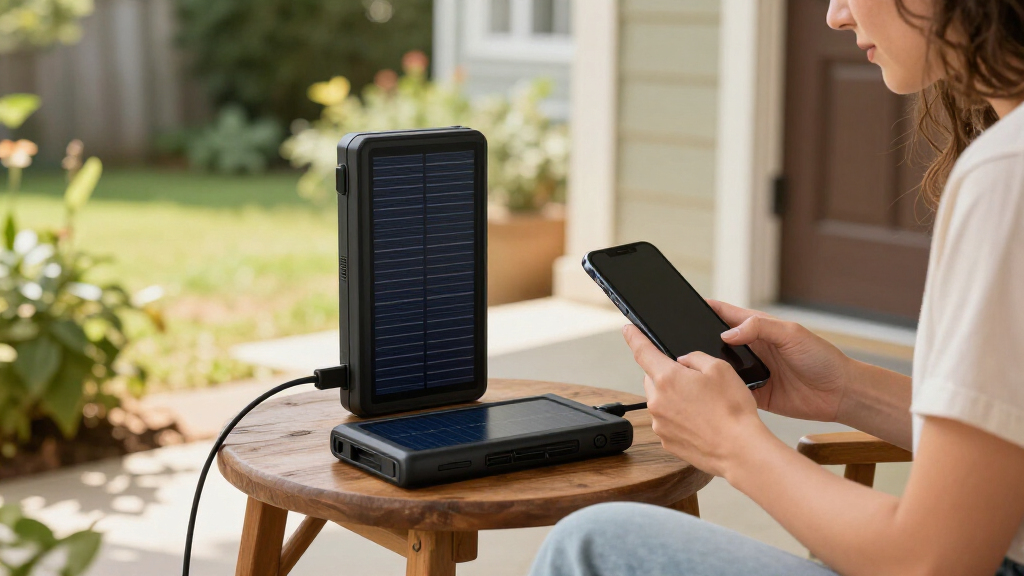

When choosing solar backup power, the real decision is whether you need a backup you can carry every day or one that can keep more equipment running through a longer outage. A compact solar power bank is designed mainly for phones and other small USB devices; a portable solar generator pairs a much larger battery with broader ports and, often, a separate solar panel. The generator has a clear capacity advantage, but it is heavier, bulkier, and more expensive. Choose the power bank for personal-device charging and portability; choose the generator when you need meaningful backup for a laptop, lights, or several devices over time.

Get backup power and energy gear delivered free — and shop member deals
- Fast, free delivery on millions of items
- Access to Prime Big Deal Days deals on October 6–7
- Prime Video, Amazon Music and more included

Jackery Explorer 300 Portable Power Station, 292Wh
- ✔ Capacity: 292Wh
- ✔ Weight: 7.1 lbs
- ✔ Output: 300W, 600W peak surge

BLAVOR Solar Power Bank 10,000mAh Portable Wireless Charger
- ✔ Capacity: 10,000mAh
- ✔ USB-C output: 20W
- ✔ Battery type: Lithium-cobalt

SOARAISE Solar Power Bank 48000mAh Wireless Portable Charger with 4 Built-in Cables
- ✔ Capacity: 48,000mAh
- ✔ Battery type: Lithium-polymer
- ✔ Solar panels: 4 built-in panels
Neither category should be judged by the word “solar” alone. Many small power banks have tiny built-in panels that recharge slowly and work best as an emergency trickle charge. Larger systems usually rely on a separate panel, and their real usefulness depends on battery capacity, panel output, sunlight, and the devices you plan to power.
At a Glance
| Criteria | Compact solar power bank | Portable solar generator | Winner |
|---|---|---|---|
| Portability | Small and light enough for a bag or pocket, depending on model | Larger and heavier; generally carried by hand or stored in a vehicle or home | A |
| Stored energy | Low capacity; best for a few phone charges or small USB devices | Much higher capacity; can support multiple devices for longer | B |
| Solar recharging | Often a small built-in panel; useful for slow top-ups, not dependable fast recharging | Typically uses a separate, larger panel; recharge speed still depends on sun and panel size | B |
| Devices and output | Usually USB ports for phones and other small electronics | Often offers USB, DC, and AC outlets; check power limits and device compatibility | B |
| Outage duration | Best for short interruptions or personal-device backup | Better suited to extended outages and broader backup needs | B |
| Cost and value | Lower purchase cost; good value if small-device charging is all you need | Higher upfront cost; worthwhile when its capacity and outputs will see regular use | Depends |
Jackery Explorer 300 Portable Power Station, 292Wh
The Jackery Explorer 300 is the most capable choice in this group when backup means more than keeping a phone alive. Its two AC outlets and 300W output let us consider small AC devices alongside phones, tablets, and other USB gear. That makes it a different kind of option from the BLAVOR and SOARAISE, which are phone chargers without AC outlets. Still, 300W is a firm limit: appliances with high startup demand or sustained power draw may not be suitable.At 7.1 pounds, it is portable enough for car camping or moving between a vehicle and a campsite, though it is far larger than either phone bank. LiFePO4 chemistry and a stated 4,000-plus charge-cycle rating support a longer-use case than an emergency-only gadget. For solar backup, the key caveat is that the panel is sold separately. The stated estimate of reaching 80% in about 2.8 hours assumes a 100W panel and favorable charging conditions; we should not assume that result from any panel or in changing weather.Compared with the SOARAISE, the Jackery offers more useful flexibility for AC equipment but less convenience for a group that only needs USB charging and built-in cables. Compared with the BLAVOR, it is a much stronger camp power source, but it is heavier and less pocketable. Choose it when AC access and higher capacity matter more than minimal carry weight; skip it if your only goal is occasional phone top-ups.
Pros:
- Two AC outlets expand backup use beyond phone and USB charging.
- 292Wh capacity and multiple port types support several kinds of small devices.
- 7.1-pound weight is manageable for car camping and transport.
- LiFePO4 battery is rated for more than 4,000 charge cycles to 70% capacity.
Cons:
- The 300W output cannot support many high-draw appliances.
- A solar panel is sold separately, adding another item to buy and carry.
- Larger and heavier than either phone-focused power bank in this roundup.
Best for: Campers and emergency-prepared households that need AC outlets for small, low-draw devices as well as USB charging.
Not ideal for: People who want a pocket-sized phone charger, need to run high-power appliances, or expect solar charging without buying a compatible panel separately.
Bottom line: We rank the Jackery first for its combination of AC backup, multiple device outputs, and defined solar-panel charging support, provided its 300W limit fits your gear.
“We rank the Jackery first for its combination of AC backup, multiple device outputs, and defined solar-panel charging support, provided its 300W limit fits your gear.”
BLAVOR Solar Power Bank 10,000mAh Portable Wireless Charger
When our priority is a small phone backup that can handle outdoor conditions, the BLAVOR 10,000mAh is the clearest fit. Its 20W USB-C output is more directly specified than the charging details provided for the SOARAISE, and the product information says it can charge an iPhone 15 to 65% in 30 minutes. That gives us a useful sense of wired charging speed, although actual results depend on the phone, cable, and starting charge.The strongest distinction from the other two picks is its IPX5 waterproof, dustproof, and shockproof construction, with flashlights and a compass carabiner adding practical outdoor features. Its 10,000mAh capacity is far below the SOARAISE’s stated 48,000mAh, and it cannot replace the Jackery for AC devices. In exchange, this format is easier to carry when we want phone power without taking a power station on a hike.Solar charging should be treated as an emergency trickle option, not the main reason to buy it. The supplied details say solar replenishment is slow compared with wall charging, and they do not specify which cables are included. Compared with the SOARAISE, the BLAVOR has a more compact outdoor role but less stated capacity and fewer simultaneous device connections. We would choose it for one person’s phone and small USB devices, and skip it when a group needs extended charging or any appliance needs AC.
Pros:
- 20W USB-C output supports faster wired phone charging than basic USB charging.
- IPX5-rated construction is suited to splashes and rough outdoor handling.
- Flashlights and a compass carabiner add useful trail-oriented features.
- Can charge up to three devices simultaneously according to the supplied details.
Cons:
- 10,000mAh capacity is modest compared with the SOARAISE’s stated capacity.
- Solar charging is slow and should not be relied on as the primary recharge method.
- Cable inclusion and compatibility details are not specified.
Best for: Hikers, day trippers, and outdoor users who want a rugged backup for a phone and a couple of small devices.
Not ideal for: Groups needing prolonged charging, users who expect meaningful solar replenishment during a short outing, or anyone needing AC power.
Bottom line: We recommend the BLAVOR for portable, rugged phone backup, while its capacity and slow solar replenishment make it a poor stand-in for the Jackery or a group-sized bank.
“We recommend the BLAVOR for portable, rugged phone backup, while its capacity and slow solar replenishment make it a poor stand-in for the Jackery or a group-sized bank.”
SOARAISE Solar Power Bank 48000mAh Wireless Portable Charger with 4 Built-in Cables
The SOARAISE 48,000mAh is aimed at buyers who need to keep several personal devices topped up without packing a pouch of separate cables. Four built-in connectors cover USB-C, Lightning, USB-A, and Micro, while a wireless pad and three ports add options for a total of up to seven devices according to the supplied description. For a family or small group carrying phones and compatible USB devices, built-in charging options reduce cable clutter.Its four solar panels are promoted as charging faster than a single-panel charger, but that claim does not make solar a dependable primary power source. The supplied information gives no full solar recharge time, and real output will vary with sun exposure and panel positioning. The large stated capacity may also mean a bulky unit; the product details do not provide a weight, so we should not assume it will be comfortable to carry on a long hike. Compared with the BLAVOR, it makes more sense for sharing and longer USB-only trips, but it gives up the compact, rugged emphasis. Compared with the Jackery, it has no listed AC outlet and cannot serve the same small-appliance role.The USB-C port is specified at 5V/3A, with a stated phone charging example of moving an iPhone from 15% to 60% in 30 minutes. That is useful for compatible phones, but the listed output should guide expectations rather than the headline capacity alone. Choose the SOARAISE when your devices are USB-powered and cable convenience matters. Skip it if weight, verified capacity in watt-hours, appliance support, or predictable solar recharging is central to your decision.
Pros:
- Four built-in cables cover several common connector types.
- Wireless charging and multiple ports accommodate different charging preferences.
- Four-panel design is intended to improve solar input over a single small panel.
- High stated capacity suits shared USB charging better than the BLAVOR’s 10,000mAh format.
Cons:
- Likely bulkier than compact phone banks, with no weight listed in the supplied specifications.
- No full solar recharge time is provided, and sunlight-dependent charging can be slow.
- No AC output is listed, so it cannot take the Jackery’s small-appliance role.
Best for: Families and small groups who want one USB-focused charger with multiple built-in cable types and wireless charging.
Not ideal for: Hikers who prioritize low weight, buyers who need AC power, or anyone relying on a published solar recharge time or a verified watt-hour capacity.
Bottom line: We place the SOARAISE third because its cable convenience suits shared USB charging, but its unspecified weight and solar recharge time make it less predictable than the other picks.
“We place the SOARAISE third because its cable convenience suits shared USB charging, but its unspecified weight and solar recharge time make it less predictable than the other picks.”
As an Amazon Associate we earn from qualifying purchases.
Key Differences
The most consequential difference is how much energy each option can store and deliver. A compact power bank is a personal charging accessory: it can keep a phone available, but its capacity is limited, and its solar panel may take a long time to add a useful amount of charge. A portable solar generator is a small power station. It can serve several devices and may provide AC power, but that does not mean it can run every household appliance. Its output rating and usable battery capacity set firm limits.
Solar charging also means different things in the two categories. A built-in panel makes a power bank convenient to leave in sunlight, yet it is generally a slow supplement to charging from a wall outlet. A generator’s separate panel can collect more energy, but the setup needs more space and clear sun. Clouds, shade, season, panel angle, and conversion losses affect both. If you need reliable backup at a known time, charge the battery from the grid ahead of time and treat solar as a way to replenish it when conditions allow.
For most people who only want emergency phone power, the compact bank is the better-value purchase because its size and price match the job. The generator earns its higher cost when you need longer runtimes, more charging ports, or power for compatible equipment such as a laptop or small light. If your plan depends on powering a fridge, medical equipment, or heating device, check the device’s wattage and startup demand against the power station’s specifications; neither category should be assumed suitable.
Detailed Comparison
Portability (Compact solar power bank wins — major)
The compact power bank wins by a major margin: it can travel in a day bag and is easy to keep close during an evacuation or commute. A portable generator is designed for transport, but its battery and separate panel take more room and can be awkward to carry. In practice, choose the bank when you expect to move around; choose the generator when it can stay at home, in a car, or at a campsite.
Stored energy (Portable solar generator wins — major)
The generator wins by a major margin because it is built around a much larger battery. That can translate into charging multiple devices or keeping them going longer, subject to the actual capacity and conversion losses. The compact bank is enough for a phone-focused emergency kit, but it is not a substitute for a larger reserve during a prolonged outage.
Solar recharging (Portable solar generator wins — moderate)
The generator usually wins by a moderate margin when paired with a suitably sized panel: a larger panel can collect more energy than the small panel commonly built into a compact bank. It also adds setup time, space needs, and another item to carry. A built-in panel is convenient for topping up slowly, but buyers should not expect it to refill a depleted bank quickly. Compare stated solar input and expected charging conditions rather than relying on panel presence alone.
Devices and output (Portable solar generator wins — major)
The generator wins by a major margin in flexibility, since many models include more ports and an AC outlet. That can make it suitable for a laptop or other compatible equipment within the station’s power limit. Compact banks usually focus on USB charging. Check connector type, continuous output, and surge requirements before buying: an AC socket alone does not guarantee that a device will work.
Outage duration (Portable solar generator wins — major)
The generator wins by a major margin for longer outages because its larger reserve can serve several devices and can be replenished with a larger panel in favorable sunlight. The compact bank is useful for a brief interruption or a single person’s phone. Actual runtime depends on what is connected and how much power it draws; using an energy-hungry device can drain even a large station quickly.
Cost and value (moderate difference)
This is a split decision. The compact bank costs less and is better value for occasional phone charging; paying for a generator would add capacity many buyers never use. The generator can be better value for a household or outdoor user who regularly needs to power several devices or wants a substantial reserve. Its higher price is justified by a concrete need for capacity and output, not simply by having a solar panel.
Compact solar power bank: Pros and Cons
Pros:
- Lightweight and easy to carry daily
- Lower upfront cost for basic device backup
- Convenient USB charging for phones and similar small electronics
Cons:
- Limited stored energy compared with a generator
- Small built-in solar panels can recharge slowly
- Usually lacks the output and ports needed for larger equipment
Portable solar generator: Pros and Cons
Pros:
- Much greater battery capacity for extended use
- More ports and broader device compatibility on many models
- Can accept a separate, larger solar panel for replenishment
Cons:
- More expensive and less convenient to carry
- Panel and station require more storage and setup space
- Runtime and appliance compatibility depend on strict output and capacity limits
Who Should Choose What
Choose Compact solar power bank if:
- You mainly need emergency charging for a phone, earbuds, or other small USB devices.
- You want a compact backup to carry in a backpack, commute kit, or travel bag.
- You have a tight budget and do not need to power equipment beyond small electronics.
Choose Portable solar generator if:
- You need backup for multiple people or devices during a longer outage.
- You want to run a compatible laptop, light, or other equipment within the station’s rated output.
- You have space to store the unit and panel and will use the extra capacity at home, in a vehicle, or outdoors.
Skip both if: You need dependable backup for high-draw appliances or critical medical equipment and have not confirmed that the device’s running and startup power fit the unit’s specifications; assess a correctly sized system with suitable runtime.
Value for Money
Pay more for a portable solar generator only when its extra capacity and output solve a real problem: keeping several devices available, supporting a laptop, or extending backup beyond a quick phone charge. In those situations, the larger battery and separate panel can justify the higher upfront cost. For basic emergency phone power, the compact bank is the stronger value because it is less costly, easier to carry, and sized for the task.
Compare total usable capacity, rated output, solar input, included accessories, and warranty rather than price or headline capacity alone. A generator sold without a panel may require additional spending before solar recharging is possible. A power bank advertised with a solar panel may still depend mainly on USB or wall charging. The best value is the option whose capacity you will actually use.
Final Verdict
For most people seeking a simple personal backup, choose a compact solar power bank. It is cheaper, more portable, and adequate for keeping a phone charged through a short disruption. Treat its built-in panel as a slow reserve rather than the main way to refill it.
Choose a portable solar generator if longer runtime, multiple devices, or compatible equipment matters more than portability and upfront cost. The deciding factor is the amount and type of power you need: buy the generator for a specific capacity requirement, and the compact bank when phone charging is the whole job. Check output and device requirements before relying on either during an outage.
Frequently Asked Questions
Can a solar power bank keep a phone charged during a long outage?
It can provide useful phone backup, but its stored energy is limited. A built-in solar panel may add charge slowly and depends on strong, direct sunlight. For a long outage, conserve phone battery and check the bank’s stated capacity and solar input before relying on it.
Is a portable solar generator the same as a home backup system?
No. A portable generator is a battery power station intended for selected devices within its output and capacity limits. It does not automatically connect to home circuits or run large appliances. Check the device requirements and the station’s rated output before use.
Does a solar panel included with a power bank recharge it quickly?
Usually not. Compact built-in panels are small, and real charging speed varies with sunlight, angle, shade, and temperature. They are best treated as a slow top-up. Wall or USB charging is generally more predictable.
When is paying more for a portable solar generator worth it?
It is worth the higher cost when you need substantially more stored energy, several output types, or backup for compatible devices beyond a phone. If you only need occasional phone charging, a compact bank is usually the more sensible purchase.
Fall Picks
fall essentials
As an affiliate, we earn on qualifying purchases.