
TL;DR
A Green Building Advisor question describes a proposed retrofit adding two layers of mineral-wool insulation, vertical furring and cement-board siding over a 1993 stucco-clad Utah home. The homeowner asks whether existing stucco can serve as the water-resistive barrier and whether insulation should remain vapor-permeable because plastic sheeting is already inside the wall. The source presents these as unanswered design questions, not a verified construction recommendation.
A homeowner seeking to add continuous exterior insulation over a 1993 Utah home’s stucco has asked whether the existing stucco can serve as the water-resistive barrier and whether the new insulation must allow outward drying. The Green Building Advisor question describes a proposed assembly but does not report a final design review, construction, or verified answer, leaving key moisture-control details unresolved.

Get backup power and energy gear delivered free with Prime
- Fast, free delivery on millions of items
- Prime Video, Amazon Music and more included
- Member-only deals all year
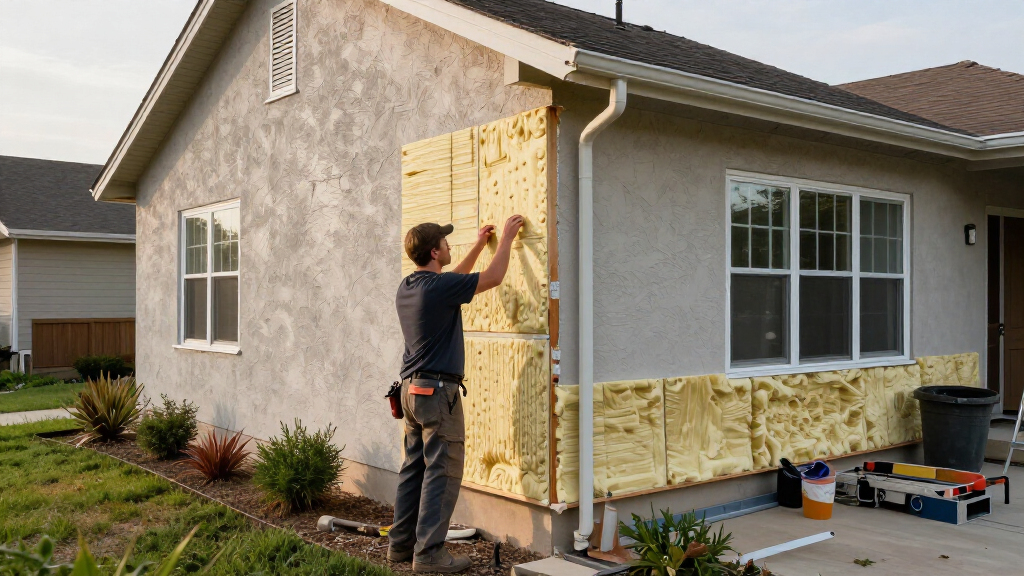
The house is described as having gypsum wallboard, interior plastic sheeting, 2-by-4 framing and 2-by-6 framing beneath the second story. The wall cavities contain a combination of blown-in cellulose and fiberglass batts, followed by 7/16-inch OSB sheathing. Outside the sheathing are tar paper, chicken wire and three-coat traditional stucco, applied without an air gap, according to the homeowner.
The proposed work would repair or seal cracks and material changes in the stucco, then add two offset layers of 1.5-inch mineral-wool insulation. The homeowner proposes 1-by-3-inch vertical furring strips and cement-board siding outside the insulation. The question does not specify a new water-resistive barrier (WRB) in the proposed layers, prompting the homeowner to ask whether the existing stucco can fill that role.
A second question concerns the plastic sheeting on the interior side of the wall. The homeowner asks whether a vapor-permeable exterior insulation, such as mineral-wool board, is needed to avoid limiting the wall’s ability to dry, and whether outward drying is expected. These are questions about the proposed assembly; the source does not establish that the plastic’s role or the wall’s drying behavior has been assessed.
Moisture Control Shapes the Retrofit
The questions matter because the proposed work would cover an existing stucco wall with several new layers, while the homeowner’s description identifies no new WRB in the planned assembly. How water is managed behind new siding and how the wall can dry are design issues that need to be resolved before installation. The source does not confirm whether the existing stucco and tar paper provide suitable water management for this specific retrofit.
The interior plastic also makes the proposed drying path a central concern. The homeowner is asking whether adding insulation that permits vapor movement outward would help avoid a wall that is restricted on both sides. That concern is not itself proof that the current wall is a “vapor barrier sandwich”; the answer depends on the actual materials, their condition and the assembly’s exposure and detailing. A mistaken assumption could leave important moisture risks unaddressed, while a project-specific assessment can clarify the roles of the existing layers before they are covered.
Products Worth Considering

Samsung 55-Inch S90H OLED 4K UHD Smart TV Bundle with Full-Motion Mount and Surge Protector

Blueair Blue Pure 211i Max Smart Air Purifier for Large Rooms

Philips Hue Bridge Pro Starter Kit with 4 A19 E26 Color Smart Bulbs
As an affiliate, we earn on qualifying purchases.
The Existing Wall and Proposed Layers
The question refers to a similar Green Building Advisor question that was closed in 2017, but the homeowner says they have follow-up questions about a comparable wall. The report’s available text does not include a response resolving the current questions, nor does it establish that the proposed retrofit has been approved or built.
The details provided describe one particular home rather than a general retrofit specification: OSB sheathing, tar paper, metal lath and traditional stucco, with interior plastic and mixed cavity insulation. The homeowner proposes mineral wool, furring and cement-board siding, but the source does not provide climate calculations, product specifications, site inspection findings or details for windows, roof edges and other transitions. Those omissions limit what can be concluded from the question alone.
Key Assembly Details Remain Open
The source does not say whether the existing stucco and tar paper have been inspected, whether cracks and material changes have been fully characterized, or whether a new WRB will be included. It also does not provide a technical answer on the compatibility of the proposed layers, the effect of the interior plastic, or the wall’s likely drying direction. No construction outcome or performance data are reported.
Other project details are absent, including how the new layers would be integrated at openings and edges, and whether local requirements affect the work. The homeowner’s questions should not be read as proof that stucco is an adequate WRB or that mineral wool is automatically the correct solution for this house.
Resolve Details Before Installation
The next step is a project-specific review of the existing wall and proposed layer sequence before the retrofit proceeds. That review would need to address the condition and function of existing materials, water management behind the new siding, the interior plastic’s role, and how the assembly can dry. The source gives no date for a design decision, construction start or follow-up answer.
Until those points are resolved, the proposal remains a homeowner’s plan rather than a confirmed retrofit specification. Any later update would need to establish whether a new WRB is included and how the final design handles the existing stucco and interior vapor-control layer.
Key Questions
What retrofit is the homeowner proposing?
The proposal is to repair or seal the existing stucco, add two offset layers of 1.5-inch mineral wool, install vertical 1-by-3-inch furring and finish with cement-board siding.
Does the existing stucco count as the WRB?
The source does not answer this. The homeowner asks whether the existing stucco can serve as the water-resistive barrier, but no assessment or final design decision is reported.
Does interior plastic mean the exterior insulation must be vapor-permeable?
The homeowner raises that concern, but the source provides no technical conclusion. The effect of the interior plastic and the suitable exterior insulation for this wall remain unresolved.
Has the retrofit been completed or approved?
No. The report describes a proposed assembly and questions about its design; it does not say the work has been built or approved.
Source: rss