Solar-powered security cameras can reduce battery maintenance, but the right choice depends on whether you need broad coverage, a multi-camera kit, or a simpler single-camera setup. I’d put the eufy Security SoloCam S340 among the strongest overall picks for its dual-lens design, while the aosu D1 Classic is a notable option for households seeking a four-camera kit. The SEHMUA 2K stands out for buyers who want pan-and-tilt coverage. The main tradeoffs are panel placement versus an integrated design, fixed versus movable views, and the flexibility of separate cameras versus a coordinated system. Read on for how all 14 options compare and which type of buyer each one suits.

Get backup power and energy gear delivered free with Prime
- Fast, free delivery on millions of items
- Prime Video, Amazon Music and more included
- Member-only deals all year
Key Takeaways
- Dual-lens designs set the standout cameras apart: the eufy SoloCam S340 and aosu T2 Pro offer more than a single fixed view, which may suit buyers who want to monitor different parts of a property.
- Four-camera kits favor coverage over simplicity: options such as the aosu D1 Classic, Cinnado S1, and Ansque bundle multiple cameras, but require more installation and placement planning than a single unit.
- Pan-and-tilt changes the coverage tradeoff: the SEHMUA can move its view, while fixed cameras depend more heavily on careful mounting and camera angles.
- Solar panel design affects installation: integrated-panel cameras keep the setup compact, while a fixed separate panel can give buyers more flexibility to find a sunny position.
- Resolution alone does not determine fit: this lineup spans 1080p, 2K, 4MP, and 3K models, so buyers should weigh field of view, camera count, and placement alongside image detail.
| Cinnado 2K Solar Wireless Outdoor Security Cameras, White, 2-Pack |  | Best Overall for Flexible Coverage | Camera count: 2 | Resolution: 2304 × 1296 pixels (2K); may switch to 768 × 432 in limited network conditions | Power: Solar with backup battery | VIEW LATEST PRICE | See Our Full Breakdown |
| SEHMUA 2K Solar-Powered Outdoor Security Cameras, 2-Pack, 360° Pan and Tilt |  | Best for Simple Two-Camera Monitoring | Camera count: 2 | Resolution: 2K | Power: Solar panels | VIEW LATEST PRICE | See Our Full Breakdown |
| Cinnado S1 Wireless Outdoor Security Cameras with Integrated Solar Panels, 4-Pack |  | Best for Four-Point Coverage | Camera count: 4 | Model: S1 | Resolution: 2K | VIEW LATEST PRICE | See Our Full Breakdown |
| SolarCam 4-Pack 2K Solar-Powered Outdoor Security Cameras |  | Best Four-Camera Kit with Pan and Tilt | Camera count: 4 | Resolution: 2K | Power: Solar and battery | VIEW LATEST PRICE | See Our Full Breakdown |
| aosu D1 Classic 4-Camera Wireless Outdoor Security Kit, Solar Powered | 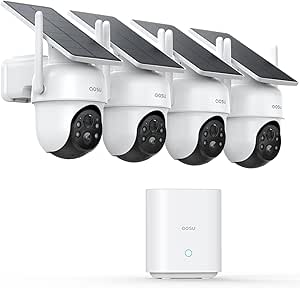 | Best for Subscription-Free Local Storage | Camera count: 4 | Resolution: 2K / 3 MP | Storage: 32 GB local storage in included base | VIEW LATEST PRICE | See Our Full Breakdown |
| AOSU Wireless Outdoor Solar Security Camera with Fixed Solar Panel |  | Best for Wide-Area Tracking | Resolution: 2K | Coverage: 360-degree pan and tilt | Power: Solar powered with fixed solar panel | VIEW LATEST PRICE | See Our Full Breakdown |
| YULIOKPP 2K Solar Outdoor Security Camera |  | Best for Dual-Band Setup | Video resolution: 2K | Camera view: 360° PTZ | Wi-Fi: 2.4 GHz and 5 GHz | VIEW LATEST PRICE | See Our Full Breakdown |
| 4MP Solar-Powered Wireless Outdoor Security Camera System, 4-Camera Kit |  | Best for Whole-Home Coverage | Camera count: 4 | Camera resolution: 4MP | Local storage: Encrypted 128GB home hub | VIEW LATEST PRICE | See Our Full Breakdown |
| Truisee 4MP Solar-Powered Outdoor Security Camera System, 2-Camera Kit |  | Best Two-Camera Local-Storage Kit | Camera count: 2 | Resolution: 4MP | Power: Solar powered; included 5W solar panel and 8000mAh battery | VIEW LATEST PRICE | See Our Full Breakdown |
| eufy Security SoloCam S340 3K Dual-Lens Solar Security Camera |  | Best for Detail and Zoom | Resolution: 3K | Camera: Dual-lens | Zoom: 8× | VIEW LATEST PRICE | See Our Full Breakdown |
| GNCC Solar-Powered Outdoor Security Camera with 1080p Video |  | Best for Flexible Single-Camera Coverage | Video resolution: 1080p | Rotation: 355° horizontal, 90° vertical | Night vision range: 26 feet | VIEW LATEST PRICE | See Our Full Breakdown |
| 2K Solar-Powered Wireless Security Camera System, 4-Pack |  | Best for Beginners Building a Four-Camera Setup | Camera count: 4 | Resolution: 2K | Power: Solar panels with built-in backup batteries | VIEW LATEST PRICE | See Our Full Breakdown |
| Ansque Wireless Outdoor Security Camera System with Solar Power, 4 Cameras |  | Best for Subscription-Free Local Storage | Camera count: 4 | Video: 2K HD | Viewing: 360° panoramic pan and tilt | VIEW LATEST PRICE | See Our Full Breakdown |
| aosu T2 Pro 3K Dual-Camera Solar Outdoor Security Camera |  | Best Premium Single-Camera Coverage | Camera design: 170° fixed wide-angle camera and 360° PTZ camera | Video resolution: Dual 3K | Zoom: Up to 8× hybrid zoom | VIEW LATEST PRICE | See Our Full Breakdown |
| solar powered security camera | Power | Storage | Weather resistance | Camera count |
|---|---|---|---|---|
| Cinnado 2K Solar Wireless Outd | Solar with backup battery | MicroSD up to 128 GB (not included) or optional cloud storage | IP65 | 2 |
| SEHMUA 2K Solar-Powered Outdoo | Solar panels | Memory card up to 128 GB (not included) or optional cloud storage | IP65 | 2 |
| Cinnado S1 Wireless Outdoor Se | Integrated solar panels | Optional FAT32 TF card or optional cloud plans | IP65 | 4 |
| SolarCam 4-Pack 2K Solar-Power | Solar and battery | MicroSD up to 128 GB (not included) or optional cloud storage | IP65 | 4 |
| aosu D1 Classic 4-Camera Wirel | Solar powered | 32 GB local storage in included base | IP65 | 4 |
| AOSU Wireless Outdoor Solar Se | Solar powered with fixed solar panel | — | IP65 | — |
| YULIOKPP 2K Solar Outdoor Secu | 6W solar panel and rechargeable battery | Compatible microSD card; optional cloud storage | IPX6 | — |
| 4MP Solar-Powered Wireless Out | — | — | IP66 | 4 |
| Truisee 4MP Solar-Powered Outd | Solar powered; included 5W solar panel and 8000mAh battery | 128GB local storage; expandable 4-channel hub | IP66; operating range -4°F to 122°F | 2 |
| eufy Security SoloCam S340 3K | Solar powered with removable solar panel | Local storage | — | — |
| GNCC Solar-Powered Outdoor Sec | 3W solar panel and 5200mAh rechargeable battery | MicroSD up to 128GB (not included) or paid cloud storage | IP65 | — |
| 2K Solar-Powered Wireless Secu | Solar panels with built-in backup batteries | Optional microSD card (not included) or cloud storage | IP65 | 4 |
| Ansque Wireless Outdoor Securi | Solar powered; stated to run on 2 hours of sunlight | 32GB built-in; expandable up to 512GB | — | 4 |
| aosu T2 Pro 3K Dual-Camera Sol | 5W solar panel and built-in 9200mAh battery | MicroSD card (not included) or optional cloud storage | — | — |
More Details on Our Top Picks
Cinnado 2K Solar Wireless Outdoor Security Cameras, White, 2-Pack
The Cinnado 2K two-pack is the most flexible two-camera choice here: its remote 360-degree pan, tilt, and zoom can follow activity across a wider area than the fixed-view Cinnado S1 cameras. That can reduce blind spots when you’re watching an open yard or driveway, while 2K video and color night vision help make event clips easier to interpret. Solar power works alongside a 5,000 mAh backup battery, and local microSD storage gives you an alternative to optional cloud service. The tradeoff is event-based monitoring: it does not record continuously, so activity between alerts may go uncaptured. It also needs 2.4 GHz Wi-Fi, and you’ll need to supply the memory card. This is my strongest all-around pick for buyers who value adjustable views over a larger camera count.
Pros:- Remote 360-degree pan, tilt, and zoom helps adjust coverage without moving the camera
- 2K video with multiple night vision modes
- Solar power is backed by a 5,000 mAh battery
- Supports local microSD storage or optional cloud storage
Cons:- Records events rather than continuously
- Works with 2.4 GHz Wi-Fi only
- MicroSD card is not included
Best for: Homeowners who want two remotely steerable cameras for a driveway, patio, or other open outdoor area
Not ideal for: Buyers who need continuous recording, use only 5 GHz Wi-Fi, or want four-camera coverage in one kit
- Camera count:2
- Resolution:2304 × 1296 pixels (2K); may switch to 768 × 432 in limited network conditions
- Power:Solar with backup battery
- Battery capacity:5,000 mAh
- Camera movement:360° pan, tilt, and zoom
- Wi-Fi:2.4 GHz only
- Weather resistance:IP65
- Storage:MicroSD up to 128 GB (not included) or optional cloud storage
Our verdict“Choose the Cinnado two-pack for steerable 2K coverage and flexible storage, provided event recording meets your needs.”
SEHMUA 2K Solar-Powered Outdoor Security Cameras, 2-Pack, 360° Pan and Tilt
The SEHMUA two-pack suits buyers who want solar-powered coverage with the familiar basics: 2K video, 360-degree pan and tilt, motion alerts, and two-way audio. Its color night vision adds a spotlight to infrared LEDs, giving it a different nighttime approach from the Cinnado two-pack, which offers multiple night vision modes and remote pan, tilt, and zoom. SEHMUA’s listed setup is straightforward, with wall or ceiling mounting and local memory-card storage as an option. The tradeoff is that the product data gives less detail about detection controls and battery backup than Cinnado’s. It also lacks 5 GHz Wi-Fi support, and local storage requires a card you provide. I’d choose this for basic two-camera solar monitoring when the spotlight-based night view fits the property.
Pros:- Two cameras provide coverage for separate outdoor areas
- 2K video with spotlight color night vision and infrared LEDs
- 360-degree pan and tilt helps redirect the view remotely
- Supports two-way audio and optional local or cloud storage
Cons:- Does not support 5 GHz Wi-Fi
- Memory card is not included
- Product data does not specify a backup battery capacity or detection range
Best for: Households seeking two solar-powered cameras with pan-and-tilt viewing, spotlight color night vision, and two-way audio
Not ideal for: Buyers who need 5 GHz Wi-Fi, detailed detection adjustments, or included local storage hardware
- Camera count:2
- Resolution:2K
- Power:Solar panels
- Camera movement:360° pan and tilt
- Night vision:Color with spotlight and infrared LEDs
- Wi-Fi:2.4 GHz only
- Weather resistance:IP65
- Storage:Memory card up to 128 GB (not included) or optional cloud storage
Our verdict“Pick SEHMUA for straightforward two-camera solar coverage with spotlight color night vision, if 2.4 GHz Wi-Fi is available.”
Cinnado S1 Wireless Outdoor Security Cameras with Integrated Solar Panels, 4-Pack
With four cameras and integrated solar panels, the Cinnado S1 is the clearest fit for buyers who want to watch several sides of a home without running power cables. Compared with the two-camera Cinnado 2K kit, this pack trades remotely steerable views for more fixed monitoring points; that can make it easier to cover separate entrances, but less adaptable when activity moves beyond a camera’s view. Event clips use 2K video, with PIR and AI detection plus spotlight color night vision. A spotlight and siren can add an active deterrent, though event-based recording means there is no continuous footage between alerts. Local TF card and optional cloud storage are available, but neither the card nor 5 GHz Wi-Fi support is included. This pick favors breadth of coverage over camera movement.
Pros:- Four cameras can cover multiple distinct areas
- Integrated solar panels support cordless installation
- 2K event video with PIR and AI detection
- Spotlight, siren, and two-way talk add response options
Cons:- Does not record continuously
- Supports 2.4 GHz Wi-Fi only
- TF card is not included
Best for: Homeowners who need four cordless cameras for separate doors, gates, or sides of a property
Not ideal for: Buyers who need continuously recorded footage, 5 GHz Wi-Fi, or remotely steerable cameras
- Camera count:4
- Model:S1
- Resolution:2K
- Power:Integrated solar panels
- Detection:PIR sensing and AI detection
- Recording:Event-based; no continuous recording
- Weather resistance:IP65
- Storage:Optional FAT32 TF card or optional cloud plans
Our verdict“Choose the Cinnado S1 four-pack when covering several locations matters more than remote camera movement or continuous recording.”
SolarCam 4-Pack 2K Solar-Powered Outdoor Security Cameras
The SolarCam four-pack combines multi-area coverage with remote pan and tilt, a useful middle ground between the fixed-camera Cinnado S1 four-pack and the two-camera, more fully steerable Cinnado kit. Each camera can pan 336 degrees and tilt 90 degrees, so you can adjust the view after installation while placing cameras around multiple sides of a property. Solar and battery power, color night vision, AI human detection, and two-way audio round out the monitoring features. Its limitations matter for always-on security: it does not offer 24/7 continuous recording, and local microSD storage requires a separately supplied card. The cameras also rely on 2.4 GHz Wi-Fi and the UBox app. I’d favor this kit when four adjustable views are more useful than an included storage base.
Pros:- Four cameras support coverage across several areas
- 336-degree pan and 90-degree tilt allow remote view adjustment
- Solar and battery power support wireless placement
- AI human detection, color night vision, and two-way audio
Cons:- Does not provide continuous 24/7 recording
- MicroSD card is not included
- Requires 2.4 GHz Wi-Fi and the UBox app
Best for: Property owners who want four solar-powered cameras with remote pan and tilt for multiple outdoor zones
Not ideal for: Buyers who need 24/7 recording, included local storage, or 5 GHz Wi-Fi
- Camera count:4
- Resolution:2K
- Power:Solar and battery
- Pan and tilt:336° pan; 90° tilt
- Wi-Fi:2.4 GHz only
- Weather resistance:IP65
- Storage:MicroSD up to 128 GB (not included) or optional cloud storage
- Dimensions:4.8 × 4.8 × 4.02 inches
Our verdict“Pick SolarCam for four remotely adjustable solar cameras, as long as event recording and separate storage are acceptable.”
aosu D1 Classic 4-Camera Wireless Outdoor Security Kit, Solar Powered
The aosu D1 Classic stands apart from the other four-camera kits with a clear ownership advantage: its base includes 32 GB of local storage, and the product data says a subscription is not required. That makes it a more self-contained choice than SolarCam or the Cinnado S1, both of which require buyers to supply a memory card for local recording. The kit also offers four solar-powered cameras, 2K/3 MP video, color night vision, and 360-degree coverage with motion tracking. The tradeoff is fixed storage capacity: 32 GB may limit how much footage remains available, especially if activity is frequent. Solar charging also depends on sunlight exposure. I’d choose aosu for buyers who want broad coverage and local recording without an ongoing storage plan, and accept the limits of a fixed-capacity base.
Pros:- Includes a base with 32 GB local storage
- No subscription is required for local recording
- Four cameras provide simultaneous multi-area coverage
- 360-degree coverage with automatic motion tracking
Cons:- Local storage is limited to 32 GB
- Solar charging performance depends on sunlight exposure
- Wi-Fi band support is not specified in the product data
Best for: Households wanting four solar-powered cameras with included local storage and no required subscription
Not ideal for: Buyers who need expandable storage, dependable solar charging in shaded locations, or detailed Wi-Fi band specifications
- Camera count:4
- Resolution:2K / 3 MP
- Storage:32 GB local storage in included base
- Power:Solar powered
- Field of view:360°
- Viewing angle:105°
- Weather resistance:IP65
- Night vision:Color
Our verdict“Choose the aosu D1 Classic if included, subscription-free local storage matters more than expandable capacity.”
AOSU Wireless Outdoor Solar Security Camera with Fixed Solar Panel
The AOSU’s 360-degree pan and tilt with automatic human tracking suits an open yard where one fixed camera would leave gaps. Its 2K video gives it a sharper stated resolution than the GNCC 1080p camera in this roundup, while Alexa and Google Assistant support offers broader voice control than the Alexa-only YULIOKPP. The fixed solar panel helps reduce battery maintenance, but continuous charging depends on a sunny mounting spot; shaded eaves may limit that benefit. It also uses 2.4 GHz Wi-Fi only, so it cannot connect over 5 GHz. I’d choose it for a broad view and hands-off tracking, but favor the YULIOKPP if dual-band Wi-Fi matters more.
Pros:- 360-degree pan-and-tilt coverage with automatic human tracking
- 2K resolution
- Fixed solar panel reduces routine battery charging when it gets direct sunlight
- Works with Alexa and Google Assistant
Cons:- Continuous solar charging depends on direct sunlight
- Supports 2.4 GHz Wi-Fi only
Best for: Homeowners with a sunny, open yard who want one camera to pan across a broad area and track people automatically
Not ideal for: Buyers with shaded mounting locations or a network that requires 5 GHz Wi-Fi
- Resolution:2K
- Coverage:360-degree pan and tilt
- Power:Solar powered with fixed solar panel
- Wi-Fi:2.4 GHz only
- Weather resistance:IP65
- Voice assistants:Alexa and Google Assistant
- Warranty and support:1-year replacement and lifetime technical support
Our verdict“Choose the AOSU for solar-assisted coverage of a broad, sunny area; choose a dual-band model if your Wi-Fi setup needs 5 GHz.”
YULIOKPP 2K Solar Outdoor Security Camera
The YULIOKPP pairs 2K video with dual-band Wi-Fi, giving buyers more flexibility than the 2.4 GHz-only AOSU when choosing a network connection. Its 360-degree PTZ view, PIR human detection, and two-way audio cover the core tasks of monitoring an entry or yard and responding remotely. A 6W solar panel and rechargeable battery support a wire-free setup, though charging still depends on usable sunlight. The spotlight adds color night vision, but it may draw attention where a more discreet camera would blend in. Local recording requires a compatible microSD card, which the provided details do not state is included. Compared with the four-camera 4MP kit, this is a single-camera option for buyers who need one flexible viewpoint.
Pros:- 2K video with 360-degree PTZ coverage
- Supports both 2.4 GHz and 5 GHz Wi-Fi
- PIR human detection and two-way audio
- MicroSD local storage is available without a mandatory subscription
Cons:- A compatible microSD card is required for local recording and is not stated as included
- Solar charging depends on available sunlight
- Spotlight-assisted color night vision may be too conspicuous for some locations
Best for: Buyers adding one outdoor camera who need 5 GHz Wi-Fi support, two-way audio, and local microSD recording
Not ideal for: Households seeking a multi-camera kit or buyers who want local recording without supplying a microSD card
- Video resolution:2K
- Camera view:360° PTZ
- Wi-Fi:2.4 GHz and 5 GHz
- Power:6W solar panel and rechargeable battery
- Motion detection:PIR human detection
- Night vision:Full color with spotlight
- Audio:Two-way audio
- Storage:Compatible microSD card; optional cloud storage
- Weather resistance:IPX6
Our verdict“Pick the YULIOKPP for a single wire-free camera with dual-band Wi-Fi, provided you can supply a microSD card for local recording.”
4MP Solar-Powered Wireless Outdoor Security Camera System, 4-Camera Kit
For buyers who want to cover several sides of a property, this kit’s four solar-powered cameras and home hub make more sense than buying the two-camera Truisee system or a single YULIOKPP. Each camera offers 4MP resolution, 355-degree pan and tilt, human detection and tracking, and two-way audio. The hub’s encrypted 128GB local storage can hold up to three months of loop recording, according to the product description, so the setup does not rely on a subscription for storage. The tradeoff is a more involved system to place and configure across multiple locations. Auto tracking also needs to be enabled manually in the app, and solar performance depends on sunlight. I’d favor this kit for broad property coverage over a simpler single-camera installation.
Pros:- Four-camera kit covers multiple areas
- Encrypted 128GB hub storage with loop recording and no subscription fees
- 4MP cameras with color night vision, human detection, and tracking
- Dual-band Wi-Fi and two-way audio
Cons:- Auto tracking must be enabled manually in the app
- Solar charging performance depends on sunlight
- A four-camera setup takes more placement and configuration than a single camera
Best for: Homeowners who want to monitor several outdoor areas with one four-camera system and keep recordings on a local hub
Not ideal for: Renters or buyers who only need one or two viewpoints and want the simplest setup possible
- Camera count:4
- Camera resolution:4MP
- Local storage:Encrypted 128GB home hub
- Night vision range:Up to 65 ft
- Battery capacity:8000mAh
- Solar panel:5W
- Wi-Fi:2.4 GHz and 5 GHz
- Field of view:355 degrees
- Weather resistance:IP66
Our verdict“Choose this kit to cover several sides of a property with local hub recording, if you can place all four cameras where their panels receive sunlight.”
Truisee 4MP Solar-Powered Outdoor Security Camera System, 2-Camera Kit
The Truisee’s two 4MP cameras and 128GB hub suit buyers who want local recording across a pair of locations without stepping up to the four-camera kit. Its encrypted hub storage, expandable to a four-channel system, leaves room to add coverage later. Each camera combines solar power, 360-degree auto-tracking, color night vision, AI human detection, and two-way audio; compared with the AOSU, it also supports dual-band Wi-Fi and offers hub connectivity over Ethernet or Wi-Fi. A tradeoff shared with the four-camera kit is that auto-tracking must be enabled manually in the app. The provided details also do not specify the solar panel’s placement or charging performance beyond its 5W rating, so buyers should plan around available sunlight.
Pros:- Two 4MP solar-powered cameras with 360-degree auto-tracking
- Encrypted 128GB local storage with no subscription fees
- Expandable four-channel hub with Ethernet or Wi-Fi connection
- Dual-band Wi-Fi, color night vision, and two-way audio
Cons:- Auto-tracking must be enabled manually in the app
- Solar charging depends on sunlight
- Two cameras may not cover a property as broadly as the four-camera kit
Best for: Households that need two outdoor viewpoints, prefer encrypted local recording, and may expand to more cameras later
Not ideal for: Buyers who need four cameras immediately or want tracking to be enabled automatically without app setup
- Camera count:2
- Resolution:4MP
- Power:Solar powered; included 5W solar panel and 8000mAh battery
- Pan and tilt:360° auto-tracking
- Storage:128GB local storage; expandable 4-channel hub
- Night vision:Color night vision up to 65 ft
- Detection:PIR and AI human detection; adjustable 16–29 ft range
- Connectivity:2.4 GHz and 5 GHz Wi-Fi; hub supports Ethernet or Wi-Fi
- Weather resistance:IP66; operating range -4°F to 122°F
Our verdict“Choose the Truisee for two locations and expandable local recording; choose the four-camera kit if you need wider coverage from the start.”
eufy Security SoloCam S340 3K Dual-Lens Solar Security Camera
The eufy SoloCam S340’s dual-lens 3K video and 8× zoom make it the detail-focused pick here: zoom can help inspect a distant part of a driveway, while 360-degree pan and tilt lets the camera redirect its view. Compared with the four-camera 4MP kit, this is a single-camera choice that emphasizes zoom and a simpler wire-free installation rather than multiple viewpoints and hub storage. Local storage without a monthly fee also avoids a required subscription. The solar panel is removable, which gives more placement flexibility, but solar operation still depends on suitable sunlight. The product notes that full coverage requires vertical installation, so buyers should check their mounting surface before choosing it. It suits a targeted view better than whole-property coverage.
Pros:- 3K resolution with 8× zoom
- Dual-lens design and 360-degree pan-and-tilt coverage
- Solar-powered, wire-free installation with removable solar panel
- Local storage without a monthly fee
Cons:- Full coverage requires vertical installation
- Solar operation depends on suitable sunlight
- One camera covers fewer locations than the two- and four-camera kits
Best for: Homeowners monitoring a driveway or yard who want zoom for distant detail and can mount the camera vertically
Not ideal for: Buyers needing multiple camera viewpoints or unable to use vertical installation for full coverage
- Resolution:3K
- Camera:Dual-lens
- Zoom:8×
- Coverage:360° pan and tilt
- Power:Solar powered with removable solar panel
- Storage:Local storage
- Installation:Wire-free; advertised 7-minute setup
Our verdict“Pick the SoloCam S340 for a single solar-powered viewpoint where zoomed detail matters more than covering multiple locations.”
GNCC Solar-Powered Outdoor Security Camera with 1080p Video
The GNCC suits buyers who want to aim one camera across a broad yard or driveway without running power. Its 355° horizontal rotation and color night vision offer more adjustable coverage than a fixed camera, while the solar panel and 5200mAh battery reduce charging visits when the panel gets useful sun. Compared with the four-camera Ansque system, GNCC is a simpler single-camera choice, but it cannot provide the same multi-area coverage or cross-camera tracking. Its 1080p video is also less detailed than the 2K and 3K options in this roundup. Motion-triggered clips, two-way audio, a siren, and a spotlight cover basic response needs; there is no continuous recording or motion tracking. Local microSD recording avoids a cloud plan, though AI recognition and cloud storage require subscriptions.
Pros:- Wide 355° horizontal and 90° vertical rotation helps reposition the view remotely
- Solar panel and 5200mAh rechargeable battery support wire-free placement
- Color night vision, spotlight, siren, and two-way audio provide several ways to respond to activity
- MicroSD recording is available without relying on cloud storage
Cons:- 1080p video provides less detail than the roundup’s 2K and 3K cameras
- Records motion-triggered events only, without continuous recording or motion tracking
- Does not support 5GHz Wi-Fi, and AI recognition and cloud storage require a subscription
Best for: Homeowners who need one solar camera with a wide, remotely adjustable view and local recording
Not ideal for: Buyers monitoring several separate areas, needing continuous recording, or using only 5GHz Wi-Fi
- Video resolution:1080p
- Rotation:355° horizontal, 90° vertical
- Night vision range:26 feet
- Power:3W solar panel and 5200mAh rechargeable battery
- Weather resistance:IP65
- Connectivity:2.4GHz Wi-Fi and Bluetooth; no 5GHz support
- Storage:MicroSD up to 128GB (not included) or paid cloud storage
- Recording:Motion-triggered event clips; no continuous recording or motion tracking
Our verdict“Choose GNCC for one broadly adjustable solar camera with local storage, and skip it if you need multi-camera coverage or sharper video.”
2K Solar-Powered Wireless Security Camera System, 4-Pack
This four-camera kit is a straightforward fit for someone who wants to cover several outdoor zones with 2K video and solar charging in one system. The combination of app alerts, two-way audio, and AI human detection can help narrow notifications to people, while dual-band Wi-Fi gives it a connection option the single-camera GNCC lacks. Compared with Ansque’s four-camera kit, this model lists Alexa compatibility and a 328-foot night vision range, but Ansque offers built-in expandable local storage and person tracking. Here, storage requires an optional microSD card or cloud service. The solar panels and backup batteries avoid routine wiring, though charging depends on sunlight and placement. It makes the most sense for broad household coverage; buyers seeking more control over local footage or moving-subject tracking should compare other kits first.
Pros:- Four cameras can cover multiple sides of a home
- 2K video with color night vision and a motion-activated spotlight
- AI human detection and two-way audio support more targeted alerts and remote responses
- Dual-band Wi-Fi supports both 2.4GHz and 5GHz networks
Cons:- MicroSD storage requires a separately supplied card, or cloud storage can be used
- Solar charging performance depends on sunlight and panel placement
- Does not list person tracking, a feature offered by the Ansque four-camera system
Best for: Households that want four outdoor viewpoints, app alerts, and dual-band Wi-Fi in a solar-powered kit
Not ideal for: Buyers who want built-in local storage, person tracking, or dependable solar charging in shaded locations
- Camera count:4
- Resolution:2K
- Power:Solar panels with built-in backup batteries
- Wi-Fi:2.4GHz and 5GHz
- Night vision:Color night vision with spotlight; stated range 328 feet
- Coverage:360° pan and tilt
- Detection:PIR and AI human detection
- Storage:Optional microSD card (not included) or cloud storage
- Weather resistance:IP65
Our verdict“Pick this kit for an accessible four-camera solar setup with dual-band Wi-Fi, but compare Ansque if built-in expandable storage or tracking matters more.”
Ansque Wireless Outdoor Security Camera System with Solar Power, 4 Cameras
Ansque stands out among the four-camera kits for buyers who want footage kept locally: it includes 32GB of built-in storage and supports expansion up to 512GB, so a cloud plan is optional rather than the only listed route. Its AI person detection and tracking, including cross-camera tracking, also give it a more active monitoring role than the 2K four-camera system, which lists human detection but not tracking. That added automation may help follow movement across monitored areas, though it still depends on Wi-Fi and the supplied description warns that stated recording duration and solar performance vary with conditions. The 2K video, color night vision, and four cameras target broad property coverage. Compared with the aosu T2 Pro, Ansque brings four separate cameras and expandable local storage, while the aosu pairs two 3K views in a single camera.
Pros:- 32GB built-in storage expands to 512GB without requiring a cloud subscription
- Four cameras with 360° viewing can monitor separate areas around a property
- AI person detection, tracking, and cross-camera tracking help follow activity
- Dual-band Wi-Fi supports 2.4GHz and 5GHz networks
Cons:- Requires Wi-Fi connectivity for its connected monitoring features
- Actual recording duration and solar performance depend on usage and conditions
- Digital zoom is listed, but it does not provide the dual 3K camera design of the aosu T2 Pro
Best for: Homeowners covering several areas who want expandable local recording and person tracking without a required cloud plan
Not ideal for: Buyers without reliable Wi-Fi or those who need recording duration and solar output to be predictable regardless of conditions
- Camera count:4
- Video:2K HD
- Viewing:360° panoramic pan and tilt
- Night vision:Color, with four LED lights and Smart IR; detection range up to 40 feet at night
- Storage:32GB built-in; expandable up to 512GB
- Recording:Event-triggered loop recording; stated up to 120 days
- Power:Solar powered; stated to run on 2 hours of sunlight
- Wi-Fi:Dual-band 2.4GHz and 5GHz
- Detection:AI person detection and tracking, including cross-camera tracking
Our verdict“Choose Ansque for four-camera coverage with expandable local storage and tracking, provided your Wi-Fi and sunlight conditions suit the installation.”
aosu T2 Pro 3K Dual-Camera Solar Outdoor Security Camera
The aosu T2 Pro takes a different route from the four-camera kits: one unit combines a 170° fixed wide-angle lens with a 360° pan-tilt camera. That pairing can keep a broad scene in view while the movable lens follows activity, and dual 3K video gives it more detail than GNCC’s 1080p camera. Its on-device AI detection for people, vehicles, and pets also avoids making recognition dependent on the optional subscription described for GNCC. Solar charging and a 9200mAh battery support a wire-free installation, although the stated 90 minutes of direct sun per day depends on local conditions and placement. Compared with Ansque, this is a more concentrated single-camera solution, not four separate viewpoints; storage also requires a microSD card or optional cloud service. The main constraint is 2.4GHz-only Wi-Fi.
Pros:- Fixed 170° lens and 360° PTZ camera combine broad scene coverage with movement tracking
- Dual 3K video and up to 8× hybrid zoom provide more detail than GNCC’s 1080p camera
- On-device AI detects people, vehicles, and pets with customizable zones
- 5W solar panel and 9200mAh battery support wire-free installation
Cons:- Supports 2.4GHz Wi-Fi only
- MicroSD card is not included, and cloud storage is optional
- A single unit cannot cover as many separate locations as a four-camera kit such as Ansque
Best for: Homeowners who want one high-detail camera to combine a fixed wide view with remotely controlled tracking
Not ideal for: Buyers who need four separate viewpoints, use only 5GHz Wi-Fi, or expect included local storage
- Camera design:170° fixed wide-angle camera and 360° PTZ camera
- Video resolution:Dual 3K
- Zoom:Up to 8× hybrid zoom
- Night vision:Full color with spotlights and IR LEDs
- Power:5W solar panel and built-in 9200mAh battery
- Solar charging:Stated as little as 90 minutes of direct sunlight per day
- Connectivity:2.4GHz Wi-Fi
- Storage:MicroSD card (not included) or optional cloud storage
- Detection:On-device AI for people, vehicles, and pets; customizable zones
Our verdict“Choose the aosu T2 Pro for detailed, dual-view monitoring from one solar camera, and choose a four-camera kit for separate property zones.”

How We Picked
I compared these 14 solar-powered cameras and kits around the decisions buyers face outdoors: how much area each setup can cover, how its solar panel is positioned, what kind of view it offers, and how many cameras are included. I also considered stated video resolution, whether the camera can pan and tilt or uses dual lenses, and whether the product is presented as a standalone camera or a coordinated system. These features affect installation effort and how well a setup can match a home’s layout.
The ranking favors useful coverage and a clear role over resolution claims alone. Multi-camera kits rank well for buyers who need several viewpoints, while a movable or dual-lens camera has an advantage for specific coverage needs. Products with less detail in their names, such as the generic 4MP and 2K kits, are harder to distinguish on the available specifications, so I treat them as options to compare closely rather than assume they outperform better-defined models. No single camera is right for every property; the recommendations below reflect different priorities.
| solar powered security camera | Weather resistance |
|---|---|
| Cinnado 2K Solar Wireless Outd | IP65 |
| SEHMUA 2K Solar-Powered Outdoo | IP65 |
| Cinnado S1 Wireless Outdoor Se | IP65 |
| SolarCam 4-Pack 2K Solar-Power | IP65 |
| aosu D1 Classic 4-Camera Wirel | IP65 |
| AOSU Wireless Outdoor Solar Se | IP65 |
| YULIOKPP 2K Solar Outdoor Secu | IPX6 |
| 4MP Solar-Powered Wireless Out | IP66 |
| Truisee 4MP Solar-Powered Outd | IP66; operating range -4°F to 122°F |
| eufy Security SoloCam S340 3K | — |
| GNCC Solar-Powered Outdoor Sec | IP65 |
| 2K Solar-Powered Wireless Secu | IP65 |
| Ansque Wireless Outdoor Securi | — |
| aosu T2 Pro 3K Dual-Camera Sol | — |
Factors to Consider When Choosing Solar Powered Security Cameras
Before choosing a camera, match its solar setup and viewing design to the place you plan to monitor. A good fit can reduce routine charging, but it still depends on sunlight, mounting options, and the number of views your property needs.
Check Sunlight at the Mounting Spot
A solar camera needs a position where its panel can receive useful sunlight, and the best camera angle may not be the sunniest location. Before buying, check whether the proposed mounting area is shaded by eaves, trees, or nearby buildings during the day. An integrated panel keeps the unit compact, but it can limit how independently you position the panel. A model with a separate fixed panel can provide more placement flexibility if the camera must face a shaded doorway. Buyers often focus on the word solar and overlook the cable route or panel mounting point. Plan both positions before deciding which design suits your exterior.
Choose Fixed, Movable, or Dual-Lens Coverage
Camera movement and multiple lenses address different coverage problems. A fixed camera provides a consistent view and can work well when you need to watch a defined entry point. Pan-and-tilt lets you redirect the view, but a camera that moves cannot show every direction at once. Dual-lens designs can offer distinct views from one device, which may help when a single mounting point needs to cover more than one area. Avoid buying based on a wide-sounding feature name without checking how the views are described and controlled. Sketch the areas you need to monitor, then decide whether one steady view, a movable view, or multiple views fits best.
Size the System to Your Property
A single camera can suit a porch or side gate, while multi-camera kits make more sense when you need to monitor separated sides of a home. More cameras also mean more mounting points, setup steps, and positions where sunlight matters. A four-camera package may cover more ground, but it can be unnecessary if your priority is one entrance. Buyers sometimes choose a large kit before deciding which areas actually need monitoring. Start with a simple coverage map and mark the views that would provide distinct information. Then compare the camera count with those locations rather than treating a larger bundle as automatically better.
Read Resolution Alongside the View
Resolution figures such as 1080p, 2K, 3K, and 4MP describe image detail, but they do not tell the whole story about what a camera will capture. Field of view, lens design, camera angle, and the distance to the subject all affect whether details are useful. A higher resolution may help when you want more detail from a particular area, yet a poorly placed camera can still miss the action. Check whether the stated resolution applies to each lens or camera in a multi-camera product. Think about the distance and area you need to see before treating a larger number as the deciding factor. Placement and coverage should guide the resolution choice.
Account for Installation and Maintenance
Solar power can reduce the need to remove a camera for charging, but it does not remove every maintenance task. Panels and lenses may need cleaning, and a shaded or seasonally sunless location can affect how reliably the setup stays powered. Multi-camera systems ask you to mount and position several units, while a single camera is simpler to install but covers less ground. Separate panels add a mounting decision and may need a cable run to the camera. Before choosing, consider whether you can reach the camera safely for adjustments or cleaning. A practical setup is one you can install and maintain at the locations that matter.
Decide Whether a Kit Is Worth the Extra Setup
A system kit is useful when you want several cameras as part of one planned installation, but the product name alone does not tell you how the cameras communicate or what controls are included. Compare what is explicitly listed for each kit, including camera count, resolution, and any named viewing features. Avoid assuming that every multi-camera system offers the same app, storage, or recording approach when those details are not specified. A standalone camera can be a simpler choice for a single location, while a kit may suit a property with several distinct approaches. Make a checklist of the functions you need and verify each against the product details. Paying for more cameras only helps when you have suitable places to install them.
Frequently Asked Questions
Can a solar security camera stay powered in a shaded location?
Solar power depends on the panel receiving sunlight, so a consistently shaded mounting spot can limit how much energy it gathers. A separate panel may let you place the camera near an entrance and position the panel in a sunnier spot, if its cable and mounting arrangement allow it. With an integrated panel, the camera’s location also determines the panel’s exposure. Check the product’s panel design and installation details before choosing a shaded location. If you cannot identify a suitable sunlit position, solar power may not fit that camera placement.
Should I choose a pan-and-tilt camera or a fixed camera?
A pan-and-tilt camera makes sense when you need to redirect one camera’s view across different areas. Its view can only point in one direction at a time, so it may not watch several approaches simultaneously. A fixed camera keeps a consistent view of a specific entrance or path and can be easier to position for that task. Dual-lens models offer another approach when you want multiple views from one device. Decide whether you need to move the view, keep one area continuously framed, or cover more than one direction.
Is a four-camera solar kit better than buying one camera?
A four-camera kit can make sense for a home with several separate approaches, such as entrances on different sides of the property. It also means more installation work and more mounting spots that need suitable sunlight. If you only need to monitor a porch or gate, a single camera may fit the task with less setup. First mark the locations you want to cover and check each for a usable mounting and panel position. Choose a kit when its additional viewpoints fill real gaps in that plan.
Does higher resolution guarantee better security footage?
No; resolution is only one part of how useful footage will be. The camera’s lens, field of view, angle, and distance from the area all shape what appears in the image. A high-resolution camera pointed too broadly or mounted too far away may show less useful detail than a well-placed camera aimed at a defined entrance. Compare resolution with the viewing design and the area you want to monitor. Choose a position that captures the right scene before relying on a higher resolution figure.
What should I check before choosing between integrated and separate solar panels?
Start with the camera location and the sun exposure available there. An integrated panel keeps the unit compact, but its position is tied to the camera’s placement. A separate panel can give you more freedom to find sunlight when the camera needs to face a shaded spot, though it adds another mounting position and may require a cable route. Check the included panel arrangement and installation details for the specific model, since product names do not establish every setup requirement. The better fit is the design that can power the camera from a practical location on your property.
Conclusion
For a broad all-around choice, I’d start with the eufy Security SoloCam S340, whose 3K dual-lens design gives it a distinctive coverage approach. Buyers who want multiple viewpoints can compare the aosu D1 Classic kit, while the SEHMUA 2K is the clearest fit for those who want pan-and-tilt movement. For a beginner, a single-camera option such as the GNCC 1080p can be a more manageable starting point than installing a multi-camera system. If you need several cameras, look closely at the Cinnado S1 or other four-camera kits and match their panel arrangements to your mounting spots. I’d choose by coverage and sunlight first, then use resolution and camera count to narrow the field.