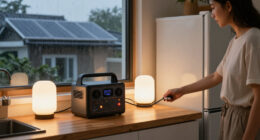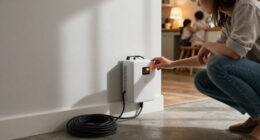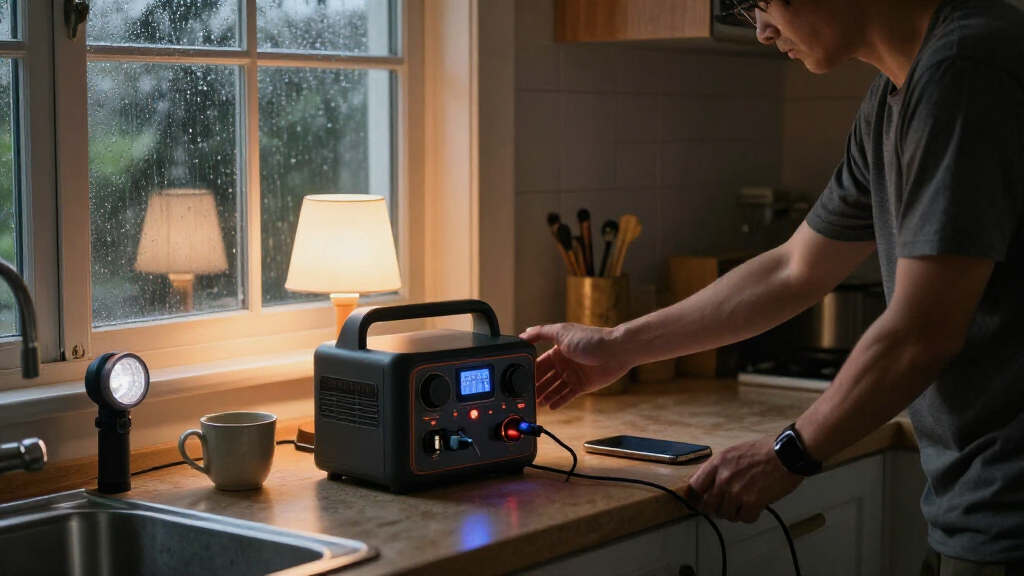
Choosing a portable power station for home backup comes down to how much equipment you need to keep running and for how long. A 1,000Wh unit costs less and is easier to move, but its usable energy may be consumed quickly by a refrigerator, networking gear, and other essential loads. A 2,000Wh unit offers substantially more runtime and often higher output, at the expense of price, weight, and storage space. Choose the smaller capacity for short outages and a few carefully selected devices; choose the larger one when keeping several essentials running for longer matters more than portability.

Get backup power and energy gear delivered free with Prime
- Fast, free delivery on millions of items
- Prime Video, Amazon Music and more included
- Member-only deals all year
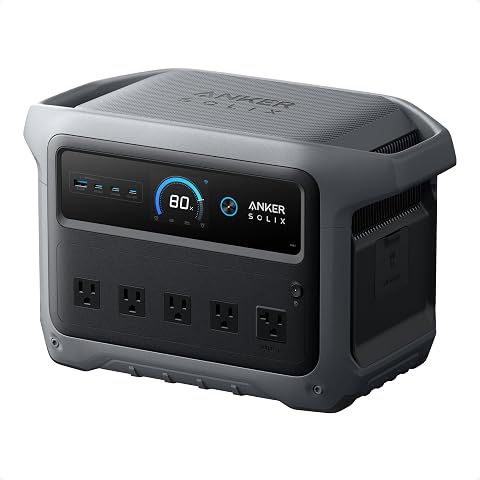
Anker SOLIX C1000 Gen 2 Portable Power Station
- ✔ Battery capacity: 1,024Wh
- ✔ Battery type: LiFePO4
- ✔ Output: 2,000W continuous; 3,000W peak

BLUETTI Elite 30 V2 Portable Power Station, 288Wh, 600W
- ✔ Battery capacity: 288Wh
- ✔ Battery type: LFP
- ✔ Continuous output: 600W

Jackery Explorer 300 Portable Power Station, 292Wh
- ✔ Capacity: 292Wh
- ✔ Battery chemistry: LiFePO4
- ✔ Rated output: 300W
These capacity classes are not substitutes for a whole-home generator. Neither guarantees that a refrigerator will run for a stated number of hours: actual runtime depends on appliance consumption, startup surges, inverter losses, temperature, and how often the refrigerator cycles. The comparison below focuses on typical models in each class; check the specific unit’s usable capacity, continuous and surge output, outlets, charging options, and battery warranty before buying.
At a Glance
| Criteria | 1,000Wh portable power station | 2,000Wh portable power station | Winner |
|---|---|---|---|
| Stored energy and runtime | About 1,000Wh nominal; less energy reaches devices after conversion losses | About 2,000Wh nominal; roughly double the stored energy before losses | B |
| Continuous and surge output | Often around 1,000–1,800W continuous, with model-specific surge limits | Often higher continuous output, but ratings vary and must be checked per model | Depends |
| Portability | Usually easier to lift and store, though still heavier than a small battery pack | Heavier and bulkier; moving it between rooms or upstairs is less convenient | A |
| Recharge options | AC, car, and sometimes solar input; charging speed varies by model | AC, car, and sometimes higher-capacity solar input; model-specific | Depends |
| Typical purchase cost | Lower initial cost in the same product family | Higher initial cost; may cost less per Wh, but compare actual specifications | A |
| Best-fit outage plan | Short outages or a few essential devices used selectively | Longer outages or multiple essential loads with less frequent rationing | Depends |
Anker SOLIX C1000 Gen 2 Portable Power Station
For buyers who want a station to cover more than phones and a few small electronics, the Anker SOLIX C1000 Gen 2 is the clear step up in this group. Its 1,024Wh battery is more than three times the capacity of either compact alternative, and its 2,000W continuous output gives it room to run a broader set of household devices, provided each device stays within its limits. That combination makes it the most practical of these three for a meaningful short-term backup plan.Compared with the BLUETTI Elite 30 V2, the Anker is far better suited to loads that need sustained power: the BLUETTI’s 600W output and 288Wh battery serve a narrower range of outage needs. The Anker also claims under-10ms UPS switchover, matching the BLUETTI’s stated threshold while offering much more stored energy. Its 49-minute AC recharge claim and solar input up to 600W can help shorten recovery between uses, though solar charging depends on panel compatibility and available sunlight.There are limits to keep in view. At 11.3kg, it is substantially heavier than the 7.1-pound Jackery, and a 1,024Wh station still cannot promise a fixed runtime without knowing the load. The listing also has an outlet-count discrepancy: it lists nine outlets, while the description refers to powering up to 10 devices. We would check the exact port layout before buying. For buyers prioritizing actual backup capability over easy carry, its capacity and output make it the strongest choice here.
Pros:
- 1,024Wh battery provides substantially more stored energy than the compact picks.
- 2,000W continuous output supports higher-demand devices within the station’s limits.
- Fast AC charging and up to 600W solar input give flexible recharge options.
- Under-10ms UPS claim and a stated 4,000-cycle life support backup-oriented use.
Cons:
- Heavier than either compact alternative at 11.3kg.
- Outlet and device-count details conflict in the listing and should be confirmed.
- Solar input is capped at 600W, and actual recharge time depends on conditions.
Best for: Households seeking a portable station for a wider range of essential devices and a larger reserve than the two sub-300Wh options provide.
Not ideal for: Buyers who need the lightest station to carry frequently, or those expecting whole-home or long-duration backup from a single portable battery.
Bottom line: Choose the Anker SOLIX C1000 Gen 2 when backup capacity and output matter more than having the smallest, lightest station.
“Choose the Anker SOLIX C1000 Gen 2 when backup capacity and output matter more than having the smallest, lightest station.”
BLUETTI Elite 30 V2 Portable Power Station, 288Wh, 600W
The BLUETTI Elite 30 V2 aims at a specific backup job: keeping smaller electronics going in a compact package. It has a 288Wh battery, but its 600W continuous output is twice the Jackery Explorer 300’s rated output. That extra headroom can matter when a device’s operating draw is above the Jackery’s limit, though it does not increase the BLUETTI’s stored energy enough to make it a long-outage solution.Its standout home feature is the claimed UPS switchover of 10ms or less. That makes it worth considering for compatible devices where a brief interruption can cause trouble, such as certain networking or computer setups. The Anker also offers UPS backup and pairs it with a much larger battery, so it is the better fit if the same setup needs longer runtime or more output. The BLUETTI counters with a smaller footprint and a claimed 0–80% AC charge in 45 minutes, plus multiple charging modes.At 9.5 pounds, it is portable, although the Jackery is lighter and has a slightly larger stated capacity at 292Wh. The BLUETTI’s 1,500W Power Lifting Mode should not be read as 1,500W of continuous power; continuous output remains 600W. Its modest capacity and unspecified device runtimes also make it harder to estimate outage coverage without doing load-by-load planning. We see it as a flexible electronics backup station, not a home-wide power source.
Pros:
- 600W continuous output exceeds the Jackery’s 300W rating.
- UPS backup is specified with a switch time of 10ms or less.
- Fast AC charging claim and several charging methods offer flexibility.
- Compact 9.5-pound format is easier to store than the Anker.
Cons:
- 288Wh capacity limits backup duration compared with the Anker.
- Power Lifting Mode’s 1,500W figure is not the continuous output rating.
- No individual device runtime estimates are provided.
Best for: People who want a compact station with UPS functionality and more continuous output headroom than the Jackery provides.
Not ideal for: Households that need longer backup duration, higher sustained appliance loads, or a clearly specified runtime for particular devices.
Bottom line: Pick the BLUETTI Elite 30 V2 for compact UPS-oriented backup and extra output headroom, while keeping expectations modest about runtime.
“Pick the BLUETTI Elite 30 V2 for compact UPS-oriented backup and extra output headroom, while keeping expectations modest about runtime.”
Jackery Explorer 300 Portable Power Station, 292Wh
The Jackery Explorer 300 is the easiest station here to move and store, weighing 7.1 pounds and measuring about 9.1 by 5.2 by 7.8 inches. For home backup, that portability is useful when we want a charged battery close to a router, phone, or other modest load, or need to carry it between rooms. Its 292Wh capacity is slightly greater than the BLUETTI’s, but the Jackery is rated for only 300W, which makes output the more important dividing line between these two compact choices.That lower rating narrows what it can power, especially when an appliance draws heavily at startup or runs above 300W. The BLUETTI’s 600W continuous output gives it more flexibility for compatible loads, and it adds a UPS feature that the supplied Jackery details do not list. The Jackery’s case is easier to carry, and its LiFePO4 battery is rated for over 4,000 cycles before reaching 70% capacity, which supports repeated use over time.Solar charging is available with compatible Jackery panels, but the panel is sold separately, so a solar-ready setup requires additional equipment. The stated 80% solar charge time assumes a 100W panel and suitable conditions. Against the Anker, the Explorer 300 is far less capable for sustained backup, but it is also a much smaller, lighter choice. We recommend it for essential electronics and short interruptions, not for powering larger household appliances or carrying a home through an extended outage.
Pros:
- At 7.1 pounds, it is the lightest station in this comparison.
- 292Wh capacity is marginally higher than the BLUETTI’s.
- LiFePO4 battery is rated for over 4,000 cycles before reaching 70% capacity.
- Multiple port types allow several small devices to connect.
Cons:
- 300W rated output limits use with higher-power appliances.
- Compatible solar panel is sold separately.
- No UPS feature is specified in the supplied product details.
Best for: Buyers who prioritize low weight and want backup for phones, small electronics, and other loads that stay within a 300W rating.
Not ideal for: Anyone needing higher-draw appliance support, UPS functionality, or substantial stored energy for longer outages.
Bottom line: Choose the Jackery Explorer 300 when easy carrying and essential-device backup matter more than higher output or longer runtime.
“Choose the Jackery Explorer 300 when easy carrying and essential-device backup matter more than higher output or longer runtime.”
As an Amazon Associate we earn from qualifying purchases.
Key Differences
The largest difference is energy reserve. A 2,000Wh station starts with about twice the stored energy of a 1,000Wh model, so it can generally run the same load longer, provided both units have suitable output and similar conversion efficiency. That extra reserve can make a meaningful difference during an overnight outage: users may be able to power a refrigerator and communications equipment while keeping some capacity for lights or device charging. It still does not make runtime predictable without knowing the appliances’ actual energy use.
Output and capacity answer different questions. Capacity, measured in watt-hours, describes how much energy is stored; output, measured in watts, describes what the station can power at one time. A larger battery does not automatically have enough continuous or surge output for a demanding appliance. Portability also changes the decision: the 1,000Wh class is usually easier to relocate, while a 2,000Wh model is better treated as a heavier household backup appliance. Price is justified when the additional energy will be used, but paying more for capacity that sits unused may be poor value.
Detailed Comparison
Stored energy and runtime (2,000Wh portable power station wins — major)
B wins; major difference. A 2,000Wh station has about twice the nominal energy reserve of a 1,000Wh unit. In practice, that can extend operation of the same set of devices or let you use more energy before recharging. Usable runtime is lower than a simple capacity calculation suggests because inverters consume energy and loads vary. Check real appliance draw and leave a reserve for outage duration uncertainty.
Continuous and surge output (moderate difference)
Depends on the exact models; moderate difference. Many 2,000Wh models also offer higher output, which can help with appliances whose motors draw extra power when starting. Capacity alone does not establish that advantage: a 1,000Wh model may have a strong inverter, while a larger unit may still fall short of a particular appliance’s startup surge. Compare continuous watts and surge rating with the appliance label or manual before purchase.
Portability (1,000Wh portable power station wins — moderate)
A wins; moderate difference. A 1,000Wh station is generally lighter and easier to carry or reposition. That matters if it must move between rooms, fit in a small storage area, or travel with the household. A 2,000Wh station’s extra reserve comes with more bulk and weight; check the actual dimensions and handle design, especially if stairs are involved.
Recharge options (minor difference)
Depends; usually a minor difference. Both classes commonly offer wall charging, and some models support car charging or solar panels. A larger unit may accept more solar input or take longer to recharge from a household outlet, but neither is guaranteed by capacity alone. Compare maximum input, compatible panel requirements, and stated recharge times. For repeated outages, recharge speed and available sunlight can matter as much as stored energy.
Purchase cost and value (moderate difference)
A wins on upfront cost; B can win on cost per stored Wh. The smaller station generally asks for less money at checkout. A larger unit may offer a lower price per watt-hour, yet that is only useful if the extra capacity supports a real backup plan. Paying more is worthwhile when longer runtime or fewer compromises during an outage are priorities. If your use is limited to a router, phones, and a few lights, the extra spend may not pay off.
Outage plan and load coverage (major difference)
Depends on the household; major difference for longer outages. A 1,000Wh station fits a deliberate plan to rotate loads or power a small set of essentials. A 2,000Wh model gives more flexibility for overnight use or several devices, assuming its output rating supports them. Neither size should be treated as automatic whole-home backup. List the loads you want to run, their wattage, and the hours needed, then include a margin for conversion losses and changing conditions.
1,000Wh portable power station: Pros and Cons
Pros:
- Lower purchase cost and usually easier to move or store.
- A practical size for communications, lighting, and limited device charging.
- Can suit short outages when loads are selected and managed.
Cons:
- Less energy reserve for overnight use or outages lasting into a second day.
- May require frequent load rotation or recharging to cover multiple essentials.
- Some models lack the output or surge capacity for larger appliances.
2,000Wh portable power station: Pros and Cons
Pros:
- Roughly twice the nominal stored energy of a 1,000Wh class unit.
- More room to support longer backup periods or a broader set of essentials.
- Often available with higher output, though the model specification must confirm it.
Cons:
- Higher upfront price and typically greater weight and storage footprint.
- Extra capacity offers little value if household loads are small or outages brief.
- A large battery still cannot run an appliance that exceeds its output rating.
Who Should Choose What
Choose 1,000Wh portable power station if:
- You mainly need a router, phones, lights, and other low-wattage essentials for a short outage.
- You expect to move the station often or have limited storage space.
- A lower initial cost matters more than extended runtime, and you can recharge or ration loads.
Choose 2,000Wh portable power station if:
- You want a better chance of carrying essential loads through an overnight outage.
- You expect to power several devices or appliances in rotation and want more energy reserve.
- The added cost and weight fit your budget and storage plan, and the specific model has adequate output.
Skip both if: You need automatic, whole-home backup, long multi-day operation without recharging, or support for high-demand appliances beyond the station’s output. Compare a properly sized generator, a home battery system, or a larger backup setup matched to those loads.
Value for Money
The 1,000Wh class is the better value when your backup plan is modest: communications, lighting, phones, and limited appliance use. It costs less to buy and is easier to handle, but a lower price does not make it economical if you repeatedly run out of energy before an outage ends. The 2,000Wh class costs more, and its extra capacity is worthwhile for households that need longer runtime or more flexibility with essential loads. Compare price per usable watt-hour, inverter output, charging input, warranty, and battery chemistry across specific models. Pay more for capacity you expect to use, not capacity alone.
Final Verdict
For most households choosing between these two sizes, the 2,000Wh class is the more capable home backup choice because its larger energy reserve offers more useful runtime during an outage. Choose it if you can manage the higher cost and weight, and confirm that its continuous and surge ratings suit the appliances you plan to run. Choose a 1,000Wh model if you need a more portable, lower-cost reserve for a few low-power essentials and can accept shorter runtime or careful load rotation. The deciding factor is how many watt-hours your outage plan requires; buy the smaller station when that plan is genuinely small, and the larger one when longer backup matters.
Frequently Asked Questions
Can a 1,000Wh power station run a refrigerator?
It may run some refrigerators for a limited period, but capacity alone cannot predict how long. Refrigerator energy use varies with model, room temperature, door openings, and compressor cycles. Check the appliance’s consumption and the station’s continuous and surge output, then allow for inverter losses. A 2,000Wh station provides more stored energy, but it does not guarantee a particular runtime.
Is a 2,000Wh station twice as useful as a 1,000Wh station?
It stores roughly twice the nominal energy, but practical usefulness depends on output, efficiency, recharge options, and the loads you need to power. It can extend runtime for compatible devices; it will not run a device that exceeds its output rating, and it may be unnecessarily heavy for a small backup plan.
Which size is better for an overnight outage?
A 2,000Wh model is generally the safer pick if you plan to run several essentials overnight, because it starts with more energy. The right size still depends on actual draw and desired reserve. Estimate the watt-hours for each load over the planned hours, then account for conversion losses and check the station’s output limits.
Is paying more for 2,000Wh worth it?
Yes, when the added energy supports longer runtime or fewer compromises during outages. It is harder to justify if you only need to charge phones and power a router or a few lights for a short period. Compare the specific models’ usable capacity, output, charging speed, and warranty alongside purchase price.
Fall Picks

Philips Hue Essential Starter Kit with Bridge and 4 E26 Smart Bulbs
As an affiliate, we earn on qualifying purchases.