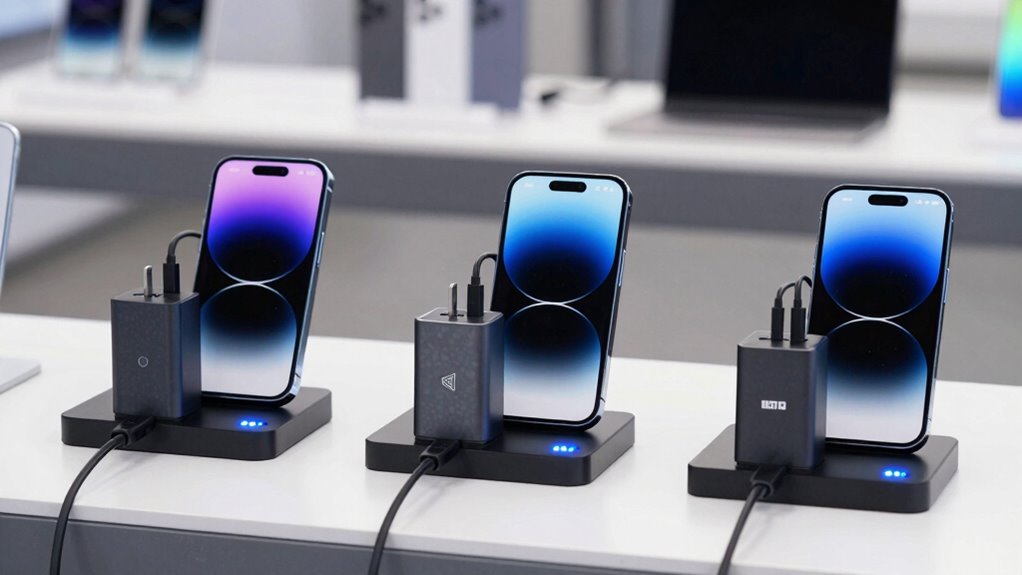

To compare fast charging claims across power brands, start by checking the wattage and industry standards like USB Power Delivery or Qualcomm Quick Charge, as higher wattage usually means faster charging, but real-world results matter more. Look for reviews and verified performance data to see if what’s advertised aligns with actual use. Consider build quality and safety features, and see if the brand emphasizes long-term battery health. Keep exploring to discover more tips for making the best choice.

Get backup power and energy gear delivered free with Prime
- Fast, free delivery on millions of items
- Prime Video, Amazon Music and more included
- Member-only deals all year
Key Takeaways
- Verify the chargers support industry standards like USB Power Delivery or Qualcomm Quick Charge for compatibility and safety.
- Compare real-world charging times from reviews rather than marketing claims to gauge actual performance.
- Check the wattage output; higher wattage generally indicates faster charging, but ensure device compatibility.
- Assess build quality and user feedback to ensure long-term performance and minimal heat issues.
- Confirm that smart charging features and temperature controls are included to protect battery health during fast charging.

When evaluating fast charging claims, understanding that not all chargers labeled as “fast” deliver the same performance is essential. Many brands advertise quick charging features, but the actual results can vary markedly based on several factors. One key aspect to evaluate is the charging technology used, such as whether the device supports wireless charging or relies on wired connections. Wireless charging offers convenience, but it often charges more slowly than wired fast chargers, making it vital to check the specific wattage and compatibility. If a brand claims to support rapid wireless charging, verify the actual wattage output—higher wattage generally means faster charging, but it can also generate more heat, potentially affecting your device’s battery health over time. Additionally, understanding charging efficiency can help you determine which charger maximizes power transfer while minimizing energy loss. The efficiency of the charging process can also be influenced by the device’s internal management systems, which vary by manufacturer. This highlights the importance of considering battery management systems when comparing different fast chargers.
Battery longevity is another critical factor in comparing fast charging claims. While rapid charging can save time, it may also contribute to faster battery wear if not managed properly. Some brands might tout their fast charging capabilities without addressing how their technology impacts long-term battery health. Look for chargers that incorporate smart charging features, which optimize power delivery based on your device’s needs. These features help prevent overheating and reduce the stress on your battery, ultimately extending its lifespan. If a charger’s specifications highlight adaptive charging or temperature control, it’s a good sign that the brand prioritizes battery longevity alongside charging speed. Moreover, choosing chargers that support industry standards can ensure compatibility and safety with a wider range of devices.
It’s also wise to examine the standards and certifications behind the fast charging technology. Reputable brands often adhere to industry standards like USB Power Delivery (USB-PD) or Qualcomm Quick Charge, which guarantee safe and reliable fast charging. Chargers that meet these standards tend to deliver consistent performance and minimize risks associated with overheating or overvoltage. Comparing the actual charging times listed in reviews or product specifications can give you a better sense of real-world performance rather than relying solely on marketing claims. Additionally, standardized protocols facilitate interoperability, making it easier to switch between different chargers and devices without compatibility issues.
Lastly, consider the overall build quality and user feedback. A well-designed charger with quality components is less likely to malfunction or cause harm to your device. User reviews often reveal how well a charger performs over time and whether it maintains its advertised speeds without compromising your device’s battery health. By focusing on these factors—wireless charging capabilities, impact on battery longevity, industry standards, and real-world reviews—you can make an informed comparison of fast charging claims across different power brands and choose a charger that aligns with your needs for speed, safety, and device care.
As an affiliate, we earn on qualifying purchases.
Frequently Asked Questions
Do All Fast Chargers Work With Every Device?
Not all fast chargers work with every device. Your device’s wireless charging compatibility and charging station compatibility matter. Check if your device supports fast charging standards like Qualcomm Quick Charge or USB Power Delivery. Some chargers are universal, but others might only work with specific brands or models. Always verify the charger’s specifications and your device’s compatibility to guarantee efficient and safe charging.
How Does Charging Speed Vary With Different Battery Sizes?
Think of your device’s battery as a sprawling highway—larger capacities mean more lanes, but the traffic (charging speed) depends on the charger’s efficiency. Bigger batteries take longer to fill because they require more energy, and charging efficiency varies across devices. So, with a bigger battery, expect a slower charge rate, even with fast chargers. Smaller batteries fill up quicker, making charging times feel like a swift breeze.
Are Fast Charging Claims Consistent Across Regions?
Fast charging claims can vary across regions due to differing regulations and available charging infrastructure. You might find that in areas with strict safety standards, charging speeds are more conservative, while regions with advanced infrastructure support faster claims. Always check local regulations and the quality of charging infrastructure, as these factors influence the actual charging speeds you experience. Comparing brands within the same region gives you a better understanding of their true charging capabilities.
What Safety Considerations Exist With Fast Chargers?
You might think fast chargers are perfectly safe, but don’t be fooled—safety protocols are essential. They include thermal management systems that prevent overheating, which can cause fires or damage your device. Always guarantee chargers meet safety standards, use recommended cables, and avoid overuse. Ironically, rushing your charge might put your device at risk, so patience and proper safety measures keep your tech safe and reliable during rapid charging.
How Do Real-World Results Compare to Manufacturer Claims?
You’ll find that real-world fast charging results often differ from manufacturer claims, mainly due to factors like battery longevity and the charging infrastructure’s quality. While brands may promise rapid charging times, actual speeds depend on your vehicle’s battery health and the availability of compatible chargers. To get the best experience, consider user reviews and real-world testing data, which provide a clearer picture than manufacturer claims alone.
Qualcomm Quick Charge compatible charger
As an affiliate, we earn on qualifying purchases.
As an affiliate, we earn on qualifying purchases.
Conclusion
Think of comparing fast charging claims like choosing a race car. Not all cars reach the finish line at the same speed, even if they claim similar horsepower. By examining actual charging times, power levels, and real-world performance, you’re steering the track more wisely. So, don’t just chase the flashy numbers—look for the car that consistently delivers on its promises. That way, you’ll win the race for efficient, reliable charging every time.
As an affiliate, we earn on qualifying purchases.
As an affiliate, we earn on qualifying purchases.
Fall Picks
fall essentials
As an affiliate, we earn on qualifying purchases.