Wiring your solar panels in series increases voltage while keeping current steady, which is good for matching inverter requirements and boosting efficiency. Parallel wiring maintains voltage but boosts current, making it better for shading resilience and ease of maintenance. Your choice impacts system performance, battery health, and shading sensitivity. To maximize your setup’s effectiveness, understanding these differences helps you select the best wiring method—more details are available if you continue exploring.
Key Takeaways
- Series wiring increases voltage while keeping current constant, ideal for inverter matching and battery efficiency.
- Parallel wiring maintains voltage but boosts current, reducing shading effects and simplifying battery maintenance.
- Shading impacts series arrays more significantly, decreasing overall system performance; parallel wiring offers higher shading resilience.
- Series wiring requires well-balanced batteries to prevent damage, whereas parallel wiring allows easier maintenance and flexibility.
- Choice depends on energy needs, environmental factors, and shading conditions, optimizing system performance and longevity.

When designing a solar power system, understanding whether to wire your solar arrays in series or parallel is essential for maximum performance. Your choice directly influences voltage, current, and how effectively your system operates under various conditions. If you’re aiming for higher voltage to match your inverter’s requirements, wiring in series increases the voltage while keeping current the same. Conversely, wiring in parallel maintains voltage but boosts current, which can be beneficial if your inverter handles higher current inputs.
Wiring solar arrays in series increases voltage, while parallel wiring boosts current for optimal system performance.
One key aspect to consider with wiring configurations is how they impact battery maintenance over time. Series wiring tends to produce higher voltage output, which can be advantageous for charging batteries efficiently. However, it’s crucial to ensure all batteries are balanced and in good condition, as a weak or damaged battery can affect the entire string. Regular battery maintenance becomes vital in this setup to prevent issues like uneven charging or reduced lifespan. With parallel wiring, current increases but voltage stays consistent, making it easier to manage batteries individually. This setup simplifies maintenance since individual batteries are less affected by the condition of others, but you need to ensure your wiring can handle the higher current load safely.
Another critical factor to consider is the shading impact. Shading on a solar array can significantly reduce its output, especially in series wiring. When arrays are connected in series, shading on one panel can diminish the entire string’s performance because the current flow is limited by the weakest panel. This means even a small shadow can reduce overall system efficiency and impact energy production. In parallel wiring, shading on one panel has less effect on the entire system since each panel operates independently. This configuration can be more resilient in shaded environments, although it may require thicker wiring and possibly more complex system management.
Additionally, understanding the impact of shading on system efficiency is crucial when selecting wiring configurations, as it directly influences energy output and reliability. Ultimately, your choice hinges on your specific energy needs and environmental conditions. If your location experiences frequent shading or you want to minimize battery maintenance challenges, parallel wiring might be the better choice. If you need higher voltage for your inverter and can manage regular battery maintenance, series wiring could optimize your system’s performance. Keep in mind that both configurations come with trade-offs, and understanding how they influence battery health and shading impact will help you make an informed decision that maximizes your solar investment.

BougeRV 20 Feet 10AWG Solar Extension Cable with Female and Male Connector with Extra Pair of Connectors Solar Panel Adaptor Kit Tool (20FT Red + 20FT Black)
UPGRADE 2.0 SOLAR CABLE: Increase a free pair of separate solar connectors. One pair (1 piece black +…
As an affiliate, we earn on qualifying purchases.
As an affiliate, we earn on qualifying purchases.
Frequently Asked Questions
How Does Wiring Affect Solar Panel Shading Effects?
Wiring affects shading mitigation and wiring efficiency by determining how shading impacts your solar system. When panels are wired in series, shading on one panel can reduce overall output because the current flows through all panels, amplifying shading effects. In contrast, parallel wiring minimizes shading impact since each panel operates independently, maintaining efficiency even if some are shaded. Proper wiring choices help maximize your system’s performance and reduce shading losses.
Can Different Types of Solar Panels Be Mixed in Series or Parallel?
Imagine connecting different types of solar panels like fitting puzzle pieces together. You can wire mixed panels in series or parallel, but you must consider panel compatibility and wiring standards. Series wiring requires matching voltages to prevent damage, while parallel wiring needs compatible current ratings. Carefully check each panel’s specifications to guarantee safe, efficient operation, making your solar setup both functional and reliable without risking electrical issues.
What Are the Safety Considerations for High-Voltage Wiring?
When working with high-voltage wiring, you need to prioritize safety by ensuring proper grounding requirements and overcurrent protection. Always double-check that your system is correctly grounded to prevent shocks or fires. Use appropriate overcurrent protection devices to avoid overloads. Never work on energized circuits, and wear insulated gloves and tools. Regularly inspect wiring for damage, and follow local electrical codes to keep yourself safe.
How Does Wiring Choice Impact System Troubleshooting?
When troubleshooting, your wiring choice creates a stark contrast: series wiring simplifies voltage balance but complicates current load issues, while parallel wiring makes current load adjustments easier but risks uneven voltage distribution. You’ll find that series setups require checking each panel’s voltage, whereas parallel systems demand monitoring current flow. Understanding this helps you quickly identify faults, ensuring safer and more efficient troubleshooting, whether in high-voltage or low-voltage scenarios.
Are There Environmental Factors Influencing Wiring Configuration Effectiveness?
Environmental factors notably influence wiring configuration effectiveness. High temperatures can cause wiring degradation over time, reducing efficiency, while exposure to moisture or harsh weather can increase corrosion risks. These conditions may necessitate choosing wiring setups that minimize stress, such as series wiring to limit exposure points. You should regularly inspect your system for environmental damage and consider protective measures, ensuring ideal performance regardless of environmental impact on your wiring.

Elnuimex 6 String Metal Solar Combiner Box, PV Combiner Box with 20A Rated Current Fuse, Surge Protective Device & 63A Air Circuit Breaker (6 String) (6 String)
【Reliable Protection】: Our solar combiner box is designed to keep safe your solar panels and inverters, ensuring their…
As an affiliate, we earn on qualifying purchases.
As an affiliate, we earn on qualifying purchases.
Conclusion
When choosing between wiring your solar arrays in series or parallel, think about your energy needs and system flexibility. Series wiring boosts voltage for efficient long-distance transmission, like a mighty river rushing to power your home. Parallel wiring offers redundancy and stable current, perfect for varied loads. Ultimately, selecting the right method can feel like harnessing the sun’s boundless power itself—an unstoppable force lighting up your world with every sunbeam.

SUMRY Hybrid Solar Inverter, 4000W DC 24V to AC 120V Pure Sine Wave Power Converter, Glass Top Cover with LCD Display, 140A MPPT Charge Controller, Supports Battery-Less or AGM Lithium Battery
Unique Glass Cover Design: Tempered glass upper cover with big 6.25 inch LCD display and touchable buttons, cool…
As an affiliate, we earn on qualifying purchases.
As an affiliate, we earn on qualifying purchases.
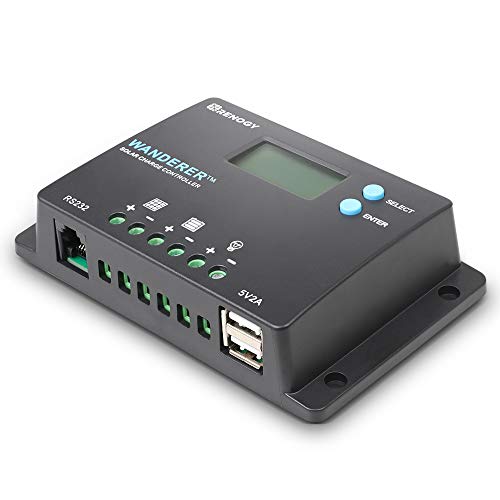
Renogy 10 Amp 12V/24V PWM Negative Ground Solar Charge Controller Compact Design w/LCD Display for AGM, Gel, Flooded and Lithium Battery, Wanderer 10A
𝐒𝐦𝐚𝐫𝐭 𝟒-𝐒𝐭𝐚𝐠𝐞 12V/24V Solar Charge Controller: Renogy charge controller 𝐦𝐚𝐱𝐢𝐦𝐢𝐳𝐞𝐬 𝐁𝐚𝐭𝐭𝐞𝐫𝐲 𝐋𝐢𝐟𝐞 & 𝐒𝐨𝐥𝐚𝐫 𝐄𝐟𝐟𝐢𝐜𝐢𝐞𝐧𝐜𝐲, this advanced pwm…
As an affiliate, we earn on qualifying purchases.
As an affiliate, we earn on qualifying purchases.