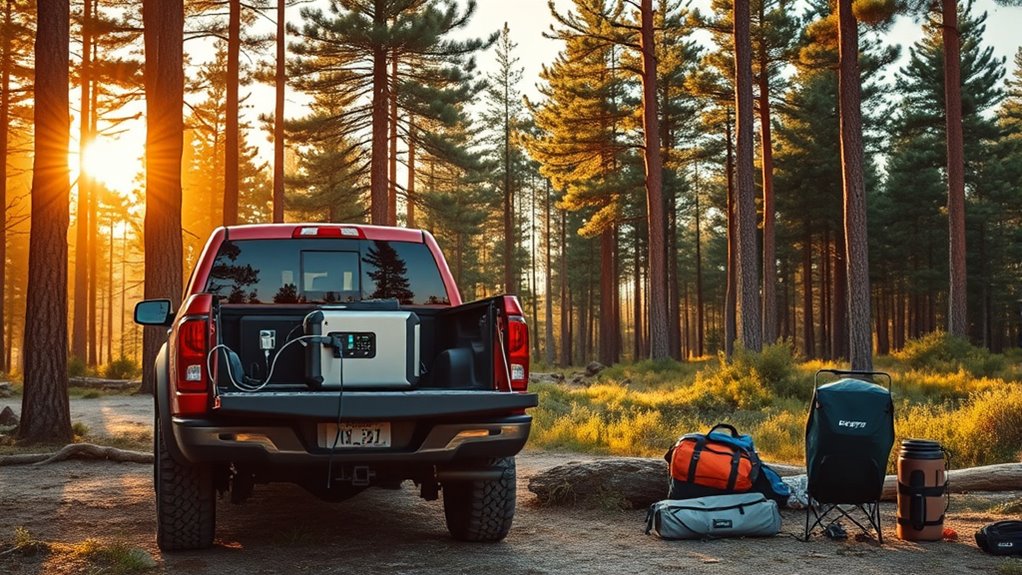

For truck camping, I’d put the Jackery Solar Generator 1000 V2 first for its practical balance of capacity, AC output, and included 200W panel. The BLUETTI AC180 is a strong alternative for campers who need more AC output, while the AFERIY expandable bundle stands out for vehicle charging flexibility. The main tradeoff is between a compact kit that is easy to stow and a larger system that can run more gear but takes up more space and needs more charging time. I compare all 15 options by capacity, output, charging setup, and truck-camping practicality below so you can match a bundle to your trip.

Get backup power and energy gear delivered free with Prime
- Fast, free delivery on millions of items
- Prime Video, Amazon Music and more included
- Member-only deals all year
Complete the kit


Key Takeaways
- The 1kWh class is the roundup’s practical middle ground: the Jackery 1000 V2, BLUETTI Elite 100 V2, and AFERIY base unit pair usable capacity with manageable size, though their charging bundles differ.
- High wattage and long runtime are separate buying decisions: the 3600W PowerMax and 3000W Jackery Explorer 2000 Plus suit bigger loads, while their size and storage demands make them less convenient for minimal truck setups.
- Included solar panels vary widely in usefulness: kits range from 40W and 60W panels to bundles with two 200W panels, so recharge speed depends heavily on the panel supplied and available sun.
- Small stations are better for electronics than camp appliances: the 192Wh and 288Wh options are easier to carry but leave less energy for repeated or high-draw use.
- The AFERIY bundle is the only listed pick with a named alternator charger: that vehicle-charging path may suit drive-heavy itineraries better than relying on solar alone.


| power station bundle for truck camping | Battery capacity | Weight |
|---|---|---|
| 1000W Portable Power Station 9 | 999Wh | 17 lb |
| Jackery Solar Generator 1000 V | 1070Wh | 23.8 lb |
| UDPOWER S2400 Portable Power S | 2083Wh | 41 lb |
| Portable Solar Generator 300W | 296Wh | — |
| PowerMax 3600SE 3600W Portable | 3600Wh | — |
| UDPOWER S1200 1190Wh Solar Gen | 1190Wh | — |
| 1000W Portable Power Station & | — | — |
| Jackery Solar Generator 300 wi | — | 7.5 lbs |
| DARAN 350W Portable Power Stat | — | 8.2 lbs |
| BLUETTI Solar Generator Elite | 1024Wh | — |
| AFERIY Expandable Portable Pow | 1024Wh, expandable to 5120Wh | — |
| Jackery Explorer 2000 Plus and | 2042.8Wh | 96.7 pounds |
| EBL 2400W Portable Power Stati | 1843.2Wh | 55 pounds |
| BLUETTI AC180 Solar Generator | 1152Wh | — |
| Portable Power Station 300W | 192Wh | 5.5 pounds |
More Details on Our Top Picks
1000W Portable Power Station 999Wh Solar Generator for Outdoor Emergency
For truck campers who want to run a modest camp setup without hauling a heavy, high-capacity unit, this model pairs a 999Wh battery with 1000W continuous output in a stated 17-pound package. That capacity can cover phones, lights, and smaller electronics, while its solar, AC, and car charging options suit trips where shore power is uncertain. Compared with the Jackery Solar Generator 1000 V2, it offers less output and capacity, but its listed weight is lower; the Jackery is the stronger choice for higher-wattage appliances and includes a solar panel in the bundle. The tradeoff here is a firm 1000W ceiling and no panel listed, so solar recharging requires a compatible panel. I’d choose it for restrained loads, not cooking appliances or other demanding gear.
Pros:- 999Wh capacity supports several small devices across a camping day.
- 1000W pure sine wave output suits sensitive electronics and modest AC loads.
- AC, car-port, and solar charging give flexibility between campsites and while traveling.
- USB-C PD and wireless charging offer convenient ways to power personal devices.
Cons:- The 1000W continuous limit rules out many high-draw appliances.
- At 17 pounds, it is heavier than a compact electronics-focused station.
- A solar panel is not specified as included, adding a separate compatibility decision.
Best for: Truck campers carrying phones, lights, and small electronics who want a sub-20-pound station and can keep appliance loads below 1000W.
Not ideal for: Campers who need to run high-wattage appliances or want a ready-to-recharge solar bundle; its output is limited and a compatible panel is not listed.
- Battery capacity:999Wh
- Continuous AC output:1000W
- AC voltage:120V
- AC outlets:2
- Battery type:Battery powered
- Weight:17 lb
- Charging options:AC, car port, and solar
- USB charging:USB-C PD and wireless charging
Our verdict“Choose this for a lighter, mid-size truck-camping setup built around electronics, but pick the Jackery 1000 V2 for more output and a listed solar panel bundle.”
Jackery Solar Generator 1000 V2 with 200W Solar Panel, 1070Wh, 1500W AC
The Jackery makes a strong case for truck campers who want a balanced station and a solar panel in the same bundle. Its 1070Wh LFP battery and 1500W AC output give it more room for appliances than the 999Wh, 1000W option, while the included 200W panel supports recharging away from hookups. Three AC outlets and two USB-C ports also make it easier to serve multiple campers at once. Compared with the larger UDPOWER S2400, this Jackery is much lighter at 23.8 pounds, but its capacity is roughly half, making it less suited to multi-day high-demand use. Fast AC charging is an appealing turnaround option, though the fast-charge feature relies on the app, and the solar panel’s stated charging time is six hours. I’d favor it for a moderate-load setup where bundle completeness matters more than maximum capacity.
Pros:- 1070Wh LFP capacity and 1500W output cover more demanding loads than 1000W-class alternatives.
- The 200W solar panel is included, making the bundle more ready for off-grid recharging.
- Three AC outlets and two USB-C ports support several devices at camp.
- 23.8-pound weight is easier to move than the 41-pound UDPOWER S2400.
Cons:- Its capacity is limited for extended trips with sustained appliance use.
- The one-hour fast-charge mode requires app use for the stated optimal feature.
- The listed solar charging time is six hours, so sun conditions and energy use affect daily recovery.
Best for: Truck campers who want a roughly 1kWh LFP station with a bundled 200W solar panel, several AC outlets, and manageable carry weight.
Not ideal for: Campers powering several high-demand appliances over multiple days; the UDPOWER S2400 offers nearly twice the capacity, albeit at substantially greater weight.
- Battery capacity:1070Wh
- Battery type:LFP
- AC output:1500W
- Surge output:3000W
- Weight:23.8 lb
- AC outlets:3
- USB ports:2 USB-C and 1 USB-A
- Included solar panel:200W
- Stated solar charging time:6 hours
Our verdict“Pick the Jackery when you want an included solar panel and a portable, moderate-capacity station rather than the heavier, longer-running UDPOWER S2400.”
UDPOWER S2400 Portable Power Station with Solar Panel Option, 2083Wh LiFePO4, 2400W (Surge 3000W) UPS, 6 AC Outlets, Emergency & Camping Backup
When the truck is a base camp rather than just a place to sleep, the 2083Wh LiFePO4 battery and 2400W output give this UDPOWER more headroom than the Jackery 1000 V2. Six AC outlets and a broad mix of USB and DC ports help keep shared camp gear connected without relying on adapters. Its stated 1.3-hour full recharge is particularly useful between drives or at a powered site, and solar input supports up to 440W. The cost of that capacity is physical: 41 pounds is a meaningful lift in and out of a truck, and the product description identifies solar as an option rather than an included panel. Compared with the PowerMax 3600SE, this is a smaller, less powerful station, but easier to fit into a truck setup. I’d choose it for longer stays with substantial loads, not frequent hand-carrying.
Pros:- 2083Wh capacity provides substantially more stored energy than the Jackery 1000 V2.
- 2400W output and 3000W surge rating allow a wider range of appliance loads.
- Six AC outlets plus USB and DC ports help serve a shared camp setup.
- Fast stated AC recharge and solar input up to 440W offer flexible recovery options.
Cons:- At 41 pounds, it is awkward for frequent solo lifting or carry-in use.
- The solar panel is described as an option, not as an included bundle component.
- It is smaller in capacity and output than the 3600Wh PowerMax 3600SE for buyers with very high energy needs.
Best for: Truck campers staying off-grid for several days who need higher appliance capacity, multiple AC outlets, and LiFePO4 battery chemistry.
Not ideal for: Campers who regularly carry their station between the truck and camp or expect a solar panel in the box; it weighs 41 pounds and panel inclusion is not stated.
- Battery capacity:2083Wh
- Battery type:LiFePO4
- AC output:2400W
- Surge output:3000W
- AC outlets:6
- USB ports:2 USB-C and 4 USB-A
- Solar input support:Up to 440W
- Weight:41 lb
- Stated recharge time:1.3 hours from 0% to 100%
Our verdict“Choose the S2400 for multi-day truck camping that calls for more output than a 1kWh station, provided its 41-pound weight and separate solar-panel needs fit your setup.”
Portable Solar Generator 300W Power Station with 60W Foldable Solar Panel
This small kit suits truck campers whose power plan is mostly phones, a laptop, lights, and other low-draw devices. The station’s 296Wh capacity and 300W output keep it far below the Jackery 1000 V2 in runtime and appliance capability, but its 6.5-pound station is easier to stow and move around a crowded truck. The product title identifies a 60W foldable panel, while the supplied details also say the solar panel is not included in the main package; I would verify bundle contents before relying on it for solar charging. Even with a panel, modest capacity makes this a better fit for topping up devices than running camp appliances through the night. It also lists a full recharge time of three hours, though real solar recovery will depend on conditions. Choose it for portability, not extended power.
Pros:- The 6.5-pound station is substantially easier to stow and carry than the larger options.
- 296Wh capacity is suitable for phones, laptops, and small electronics.
- Multiple AC, USB, and DC outputs allow several types of device to connect.
- A foldable solar panel is identified in the product title for portable recharging.
Cons:- 300W output limits use with appliances that draw more power.
- 296Wh is modest for overnight or multi-day use beyond personal electronics.
- The details conflict on whether the 60W panel is included, so bundle contents need confirmation.
Best for: Solo truck campers and minimalist weekend travelers who need to recharge personal electronics and want a small station that is easy to pack.
Not ideal for: Campers running refrigerators, cooking appliances, or multiple devices over several days; its 296Wh capacity and 300W output are restrictive.
- Battery capacity:296Wh
- Maximum output:300W
- Station weight:6.5 lb
- Station dimensions:9 x 5.5 x 7.5 in
- Solar panel power:60W
- Solar panel weight:4 lb
- Output ports:2 AC, 2 USB-A, 1 USB-C, and 1 DC
- Stated full charge time:3 hours
- Warranty:12 months
Our verdict“Pick this compact kit for personal-device charging and easy packing, but choose the Jackery 1000 V2 or a larger station for appliance use and longer stays.”
PowerMax 3600SE 3600W Portable Power Station with 2x200W Solar Panels
For truck campers building a high-draw setup around a parked truck, the PowerMax stands apart with a 3600Wh LiFePO4 battery, 3600W continuous output, and two 200W solar panels. That is far more stored energy and power than the UDPOWER S2400, which can matter for running several appliances or stretching time between charging stops. The listed 14 output ports and UPS function also make it useful as a backup station beyond camping. The tradeoff is bulk: the product data gives no weight or dimensions, but a station with this capacity is a less natural choice for frequent lifting than the 23.8-pound Jackery 1000 V2. Its 2.4-hour recharge claim and 3000W combined AC-and-solar input are compelling, though truck campers should plan around cargo space and keep the solar panels positioned for sun. This is capability over portability.
Pros:- 3600Wh capacity offers more stored energy than the UDPOWER S2400.
- 3600W continuous output and 7200W surge support demanding loads.
- Two 200W solar panels are listed with the station for a 400W panel bundle.
- LiFePO4 chemistry, UPS function, and 14 output ports suit camp and backup use.
Cons:- The high-capacity design is less suited to frequent lifting, and product data omits its weight and dimensions.
- Its size may take up valuable truck-bed or cab storage space.
- The 25-year service-life figure is stated in the product data, but no operating conditions are provided.
Best for: Truck campers with room for a large station who need substantial stored energy, high continuous output, and bundled solar panels for appliance-heavy stays.
Not ideal for: Campers prioritizing easy lifting, compact storage, or a light-and-fast weekend kit; the high-capacity design is bulkier than the Jackery 1000 V2, and no weight is provided.
- Battery capacity:3600Wh
- Battery type:LiFePO4
- Continuous output:3600W
- Surge output:7200W
- Solar panels:2 x 200W
- Maximum combined AC and solar input:3000W
- Stated full recharge time:2.4 hours
- Output ports:14
- UPS function:Included
Our verdict“Choose the PowerMax if you want a large, solar-equipped station for demanding truck-camp loads and have room to transport it; choose the UDPOWER S2400 for a smaller capacity class.”
UDPOWER S1200 1190Wh Solar Generator Kit with 120W Panel, Portable Power Station for Home Backup, RV, Outdoor & Emergency Use
For truck campers who want more stored energy than a compact weekend unit can offer, the UDPOWER S1200’s 1190Wh LiFePO4 battery gives it a useful reserve for several small devices or intermittent higher-draw gear. Its capacity exceeds the BLUETTI Elite 100 V2’s 1024Wh, though the BLUETTI specifies a much stronger 1800W output and has clearer weight and size information. The S1200 includes five AC outlets and a broad mix of USB and DC ports, so several devices can stay connected at camp. Its 120W waterproof foldable panel can help replenish the battery outdoors, but it is a smaller solar input than the 200W panels supplied with the BLUETTI and the 1000W kit. I’d weigh its larger capacity against the missing weight details and the note that the panel and station ship separately.
Pros:- 1190Wh LiFePO4 battery provides more stored energy than the BLUETTI Elite 100 V2.
- Five AC outlets plus USB-C, USB-A, car, and DC5521 ports accommodate a varied camp setup.
- Foldable IP65 waterproof 120W solar panel is suited to outdoor charging.
- Listed transfer time under 0.01 seconds can support connected critical devices during a power interruption.
Cons:- Station weight is not specified, making truck-bed handling and packing harder to plan.
- The 120W panel offers less solar input than the 200W panels included with the BLUETTI Elite 100 V2 and 1000W kit.
- The panel and power station may ship separately, complicating bundle setup.
Best for: Truck campers planning multi-night stays who want close to 1.2kWh of battery capacity and several device connections.
Not ideal for: Buyers who need a clearly documented, easy-to-lift bundle or faster solar replenishment; the station’s weight is unspecified and its 120W panel is modest.
- Battery capacity:1190Wh
- Battery type:LiFePO4
- Peak power:1800W
- Solar panel:120W foldable, IP65 waterproof
- AC outlets:5
- USB ports:2 USB-C, 4 USB-A
- DC outputs:1 car port, 2 DC5521 ports
- Dimensions:18.7 x 31.5 x 0.59 inches
Our verdict“Choose the S1200 for its comparatively large battery and varied ports, but skip it if documented portability or stronger included solar input matters more.”
1000W Portable Power Station & 200W Foldable Solar Panel Generator Kit
This kit’s strongest truck-camping case is the included 200W foldable panel: it gives campers more solar input than the 120W panel bundled with the UDPOWER S1200, which may help when the truck is parked for the day. The listing describes a 1000W power station and a useful mix of AC, USB-C, USB-A, car, and DC outputs, plus a wireless charging pad for compatible phones. An LCD and built-in lighting add convenience around camp. The main limitation is that the battery’s watt-hour capacity and the unit’s weight are not provided, so I can’t judge how long it will run devices or how easily it fits in a truck. Compared with the compact Jackery 300, this is the more panel-focused kit, but its bulk and unspecified energy reserve make it harder to recommend for minimalist packing.
Pros:- Included 200W foldable panel provides more listed solar input than the UDPOWER S1200’s 120W panel.
- Output selection includes dual AC, 60W USB-C PD, USB-A, car, DC5525, and wireless charging.
- LCD shows battery, input, and output information.
- Built-in LED and SOS flash add utility for camp and emergency use.
Cons:- Watt-hour battery capacity is not listed, preventing a meaningful runtime estimate.
- Weight and dimensions are not provided, so truck-bed storage and handling are difficult to assess.
- Listed solar input is limited to 200W, and charging may slow in weak sunlight.
Best for: Truck campers who want a larger included solar panel, multiple ways to charge devices, and built-in camp or emergency lighting.
Not ideal for: Buyers who need to estimate runtime or plan around a known carrying weight; the battery capacity and product weight are not specified.
- Power station wattage:1000W
- Solar panel:200W foldable monocrystalline
- Solar panel coating:ETFE
- Energy conversion rate:23%
- AC outputs:2 x 100–120V
- USB-C output:PD, 60W
- Other outputs:QC 3.0 USB-A, 12V car socket, wireless charging pad, DC5525
- Recharging methods:AC wall, 12V car, solar
- Safety protections:Overcharge, over-discharge, overload, short circuit, overheating
Our verdict“Pick this kit when its included 200W panel and broad charging options matter most, but choose a model with documented watt-hours if runtime planning comes first.”
Jackery Solar Generator 300 with 40W Solar Panel
When truck-bed space is tight and the power plan is mostly phones, cameras, a laptop, or a drone, the 7.5-pound Jackery Explorer 300 is easier to justify than the much larger UDPOWER S1200 or BLUETTI Elite 100 V2. Its 292Wh capacity and 300W rated output suit small electronics, while the 100W USB-C PD port offers a direct charging option for compatible gear. The tradeoff is runtime: this is a compact electronics station, not a substitute for a high-capacity unit when you want to run demanding appliances or stretch power across several nights. The supplied 40W panel is also slower than the 200W panel in the BLUETTI bundle; the listed 7.5-hour solar charge time makes that gap concrete. I’d choose it for portability, not appliance power.
Pros:- At 7.5 pounds, it is easier to move and stow than the larger-capacity UDPOWER S1200 and BLUETTI Elite 100 V2.
- 100W USB-C PD port suits compatible laptops and other USB-C devices.
- Two AC outlets, two USB-A ports, and a 120W car port cover common small-device charging needs.
- Listed LiFePO4 battery life exceeds 4,000 charge cycles.
Cons:- 292Wh capacity and 300W rated output limit appliance use and extended runtimes.
- The included 40W panel is slower for solar replenishment than the BLUETTI Elite 100 V2’s 200W panel.
- Listed solar charging time with the included 40W panel is approximately 7.5 hours.
Best for: Solo truck campers and photographers who prioritize a light, compact station for charging small electronics.
Not ideal for: Campers running higher-draw appliances or seeking extended off-grid power; its 292Wh capacity and 300W rated output are limited for those jobs.
- Capacity:292Wh
- Weight:7.5 lbs
- AC outlets:2
- USB-C port:100W PD
- USB-A ports:2
- Car port:120W
- Peak surge:600W
- Charge cycles:Over 4,000
- Solar charging time:Approximately 7.5 hours with 40W panel
Our verdict“Choose the Jackery 300 when easy carrying and small-device charging outweigh the need for long runtimes or higher-wattage appliances.”
DARAN 350W Portable Power Station with 40W Solar Panel (600W Surge), 288Wh
The DARAN makes a practical middle ground for truck campers who want a small station with a solar panel in the box, rather than assembling a compact setup separately. Its 288Wh capacity is close to the Jackery Solar Generator 300’s 292Wh, while the DARAN lists 350W continuous AC output against the Jackery’s 300W rating. That modest output difference may broaden the small devices it can support, but neither unit is intended for high-demand appliances or long runtimes. The included 40W foldable panel offers a way to recharge away from shore power, though its limited wattage means solar recovery can take time. At 8.2 pounds, it is still portable for a truck camp, but it is heavier than the Jackery 300. I’d favor this kit when the included panel and extra AC output matter more than minimizing weight.
Pros:- Included 40W foldable panel makes it a more ready-to-use solar bundle than a station requiring a separately purchased panel.
- 350W continuous AC output is higher than the Jackery Solar Generator 300’s listed 300W rating.
- 288Wh LiFePO4 battery is rated for more than 3,000 cycles.
- At 8.2 pounds, it remains manageable for moving around a truck camp.
Cons:- The 40W panel provides limited solar input for replenishing the battery quickly.
- 288Wh capacity and 350W continuous output are not suited to larger appliances or extended high-draw use.
- It weighs more than the 7.5-pound Jackery Solar Generator 300 despite having a similar capacity.
Best for: Truck campers who want a compact LiFePO4 station and included 40W solar panel for lights, phones, and modest electronics.
Not ideal for: Buyers expecting to run high-draw appliances or quickly refill the battery from sunlight; the output is 350W and the included panel is only 40W.
- Capacity:288Wh
- Continuous AC output:350W
- Surge output:600W
- Battery type:LiFePO4
- Solar panel:40W foldable
- Weight:8.2 lbs
- Ports:2 AC, 1 USB-C PD, 2 USB-A, 1 12V cigar lighter
- Recharging methods:AC wall outlet, solar panel, 12V car socket
- Battery life cycles:3000+
Our verdict“Choose the DARAN if you want a small station with an included panel and slightly higher listed AC output than the Jackery 300, not if fast solar recovery is a priority.”
BLUETTI Solar Generator Elite 100 V2 with 200W Solar Panel Included, 1024Wh
For truck campers who want a substantial battery without stepping up to a much larger 2kWh-class setup, the BLUETTI Elite 100 V2 offers 1024Wh in a 25-pound, relatively compact unit, plus a 200W panel. Its 1800W rated output and 3600W surge give it a stronger appliance-power profile than the smaller Jackery 300 or DARAN, while its capacity is lower than the UDPOWER S1200’s 1190Wh. The listed 45-minute charge to 80% can help when AC power is available, and the LiFePO4 battery is rated for over 4,000 cycles. The tradeoff is that 25 pounds is still a substantial lift for frequent moves, and 1024Wh won’t support larger loads indefinitely. I’d choose this over the S1200 when documented size and output matter more than its extra battery capacity.
Pros:- 1800W rated output and 3600W surge support more demanding gear than the Jackery 300 or DARAN.
- Included 200W solar panel provides more listed panel wattage than the UDPOWER S1200’s 120W panel.
- 1024Wh LiFePO4 battery is rated for over 4,000 cycles.
- Documented 25-pound weight and compact dimensions make storage planning clearer than with products lacking weight data.
Cons:- At 25 pounds, it is heavier to move than the Jackery Solar Generator 300 or DARAN.
- Its 1024Wh capacity is lower than the UDPOWER S1200’s 1190Wh.
- A roughly 1kWh battery can still run short during extended use of higher-draw equipment.
Best for: Truck campers who need strong AC output, a roughly 1kWh battery, and an included 200W panel in a documented, compact enclosure.
Not ideal for: Campers who need the longest possible runtime or a lightweight station; it weighs 25 pounds and has less capacity than the UDPOWER S1200.
- Battery capacity:1024Wh
- Battery type:LiFePO4
- Surge power:3600W
- Charge time:45 minutes to 80%
- Item weight:25 lbs
- Dimensions:12.6 x 8.5 x 9.8 inches
- Cycle life:4000+ cycles
- Solar panel:200W included
Our verdict“Pick the Elite 100 V2 for its high output, included 200W panel, and clearly specified size, but choose the S1200 if battery capacity is the priority.”
AFERIY Expandable Portable Power Station, 1024Wh LiFePO4 Solar Generator + DC600 Alternator Charger
The standout for truck camping is the included 580W DC600 alternator charger: it gives you a much faster vehicle-charging path than relying on a standard 12V socket, handy when driving between campsites. Its 1024Wh starting capacity is smaller than the Jackery Explorer 2000 Plus, but the AFERIY can expand to 5120Wh if your trips later grow into longer off-grid stays. The 1800W output suits many everyday camp appliances, while 14 outlets help when several people need to charge devices at once. The tradeoff is that this bundle includes no solar panel, and the base capacity is modest for running high-draw equipment for long periods. I’d rank it ahead of solar-focused kits for drivers who can recharge on the road, but not for buyers who want a panel included.
Pros:- Included 580W alternator charger supports substantially faster vehicle charging than a typical cigarette-lighter connection.
- Expandable from 1024Wh to 5120Wh as power needs increase.
- 1800W AC output can handle many common camp appliances.
- 14 output ports allow several devices to run or charge at once.
Cons:- No solar panel is included, so solar charging requires a separate purchase.
- The 1024Wh base capacity is below the Jackery Explorer 2000 Plus and EBL 2400Wh-class setup.
- The listed product dimensions do not include a weight, making truck-bed handling harder to judge.
Best for: Truck campers who cover ground daily and want faster vehicle recharging, with the option to add capacity for longer trips.
Not ideal for: Campers who park for several days without driving or want a solar panel included; the base battery is 1024Wh and the bundle lists no panel.
- Battery capacity:1024Wh, expandable to 5120Wh
- Battery chemistry:LiFePO4
- AC output:1800W continuous, 3600W peak
- Included vehicle charger:DC600, 580W
- Output ports:14
- UPS transfer time:Under 10ms
- Dimensions:13.77 × 8.66 × 10.35 inches
Our verdict“Choose the AFERIY if driving is part of your recharge plan and you want a system that can grow beyond its 1024Wh starting capacity.”
Jackery Explorer 2000 Plus and 2 × 200W Solar Panels, 2042Wh, 3000W AC Output
This bundle is the strongest fit here for truck campers who need substantial power and want solar panels in the package. The 2042.8Wh battery and 3000W AC output give it more headroom than the BLUETTI AC180 for demanding appliances, while its two included 200W panels provide a ready-made way to recharge when camped. Jackery also allows substantial expansion, up to 24kWh when using compatible extra batteries and a second station, making it the most expandable system in this group. That scale comes with a practical penalty: the station alone weighs 96.7 pounds, so loading it into a truck or moving it around camp is not a casual task. Solar charging speed claims depend on using more panels than the two included here. I’d pick it for power-hungry, longer stays, not minimalist setups.
Pros:- 2042.8Wh capacity and 3000W AC output provide more appliance headroom than the BLUETTI AC180.
- Includes two 200W solar panels for campsite recharging.
- Expandable capacity can reach 24kWh with compatible additional equipment.
- LiFePO4 battery and stated five-year warranty support longer-term use.
Cons:- At 96.7 pounds, the station is heavy to load, unload, or reposition at camp.
- The included 400W of solar is less than the six 200W panels cited for the two-hour full-charge claim.
- The product information lists only two total power outlets, limiting simultaneous AC connections without additional power strips.
Best for: Truck campers with space for a heavy power station who run several demanding appliances and want included solar panels plus a major expansion path.
Not ideal for: Solo campers who prioritize easy lifting, compact storage, or a lightweight setup; the station weighs 96.7 pounds before considering the panels.
- Battery capacity:2042.8Wh
- AC output:3000W
- Included solar panels:2 × 200W
- Expandable capacity:Up to 24kWh with compatible configuration
- Battery chemistry:LiFePO4
- Weight:96.7 pounds
- Dimensions:18.6 × 14.1 × 14.7 inches
- Total outlets:2
Our verdict“Pick the Jackery Explorer 2000 Plus bundle when high output, included solar, and future expansion matter more than manageable weight.”
EBL 2400W Portable Power Station with 200W Solar Panel
The EBL’s case for truck camping is its combination of 1843.2Wh capacity, 2400W output, and 12-device charging. That gives it more AC power than the AFERIY and more listed capacity than the BLUETTI AC180, which can help when a camp setup includes a fridge, cooking gear, and several personal devices. Its included 200W panel offers a basic solar option, though the product information says the panel ships separately, so buyers should plan around separate delivery. The panel’s stated 200W rating also means slower replenishment than a larger array: the listing estimates six to 14 hours for a full charge at that input. At 55 pounds, this is a substantial item to handle, and no vehicle alternator charger or expansion system is specified. I’d favor it for device-heavy camps, not frequent solo packing and unloading.
Pros:- 1843.2Wh battery offers more stored energy than the BLUETTI AC180.
- 2400W output exceeds the AFERIY’s 1800W continuous rating.
- 12 output ports support a range of devices at the same time.
- A 200W solar panel is part of the bundle, with multiple connector types listed.
Cons:- The station weighs 55 pounds, making frequent loading and unloading strenuous.
- The included 200W panel is listed as shipping separately and may take six to 14 hours to recharge the station in suitable conditions.
- No alternator charger or expandable-battery option is specified.
Best for: Truck campers who need several AC and USB connections for a shared camp and can accommodate a 55-pound station.
Not ideal for: Campers who need fast solar recovery from a single panel, easy one-person handling, or a bundled alternator charger.
- Battery capacity:1843.2Wh
- AC output:2400W
- Battery chemistry:LiFePO4
- Included solar panel:200W, ships separately
- Total output ports:12
- AC outlets:4
- Weight:55 pounds
- Dimensions:15 × 21 × 15 inches
Our verdict“Choose the EBL if your truck camp has many devices to power and you can manage its weight and slower single-panel recharging.”
BLUETTI AC180 Solar Generator with 200W Solar Panel Included, 1152Wh, 1800W
The AC180 lands between the compact 1kWh-class stations and the heavier, higher-capacity Jackery Explorer 2000 Plus. Its 1152Wh capacity and 1800W AC output cover a practical range of truck-camping needs without pushing into the Jackery’s 96.7-pound class. The included 200W solar panel makes this a more complete solar bundle than the AFERIY, which instead stands out for its vehicle alternator charger. BLUETTI lists rapid AC charging and 11 outlets, useful when you need to top up between trips and connect multiple camp devices. The limits are capacity and solar input: 1152Wh is not much reserve for sustained high-draw appliances, and the included panel is smaller than the Jackery bundle’s combined 400W. Its 2700W lifting mode also depends on device compatibility and is not the same as continuous output.
Pros:- Includes a 200W solar panel, unlike the AFERIY bundle.
- 1800W continuous AC output supports many common camp appliances.
- 11 outlets provide flexible connections for camp electronics.
- Fast AC charging can reduce downtime when a wall outlet is available.
Cons:- 1152Wh capacity is well below the Jackery Explorer 2000 Plus and EBL.
- The included 200W panel offers less solar input than the Jackery bundle’s two 200W panels.
- 2700W lifting mode is not a substitute for 2700W continuous output.
Best for: Truck campers seeking a reasonably balanced station-and-panel kit for phones, lights, laptops, and moderate appliance use.
Not ideal for: Campers running high-wattage appliances for long stretches or wanting rapid solar replenishment from a larger included panel array.
- Battery capacity:1152Wh
- Battery chemistry:LiFePO4
- AC output:1800W continuous
- Power lifting mode:Up to 2700W
- Included solar panel:200W
- Total outlets:11
- UPS transfer time:20ms
Our verdict“The BLUETTI AC180 is a sensible middle-ground pick for campers who want a panel included and do not need the larger reserves of the Jackery or EBL.”
Portable Power Station 300W (600W Surge), 192Wh LiFePO4 Battery Solar Generator with Carry Bag
At 5.5 pounds and 192Wh, this is a small-device companion, not a substitute for the larger stations in this roundup. It makes sense in a truck cab or day bag for phones, a laptop, lights, and other modest loads; its 300W continuous output rules out most high-draw camp appliances. Compared with the BLUETTI AC180, it gives up nearly all-day energy reserves and serious AC capacity, but is far easier to carry and stow. The included backpack adds portability, while solar and car charging offer options for topping it up; however, a solar panel is not included. Two AC outlets are useful at this size, though the limited capacity means buyers will need to prioritize what stays connected. I’d choose it as a secondary power source for short outings, not as the main station for multi-day truck camping.
Pros:- At 5.5 pounds, it is much easier to carry than the BLUETTI AC180 or larger stations.
- LiFePO4 battery chemistry and built-in BMS protection are specified.
- Supports solar and car charging for flexible replenishment options.
- Includes a carry bag and offers two AC outlets plus USB and DC connections.
Cons:- 192Wh capacity is far below every larger station in this batch.
- 300W continuous output excludes many high-draw camping appliances.
- Solar panel is not included, so solar charging requires a separate accessory.
Best for: Solo truck campers who want lightweight backup for phones, lights, and other low-wattage essentials during short trips.
Not ideal for: Campers who need to run a fridge, cooking appliance, or multiple devices overnight; 192Wh capacity and 300W continuous output impose firm limits.
- Battery capacity:192Wh
- Battery chemistry:LiFePO4
- Continuous output:300W
- Surge output:600W
- Weight:5.5 pounds
- Dimensions:8.7 × 5.1 × 7.2 inches
- Charging time:3 hours to 80%
- Ports:2 × AC, 1 × DC5521, 1 × USB-C, 2 × USB-A
Our verdict“Buy this compact unit as a carryable backup for small electronics, but choose a larger station for appliance use or multi-day power.”

How We Picked
I ranked these bundles for truck-camping usefulness, not for maximum headline wattage alone. I weighed battery capacity and chemistry, AC output, included panel size, charging flexibility, portability, and whether the product details make its intended role clear. A bundle ranked higher when its station and charging gear formed a practical pairing for common camp needs, rather than leaving buyers to fill major gaps themselves.
The ranking also reflects tradeoffs: compact stations score well for easy storage but cannot match larger units for sustained loads, while high-capacity systems offer more headroom at the cost of bulk. I gave the AFERIY bundle credit for its listed alternator charger, and treated panel size as a meaningful distinction among solar kits. Several listings provide limited detail beyond capacity and output, so I avoid assuming features that are not specified; buyers should verify dimensions, charging times, and port details before choosing.
Factors to Consider When Choosing Power Station Bundle For Truck Camping
A truck-camping power setup has to fit the way you travel, not just the devices you own. I’d start by mapping your actual overnight loads and charging opportunities, then use the bundle details to judge whether the station can keep up without becoming awkward cargo.
Estimate Energy Use Across the Whole Trip
Battery capacity in watt-hours describes stored energy, not how many hours every device will run. Add up the watt-hours for lights, phones, a laptop, and any cooler or other appliance you plan to use, then include a buffer for conversion losses and changing conditions. A device’s rated watts alone can mislead: a high-draw appliance used briefly may consume less energy than a modest cooler running all night. Avoid choosing solely by the largest capacity you can fit, since unused capacity adds weight and takes up truck-bed space. If your trip includes several nights away from charging, prioritize usable capacity and a clear recharge plan together.
Match AC Output to Startup and Running Loads
The station’s continuous AC output limits what it can run at one time, while surge output covers only brief startup demand for some devices. Check both figures against the equipment labels, especially for appliances with motors or compressors. A large battery does not make a low-output station suitable for a high-wattage appliance. Also think about simultaneous use: charging a laptop while running a cooking appliance can exceed the output limit even when each device works on its own. If your camp setup relies mostly on USB and 12V gear, paying for very high AC output may add bulk without solving a real need.
Judge the Solar Bundle by Panel Wattage and Camp Conditions
The included panel is a starting point, not a promise of a particular daily recharge. Panel wattage, sun angle, shade, season, and cable placement all affect what reaches the station. A 40W or 60W panel may help top up a compact kit, but it is a different proposition from a bundle with one or two 200W panels. Truck campsites can be shaded, so think about whether you can place panels in direct sun while the vehicle stays parked nearby. Before buying, check that the panel connection and supported solar input work together; a larger panel cannot help if the station cannot accept its output.
Plan How You Will Recharge While Driving
Vehicle charging can reduce dependence on sunny weather, but not every bundle includes an alternator charger or the same vehicle-input setup. Check whether the charging accessory is included, sold separately, or absent from the listing, and confirm compatibility with your vehicle and station. A standard vehicle outlet may recharge much more slowly than a purpose-built alternator system, so do not assume a few hours of driving will refill a large battery. Driving also has to fit your itinerary; a remote stay without engine time needs enough stored energy or solar input. Keep charging cables secure and follow the accessory’s installation instructions rather than improvising a permanent vehicle connection.
Balance Battery Size Against Storage and Handling
In a truck, the power station competes with sleeping gear, food, recovery equipment, and other cargo. Compare dimensions and weight—not just capacity—and decide where the unit can sit while charging and operating. A compact 192Wh or 288Wh model can be easier to move and stow, but it is not a substitute for a larger station when several devices need power overnight. Larger systems may be the better fit for fixed bed platforms or longer stays, while frequent pack-in and pack-out favors manageable size. Leave room for airflow and keep the station protected from weather; portability does not mean it should be exposed to rain or loose cargo.
Pay for Expandability Only If Your Plans Need It
Expandable capacity can make sense if your power needs are likely to grow, such as adding longer trips or more equipment later. But expansion brings additional cost, storage demands, and charging decisions, and the base station still needs to meet your immediate output needs. Check whether expansion batteries and charging accessories are compatible and available for the exact model. For a few nights of phone, lighting, and laptop use, a simpler self-contained kit may be easier to manage. Choose a larger or expandable system when you can name the loads and trip pattern that justify it, not just because future capacity sounds reassuring.
Frequently Asked Questions
Is a 1kWh power station enough for a weekend of truck camping?
It can be enough for phones, lights, a laptop, and modest intermittent use, but the answer depends on your appliances and whether you can recharge during the trip. A continuously running cooler or high-draw cooking device can use energy much faster than occasional electronics charging. Estimate daily watt-hour use from device labels and expected hours, then compare that total with the station’s capacity while allowing for conversion losses. Solar or vehicle charging can extend a 1kWh setup, but only when the bundle and trip conditions support it. If you expect several cloudy, stationary days, consider a larger battery or a more reliable charging plan.
Can I run a 12V fridge from a power station overnight?
Often, but check the fridge’s input requirements, startup behavior, and average energy use rather than judging by its peak wattage alone. Confirm that the station has a compatible 12V output and that its capacity can cover the fridge plus your other overnight loads. Temperature settings, ambient heat, ventilation, and how often the lid opens can change consumption. A larger station may offer more runtime, but a compact model could still work for a short night if the fridge draws little energy. For a multi-night stay, plan a way to replace the energy the fridge uses.
Are the included solar panels enough to recharge a power station each day?
Not automatically; included panel wattage sets only part of the picture. Shade, weather, season, panel angle, and the station’s solar input limit all affect charging, and real-world output can fall below the panel’s rated figure. A smaller panel is more useful for topping up light daily use than for restoring a large battery after heavy consumption. If your campsite is shaded or your route depends on reliable daily power, plan for vehicle charging, a larger compatible panel, or reduced energy use. Check charging compatibility and input limits before adding panels to a bundle.
Should I choose a station with an alternator charger or rely on solar?
It depends on how your itinerary creates charging time. A named alternator charger, like the one listed with the AFERIY bundle, can suit trips with regular driving and limited exposure to sun, while solar may be preferable during long parked stays with open sunlight. Neither method is guaranteed to refill a large station quickly; charging speed depends on the charger, station input limits, and conditions. Some campers benefit from using both, but that adds equipment and setup requirements. Verify exactly what is included and compatible before treating either charging method as part of your plan.
How much AC output do I need for truck-camping equipment?
Start with the highest wattage device you expect to run, then check its startup demand and whether you will operate other AC devices at the same time. The station’s continuous output must handle the combined running load; a surge figure generally covers only a short spike. Many electronics and lights can use USB or 12V outputs, which may avoid unnecessary AC conversion. If your needs are limited to those devices, a high-output unit can add weight without a useful benefit. For appliances, compare their labels with the station’s continuous and surge ratings before packing for a trip.
Conclusion
For most truck campers, I’d start with the Jackery Solar Generator 1000 V2 as the best overall balance of capacity, output, and a useful included panel. The best value depends on your load: the UDPOWER S1200 is a sensible middle-capacity kit, while the compact Jackery Solar Generator 300 suits electronics-first trips where low bulk matters more than long runtime. For a best premium choice with more capacity and output headroom, look at the Jackery Explorer 2000 Plus or PowerMax 3600SE, accepting the storage demands that come with a larger system. The best pick for beginners is a straightforward, self-contained bundle such as the BLUETTI Elite 100 V2; the AFERIY bundle is the more specific choice for campers who want the listed alternator charger and future expansion. Match the station to your actual devices and charging opportunities before deciding between extra capacity and easier packing.