

The best battery backup for a boat depends on whether you need reserve power for essential electronics, a trolling motor, or portable devices. My best overall pick is the ECO-WORTHY 12V 100Ah LiFePO4, which pairs useful capacity with Bluetooth monitoring and low-temperature protection. For longer runtimes, the WattCycle 314Ah Mini offers far more stored energy, while the Jackery Explorer 300 is a simpler choice for portable, low-draw devices. The main tradeoffs are capacity, weight, charging compatibility, and how much installation a battery requires. Read on for the full breakdown and guidance on matching a backup to your boat and your loads.

Get backup power and energy gear delivered free with Prime
- Fast, free delivery on millions of items
- Prime Video, Amazon Music and more included
- Member-only deals all year
Key Takeaways
- The ECO-WORTHY 100Ah LiFePO4 is the strongest all-around fit: it combines a familiar Group 24 format with Bluetooth monitoring and low-temperature protection, features absent from the compact ExpertPower lead-acid pick.
- Capacity varies sharply across the lineup: the WattCycle 314Ah and DUMFUME 300Ah are aimed at extended use, while the 33Ah ExpertPower and 292Wh Jackery suit smaller, lower-draw backup tasks.
- Most of the lineup is built around 12V boat systems: the Jackery is a portable power station, so it serves device charging and other portable loads rather than acting as a direct replacement for a 12V house battery.
- Battery monitoring and cold-weather features distinguish some 100Ah options: ECO-WORTHY and HumsiENK list Bluetooth, while ECO-WORTHY also lists low-temperature protection; buyers should check the other models’ documentation for comparable functions.
- High capacity brings fit and system questions: the metal-case ECO-WORTHY EnergyRock and large WattCycle and DUMFUME batteries may suit longer outings, but boaters need to verify dimensions, mounting, charging, and load compatibility before choosing them.


| battery backup for boat | Capacity | Voltage | Weight | Dimensions |
|---|---|---|---|---|
| ExpertPower EXP33-12V 33Ah SLA | 33Ah | 12V | 21.6 lb | 7.68 × 5.12 × 6.10 in |
| ECO-WORTHY 12V 100Ah LiFePO4 L | 100Ah | 12.8V | 23.2 lb | 10.24 × 6.61 × 8.23 in |
| ECO-WORTHY EnergyRock 12V 280A | 280Ah | 12V | — | — |
| POERUNI 12V 100Ah LiFePO4 Batt | 100Ah | 12V | 24 lb | 10.24 × 8.23 × 6.65 in |
| HumsiENK 12V 100Ah LiFePO4 Bat | 100Ah | 12V | 19.7 lb | 10.2 × 6.6 × 8.2 in |
| WattCycle 12V 314Ah Mini LiFeP | 314Ah | 12V | 62.5 lb | 7.64 x 15.12 x 9.76 in |
| Jackery Explorer 300 Portable | 292Wh | — | 7.1 lb in supplied product information | — |
| DUMFUME 12.8V 300Ah LiFePO4 Ba | 300Ah | 12.8V | 57.28 lb | 15.16 x 7.6 x 9.84 in |
| 12V 100Ah LiFePO4 Battery | 100Ah | 12.8V | 21.6 lb | 6.49 x 10.24 x 8.98 in |
More Details on Our Top Picks
ExpertPower EXP33-12V 33Ah SLA AGM Battery
I’d choose the ExpertPower EXP33 for a boat that needs modest backup power for a security system, small electronics, or another standby load—not for long trolling-motor runs. Its 33Ah AGM capacity is far below the 100Ah options from ECO-WORTHY and HumsiENK, so runtime is the clear compromise. In return, it uses a familiar, maintenance-free, spill-proof lead-acid design and does not require a lithium-specific charging setup. At 21.6 pounds, it is also close in weight to the larger HumsiENK lithium battery, despite holding much less capacity. The listed 12-year float-service life suits equipment kept charged between outings, but that figure is not the same as a guarantee of 12 years in demanding cycling use. I’d skip it when the boat needs substantial daily energy or a lighter battery.
Pros:- Maintenance-free, spill-proof AGM construction suits enclosed or hard-to-reach installations.
- 33Ah capacity can cover modest standby and backup loads.
- M6 terminals and compact listed dimensions support straightforward installation where the fit matches.
- Designed life is listed as 12 years in float service.
Cons:- At 33Ah, it holds substantially less energy than the ECO-WORTHY and HumsiENK 100Ah batteries.
- Weighs 21.6 pounds, close to the lighter HumsiENK despite its much lower capacity.
- Warranty specifics are not provided in the supplied product information.
Best for: Boat owners seeking an AGM battery for a small standby circuit or backup electronics, with a compatible 12V lead-acid charging setup.
Not ideal for: Anglers running a trolling motor for extended periods or boaters powering several appliances, because 33Ah offers much less capacity than the 100Ah and 280Ah lithium options.
- Chemistry:Lead-acid AGM
- Voltage:12V
- Capacity:33Ah
- Terminal:M6
- Dimensions:7.68 × 5.12 × 6.10 in
- Weight:21.6 lb
- Designed life:12 years in float service
Our verdict“Choose the ExpertPower for modest, mostly standby boat loads if you prefer AGM simplicity over the greater capacity of the lithium picks.”
ECO-WORTHY 12V 100Ah LiFePO4 Lithium Battery with Bluetooth
The ECO-WORTHY stands out for boaters who want 100Ah of lithium capacity and a quick way to check battery status from a phone. Its Bluetooth app reports voltage, current, and capacity, which can make it easier to spot dwindling reserve before electronics go offline. Compared with the HumsiENK 100Ah, it offers the same stated capacity and a similar Group 24 fit, but weighs 23.2 pounds rather than 19.7. The ECO-WORTHY’s 100A BMS and low-temperature charging cutoff add useful protection, though the cutoff means charging must stop below the stated threshold. It supports up to four batteries in parallel or two in series, giving more expansion flexibility than the ExpertPower AGM. I’d check charger compatibility and available compartment space before replacing a boat’s existing battery.
Pros:- Bluetooth monitoring displays voltage, current, and capacity through an app.
- 100Ah capacity and 12.8V nominal voltage suit many 12V boat circuits.
- Built-in 100A BMS protects against several electrical and temperature faults.
- Low-temperature cutoff prevents charging below the stated cell-temperature threshold.
Cons:- At 23.2 pounds, it is heavier than the 19.7-pound HumsiENK 100Ah battery.
- Charging is cut off below 19.4°F, limiting cold-weather charging until the battery warms.
- A lithium-compatible charging setup may be needed when replacing an AGM or lead-acid battery.
Best for: Boat owners replacing a Group 24 battery who want 100Ah lithium capacity, app-based status checks, and the option to expand a battery bank.
Not ideal for: Buyers prioritizing the lightest 100Ah option, or those who need to charge below 19.4°F without a way to warm the battery.
- Chemistry:LiFePO4
- Voltage:12.8V
- Capacity:100Ah
- Energy:1,280Wh
- BMS:100A
- Weight:23.2 lb
- Dimensions:10.24 × 6.61 × 8.23 in
- Low-temperature charging cutoff:19.4°F (−7°C)
- Expansion support:Up to 4P2S
Our verdict“Pick this ECO-WORTHY when phone-based monitoring and expandable 100Ah lithium storage matter more than minimizing battery weight.”
ECO-WORTHY EnergyRock 12V 280Ah Metal Case LiFePO4 Battery
For a boat with sustained, heavier loads, the EnergyRock’s 280Ah capacity is a different class from the 100Ah ECO-WORTHY and POERUNI batteries. That reserve can better suit extended trips with multiple onboard systems, while its 200A BMS supports a higher-current setup than their listed 100A BMS designs. The metal case, safety switch, and Bluetooth monitoring make this the more feature-rich large-capacity pick in this group; the switch also gives owners a direct way to isolate the battery. Those benefits come with a larger, heavier installation and a need to configure charging appropriately: the supplied data calls for 14.6V charging, with 13.8V float voltage optional. I’d favor it over the smaller batteries when runtime is the priority, but not for a compact compartment or a minimal backup circuit.
Pros:- 280Ah capacity provides far more reserve than the 100Ah ECO-WORTHY and POERUNI batteries.
- 200A BMS supports a higher-current system than the listed 100A designs.
- Metal case and safety switch add physical protection and a direct isolation control.
- Bluetooth monitoring and low-temperature protection provide useful status and charging safeguards.
Cons:- A 280Ah battery and metal case can be harder to fit and handle than the smaller 100Ah options.
- Requires a LiFePO4-compatible charging setup configured around the specified voltage.
- The supplied details do not state dimensions or weight, so compartment fit and installation handling need confirmation.
Best for: Boat owners with space for a larger battery who need substantial reserve for multiple onboard loads or longer trips.
Not ideal for: Owners with a small battery compartment or a simple backup circuit that does not need 280Ah; its size, weight, and charging requirements may be excessive.
- Chemistry:LiFePO4
- Voltage:12V
- Capacity:280Ah
- Case material:Metal
- BMS:200A
- Charging voltage:14.6V
- Float voltage:13.8V (optional)
- Low-temperature protection:Yes
- Monitoring:Bluetooth
Our verdict“Choose the EnergyRock when your boat needs a large energy reserve and has room for a metal-cased battery and compatible charging system.”
POERUNI 12V 100Ah LiFePO4 Battery
The POERUNI is aimed at boaters who expect frequent deep cycling and want a stated longevity figure, with 15,000+ cycles at 80% depth of discharge. Its 100Ah capacity places it alongside the ECO-WORTHY and HumsiENK, but its listed differentiator is cycle-life performance rather than Bluetooth monitoring or the lighter 19.7-pound HumsiENK build. At 24 pounds, it is also the heaviest of those three 100Ah lithium picks. Built-in protection covers overcharge, over-discharge, current, short circuit, and temperature extremes, which suits a dedicated trolling-motor or house-battery role. A key installation limit is its prohibition on inverted mounting; check the boat’s tray orientation before choosing it. The cycle claim is attractive for regular use, but actual service life depends on operating and charging conditions.
Pros:- 100Ah capacity and 1,280Wh energy rating suit many 12V trolling-motor and boat loads.
- Listed for more than 15,000 cycles at 80% depth of discharge.
- Built-in BMS protection covers overcharge, over-discharge, overcurrent, short circuit, and temperature extremes.
- Operating temperature range is listed from −20°C to 60°C.
Cons:- Cannot be mounted in an inverted position, which can rule it out for some installations.
- At 24 pounds, it is heavier than the 19.7-pound HumsiENK 100Ah battery.
- No Bluetooth monitoring is listed, unlike the ECO-WORTHY and HumsiENK alternatives.
Best for: Frequent boaters seeking a 100Ah lithium battery for repeated deep-cycle use in a correctly oriented battery tray.
Not ideal for: Owners who need an inverted installation, Bluetooth status monitoring, or the lightest 100Ah option; the HumsiENK is lighter and includes Bluetooth.
- Chemistry:LiFePO4
- Voltage:12V
- Capacity:100Ah
- Energy:1,280Wh
- Weight:24 lb
- Dimensions:10.24 × 8.23 × 6.65 in
- Cycle life:15,000+ cycles at 80% depth of discharge
- Operating temperature:−20°C to 60°C
- Mounting restriction:Do not mount inverted
Our verdict“Choose the POERUNI for repeated deep-cycle boat use if its mounting orientation works and cycle-life claims matter more than lower weight or app monitoring.”
HumsiENK 12V 100Ah LiFePO4 Battery with Bluetooth
The HumsiENK makes the strongest case for a lightweight 100Ah replacement: at 19.7 pounds, it weighs less than the ECO-WORTHY and POERUNI 100Ah batteries while retaining the same stated 1,280Wh energy. Its Group 24–31 compatibility gives buyers several common battery-box sizes to check, and Bluetooth monitoring adds app-based visibility without stepping up to the much larger 280Ah EnergyRock. The 100A BMS includes automatic low-temperature shutdown, and the listed IP65 protection is useful where splash exposure is a concern, though it does not remove the need for suitable installation and connections. It requires an external charger, so I’d verify the boat’s charging equipment before replacing an existing battery. This is a more compact, lighter choice than the POERUNI, but offers less capacity than the EnergyRock.
Pros:- At 19.7 pounds, it is lighter than the ECO-WORTHY and POERUNI 100Ah alternatives.
- Bluetooth-enabled 100A BMS provides app-based monitoring.
- Group 24–31 compatibility may fit a range of common battery-box formats.
- IP65 protection and automatic low-temperature shutdown are listed.
Cons:- Requires an external charger, so existing boat charging equipment must be checked for compatibility.
- Its 100Ah capacity is far below the 280Ah EnergyRock for extended, high-demand trips.
- The supplied information does not specify the low-temperature shutdown threshold.
Best for: Boat owners replacing a Group 24–31 battery who want 100Ah lithium storage, lower carried weight, and app-based monitoring.
Not ideal for: Boaters who need a charger included, substantially more than 100Ah, or a battery with documented dimensions that match a nonstandard compartment.
- Chemistry:LiFePO4
- Voltage:12V
- Capacity:100Ah
- Energy:1,280Wh
- Weight:19.7 lb
- Dimensions:10.2 × 6.6 × 8.2 in
- BMS:100A smart BMS with Bluetooth
- Group-size compatibility:BCI Group 24–31
Our verdict“Pick the HumsiENK if you want a lighter, app-monitored 100Ah lithium upgrade and already have a compatible external charging setup.”
WattCycle 12V 314Ah Mini LiFePO4 Battery with 200A BMS, 4.01kWh, 6000+ Cycles
For a boat with sustained house loads, the WattCycle’s 314Ah capacity and 4.01kWh of stored energy offer much more reserve than the 100Ah batteries in this lineup. That can mean longer stretches running lights, electronics, and other compatible 12V equipment before recharging. Its 200A BMS and stated 6,000-plus cycle life suit repeat deep-cycle use, while the compact dimensions help with placement compared with a larger bank of smaller batteries. The DUMFUME 300Ah is a close-capacity alternative, but it lists an IP65 rating and low-temperature protection; those details are not provided for the WattCycle. At 62.5 pounds, this is not a light portable battery, and lithium installation, charger compatibility, and upfront cost all need planning. It is a storage battery, not a substitute for a starting battery.
Pros:- 314Ah and 4.01kWh provide substantially more reserve than the 100Ah options in this roundup.
- 200A built-in BMS supports protected battery operation.
- Rated for more than 6,000 cycles.
- Compact dimensions for its stated capacity.
Cons:- At 62.5 pounds, it is still cumbersome to move or install alone.
- Lithium chemistry calls for compatible charging equipment and careful installation.
- No waterproof rating or cold-weather cutoff details are supplied.
Best for: Boat owners running substantial 12V house loads who want a single high-capacity deep-cycle battery and can accommodate its weight and lithium charging requirements.
Not ideal for: Boaters who need a portable backup, an engine-starting battery, or clearly specified waterproof and low-temperature protection.
- Voltage:12V
- Capacity:314Ah
- Energy:4.01kWh
- BMS:200A
- Cycle life:6,000+ cycles
- Weight:62.5 lb
- Dimensions:7.64 x 15.12 x 9.76 in
- Cell type:Lithium-ion, LiFePO4
Our verdict“Choose the WattCycle when your boat needs high-capacity 12V house power and you can manage its weight, installation, and lithium charging needs.”
Jackery Explorer 300 Portable Power Station, 292Wh
The Jackery Explorer 300 is the most self-contained choice here: its 292Wh capacity, AC outlets, USB ports, and car port let you power small personal electronics without wiring a separate battery into the boat. Compared with the WattCycle and DUMFUME, it is far easier to carry and offers multiple output types, but its energy reserve is tiny beside their multi-kilowatt-hour capacities. That makes it a practical backup for phones, cameras, or a laptop—not a replacement for a marine house bank or power for heavy 12V loads. The product description lists LiFePO4 cells and over 4,000 charge cycles, though the supplied technical details also describe the cell type more generally as lithium-ion. Solar charging is optional, and the panel is not included; check that the unit’s output and charging setup match the devices you plan to use aboard.
Pros:- Integrated AC, USB-A, USB-C, and car-port outputs simplify powering small devices.
- Portable power-station format avoids installing a standalone battery bank.
- 300W rated output with a stated 600W peak surge.
- Solar charging is supported when paired with a compatible panel.
Cons:- 292Wh capacity is limited for boat systems or extended use.
- Solar panel is not included.
- Output and form factor are not a substitute for a dedicated marine deep-cycle battery.
Best for: Boaters who want a grab-and-go power station for phones, cameras, and other small electronics, especially when portability and built-in outlets matter more than long runtime.
Not ideal for: Anyone seeking a wired-in marine battery backup for bilge systems, a trolling motor, or extended 12V house loads; its 292Wh capacity is far below the large batteries here.
- Capacity:292Wh
- Peak output:600W
- AC outlets:2
- Ports:100W USB-C, 2 USB-A, 120W car port
- Battery cell type:LiFePO4 stated in description
- Cycle life:4,000+ cycles to 70% capacity, as stated
- Weight:7.1 lb in supplied product information
- Solar panel:Not included
Our verdict“Pick the Jackery for portable backup of small electronics, but choose a dedicated high-capacity battery such as the DUMFUME for sustained boat loads.”
DUMFUME 12.8V 300Ah LiFePO4 Battery with 200A BMS
The DUMFUME pairs near-4kWh capacity with marine-relevant protection details that are absent from the WattCycle listing: an IP65 rating and low-temperature cutoff. Its 300Ah capacity is slightly below WattCycle’s 314Ah, but the stated 15,000-cycle life at 60% depth of discharge and five-year warranty give this option a strong longevity case for a boat used regularly. The 200A BMS suits substantial deep-cycle loads, while its roughly 57-pound weight remains a serious installation consideration. This is explicitly a storage battery, not an engine-starting battery; keep starting duties on a suitable separate battery. The 100Ah models in the roundup are easier to place and may suit lighter loads, but they cannot match this battery’s reserve. Long-term storage also calls for a recharge about every six months, according to the product information.
Pros:- 300Ah and 3,840Wh provide substantial reserve for boat house loads.
- IP65 rating and low-temperature cutoff are useful marine-oriented protections.
- 200A BMS and stated 15,000-cycle life at 60% depth of discharge.
- Five-year warranty and stated 10-year lifespan.
Cons:- Nearly 58 pounds makes placement and installation demanding.
- Not suitable for engine starting.
- Requires periodic recharging during long-term storage.
Best for: Boat owners seeking a large deep-cycle house battery with stated water and cold-temperature protection for recurring marine use.
Not ideal for: Boaters who need engine cranking, a lightweight portable battery, or a smaller-capacity option for modest electronics loads.
- Voltage:12.8V
- Capacity:300Ah
- Energy capacity:3,840Wh
- BMS current:200A
- Cycle life:15,000 cycles at 60% depth of discharge
- Protection:IP65; low-temperature cutoff
- Weight:57.28 lb
- Dimensions:15.16 x 7.6 x 9.84 in
- Warranty:5 years
Our verdict“Choose the DUMFUME for a high-capacity marine house bank when its protection features matter more than reducing battery weight.”
12V 100Ah LiFePO4 Battery, Group 24 Deep Cycle RV/Trolling Motor Battery
This 100Ah battery is the more manageable route for a boat with moderate backup needs: at 21.6 pounds, it is much easier to handle than the 57- to 63-pound WattCycle and DUMFUME units. Its Group 24 format and M8 terminals may suit a straightforward replacement or a smaller dedicated electronics bank, and the stated expansion support allows a larger setup with compatible batteries. Unlike the Jackery Explorer 300, this is a standalone deep-cycle battery rather than a power station with AC outlets, so it belongs in a properly designed 12V system. The tradeoff is less reserve: 100Ah cannot provide the extended runtime of the 300Ah-class options. It is also not for engine starting, and charging below 32°F is disabled; a compatible lithium charger is recommended.
Pros:- At 21.6 pounds, it is easier to move and install than the high-capacity WattCycle and DUMFUME.
- 100Ah capacity suits smaller 12V deep-cycle systems.
- Supports expansion up to four in series and four in parallel, as stated.
- Built-in BMS and five-year warranty.
Cons:- Less capacity than the 300Ah-class batteries for extended boat loads.
- Not suitable for engine starting.
- Charging is disabled below 32°F, and compatible lithium charging equipment is recommended.
Best for: Owners of smaller boats or moderate-load 12V systems who need a lighter deep-cycle battery and may expand capacity later.
Not ideal for: Boaters needing long-duration high-load backup, engine cranking, or dependable charging in freezing conditions without temperature-managed charging arrangements.
- Voltage:12.8V
- Capacity:100Ah
- Weight:21.6 lb
- Dimensions:6.49 x 10.24 x 8.98 in
- Battery type:Lithium-ion, LiFePO4
- Terminal:M8
- Number of cells:4
- Resistance:40 milliohms
- Expansion:Up to 4 in series and 4 in parallel
Our verdict“Choose this battery for a smaller boat’s 12V deep-cycle needs when low weight matters more than the long reserve offered by the larger batteries.”
How We Picked
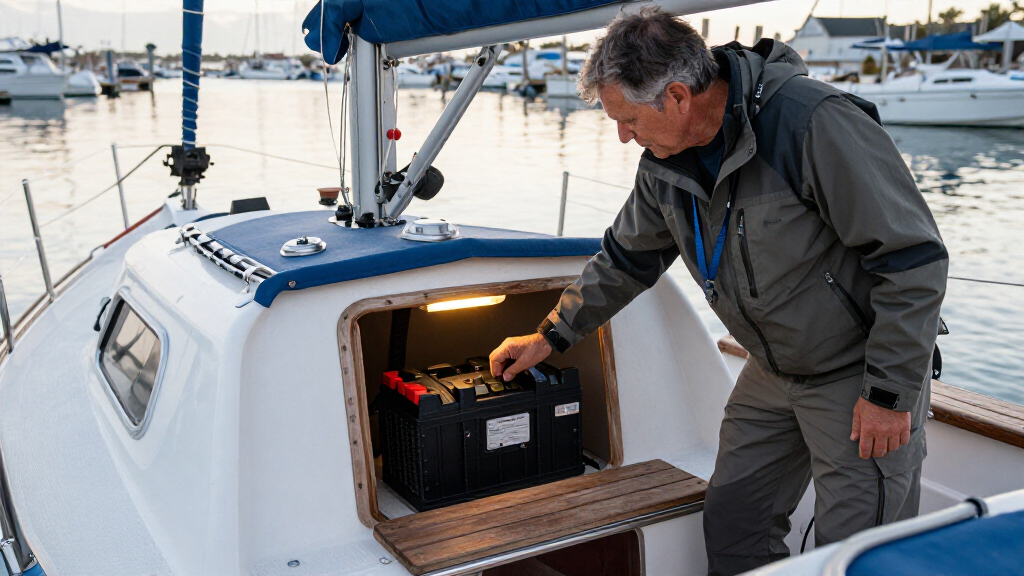
I ranked these options by how well their stated capacity, format, and features fit the different jobs boaters mean by battery backup: keeping essential electronics running, powering a trolling motor, or charging portable devices. I gave priority to practical onboard fit, usable capacity for the intended role, battery chemistry, built-in protection or monitoring, and the information supplied about the product. A 12V deep-cycle battery and a portable power station serve different needs, so I judged each against its own likely use rather than treating them as direct substitutes.
The order reflects the balance of versatility and tradeoffs, not capacity alone. The ECO-WORTHY 100Ah stands out as a broadly useful 12V lithium option with Bluetooth and low-temperature protection; the high-capacity WattCycle, DUMFUME, and EnergyRock models move up for buyers who need more stored energy, but they demand closer checks on installation and system fit. The ExpertPower offers a simpler lead-acid alternative, while the Jackery is best understood as portable device power. Where a listing does not specify a feature, I do not assume it is included.
| battery backup for boat | Chemistry |
|---|---|
| ExpertPower EXP33-12V 33Ah SLA | Lead-acid AGM |
| ECO-WORTHY 12V 100Ah LiFePO4 L | LiFePO4 |
| ECO-WORTHY EnergyRock 12V 280A | LiFePO4 |
| POERUNI 12V 100Ah LiFePO4 Batt | LiFePO4 |
| HumsiENK 12V 100Ah LiFePO4 Bat | LiFePO4 |
| WattCycle 12V 314Ah Mini LiFeP | — |
| Jackery Explorer 300 Portable | — |
| DUMFUME 12.8V 300Ah LiFePO4 Ba | — |
| 12V 100Ah LiFePO4 Battery | — |
Factors to Consider When Choosing Battery Backup For Boat
Before choosing a boat battery backup, I would start with the job it must do and the rest of the boat’s electrical system. The product names and capacity figures alone cannot tell you whether a battery will fit, recharge correctly, or support your actual loads. These checks can prevent buying more capacity than you can use—or a battery that does not suit your installation.
Size the battery around actual loads and runtime
List the devices you want powered, their draw in watts or amps, and how many hours you expect to use them between charges. Add the loads that may run at the same time, then allow for changes such as a longer trip or cloudy charging conditions. A large capacity figure does not promise a specific runtime because motor demand, device behavior, and battery limits all matter. For trolling motors, check the motor’s voltage and current needs against the battery’s specifications rather than estimating from amp-hours alone. A small backup dedicated to navigation or communications can be a better choice than asking one battery to serve every load.
Check voltage, chemistry, and charger compatibility
Match the battery voltage to the equipment and system it will power; a 12V battery is not a substitute for a different-voltage bank. Lithium iron phosphate and sealed lead-acid batteries have different charging requirements, so check the battery maker’s charging profile against the boat’s charger, alternator, and any solar controller. Do not assume that a charger suitable for lead-acid will correctly charge LiFePO4. If you plan to connect batteries in series or parallel, confirm that the manufacturer permits the configuration and follow its limits. A battery can have ample capacity and still be the wrong choice if the charging system is incompatible.
Measure the installation space and plan secure mounting
Measure the battery compartment’s length, width, height, and access path before ordering; a listed group size does not guarantee a perfect fit in every boat. Account for cable clearance, terminals, ventilation requirements, and room to inspect or remove the battery. Boats move and vibrate, so the battery needs a secure mounting arrangement suited to the vessel and the manufacturer’s instructions. Metal-case construction may appeal to buyers who want a more substantial enclosure, but it does not remove the need to verify dimensions and mounting points. A compact model is only useful if its terminals and cables can be safely reached.
Treat cold-weather protection and storage as separate checks
Boating in cold conditions raises a charging question as well as a storage question. Some lithium batteries list low-temperature protection, but buyers should read the documentation for the exact temperature limits and what the protection controls. Do not assume that a battery can be charged below freezing simply because it is marketed for marine or outdoor use. For seasonal storage, follow the manufacturer’s guidance on charge level, disconnection, and inspection; routines differ by chemistry and model. If the boat sits unused for long periods, accessible state-of-charge information can also help you spot a problem before the next outing.
Choose monitoring and protection for your setup
A built-in battery management system can help manage specified electrical limits and protective functions, but its presence does not replace correct wiring, fusing, or system design. Bluetooth monitoring can make it easier to check battery status without opening a compartment, though the app’s readings and alerts should be confirmed in the product documentation. Look for the continuous and peak current limits, supported temperature range, and any restrictions on motor use. Match those figures to the equipment’s startup and operating demands, not just its average draw. When specifications are unclear, ask the manufacturer before connecting the battery to a high-current load.
Decide whether you need a battery or portable power station
A 12V deep-cycle battery is designed to connect with a suitable boat electrical system, while a portable power station is a self-contained option for compatible devices and outlets. A power station can simplify charging phones or small electronics, but it may not replace a marine battery for a trolling motor or fixed 12V loads. Check its output type, continuous wattage, charging methods, and whether the devices you plan to plug in are supported. Also account for where it will be stored and protected from spray, moisture, and movement. Avoid choosing based on watt-hours alone: output limits and connection types can be just as important.
Frequently Asked Questions
Can I use a portable power station instead of a 12V boat battery?
Only if the power station’s outputs match the device and load you intend to run. The Jackery Explorer 300 is better suited to portable electronics and other compatible low-draw devices than to replacing a boat’s house battery or powering a trolling motor. Check its continuous output, connection type, and the load’s startup demand before use. A deep-cycle battery is usually the more direct option for equipment wired into a 12V system. You can carry both when portable device charging and onboard battery backup are separate needs.
Is a 100Ah battery enough for a boat trolling motor?
It may be, but amp-hours alone cannot answer that. Runtime depends on motor voltage, the current drawn at your typical speed, water and load conditions, and how long you operate it. Confirm the motor’s voltage and current requirements and compare them with the battery’s continuous and peak limits. Also check whether the battery maker approves the intended motor use. For long days or frequent high-throttle use, a larger-capacity model may make more sense, provided it fits and your charging setup can support it.
Can I charge a LiFePO4 boat battery with my existing marine charger?
Do not assume compatibility from the word “marine” on the charger. Check whether the charger has a LiFePO4 setting or a charging profile approved by the battery manufacturer, and review its voltage and current limits. The same check applies to an alternator and solar controller if they will charge the battery. Using an unsuitable profile can prevent proper charging or conflict with the battery’s operating limits. If the charger documentation is unclear, confirm compatibility with both manufacturers before connecting it.
Should I choose a larger-capacity battery or a smaller backup battery?
Choose based on the loads you need to cover, the trip length, and the space and charging capacity available on the boat. The 300Ah-class options in this roundup suit buyers seeking extended energy reserves, while a smaller battery can be more practical for backup electronics or a limited installation space. Extra capacity adds little benefit if your charging system cannot replenish it or the battery exceeds the compartment’s dimensions. Estimate normal and peak use separately, then include a reserve for delays. That process can reveal whether you need one larger battery or a separate backup for essential equipment.
Can I connect two 12V batteries to get more capacity or voltage?
Only if both battery manufacturers permit the planned series or parallel arrangement. Parallel connections can raise total capacity while keeping voltage the same; series connections raise voltage, which can damage equipment not designed for it. Batteries should be compatible in chemistry, model, age, capacity, and state of charge, and the wiring and protection need to suit the combined current. Follow the manufacturer’s limits for battery count and connection method rather than improvising. If the boat’s system or the instructions are unclear, have a qualified marine electrician review the design.
Conclusion
For most boaters seeking a versatile 12V lithium backup, I would start with the ECO-WORTHY 100Ah LiFePO4: its Group 24 format, Bluetooth monitoring, and low-temperature protection give it a useful balance of onboard practicality and stated features. For a value-minded, lower-capacity backup, the ExpertPower 33Ah SLA AGM is the simpler lead-acid choice, especially for modest loads, though it is not a like-for-like alternative to the lithium batteries for capacity. Buyers prioritizing extended runtime should compare the WattCycle 314Ah Mini and DUMFUME 300Ah against their available space, charging system, and load requirements; the metal-case ECO-WORTHY EnergyRock 280Ah is another high-capacity path. Beginners who want portable power for compatible electronics may find the Jackery Explorer 300 easier to handle, but should not treat it as a trolling-motor battery. For Bluetooth on a 100Ah format, the HumsiENK is another option to compare with ECO-WORTHY, while the POERUNI and the 100Ah Group 24 deep-cycle model may suit buyers whose priority is a straightforward 12V trolling-motor battery. My final choice would come only after checking fit, charger compatibility, and the battery’s current limits against the boat’s equipment.