For homeowners seeking solar panel kits for home use, my best overall pick is the SUNGOLDPOWER 5000W 48V Off-Grid Solar Kit, which brings panels, an inverter, and LiFePO4 storage together in a substantial system. The Renogy 400W Premium Solar Kit stands out for a smaller setup with an MPPT controller, while ECO-WORTHY’s 10 kW kit with 32.2 kWh of battery storage suits buyers who need more backup capacity. The main tradeoff is system scale: compact 12V kits are simpler for modest loads, while larger 48V and 10 kW packages can serve more demanding off-grid needs but call for more planning and installation expertise. Kit labels alone do not establish how much of a home’s energy use a system can cover; panel output, usable storage, and local conditions all matter. Read on for the full breakdown and a guide to matching a kit to your home.

Get backup power and energy gear delivered free with Prime
- Fast, free delivery on millions of items
- Prime Video, Amazon Music and more included
- Member-only deals all year
Key Takeaways
The lineup spans very different jobs. A 200W or 400W kit is a small-scale option, not a direct substitute for a 5 kW or 10 kW off-grid system.
Battery capacity changes the backup picture. The 10 kW kit with 32.2 kWh of storage is aimed at longer or heavier backup needs than the 16.1 kWh version, though actual runtime depends on loads.
Voltage and system scale go together. The 12V kits suit modest setups; 48V systems are more appropriate for higher-power installations and need compatible components.
Included components differ. Some options bundle batteries and inverters, while the 200W ECO-WORTHY kit centers on panels and a PWM controller, leaving more system decisions to the buyer.
Convenience and flexibility trade places. Complete kits reduce component-matching work, while panel-focused kits can be a better fit for buyers who already own compatible equipment.
| ECO-WORTHY 400W 12V Complete Solar Panel Kit with Lithium Batteries and 2000W Inverter | 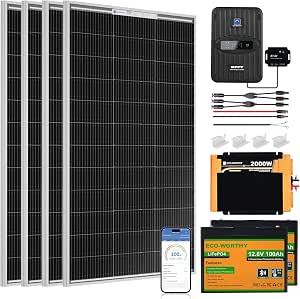 | Best Complete 12V Kit | Solar panel output: 400W total; four 100W panels | Battery capacity: Two 12V 100Ah lithium batteries | Charge controller: 40A MPPT | VIEW LATEST PRICE | See Our Full Breakdown |
| SUNGOLDPOWER 5000W 48V Off-Grid Solar Kit with Inverter, Panels, and LiFePO4 Battery |  | Best for Higher-Power Off-Grid Setups | Inverter power: 5000W | System voltage: 48V | Inverter output: 120V AC | VIEW LATEST PRICE | See Our Full Breakdown |
| ECO-WORTHY 1170W Solar Power System with 48V 50Ah Battery and 3500W Inverter |  | Best Panel Output in a Bundled 48V System | Solar panel output: 1170W total; six 195W panels | Solar cell type: N-type bifacial, 18 busbars | Panel conversion efficiency: 25% | VIEW LATEST PRICE | See Our Full Breakdown |
| ECO-WORTHY 200W 12V/24V Monocrystalline Solar Panel Kit with 30A PWM Charge Controller |  | Best Starter Kit for Small Off-Grid Loads | Panel output: 200W total; two 100W panels | Panel type: Monocrystalline | System voltage: 12V or 24V | VIEW LATEST PRICE | See Our Full Breakdown |
| Renogy 400W 12V Premium Solar Kit with 40A MPPT Charge Controller |  | Best 400W Kit for Buyers Adding Their Own Storage | Total panel output: 400W | Panel configuration: Four 100W panels | Output voltage: 12V | VIEW LATEST PRICE | See Our Full Breakdown |
| ECO-WORTHY 400W 12V Solar Panel Kit with MPPT Controller and Bluetooth |  | Best 12V Kit for Remote Monitoring | Total panel power: 400W | System voltage: 12V | Panels: 4 × 100W monocrystalline | VIEW LATEST PRICE | See Our Full Breakdown |
| ECO-WORTHY 10 kW Off-Grid Solar System Kit with 9.36 kWh Daily Output |  | Best Expandable 120/240V Starter System | System type: Off-grid solar system | Solar array: 2,340W; 12 × 195W N-type bifacial panels | Estimated daily output: 9.36 kWh under four hours of full sunlight | VIEW LATEST PRICE | See Our Full Breakdown |
| ECO-WORTHY 10 kW Off-Grid Solar Panel Kit with 16.1 kWh Battery |  | Best Middle Ground for Stored Energy | Total PV capacity: 2,950W | Panels: 5 × 590W monocrystalline | Estimated daily generation: Up to 11.8 kWh under optimal conditions | VIEW LATEST PRICE | See Our Full Breakdown |
| ECO-WORTHY 1200W Complete Solar Panel Kit with 48V 100Ah LiFePO4 Battery and 3500W Inverter |  | Best Complete Kit for Cabins and Sheds | Total system power: 1,200W | Panels: 6 × 195W N-type bifacial | Estimated daily output: Approximately 4.68 kWh | VIEW LATEST PRICE | See Our Full Breakdown |
| ECO-WORTHY 10 kW Off-Grid Solar Panel Kit with Split-Phase Inverter and 32.2 kWh Battery Storage |  | Best for Maximum Included Storage | Total PV capacity: 10,620W | Panels: 18 × 590W monocrystalline | Battery storage: 32.2 kWh total | VIEW LATEST PRICE | See Our Full Breakdown |
| ECO-WORTHY 400W 12V Solar Panel Kit with 100Ah Lithium Battery |  | Best Compact Complete Kit | Solar array: 400W total; four 100W monocrystalline panels | Daily output: Up to 1.6kWh under ideal conditions | Battery: 12V 100Ah lithium | VIEW LATEST PRICE | See Our Full Breakdown |
| ECO-WORTHY 10 kW Off-Grid Solar System Kit with Split-Phase Inverter, Batteries, and Solar Panels |  | Best for High-Demand Off-Grid Homes | Inverter output: 10,000W continuous; 20,000W peak | AC output: 120V/240V split-phase | Solar array: Nine 590W panels; 5,310W total | VIEW LATEST PRICE | See Our Full Breakdown |
| ECO-WORTHY 5 kW Off-Grid Solar System Kit with 2,340 W Panels |  | Best Mid-Range Off-Grid System | Solar array: 12 × 195W panels; 2,340W total | Panel type and efficiency: N-type monocrystalline; 25% efficiency | Inverter: 48V off-grid inverter; 5,000W | VIEW LATEST PRICE | See Our Full Breakdown |
More Details on Our Top Picks
ECO-WORTHY 400W 12V Complete Solar Panel Kit with Lithium Batteries and 2000W Inverter
I’d rank this as the most self-contained choice for a small off-grid home setup: it bundles 400W of panels, two lithium batteries, an MPPT controller, and a 2000W inverter, so the core power components are included. Its stated storage and pure sine wave output make it more capable of running household-style AC devices than the Renogy 400W kit, which includes panels and a controller but no battery or inverter. The tradeoff is that this remains a 12V system, with a 2000W inverter ceiling; it is not the best match for larger loads or an expandable whole-home system. The advertised daily output of up to 1.6 kWh also depends on ideal sunlight, so I’d treat that as a best-case estimate rather than a daily guarantee.
Pros:- Bundles panels, two lithium batteries, MPPT controller, inverter, and accessories.
- Two 12V 100Ah batteries provide included storage rather than requiring a separate battery purchase.
- Pure sine wave inverter supports AC devices rated under 2000W.
- Bluetooth module and MPPT controller support monitoring and efficient charging.
Cons:- The 12V architecture and 2000W inverter limit its fit for larger household loads.
- The stated daily output relies on ideal sunlight conditions.
- A complete bundle may be more equipment than buyers need if they already own batteries or an inverter.
Best for: Off-grid homeowners or cabin owners seeking one bundled 12V setup for modest AC loads and battery storage.
Not ideal for: Households planning to run high-demand appliances or build a larger 48V system; the inverter is limited to 2000W and the kit is designed around 12V.
- Solar panel output:400W total; four 100W panels
- Battery capacity:Two 12V 100Ah lithium batteries
- Charge controller:40A MPPT
- Inverter:12V, 2000W pure sine wave
- Estimated daily output:Up to 1.6 kWh under stated ideal conditions
- Solar cell type:12BB bifacial
- Panel dimensions:35.63 × 23.03 × 1.18 inches
- Connectors:MC4
Our verdict“Choose this kit if you want a bundled 12V off-grid setup with batteries and an inverter, but skip it for larger home loads.”
SUNGOLDPOWER 5000W 48V Off-Grid Solar Kit with Inverter, Panels, and LiFePO4 Battery
For a home-scale off-grid project among these picks, this kit’s distinguishing feature is its 5000W inverter and 48V platform. It pairs six 200W panels with a 51.2V 100Ah LiFePO4 battery, giving buyers a bundled starting point that is more suited to heavier AC loads than the ECO-WORTHY 400W 12V Complete Kit. The stated 4.8 kWh daily output, however, assumes four hours of full sunlight, and the included 1200W of panels is modest beside the inverter’s capacity. That leaves room to expand the PV array—up to the stated 5500W input—but expansion adds equipment and planning. I’d favor this over smaller kits when the goal is a more substantial 48V off-grid system, not a simple starter installation.
Pros:- 5000W inverter and 48V system support a larger off-grid setup than the 12V kits here.
- Includes a 51.2V 100Ah LiFePO4 battery and six 200W panels.
- PV input capacity is specified up to 5500W, allowing room for additional panels.
- Includes extension cables and Z-bracket mounts.
Cons:- The stated 4.8 kWh daily output depends on four hours of full sunlight.
- The included 1200W panel array is small relative to the 5000W inverter capacity.
- Its 48V off-grid design is not a straightforward fit for buyers seeking a small, simple 12V system.
Best for: Off-grid homeowners who need a 48V system, a higher-power inverter, and a kit they can expand with additional solar panels.
Not ideal for: Buyers seeking a compact, low-complexity starter kit or a system with substantial panel capacity already included; the six panels total 1200W.
- Inverter power:5000W
- System voltage:48V
- Inverter output:120V AC
- Solar panels:Six 200W monocrystalline panels
- Battery:51.2V 100Ah LiFePO4
- Maximum PV array:5500W, 500V
- Battery charging capability:Up to 100A
- Estimated daily output:Approximately 4.8 kWh with four hours of full sunlight
Our verdict“Pick this for a higher-power 48V off-grid project with room to add panels, not for a compact starter kit.”
ECO-WORTHY 1170W Solar Power System with 48V 50Ah Battery and 3500W Inverter
This kit puts more solar collection on the roof than the SUNGOLDPOWER 5000W kit: its six panels total 1170W, nearly matching that model’s 1200W array, while including a 48V battery, 3500W inverter, and 80A MPPT controller. The stated daily generation is about 4.68 kWh under four hours of full sunlight, but the battery stores 2560Wh of usable energy, so buyers should distinguish panel production from what can be stored at once. WiFi monitoring and 20ms UPS switching add practical control and backup functionality that the basic Renogy 400W kit lacks. The main compromise is storage capacity: this battery is smaller than the Sungoldpower battery by rated energy, despite the similar panel output. I’d choose it for a bundled 48V system where panel harvest and inverter features matter more than extended storage.
Pros:- Includes 1170W of bifacial panels, a 48V battery, inverter, and installation accessories.
- 3500W inverter includes WiFi monitoring, 80A MPPT charging, and UPS switching.
- Battery is specified for more than 4000 cycles.
- System can be connected in parallel with up to six units.
Cons:- The 2560Wh usable battery capacity may limit backup duration for larger loads.
- The stated daily generation assumes four hours of full sunlight.
- Battery charging is specified for temperatures of 32°F and above.
Best for: Off-grid homeowners seeking a bundled 48V system with a substantial panel array, WiFi monitoring, and UPS switching.
Not ideal for: Households that need long overnight backup or substantial stored energy; the included battery has 2560Wh of usable energy.
- Solar panel output:1170W total; six 195W panels
- Solar cell type:N-type bifacial, 18 busbars
- Panel conversion efficiency:25%
- Battery:48V 50Ah LiFePO4
- Usable battery energy:2560Wh
- Inverter:3500W output; 7000W surge
- MPPT controller:80A
- UPS switching time:20ms
Our verdict“Choose this bundled 48V option when you want a strong panel array and monitoring features, but prioritize a larger battery if overnight backup is the goal.”
ECO-WORTHY 200W 12V/24V Monocrystalline Solar Panel Kit with 30A PWM Charge Controller
I’d place this kit at the entry point for buyers who want panels and basic charging hardware, not a complete home power system. Its two 100W panels, 30A PWM controller, brackets, and cables provide a simpler starting package than the battery-and-inverter bundles from ECO-WORTHY and SUNGOLDPOWER. The 12V parallel or 24V series wiring options also make it more flexible than a fixed-voltage starter setup. That flexibility does not change its modest 200W panel capacity: the stated 800Wh daily output assumes four hours of full sunshine, and there is no battery or inverter included. Compared with the Renogy 400W kit, this is the smaller, lighter-duty choice, but its included mounting hardware and controller suit a small shed, cabin, or supplemental charging system.
Pros:- Two panels can be wired for either 12V or 24V systems.
- Includes a 30A PWM controller, mounting brackets, and cables.
- Aluminum alloy frames and IP65-rated junction boxes suit outdoor installation.
- The 200W array offers a simpler small-scale starting point than the 400W Renogy kit.
Cons:- No battery or inverter is included, so additional equipment is needed to store and use power.
- The stated 800Wh daily output depends on four hours of full sunshine.
- The 31.6-pound kit may be cumbersome for some mounting locations.
Best for: Owners of small cabins, sheds, or off-grid workspaces who need a basic panel-and-controller kit for a 12V or 24V battery system.
Not ideal for: Households expecting a ready-to-run home power system or meaningful appliance coverage; batteries and an inverter are not included, and panel output is 200W.
- Panel output:200W total; two 100W panels
- Panel type:Monocrystalline
- System voltage:12V or 24V
- Charge controller:30A PWM
- Maximum efficiency:21.5%
- Estimated daily output:800Wh under four hours of full sunshine
- Dimensions:35.2 × 23.1 × 1.3 inches per panel
- Weight:31.6 lbs
Our verdict“Choose this for a small 12V or 24V off-grid installation where you already have, or plan to add, a battery and inverter.”
Renogy 400W 12V Premium Solar Kit with 40A MPPT Charge Controller
Unlike the ECO-WORTHY 400W Complete Kit, this Renogy package concentrates on solar collection and charging rather than supplying a battery and inverter. Its four 100W monocrystalline panels and 40A MPPT controller suit buyers who already have a 12V battery bank or want to choose storage separately. The Bluetooth module adds phone-based monitoring, while the brackets, cables, and adaptor kit reduce the number of separate setup parts to source. That modular approach can be useful for an existing off-grid home, but it is not a ready-to-use power system: battery and inverter costs and compatibility are on the buyer. The panels’ listed 56.4-pound weight and 41.8-by-20.9-inch dimensions also call for a planned mounting area. Compared with the 200W ECO-WORTHY kit, it offers twice the panel output, but requires more roof space.
Pros:- Four 100W panels provide 400W of total solar output.
- 40A MPPT controller is included for battery charging.
- Bluetooth module supports phone-based monitoring and adjustment.
- Includes Z-brackets, cables, and an adaptor kit.
Cons:- Battery and inverter are not included, so it cannot provide stored or converted AC power on its own.
- The panels have a listed total weight of 56.4 pounds and need substantial installation space.
- Its 12V configuration is less suited to larger household systems than the 48V bundled kits.
Best for: Homeowners with an existing 12V battery and inverter who want to add 400W of solar charging with phone monitoring.
Not ideal for: Buyers who want a complete system with energy storage and AC power included, or who have limited space for four large panels.
- Total panel output:400W
- Panel configuration:Four 100W panels
- Output voltage:12V
- Maximum battery voltage:32V
- Charge controller:40A MPPT
- Panel material:Monocrystalline silicon
- Panel dimensions:41.8 × 20.9 × 1.38 inches
- Item weight:56.4 pounds
Our verdict“Pick this if you already have compatible 12V storage and want a 400W panel-and-controller package; choose a complete kit if you need batteries and an inverter.”
ECO-WORTHY 400W 12V Solar Panel Kit with MPPT Controller and Bluetooth
I’d place this kit among the more straightforward ways to add 400W of off-grid solar where a 12V system makes sense. Four 100W panels give buyers more placement flexibility than one large panel, and the 40A MPPT controller can track input and protect against overcharge and overdischarge. Its Bluetooth module adds local app monitoring, though the range tops out at 82 feet, so it is not a substitute for remote internet access. Compared with the ECO-WORTHY 1200W Complete Solar Panel Kit, this is a smaller panel-and-controller package rather than a full system with battery and inverter. That keeps the setup focused, but buyers must source those major components separately. I’d choose it for a modest 12V installation, not as a ready-to-power household backup.
Pros:- Four 100W panels provide 400W of rated solar capacity and flexible placement.
- 40A MPPT controller includes overcharge and overdischarge protection.
- Bluetooth monitoring provides local system visibility within a stated range of up to 82 feet.
- Bypass diodes and stated wind and snow load ratings support use in variable conditions.
Cons:- Battery and inverter are not included, so this is not a complete home backup kit.
- Daily energy production varies with sunlight and site conditions.
- Bluetooth monitoring is limited to a local range rather than internet-based access.
Best for: DIYers building a modest 12V off-grid setup who want four manageable panels and nearby phone monitoring.
Not ideal for: Homeowners seeking a complete system with battery and inverter, or buyers who need substantial household backup capacity.
- Total panel power:400W
- System voltage:12V
- Panels:4 × 100W monocrystalline
- Charge controller:40A MPPT
- Panel efficiency:21%
- Estimated daily generation:Average 1.6 kWh, depending on sunlight
- Bluetooth range:Up to 82 feet
- Included components:Fuse, Bluetooth module, and mounting Z brackets
Our verdict“Choose this kit for a small 12V off-grid array with local monitoring, but look elsewhere if you need storage and an inverter included.”
ECO-WORTHY 10 kW Off-Grid Solar System Kit with 9.36 kWh Daily Output
This kit pairs a 2,340W bifacial array with 10.24 kWh of lithium storage and a 10,000W inverter, making it a substantial off-grid package without the larger panel field and battery bank of the ECO-WORTHY 10 kW kit with 32.2 kWh storage. The inverter’s 120V/240V output and support for up to six units in parallel leave room for a system that may grow over time. The stated 9.36 kWh daily output assumes four hours of full sunlight, so I would treat it as a condition-specific estimate, not a guaranteed daily supply. App monitoring over Bluetooth or Wi-Fi and multiple charging modes add flexibility. The tradeoff is installation: this is a complex system for which professional installation is recommended, not a simple beginner kit.
Pros:- 10,000W continuous inverter supports 120V and 240V output.
- Includes two 48V 100Ah lithium batteries for 10.24 kWh total storage.
- Inverter supports parallel operation with up to six units.
- Bluetooth and Wi-Fi app monitoring and multiple charging modes add system flexibility.
Cons:- Professional installation is recommended for this high-capacity off-grid system.
- The 9.36 kWh daily figure depends on four hours of full sunlight and actual conditions may differ.
- Its 2,340W array and 10.24 kWh storage are smaller than the 10 kW kit with 32.2 kWh storage.
Best for: Off-grid property owners who want 120V and 240V output, included lithium storage, and the option to expand inverter capacity.
Not ideal for: First-time DIY installers or households that need a larger included battery reserve and a more extensive solar array.
- System type:Off-grid solar system
- Solar array:2,340W; 12 × 195W N-type bifacial panels
- Estimated daily output:9.36 kWh under four hours of full sunlight
- Battery storage:10.24 kWh total; 2 × 48V 100Ah lithium batteries
- Inverter output:10,000W continuous
- AC output:120V / 240V
- Parallel inverter support:Up to 6 units
- Battery monitoring:Mobile app via Bluetooth or Wi-Fi
Our verdict“Pick this package if you want an expandable 120/240V off-grid system with batteries included, provided you can arrange qualified installation.”
ECO-WORTHY 10 kW Off-Grid Solar Panel Kit with 16.1 kWh Battery
With 2,950W of panels and a 16.076 kWh LiFePO₄ battery, this kit occupies a useful middle ground between the ECO-WORTHY 10 kW system with 9.36 kWh daily output and the much larger 32.2 kWh-storage package. The battery capacity gives buyers more stored energy than the smaller system, while the 10,000W split-phase inverter can serve 120V or 120/240V loads. Five 590W panels keep the panel count relatively low, but each is large and heavy, so roof layout and handling need planning. The kit can generate up to 11.8 kWh under optimal conditions; actual production will vary. Battery expansion and multiple monitoring options add flexibility, though professional installation is recommended and pallet delivery requires a location that can receive a truck shipment.
Pros:- 16.076 kWh LiFePO₄ battery provides more storage than the 10.24 kWh system in this lineup.
- 10,000W inverter supports 120V or 120/240V split-phase output.
- Battery monitoring is available through a display, Bluetooth, Wi-Fi, and PC connectivity.
- Battery and inverter capacity can be expanded through parallel connections.
Cons:- Professional installation is recommended for the inverter, battery, and array.
- The 590W panels are large, at nearly 90 inches long and 72.8 lb each.
- Pallet freight delivery requires a suitable address and truck access.
Best for: Homeowners or cabin owners seeking a sizable off-grid battery reserve and split-phase output without choosing the largest storage package.
Not ideal for: Buyers with limited roof or handling capacity for large panels, or those unable to receive a truck-delivered pallet.
- Total PV capacity:2,950W
- Panels:5 × 590W monocrystalline
- Estimated daily generation:Up to 11.8 kWh under optimal conditions
- Inverter output:10,000W continuous; 20,000W peak
- Output voltage:120V or 120/240V split phase
- Battery:48V, 314Ah LiFePO₄
- Battery energy capacity:16.076 kWh
- Maximum parallel batteries:15
Our verdict“Choose this kit for a substantial battery reserve and split-phase power in a package between the smaller and largest ECO-WORTHY 10 kW options.”
ECO-WORTHY 1200W Complete Solar Panel Kit with 48V 100Ah LiFePO4 Battery and 3500W Inverter
For a cabin, shed, or smaller off-grid property, this package offers a more complete starting point than the 400W ECO-WORTHY kit, since it includes panels, a 48V LiFePO₄ battery, and a 3,500W inverter. Its six 195W bifacial panels make a 1,200W array, while the inverter’s 7,000W peak rating can accommodate brief startup demands above its continuous rating. The stated 4.68 kWh daily output is a useful planning reference, but it depends on sunlight and installation conditions. Wi-Fi monitoring and CAN/RS485 communication add visibility and coordination between components. Compared with the 10 kW ECO-WORTHY systems, this is a smaller-scale choice with less inverter capacity and storage, but it avoids the footprint and installation demands of those larger packages. The one-year warranty is a clear drawback for a complete system.
Pros:- Complete system includes six panels, a 48V LiFePO₄ battery, and a hybrid inverter.
- 3,500W rated and 7,000W peak inverter supports a range of 110/120V appliances.
- N-type bifacial panels are specified at 25% conversion efficiency.
- Wi-Fi monitoring and CAN/RS485 communication support system monitoring and integration.
Cons:- The 1,200W array and 3,500W rated inverter are smaller than the included equipment in the 10 kW systems.
- Daily output depends on sunlight and site conditions.
- The stated one-year manufacturer warranty is short for a complete solar system.
Best for: Cabin, shed, or small-home owners who want panels, lithium storage, and an inverter in one off-grid package.
Not ideal for: Households with high continuous loads or buyers who want a longer stated manufacturer warranty.
- Total system power:1,200W
- Panels:6 × 195W N-type bifacial
- Estimated daily output:Approximately 4.68 kWh
- Battery:48V 100Ah LiFePO₄
- Inverter:3,500W rated / 7,000W peak
- Charge controller:80A MPPT
- Connectivity:Wi-Fi, CAN, and RS485
- Warranty:1 year
Our verdict“This is the more fitting complete package for a cabin or shed with moderate loads, rather than a high-demand home seeking 10 kW-class capacity.”
ECO-WORTHY 10 kW Off-Grid Solar Panel Kit with Split-Phase Inverter and 32.2 kWh Battery Storage
This is the most storage-heavy option in this batch: 32.2 kWh of LiFePO₄ capacity paired with an 10,620W panel array and 10,000W split-phase inverter. Compared with the ECO-WORTHY 10 kW kit with 16.1 kWh of storage, it doubles the battery count and total storage, making it a better fit for buyers prioritizing a larger energy reserve. The inverter supports 120V or 120/240V output, dual MPPT controllers, and up to 200A battery charging. That capability comes with a substantial physical and installation footprint: 18 panels, two batteries, and truck delivery require careful site planning, and professional installation is recommended. I would reserve this package for properties with substantial off-grid demand, not modest cabins that can use a smaller array and battery bank.
Pros:- 32.2 kWh total LiFePO₄ storage is the largest battery capacity in this batch.
- 10,620W total PV capacity pairs a large array with the battery bank.
- 10,000W inverter supports 120V or 120/240V split-phase output.
- Dual MPPT controllers and Bluetooth, Wi-Fi, and PC monitoring support system management.
Cons:- Professional installation is recommended due to the scale of the system.
- The 18-panel array and two batteries require substantial space and handling.
- Truck delivery requires an address and site that can accommodate a large shipment.
Best for: Owners of larger off-grid homes who need substantial included battery storage, a large solar array, and 120/240V split-phase output.
Not ideal for: Small cabins, modest-load households, or buyers without space for 18 panels and access for truck delivery.
- Total PV capacity:10,620W
- Panels:18 × 590W monocrystalline
- Battery storage:32.2 kWh total
- Batteries:2 × 48V, 314Ah LiFePO₄
- Inverter output:10,000W continuous; 20,000W peak
- Output voltage:120V or 120/240V split phase
- Maximum battery charging current:200A
- Maximum system voltage:500V
Our verdict“Choose this package when your off-grid home can use its 32.2 kWh reserve and you have the space and installation support for a large system.”
ECO-WORTHY 400W 12V Solar Panel Kit with 100Ah Lithium Battery
For a smaller off-grid setup, I’d rank this ahead of the larger ECO-WORTHY 5 kW Off-Grid Solar System Kit because it arrives with the core pieces already matched: panels, battery, controller, inverter, and mounting accessories. Its 400W array and 12V 100Ah battery suit modest daily needs, while the 1100W pure sine wave inverter supplies standard 110V AC for compatible small or medium devices. The lithium battery’s stated lifespan of more than 3,000 deep cycles and built-in BMS support repeated use, and Bluetooth monitoring adds a convenient way to check system status. The tradeoff is capacity: the claimed up to 1.6kWh per day depends on ideal sunlight, and the description does not establish support for larger household loads. I’d choose this for a cabin or limited backup circuit, not whole-home power.
Pros:- Includes four panels, lithium battery, MPPT controller, inverter, Bluetooth module, and mounting accessories.
- 40A MPPT controller is rated for up to 99% tracking efficiency.
- Lithium battery includes a BMS and is rated for more than 3,000 deep cycles.
- Pure sine wave inverter provides 110V AC output.
Cons:- The stated daily output of up to 1.6kWh relies on ideal sunlight conditions.
- Its 1100W inverter and 400W array are not presented as suitable for larger household loads.
Best for: Cabin owners or homeowners seeking a self-contained 12V system for modest loads and small-device backup.
Not ideal for: Buyers aiming to run large appliances or cover substantial household demand; the 400W array and 100Ah battery are a smaller setup than the 5 kW and 10 kW kits.
- Solar array:400W total; four 100W monocrystalline panels
- Daily output:Up to 1.6kWh under ideal conditions
- Battery:12V 100Ah lithium
- Charge controller:40A MPPT; up to 99% tracking efficiency
- Inverter:1100W pure sine wave; 110V AC output
- Panel conversion rate:23%
- Panel dimensions:35.63 × 23.03 × 1.18 in each
- Included components:Four panels, MPPT controller, lithium battery, inverter, Bluetooth module, mounting brackets, and accessories
Our verdict“Choose this complete kit for modest off-grid or backup needs, but step up to a higher-capacity system for larger appliances.”
ECO-WORTHY 10 kW Off-Grid Solar System Kit with Split-Phase Inverter, Batteries, and Solar Panels
This is the lineup’s most capable choice for buyers planning a substantial off-grid home system: its 10,000W split-phase inverter supplies 120V/240V output, and four batteries provide 20.48kWh of storage. That makes it a larger-scale proposition than the ECO-WORTHY 5 kW Off-Grid Solar System Kit, with more inverter output and battery capacity for broader household use. The nine bifacial panels total 5,310W, and dual MPPT controllers give the system two solar inputs to manage. Battery monitoring over WiFi or Bluetooth also offers a way to track system status. The main tradeoff is installation complexity: professional installation is recommended, and the 89.7-inch panels are large and ship on a pallet. I’d put it on a shortlist for a planned off-grid residence, but not for a casual DIY or small backup setup.
Pros:- Combines a 10,000W split-phase inverter, nine solar panels, four batteries, and cables.
- 20.48kWh of LiFePO₄ storage supports a larger reserve than the 5 kW kit in this batch.
- Bifacial dual-glass panels may gain output from reflected light, with a stated potential boost of up to 25%.
- Dual MPPT controllers and WiFi or Bluetooth battery monitoring support system management.
Cons:- Professional installation is recommended, making it a poor fit for a simple DIY project.
- The large panels ship on a pallet and require space and careful handling.
- Its scale and 120V/240V capability may be excessive for buyers seeking only basic backup power.
Best for: Homeowners planning a professionally installed off-grid system with 120V/240V loads and substantial battery storage.
Not ideal for: DIY beginners, small properties, or buyers with limited room for large pallet-shipped panels and a multi-battery system.
- Inverter output:10,000W continuous; 20,000W peak
- AC output:120V/240V split-phase
- Solar array:Nine 590W panels; 5,310W total
- Panel type and efficiency:N-type monocrystalline bifacial, dual-glass; 23.23% efficiency
- Battery storage:Four 48V 100Ah LiFePO₄ batteries; 20.48kWh total
- Battery protection:100A BMS and 125A circuit breaker
- Battery communication:CAN/RS485
- Panel dimensions:89.7 × 44.6 × 1.4 in each
- Certifications:UL 1973, UL 9540A, CEC, TÜV, and CSA
Our verdict“Pick this system for a professionally planned off-grid home with sizeable loads; choose a smaller kit if your needs or installation space are limited.”
ECO-WORTHY 5 kW Off-Grid Solar System Kit with 2,340 W Panels
I see this as the middle ground between the 400W ECO-WORTHY kit and the much larger 10 kW split-phase system: it pairs a 2,340W panel array with a 5,000W inverter and a 51.2V 100Ah LiFePO₄ battery. That combination is aimed at storing solar energy for essentials rather than supplying the larger system’s 120V/240V split-phase output and 20.48kWh battery bank. The 25% panel efficiency and included cables and Z brackets make this a more complete starting package for a cabin, shed, or selected home backup loads. Still, a 5,000W inverter rating doesn’t mean the battery and array can sustain every load indefinitely; output depends on sunlight, storage, and demand. The 12 panels also call for more mounting and wiring work than the compact 400W kit. I’d favor it for moderate off-grid needs, not a whole-home installation without careful load planning.
Pros:- Includes 12 panels, a 5,000W inverter, a LiFePO₄ battery, cables, and Z brackets.
- 25% panel efficiency helps make use of available mounting area.
- LiFePO₄ battery provides deep-cycle energy storage.
- Panels are designed for roof, ground, or shed mounting.
Cons:- DIY setup requires electrical wiring and panel mounting.
- Handling and installing 12 panels adds work compared with the 400W kit.
- The 120V output and 2,340W array are a smaller-scale option than the 10 kW split-phase system.
Best for: Cabin owners and homeowners planning moderate off-grid power or backup for selected essentials who can handle panel mounting and wiring.
Not ideal for: Buyers seeking plug-and-play installation or a full 120V/240V home system; this kit calls for DIY wiring and provides 120V output.
- Solar array:12 × 195W panels; 2,340W total
- Panel type and efficiency:N-type monocrystalline; 25% efficiency
- Inverter:48V off-grid inverter; 5,000W
- Battery:51.2V 100Ah Cubix LiFePO₄
- Output voltage:120V AC
- Maximum voltage:48V DC
- Panel dimensions:58.86 × 26.18 × 1.18 in each
- Panel weight:21.9 lb each
- Included components:Inverter, battery, 12 solar panels, cables, and Z brackets
Our verdict“Choose this for a moderate off-grid setup with essential loads and room for a 12-panel array, not for a simple or whole-home solution.”
How We Picked
I compared the 13 kits as potential home energy systems, not as interchangeable bundles. The main criteria were panel capacity, system voltage, included inverter and battery components, controller type, stated storage, and how clearly each package fits a particular scale of use. I also weighed practical ownership factors: whether a buyer must source compatible parts, how much electrical planning the system implies, and whether the kit appears suited to modest loads, backup, or broader off-grid use.
The ranking favors useful balance and a clear home-use role over headline wattage alone. Complete packages with a coherent mix of panels, inverter, and battery rank ahead of narrower kits when they make setup decisions easier; smaller kits still earn a place when their simpler scale is an advantage. Large systems are ranked for buyers with substantial loads and the space, budget, and installation support to match—not simply because their capacity figures are higher. Product specifications do not establish grid-interconnection approval, actual daily production, or the energy a home can use, so buyers should confirm those details for their location and planned loads.
Factors to Consider When Choosing Solar Panel Kits For Home
Choosing a kit starts with the job you expect it to do. Before comparing panel wattage, I would separate everyday energy use from backup needs, then check whether the package includes the components and installation support that job requires.
Match the System to Your Loads, Not Your Roof Alone
List the appliances you want to run and estimate their watt-hours per day, including how long each will operate. A refrigerator, lights, and communications gear create a different system requirement from electric cooking, space heating, or a well pump. Pay attention to startup surges from motors, since an inverter must handle them even when the average load looks modest. Then compare that demand with both panel output and battery capacity; panel wattage alone says little about overnight coverage. Leave room for cloudy weather and seasonal changes rather than sizing to a perfect sunny day. A kit that seems oversized for essential backup may be undersized if you intend to power most of a home.
Treat Battery Capacity and Inverter Power as Separate Questions
Battery storage answers how long energy can be supplied; inverter power answers how much can run at once. A large battery paired with an undersized inverter can still limit which appliances operate together, while a powerful inverter cannot make a small battery last longer. Check whether the stated battery capacity is nominal or usable and whether the kit specifies continuous and surge inverter output. Battery chemistry, temperature limits, and the ability to expand storage also affect real-world usefulness. Avoid choosing by a single large number on the package. For backup planning, size for the essential circuits and runtime you need, then check the inverter’s ability to support their combined demand.
Check Compatibility Before Adding or Replacing Components
Solar kits combine components that must work at compatible voltages and within the controller’s input limits. Before adding panels or batteries, check the charge controller’s maximum PV voltage and current, the inverter’s battery voltage, and the battery’s approved charging settings. Mixing different battery types or connecting batteries with different ages and capacities can create performance and safety problems. Panel expansion is not always as simple as wiring another module in parallel or series. Ask the seller for wiring diagrams and compatibility documentation when those details are not clear. A kit with fewer included parts can still make sense if you already own compatible equipment, but it shifts more responsibility to you.
Decide Whether You Need Off-Grid Operation or Grid Connection
An off-grid kit and a grid-connected home solar system solve different problems. Off-grid operation requires storage or another source of power for periods when solar production falls, while a grid-connected system may need specific equipment and utility approval to export energy or operate during outages. A kit described as complete does not automatically include the permits, electrical balance-of-system parts, or interconnection equipment your home may require. Check local building and electrical rules before ordering, especially for a system serving household circuits. If you want outage protection, confirm that the design can isolate from the grid safely and power the circuits you intend to keep running. Do not assume a standard off-grid inverter can connect to a utility supply.
Plan the Installation, Mounting, and Future Service
Panel placement affects output as much as the panel rating: shading, roof direction, tilt, and seasonal sun angles can reduce production. Confirm whether mounting hardware, wiring, breakers, and disconnects are included, since the word kit can describe packages with very different levels of completeness. Roof installations bring structural and weatherproofing questions that ground-mounted systems avoid but may require more land and trenching. Larger 48V and multi-kilowatt systems can involve hazardous currents and complex wiring, making qualified installation support a sensible part of the plan. Check warranty terms and the availability of replacement components before committing. A system that can be serviced locally may be a better fit than one with more capacity but limited support.
Compare Complete Packages Against the Cost of Missing Parts
A panel-only or controller-focused kit can be a practical choice if you already have a suitable battery and inverter, but it may not be the simplest route for a first system. For each package, make a list of what is included and what you still need, such as batteries, mounting rails, cables, protection devices, and monitoring hardware. Component compatibility and installation work can change the total project cost and timeline. More storage can justify a larger system for buyers who need longer backup, but it adds weight, space requirements, and maintenance considerations. Avoid paying for capacity that your roof, wiring, or energy habits cannot use. The right comparison is between complete, compatible systems for the same job—not just their panel wattage.
Frequently Asked Questions
Can one of these kits power my whole home?
That depends on the home’s daily energy use, peak loads, and how much of that demand you expect to run from solar. The 5 kW and 10 kW systems are more suited to substantial off-grid applications than the 200W or 400W kits, but their labels alone do not prove they can cover an entire household. Heating, air conditioning, electric cooking, and water heating can consume far more energy than essential lights and electronics. Compare your utility usage with the system’s expected production and usable battery capacity, then account for local sun and seasonal variation. A qualified installer can also check whether the inverter and home electrical setup can support your intended loads.
What is the practical difference between a 12V kit and a 48V kit for a home?
A 12V kit is generally aimed at smaller loads and simpler, lower-power setups, while 48V systems are more appropriate for larger installations. At higher power, a higher battery voltage can reduce current for the same output, which affects wiring and component sizing. The tradeoff is that 48V equipment and batteries must all be compatible, and installation planning is more involved. A 12V kit may work well for a small cabin or limited backup but can be a poor fit for powering several household circuits. Choose voltage based on the system design and expected loads, not on a belief that one voltage is always better.
Do I need a battery if I only want to use solar during the day?
Not necessarily, but the answer depends on how the kit is designed and whether your home can use solar power directly while it is being produced. A battery stores excess energy for later use, including after sunset or during an outage. Without one, solar production may not match household demand, and a grid-connected system generally needs equipment designed and approved for that arrangement. Several kits in this roundup include batteries, while the 200W ECO-WORTHY package focuses on panels and a PWM controller. Before buying a battery-free setup, confirm inverter requirements, grid rules, and how surplus energy will be handled.
How much battery storage should I choose for backup?
Start with the appliances you need during an outage and how many hours or days you want them to run. Add their estimated energy use, then account for battery usable capacity, inverter losses, and periods of weak solar production. The 10 kW ECO-WORTHY options with 16.1 kWh and 32.2 kWh of storage illustrate how storage can differ even among systems with similar headline power; more storage can extend backup, but it does not automatically increase the inverter’s output. Include high-demand appliances only if the inverter and battery can support their power needs. For critical medical or safety equipment, plan for a backup source and have the system design checked by a qualified professional.
Can I install a large off-grid kit myself or connect it to my home wiring?
Some small portable or low-voltage setups may be manageable for a capable owner, but large 48V and multi-kilowatt systems involve higher electrical and fire risks. Home wiring, transfer equipment, grounding, overcurrent protection, and disconnects must match local electrical codes. An off-grid label does not mean a system is approved to connect to utility wiring, and grid-connected operation may require utility permission and dedicated equipment. Check permits, inspection requirements, and the manufacturer’s installation instructions before purchasing. For whole-home or split-phase systems, I would plan for a licensed electrician or solar installer to review the design and connection.
Conclusion
For a balanced, substantial off-grid package, my best overall choice is the SUNGOLDPOWER 5000W 48V kit, which combines panels, inverter, and LiFePO4 storage in one system. Buyers seeking a smaller entry point should compare the Renogy 400W Premium Kit for its MPPT controller, while the ECO-WORTHY 200W kit is a simpler panel-and-controller option for modest loads and owners who can supply compatible components. For a bigger backup setup, the ECO-WORTHY 10 kW kit with 32.2 kWh storage is my premium pick; its greater storage suits buyers with demanding loads, provided the installation and electrical plan match. The 400W ECO-WORTHY kits are better beginner candidates than the large systems, though buyers should compare whether they want a battery and Bluetooth monitoring included. For a specific need, choose the 10 kW split-phase or other large-format kits only when your loads, available space, and professional installation plan justify that scale. Before choosing any kit, size it around the energy you need, verify every component and local requirement, and confirm what the package leaves out.