TL;DR

Get backup power and energy gear delivered free — and shop member deals
- Fast, free delivery on millions of items
- Access to Prime Big Deal Days deals on October 6–7
- Prime Video, Amazon Music and more included
Solar backup power banks are portable batteries (typically 5,000–50,000 mAh) with integrated photovoltaic panels that recharge via sunlight, though USB wall charging remains the primary method. The small onboard panels (usually 5–10W) take 20–40+ hours of direct sun for a full charge, so treat solar as a backup trickle charger. For serious off-grid power, a detachable or foldable panel paired with a quality power bank is usually more efficient.
Your phone hits 3% battery, the power’s been out since the storm rolled through six hours ago, and the sun is finally breaking through the clouds. That’s the exact moment a solar backup power bank earns its place in your emergency kit.
But here’s the catch most buyers learn the hard way: the solar panel on these devices is a trickle charger, not a power plant. If you expect sunshine to refill your battery bank in an afternoon, you’ll be disappointed.
In this guide, you’ll learn what solar power banks actually do well, how to decode the confusing mAh-versus-watt-hour math, which safety and airline rules matter, and when you’d be better off with a separate panel instead. No hype — just the honest picture.
Treat the onboard solar panel as a trickle backup: expect 20–40+ hours of direct sun for a full charge, and rely on USB wall charging as your primary method.
Convert mAh mentally: 10,000 mAh ≈ 2–3 phone charges and 20,000 mAh ≈ 4–6, with roughly 30% lost to voltage conversion and heat.
For laptop charging, you need 60W+ USB-C Power Delivery — a standard 10–20W port won’t work.
A detachable or foldable panel paired with a separate power bank charges 3–5x faster than an all-in-one and keeps the battery out of damaging heat.
Airlines cap batteries at 100Wh (≈26,800 mAh at 3.7V) in carry-on only — check the label before you fly, and never store banks on hot dashboards.
What a Solar Power Bank Actually Is (and Who It’s Really For)
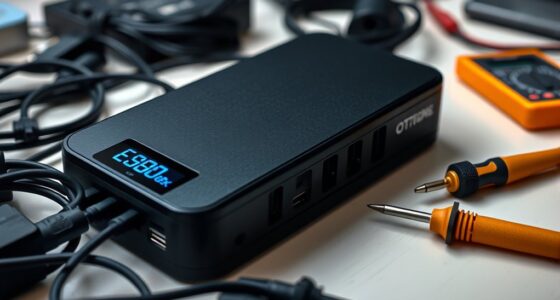
A solar backup power bank is a portable battery pack — usually 5,000 to 50,000 mAh — with integrated photovoltaic panels on its casing that slowly recharge the internal battery from sunlight. Think of it as a regular power bank wearing a small solar backpack. The backpack helps, but you wouldn’t hike across a country relying on it alone.
Why does this matter? Because the integrated panel changes the device’s role, not just its feature list. A regular power bank is a finite resource — once it’s empty, it’s dead weight until you find an outlet. Adding solar turns it into a slow but self-replenishing one. That distinction is the whole reason to buy one: you’re not paying for fast charging, you’re paying for the ability to generate some power when no grid exists at all. If that tradeoff doesn’t match your situation, a cheaper conventional bank is the smarter buy.
These devices sit between two categories: the pocket power bank you toss in a bag, and the bulkier portable power station that runs a mini-fridge. That middle position comes with real tradeoffs. You give up the pocketability of a small bank (solar models are heavier and thicker) and the serious output of a power station (they can’t run appliances). What you get in return is a device light enough to carry that never fully runs out of options. That’s why solar banks are built for a specific sweet spot: multi-day hiking, camping trips, and emergency preparedness kits where outlet access disappears for stretches at a time — scenarios where a top-up of 10–20% per day is genuinely valuable, not disappointing.
Picture a three-day backpacking trip in the Sierras. Your 20,000 mAh bank covers days one and two. By day three, that rooftop panel has clawed back maybe 30–40% of a charge from trail breaks in the sun. Is that miraculous? No. But the implication matters: your phone dies on day three without it, and survives with it. The panel isn’t refilling your battery — it’s buying you extra days of operation, which in an emergency or a navigation-critical situation is exactly the margin you need. That’s the honest value proposition: a small trickle, sustained over time, can be the difference between a working GPS and a dead phone at a trail junction.
The Honest Truth About Solar Charging Speeds
Here’s the number nobody puts on the box: a typical onboard solar panel produces just 5–10 watts, which means a full solar recharge takes 20–40+ hours of direct sunlight. That’s days of charging, not an afternoon on the patio. This is the single biggest source of customer disappointment with these products.
Why so slow? Panel output scales with surface area, and a power bank’s face is roughly the size of a smartphone. Real solar arrays that power homes use panels a hundred times larger. You can’t cheat physics with a device that fits in a jacket pocket.
Cloudy days and window glass make it worse — output can drop 50–80% through a window or under overcast skies. The panel wants direct, unobstructed sun.
If you do buy one, look for monocrystalline panels (more efficient than polycrystalline) and models with detachable or foldable panels. Detachable panels let you position the panel toward the sun while your battery — and your phone — stay cool in the shade. That matters more than you’d think, which we’ll get to shortly.
Solar on a power bank is your backup’s backup. USB wall charging is still the primary way you’ll fill this battery 95% of the time.
Decode the Specs: mAh, Wh, and What You Actually Get
Solar backup power banks are rated in mAh, but that number is misleading because a 20,000 mAh battery at 3.7V delivers far less at the 5V USB output — roughly 74Wh in theory, and about 30% less after conversion losses. In plain terms: the number on the box is bigger than what your phone receives.
Practical math: a 10,000 mAh bank ≈ 2–3 phone charges, and a 20,000 mAh bank ≈ 4–6 charges. After that, losses eat the rest. If a $20 bank claims 50,000 mAh, be skeptical — counterfeit capacity claims are rampant in this market, and verified brands like Anker, Goal Zero, BLAVOR, and BigBlue earn their price premium with honest cells.
Here’s a quick reference for matching capacity to your situation:
| Capacity | Phone Charges | Best For | Laptop? |
|---|---|---|---|
| 10,000 mAh | 2–3 | Daily carry, day hikes | No |
| 20,000 mAh | 4–6 | Weekend camping, emergencies | Rarely |
| 25,000–30,000 mAh | 6–8 | Multi-day trips, power outages | Yes, if 60W+ USB-C PD |
| 30,000+ mAh | 8+ | Expeditions, base camps | Yes — but check airline limits |
Want to charge a laptop, camera, or drone? You need USB-C Power Delivery of 60W or more. Standard 10–20W ports won’t touch a MacBook. Modern banks increasingly include one bi-directional USB-C port that handles both input and output, plus USB-A ports for older gear and even Qi wireless pads on some models.
All-in-One vs. Detachable Panel: Which Setup Wins?
Solar power banks are portable and self-contained, but a detachable panel plus a separate quality power bank is usually the more efficient setup for serious off-grid use. A foldable 20–28W panel charges a bank three to five times faster than an onboard 5W strip, and you can aim it at the sun all day without moving your battery.
Consider two campers at the same site. Camper A clips her all-in-one bank to her backpack, panel-up, walking a winding forest trail where direct sun comes and goes. Camper B props his 21W folding panel on a rock facing southwest, cable running to his bank in the tent’s shade. By dinner, Camper B has a full battery. Camper A has a warm bank at 45%.
| Feature | All-in-One Solar Bank | Detachable Panel + Bank |
|---|---|---|
| Solar charging speed | Slow (5–10W) | Fast (20–28W typical) |
| Convenience | One device, grab-and-go | Two pieces to manage |
| Panel positioning | Fixed to battery | Fully adjustable |
| Battery quality | Limited to built-in cells | Upgrade independently |
| Heat management | Battery sits in sun | Battery stays shaded |
| Best for | Emergency kits, casual use | Camping, vanlife, extended off-grid |
The all-in-one still wins on simplicity. If you want one thing in the glovebox for hurricane season, it’s the right call. If you’re planning a week without outlets, go modular.
Safety, Durability, and the Airline Rule You Can’t Ignore
Most quality solar power banks use lithium-ion or lithium-polymer cells rated for 500–1,000 charge cycles, and safety comes down to certifications and how you treat the battery. Look for UL, CE, or FCC certification — cheap uncertified cells are the ones making headlines for overheating. For outdoor use, an IP65 or IP67 rating means the bank shrugs off rain and dust, and ruggedized casings survive drops that would crack a phone.
Now the rule that ruins airport mornings: airlines generally require batteries to be under 100Wh in carry-on luggage only. That works out to roughly 26,800 mAh at 3.7V — a 30,000 mAh bank may get flagged or confiscated. Check the Wh rating printed on the label before you pack.
Heat is the silent killer. Never leave a power bank on a car dashboard in summer; internal temperatures can push past 60°C (140°F), degrading the cells and creating genuine fire risk. That’s also why detachable panels win: batteries hate sunbathing. Store your bank at a partial charge — around 50% — in a cool drawer, and it’ll hold healthy capacity for years.
Rule of thumb: if it’s too hot for a chocolate bar on your dashboard, it’s too hot for a lithium battery.
Your 5-Point Buying Checklist
Buying well comes down to five checks, and running through them takes two minutes against any product listing. Here they are, in order of importance:
- Verify real capacity. Prefer reputable brands and check Wh, not just mAh. If the price-per-mAh looks too good to be true, the cells are probably overstated.
- Match ports to your gear. You want USB-C PD (20W minimum for phones, 60W+ for laptops), plus at least one USB-A. Check for pass-through charging if you want to charge the bank and your devices at once — not all support it.
- Check the panel wattage and type. Monocrystalline beats polycrystalline, and 10W beats 5W. Detachable panels earn bonus points.
- Confirm durability specs. IP65 minimum for outdoor use; IP67 if it might get dunked. Look for a UL/CE/FCC mark.
- Respect the 100Wh airline ceiling if you fly — stay at or under ~26,800 mAh.
Nice-to-haves worth a few extra dollars: a smart display showing exact percentage instead of four vague LEDs, a built-in flashlight with SOS mode, and GaN circuitry that charges cooler and faster. The emergency-preparedness market has pushed all of these from premium features toward standard equipment.
Frequently Asked Questions
Can a solar power bank charge using only solar?
Yes, but slowly. A typical 5–10W onboard panel needs 20–40+ hours of direct sunlight for a full charge — that’s several days, not an afternoon. Solar works best as a way to top up or extend your battery, not fully recharge it.
Can I take a solar power bank on a plane?
Usually yes, if the battery is under 100Wh (about 26,800 mAh at 3.7V), and it must go in carry-on luggage, not checked bags. Larger banks may need airline approval or be prohibited. Check the Wh rating printed on the device before flying.
Do solar power banks work through windows or on cloudy days?
Barely. Window glass can cut panel output by 50% or more, and heavy clouds can reduce it by 80%. For meaningful solar gain, the panel needs direct, outdoor sunlight angled toward the sun — which is another reason detachable panels outperform fixed ones.
How long does a solar power bank last?
The battery typically survives 500–1,000 full charge cycles, which works out to roughly 2–4 years of regular use. To maximize lifespan, store it around 50% charge in a cool place and keep it off hot dashboards — heat degrades lithium cells faster than anything else.
Are cheap solar power banks safe?
The cheap ones with inflated capacity claims are the risky ones. Stick to certified (UL, CE, FCC) models from verified brands like Anker, Goal Zero, BLAVOR, Hiluckey, or BigBlue. If a $25 bank claims 50,000 mAh, the cells are almost certainly overstated and possibly uncertified.
Conclusion
Buy the battery first, the solar panel second. A solar power bank is really a good power bank with a useful parachute — invaluable when the grid fails or the trail runs long, as long as you never expect the sun to do the wall charger’s job.
Charge it at home, store it at half power in a cool place, and when the lights go out, you’ll be the neighbor whose phone still works. That quiet advantage is worth every watt.
Fall Picks
fall essentials
As an affiliate, we earn on qualifying purchases.