For most campers, I’d start with the Renogy 200W Portable Solar Panel: its stated 25% efficiency and practical output make it a strong middle ground for charging a compatible power station. The BigBlue 28W is a lighter choice for phones and small devices, while the Jackery Solar Generator 1000 v2 bundle suits campers who want a battery and panel together. The main tradeoffs are portability, charging capacity, setup, and whether a panel includes the power station needed to store energy. Read on for the full breakdown of all 14 options and which camping setup each one fits best.

Get backup power and energy gear delivered free with Prime
- Fast, free delivery on millions of items
- Prime Video, Amazon Music and more included
- Member-only deals all year
Key Takeaways
- Renogy’s 200W panel is the strongest all-around starting point for campers who need useful charging capacity without jumping to a 400W-class setup.
- BigBlue’s 28W charger serves a different job: it is aimed at small devices, not recharging a power station or running camp appliances.
- 400W and 480W panels favor energy-hungry base camps, but their larger footprints and setup demands can work against hikers and short overnight trips.
- Higher efficiency claims and waterproof ratings are not the whole story; connector compatibility, usable placement, and included accessories affect real campsite utility.
- The Jackery bundle is the clearest all-in-one route because it pairs a panel with a power station, while most standalone panels require buyers to supply a compatible battery.
| Movsunpv 200W Foldable Portable Solar Panel |  | Best for Connector Flexibility | Maximum power: 200 W | Maximum voltage: 20.9 V | Cell type: N-type monocrystalline | VIEW LATEST PRICE | See Our Full Breakdown |
| Renogy 200W Portable Solar Panel with 25% Efficiency |  | Best for Direct Device Charging | Power: 200 W | Cell type: 16BB N-type monocrystalline silicon | Efficiency: 25% | VIEW LATEST PRICE | See Our Full Breakdown |
| BigBlue 28W Folding Solar Panel Charger with Dual USB-C and USB-A |  | Best for Backpacking Electronics | Power: 28 W | Ports: 2 USB-C and 1 USB-A | Output voltage: 5 V | VIEW LATEST PRICE | See Our Full Breakdown |
| Ecosonique 200W Foldable Portable Solar Panel with MC4 Output |  | Best Lightweight 200W Pick | Maximum power: 200 W | Conversion efficiency: Up to 23.5% | Maximum voltage: 20 V | VIEW LATEST PRICE | See Our Full Breakdown |
| CTOLITY 400W Foldable Portable Solar Panel |  | Best for High-Capacity Camp Setups | Maximum power: 400 W | Output voltage: 40 V DC listed; title also states 36V | Conversion efficiency: 23.4% | VIEW LATEST PRICE | See Our Full Breakdown |
| SOKIOVOLA 200W Foldable Portable Solar Panel, 25% Efficiency, IP68 Waterproof |  | Best for Broad Power-Station Compatibility | Maximum power: 200 watts | Conversion efficiency: Up to 25% | Output voltage: 18 volts | VIEW LATEST PRICE | See Our Full Breakdown |
| ZOUPW Foldgo 200W Portable Solar Panel |  | Best for Direct USB Device Charging | Maximum power: 200 watts | Cell type: Monocrystalline | Efficiency: Up to 23.5% | VIEW LATEST PRICE | See Our Full Breakdown |
| ZOUPW 110W Bifacial Foldable Portable Solar Panel |  | Best Lightweight Pick | Maximum power: 110 watts | Cell type: N-type 16BB monocrystalline | Efficiency: 25%+ manufacturer claim | VIEW LATEST PRICE | See Our Full Breakdown |
| Twelseavan 400W Foldable Portable Solar Panel |  | Best for High-Capacity Campsite Charging | Maximum power: 400 watts | Conversion efficiency: 24% | Amperage capacity: 10.6 amps | VIEW LATEST PRICE | See Our Full Breakdown |
| DOKIO 200W 18V Portable Foldable Solar Panel Kit |  | Best Complete Kit for Stationary Campsites | Maximum power: 200 watts | Output voltage: 18 volts | Maximum voltage: 22.5 volts | VIEW LATEST PRICE | See Our Full Breakdown |
| EBL 200W Foldable Portable Solar Panel |  | Best for Broad Power Station Compatibility | Cell type: Monocrystalline silicon | Conversion efficiency: Up to 23.5% | Maximum voltage: 35 V DC | VIEW LATEST PRICE | See Our Full Breakdown |
| ZOUPW 480W Bifacial Portable Solar Panel, N-Type 16BB |  | Best High-Output Bifacial Panel | Maximum power: 480 W | Cell type: N-type monocrystalline, 16BB | Conversion efficiency: 25%+ | VIEW LATEST PRICE | See Our Full Breakdown |
| Jackery Solar Generator 1000 v2 with 200W Solar Panel |  | Best Complete Camping Power Kit | Battery capacity: 1,070 Wh | Battery type: LFP | AC output: 1,500 W | VIEW LATEST PRICE | See Our Full Breakdown |
| FlexSolar 100W Foldable Portable Solar Panel Charger |  | Best Lightweight Direct-Device Charger | Maximum power: 100 W | Conversion efficiency: 23%+ | Cell type: Monocrystalline silicon | VIEW LATEST PRICE | See Our Full Breakdown |
| portable solar panels for camping | Weight | Maximum power | Cell type | Warranty |
|---|---|---|---|---|
| Movsunpv 200W Foldable Portabl | 16.1 lb | 200 W | N-type monocrystalline | — |
| Renogy 200W Portable Solar Pan | 13.89 lb | — | 16BB N-type monocrystalline silicon | 2-year material and workmanship warranty |
| BigBlue 28W Folding Solar Pane | 1.5 lb | — | — | — |
| Ecosonique 200W Foldable Porta | 11 lb | 200 W | — | 12 months |
| CTOLITY 400W Foldable Portable | — | 400 W | Monocrystalline | — |
| SOKIOVOLA 200W Foldable Portab | 16.3 pounds | 200 watts | — | 12 months |
| ZOUPW Foldgo 200W Portable Sol | 19.8 pounds | 200 watts | Monocrystalline | — |
| ZOUPW 110W Bifacial Foldable P | 6.8 pounds | 110 watts | N-type 16BB monocrystalline | 36 months |
| Twelseavan 400W Foldable Porta | About 22.7 pounds | 400 watts | — | 24 months |
| DOKIO 200W 18V Portable Foldab | — | 200 watts | N-type 16BB monocrystalline silicon | 10-year power output warranty |
| EBL 200W Foldable Portable Sol | 17.95 lbs | — | Monocrystalline silicon | 1 year |
| ZOUPW 480W Bifacial Portable S | 22.5 lb | 480 W | N-type monocrystalline, 16BB | 36 months |
| Jackery Solar Generator 1000 v | — | — | — | 5 years |
| FlexSolar 100W Foldable Portab | 4.1 lbs (1.85 kg) | 100 W | Monocrystalline silicon | — |
More Details on Our Top Picks
Movsunpv 200W Foldable Portable Solar Panel
The Movsunpv suits campers who want a 200W panel that can connect to several styles of portable power station without buying a separate adapter. Its included 4-in-1 cable covers XT60, DC5521, DC7909, and Anderson connections, a practical advantage over the Renogy 200W, whose 4-in-1 adapter is sold separately. Four adjustable kickstands let you angle the panel toward the sun at camp, while its foldable construction makes it more manageable to transport than a rigid panel.
The tradeoff is weight: at 16.1 pounds, it is better for car camping than carrying far from the vehicle. Its stated efficiency reaches 25%, but like other panels in this group, output falls in shade or clouds. I would also treat its weather protection cautiously: the product information lists both IP65 and IP67 ratings, so the exact rating is unclear.
Pros:- Included 4-in-1 cable supports XT60, DC5521, DC7909, and Anderson connections.
- Four adjustable kickstands help position the panel toward available sunlight.
- Foldable 200W design is suited to charging compatible power stations at a campsite.
- N-type monocrystalline cells have a stated conversion efficiency of up to 25%.
Cons:- At 16.1 pounds, it is heavy for trips that involve carrying gear any distance.
- Product information conflicts between IP65 and IP67 waterproof ratings.
- Shaded or cloudy conditions can reduce output substantially.
Best for: Car campers with a compatible power station who want several common connector options included in the box.
Not ideal for: Backpackers and campers who need a clearly specified water-resistance rating or expect dependable output in shade.
- Maximum power:200 W
- Maximum voltage:20.9 V
- Cell type:N-type monocrystalline
- Stated conversion efficiency:Up to 25%
- Weight:16.1 lb
- Dimensions:27.36 × 1.77 × 30.94 in
- Kickstands:4 adjustable; supports 45° angle
- Included cable:4-in-1: XT60, DC5521, DC7909, and Anderson
Our verdict“Choose the Movsunpv for car camping when its included multi-connector cable matters more than minimizing pack weight.”
Renogy 200W Portable Solar Panel with 25% Efficiency
The Renogy is a strong fit for campsites where phones and small electronics need charging alongside a power station. Its built-in 45W USB-C PD and dual USB-A ports let you charge devices directly from the panel, so you may not need to route every small device through a power station. Compared with the Movsunpv 200W, it is lighter at 13.89 pounds and folds into a compact package, though the Movsunpv includes a broader multi-connector adapter in the box.
Its 16BB N-type cells have a stated 25% efficiency, and four kickstands plus a magnetic closure support campsite setup and packing. The main catch for power-station owners is that the 4-in-1 adapter is sold separately; MC4 compatibility alone does not guarantee a match with every station. This is a car-camping panel rather than a hiking choice, and charging still depends on getting useful sunlight.
Pros:- USB-C PD 45W and two USB-A ports support direct charging of personal devices.
- 16BB N-type cells have a stated 25% efficiency.
- At 13.89 pounds, it weighs less than the Movsunpv 200W.
- Magnetic closure and four kickstands make packing and campsite positioning straightforward.
Cons:- The 4-in-1 adapter for some power stations is sold separately.
- Power-station compatibility depends on the station’s input requirements.
- Its weight and folded size are better suited to vehicle transport than backpacking.
Best for: Car campers who want a 200W panel with direct USB charging for phones and other devices, as well as MC4 output for a compatible power station.
Not ideal for: Campers whose power station needs a 4-in-1 adapter included, or hikers looking for a lightweight panel to carry on foot.
- Power:200 W
- Cell type:16BB N-type monocrystalline silicon
- Efficiency:25%
- Maximum voltage:21.6 V
- Amperage capacity:11.3 A
- Weight:13.89 lb
- Folded dimensions:23.72 × 22.99 × 1.97 in
- Connectors:MC4, USB-C PD 45W, and dual USB-A
- Warranty:2-year material and workmanship warranty
Our verdict“Pick the Renogy if direct USB charging and a lighter 200W package matter more than getting a multi-connector adapter in the box.”
BigBlue 28W Folding Solar Panel Charger with Dual USB-C and USB-A
For campers carrying a phone, GPS unit, or power bank rather than a large power station, the BigBlue is the most portable match in this group. At just 1.5 pounds, it folds to 11 × 6 × 1.4 inches and can fit into a hiking kit far more easily than the 11-pound Ecosonique or the larger 200W panels. Its two USB-C ports and one USB-A port offer several ways to charge small devices directly when the panel is in sunlight.
That compactness comes with a firm capacity limit: 28W is not enough for laptops or large power stations, and there is no internal battery to save energy for later. Output also varies with sunlight, so a phone connected at camp may charge slowly when clouds pass. The IP44 rating applies to the panel surface, not the USB junction box, which needs protection from water. Choose this for hiking electronics, not as a substitute for a campsite power-station panel.
Pros:- At 1.5 pounds, it is much easier to carry on foot than the 200W panels in this roundup.
- Two USB-C ports and one USB-A port provide charging options for small electronics.
- Compact folded dimensions suit a backpack or small camp kit.
- Designed for direct solar charging without requiring a separate power station.
Cons:- Its 28W output is unsuitable for laptops and large power stations.
- There is no internal battery, so it cannot store power for use after sunset.
- The USB junction box is not waterproof, and output varies with sunlight.
Best for: Backpackers and lightweight campers who need a portable way to charge phones, GPS devices, and power banks in direct sunlight.
Not ideal for: Campers who need to charge a laptop, run a large power station, store energy for nighttime, or leave the charging connections exposed to rain.
- Power:28 W
- Ports:2 USB-C and 1 USB-A
- Output voltage:5 V
- Output current:Up to 3 A per port; 4.8 A combined
- Solar conversion efficiency:25.4%
- Water resistance:IP44 panel surface; USB junction box is not waterproof
- Folded dimensions:11 × 6 × 1.4 in
- Weight:1.5 lb
- Battery:No internal battery
Our verdict“Choose the BigBlue for lightweight trips centered on small USB devices, not for powering a full campsite.”
Ecosonique 200W Foldable Portable Solar Panel with MC4 Output
The Ecosonique is the most appealing 200W option here when panel weight and a compact folded footprint matter. At 11 pounds, it is lighter than the Renogy and Movsunpv models, while still offering MC4 output for a compatible power station. It also includes adapters for several station connections and separate USB-C PD3.0 and USB-A QC3.0 outputs, giving car campers more ways to charge without relying on a single cable setup.
Its stated efficiency of up to 23.5% is below the 25% figures listed for the Renogy and Movsunpv, but the weight and output selection may matter more to buyers who regularly move gear between vehicle and campsite. The tradeoffs are a 12-month warranty and performance that remains sunlight-dependent. At 11 pounds, it is still not a natural choice for backpacking; the BigBlue is far easier to carry, though it cannot serve a 200W power station.
Pros:- At 11 pounds, it is lighter than the Renogy and Movsunpv 200W panels.
- MC4, USB-C PD3.0, USB-A QC3.0, and included adapters offer multiple connection options.
- Four adjustable kickstands support positioning in changing campsite conditions.
- Folded dimensions are relatively compact for a 200W panel.
Cons:- Its stated efficiency of up to 23.5% is lower than the Renogy and Movsunpv figures.
- The 12-month warranty is shorter than Renogy’s stated two-year warranty.
- At 11 pounds, it remains cumbersome for hiking or backpacking.
Best for: Car campers who want a relatively light 200W panel with adapters and direct USB outputs for compatible gear.
Not ideal for: Backpackers who need a genuinely low-weight panel, or buyers who prioritize a longer stated warranty or the highest listed efficiency.
- Maximum power:200 W
- Conversion efficiency:Up to 23.5%
- Maximum voltage:20 V
- Amperage capacity:10 A
- Weight:11 lb
- Folded dimensions:18.04 × 16.35 × 2.95 in
- Connectors:DC, MC4, USB-A, and USB-C
- USB outputs:USB-C PD3.0 45 W; USB-A QC3.0
- Warranty:12 months
Our verdict“Choose the Ecosonique if you want a lighter-than-most 200W car-camping panel with multiple outputs and adapters included.”
CTOLITY 400W Foldable Portable Solar Panel
The CTOLITY is the high-output choice for campers bringing a power station that can accept a substantial solar input. Its stated 400W capacity is double that of the Renogy and Ecosonique 200W panels, making it a better fit on paper for larger off-grid setups or RV camps where charging demand is higher. The foldable format, adjustable kickstands, and MC4 connectors are aimed at positioning the panel outdoors and linking it to compatible equipment.
That extra capacity comes with more uncertainty than the other options: the product title lists 36V, while the specifications state 40V DC. Buyers should verify their power station’s input limits before connecting it. Unlike the Ecosonique, the supplied details give no panel weight or dimensions, so transport and storage are harder to plan around. The listed contents also specify the panel only, with no adapter kit described. Its weather-resistant ETFE surface does not remove the need for suitable sunlight.
Pros:- Stated 400W capacity is higher than the 200W panels in this group.
- Foldable design and adjustable kickstands support outdoor positioning.
- MC4 connectors suit compatible power stations and solar setups.
- ETFE-laminated surface is described as weather-resistant.
Cons:- Product title lists 36V, while the specification lists 40V DC; verify compatibility before use.
- No panel weight or dimensions are provided, making transport and storage planning difficult.
- Only the solar panel is listed as included, with no adapter kit specified.
Best for: RV campers and car campers with a high-capacity power station whose solar input supports the panel’s stated 40V DC output and MC4 connection.
Not ideal for: Backpackers, buyers who need known folded dimensions and weight before packing, or power-station owners whose input limits are unclear.
- Maximum power:400 W
- Output voltage:40 V DC listed; title also states 36V
- Conversion efficiency:23.4%
- Connector type:MC4
- Cell type:Monocrystalline
- Surface:ETFE-laminated; described as weather-resistant
- Included components:Solar panel
- Model number:400W-NEW
Our verdict“Consider the CTOLITY for a high-capacity vehicle-based setup only after confirming your power station supports its stated voltage and MC4 connection.”
SOKIOVOLA 200W Foldable Portable Solar Panel, 25% Efficiency, IP68 Waterproof
The SOKIOVOLA earns this role with a 200W rating and a five-connector cable covering several common portable power-station inputs. That flexibility can save campers from buying a separate adapter, while the magnetic handle and carry bag make it easier to move from the car to a sunny campsite. Its 16.3-pound weight is lighter than the ZOUPW Foldgo 200W, though still a substantial carry for a hike. The manufacturer states up to 25% efficiency and describes the ETFE-coated panel as waterproof and dustproof; actual charging depends on sunlight and the connected station’s input limit. Choose this over the ZOUPW if lower carry weight and IP68 protection matter more than built-in USB charging. Skip it if you need a genuinely lightweight panel for backpacking.
Pros:- Five connector options suit a range of portable power stations
- At 16.3 pounds, it is lighter than the ZOUPW Foldgo 200W
- Folds with a magnetic handle and includes a carry bag
- Manufacturer states up to 25% conversion efficiency and an IP68 rating
Cons:- Still heavy for carrying any distance on foot
- Connected power-station input limits can restrict usable output
- 12-month warranty is shorter than the ZOUPW 110W’s 36-month warranty
Best for: Car campers with a compatible power station who want a 200W panel and several connection options without the Foldgo’s extra weight.
Not ideal for: Backpackers and hikers who need a low-weight setup, or owners whose power station cannot accept the panel’s available output.
- Maximum power:200 watts
- Conversion efficiency:Up to 25%
- Output voltage:18 volts
- Weight:16.3 pounds
- Folded size:21 × 23 inches
- Dimensions:78.68 × 23 × 1.5 inches
- Connector types:MC4; included cable supports XT60, DC5521, DC7909, DC8020, and Anderson
- Construction:ETFE coating and monocrystalline silicon cells
- Warranty:12 months
Our verdict“Choose the SOKIOVOLA for car camping when multi-connector compatibility and a lighter 200W foldable panel matter more than direct USB charging.”
ZOUPW Foldgo 200W Portable Solar Panel
The Foldgo is the most self-contained 200W option in this group for campers who want to charge small devices without routing everything through a power station. Its USB-C PD 60W and QC3.0 USB-A ports provide direct charging, while the included five-in-one cable connects to compatible stations. Adjustable kickstands help angle the panel toward the sun at a stationary campsite. The tradeoff is portability: at 19.8 pounds, it weighs more than the SOKIOVOLA 200W, and its folded case is also larger. Its IP67 rating applies to the panel, but the junction box is not submersible, so this is no reason to leave it exposed to standing water. Choose it over the SOKIOVOLA for onboard USB convenience; skip it if minimizing packed weight is the priority.
Pros:- USB-C PD 60W and QC3.0 USB-A ports charge devices directly
- Five-in-one cable supports several power-station connector types
- Adjustable kickstands help set the panel angle at camp
- IP67 water-resistance rating for outdoor use
Cons:- At 19.8 pounds, it is heavier than the SOKIOVOLA 200W
- Folded dimensions of 25 × 23.1 × 2.76 inches take substantial packing space
- Junction box is water-resistant but not submersible
Best for: Car campers who want to charge a phone or tablet directly from the panel while also having a cable for a compatible power station.
Not ideal for: Hikers and campers prioritizing a lighter, smaller carry, or anyone who needs a panel and junction box suitable for submersion.
- Maximum power:200 watts
- Cell type:Monocrystalline
- Efficiency:Up to 23.5%
- Output voltage:18.6 V DC
- Water resistance:IP67
- USB outputs:QC3.0 USB-A and PD 60W USB-C
- Folded dimensions:25 × 23.1 × 2.76 inches
- Weight:19.8 pounds
- Included cable:10-foot 5-in-1 cable: XT60, Anderson, DC7909, DC8020, and DC5521
Our verdict“Pick the Foldgo if direct USB charging and adjustable stands are worth the extra weight and packed size for your car-camping setup.”
ZOUPW 110W Bifacial Foldable Portable Solar Panel
At about 6.8 pounds, this is the easiest panel in the batch to carry between a car, campsite, and sunny clearing. Its 110W rating is well below the 200W SOKIOVOLA and Foldgo, so expect a smaller charging contribution rather than equivalent power-station replenishment. The distinguishing feature is its bifacial design: rear-side light may add output when the panel is placed where reflected light can reach its back, but the claimed gain depends on the campsite surface and setup. The included five-connector cable broadens compatibility, and the IP68 rating suits outdoor use. Its 36-month warranty is longer than the 200W options listed here. Choose it for easier carrying and modest charging needs; skip it if fast, high-capacity charging is the goal.
Pros:- About 6.8 pounds, much lighter than the 200W panels in this batch
- Bifacial cells can use rear-side light when the setup allows
- Five-connector cable supports a range of compatible power stations
- IP68 rating and 36-month warranty
Cons:- 110W maximum power offers less charging capacity than the 200W panels
- Any rear-side output gain depends on light reaching the back of the panel
- Connector matching is still required for the specific power station
Best for: Campers who carry gear on foot from a vehicle or need a lighter panel for topping up a compatible power station and small camping electronics.
Not ideal for: Campers running higher-energy appliances or seeking 200W-class charging from a single panel.
- Maximum power:110 watts
- Cell type:N-type 16BB monocrystalline
- Efficiency:25%+ manufacturer claim
- Maximum and output voltage:20.6 volts
- Amperage capacity:5.3 amps
- Dimensions:45.2 × 0.9 × 25.2 inches
- Weight:6.8 pounds
- Included accessories:Storage bag, user manual, and 10-foot 5-in-1 connector cable
- Warranty:36 months
Our verdict“Choose the ZOUPW 110W when carrying ease matters more than the higher charging capacity of the SOKIOVOLA or Foldgo.”
Twelseavan 400W Foldable Portable Solar Panel
For a stationary campsite with a power station built to accept high-voltage solar input, the Twelseavan’s 400W maximum output sets it apart from the 200W SOKIOVOLA and DOKIO kits. That extra rated capacity can support a higher-output setup, but it also brings compatibility and carrying constraints. Its 46.9V open-circuit voltage may exceed the input limits of smaller stations, so check the station’s specifications before buying rather than relying on connector fit alone. At about 22.7 pounds, it is also the heaviest panel in this batch. Adjustable kickstands and a magnetic handle help with campsite placement, while IP65 weather resistance is suitable for outdoor conditions but does not mean submersible. This is a capacity-first choice, not a lightweight camping panel.
Pros:- 400W maximum power rating exceeds the 200W panels in this batch
- Adjustable kickstands and magnetic handle support campsite setup and carrying
- Includes multiple connectors and three DC adapters
- IP65-rated design for outdoor use
Cons:- 46.9V open-circuit voltage may exceed smaller power stations’ input limits
- About 22.7 pounds is a heavy carry for camping on foot
- IP65 is not a submersion rating
Best for: Car campers with a high-capacity power station that explicitly accepts the panel’s voltage and who want more rated solar input at a stationary camp.
Not ideal for: Owners of smaller power stations with lower voltage limits, and campers who need to carry a panel far from the vehicle.
- Maximum power:400 watts
- Conversion efficiency:24%
- Amperage capacity:10.6 amps
- Open-circuit voltage:46.9 volts
- Output voltage:40 volts
- Weight:About 22.7 pounds
- Folded size:26 × 35.5 inches
- Construction and protection:Monocrystalline silicon; IP65-rated
- Warranty:24 months
Our verdict“Choose the Twelseavan only if your power station accepts its high voltage and you value 400W-rated capacity over easy transport.”
DOKIO 200W 18V Portable Foldable Solar Panel Kit
The DOKIO is a better fit for campers who want more than a bare panel: its adjustable bracket, charge controller, cables, adapters, and mounting hardware make it a kit-oriented pick for an RV stop or established campsite. The controller adds USB output and protections against faults such as overcharge and short circuit, which can simplify charging smaller devices within the kit’s setup. Compared with the SOKIOVOLA 200W, the DOKIO supplies more bundled hardware and a 10-year power output warranty, but it weighs 19.4 pounds and has a bracket that should be adjusted gently. Its aluminum frame and 1.6-inch folded thickness suit vehicle transport better than hiking. Choose it for a more complete stationary setup; skip it if low weight or fast pack-up matters most.
Pros:- Includes an adjustable bracket, charge controller, cables, adapters, and mounting hardware
- Controller provides USB output and several built-in protections
- 10-year power output warranty is longer than the other panels in this batch
- Folded thickness is 1.6 inches for vehicle packing
Cons:- At 19.4 pounds, it is not suited to extended carries on foot
- Bracket should be adjusted gently to reduce the risk of breakage
- More bundled hardware can mean a less simple pack-and-deploy setup than a standalone panel
Best for: RV campers and car campers who want a 200W panel kit with an included controller, adjustable bracket, and mounting accessories.
Not ideal for: Backpackers, or campers who want the lightest possible setup and may find a 19.4-pound kit with a bracket cumbersome.
- Maximum power:200 watts
- Output voltage:18 volts
- Maximum voltage:22.5 volts
- Amperage capacity:11.36 amps
- Cell type:N-type 16BB monocrystalline silicon
- Item weight:19.4 pounds
- Unfolded dimensions:55.1 × 29.6 × 0.8 inches
- USB output:5V 2A
- Warranty:10-year power output warranty
Our verdict“Choose the DOKIO if you want a bundled 200W campsite charging kit and value its controller and long power-output warranty over lower carry weight.”
EBL 200W Foldable Portable Solar Panel
The EBL earns its place for campers who want a 200W panel with several connection paths rather than a bare panel that needs extra adapters. Its included cable supports MC4, XT60, Anderson, DC7909, and aviation connections, making it more flexible across power stations than the FlexSolar 100W, which is aimed more at smaller devices and lower-output charging. Four kickstands help angle the panel toward the sun at camp, while its IP65 design offers some protection against dust and water exposure.
The tradeoff is carrying nearly 18 pounds, plus its long 94-inch unfolded footprint, so it suits car camping better than trips where gear must be carried far. Its 200W rating also depends on strong sunlight and placement. I’d choose it for connector flexibility, but the Jackery 1000 v2 bundle is a more integrated option if you also need a power station.
Pros:- Included MC4-to-four-connector cable supports several common power station inputs.
- Four kickstands help position the panel toward available sunlight.
- 200W output suits campers charging a compatible power station.
- IP65 design adds protection against dust and water exposure.
Cons:- At 17.95 pounds, it is heavy for walk-in campsites.
- Its 94.17-inch unfolded length needs substantial clear ground space.
- Solar output varies with sunlight, shade, and panel positioning.
Best for: Car campers with an existing portable power station who need a 200W panel and connectors for several input types.
Not ideal for: Backpackers or campers who must carry gear over long distances; its 17.95-pound weight and wide unfolded shape are cumbersome.
- Cell type:Monocrystalline silicon
- Conversion efficiency:Up to 23.5%
- Maximum voltage:35 V DC
- Weight:17.95 lbs
- Folded dimensions:25.31 × 20.87 × 2.17 in
- Unfolded dimensions:94.17 × 20.83 × 0.25 in
- Connectors:MC4, XT60, Anderson, DC7909, aviation
- Warranty:1 year
Our verdict“Choose the EBL if connector flexibility matters more than low carry weight and you camp close to your vehicle.”
ZOUPW 480W Bifacial Portable Solar Panel, N-Type 16BB
For a campsite built around a large power station, the ZOUPW’s standout is its 480W rating and bifacial design: the panel can capture light from both sides, which may help when its surroundings reflect sunlight. Its N-type monocrystalline 16BB cells are listed at 25%+ conversion efficiency, and the IP68 rating gives it stronger stated water and dust protection than the EBL 200W. The included extension cable, connector cable, stakes, and storage bag also make it a more complete panel setup.
That capacity comes with a real footprint: unfolded, it measures about 138.6 inches long, and at 22.5 pounds it is better suited to a vehicle-accessible campsite than a walk-in site. It also needs compatible equipment and useful sunlight; the maker cautions against shaded operation and placing weight on the panel. Compared with the FlexSolar 100W, this is a power-station-focused choice, not a compact device charger.
Pros:- 480W rated output targets faster solar input for compatible power stations.
- Bifacial construction can capture sunlight from both sides.
- IP68 rating offers strong stated water and dust protection.
- Includes extension and connector cables, stakes, and a storage bag.
Cons:- The 138.6-inch listed length makes campsite placement space-intensive.
- At 22.5 pounds, it is not a practical choice for carrying far from a vehicle.
- The maker advises against shaded operation, stepping on it, or placing heavy objects on it.
Best for: Car campers with a high-capacity power station who can set up a large panel in an open, sunny campsite.
Not ideal for: Backpackers, shaded-site campers, or anyone needing a small panel for direct phone charging; its size and intended use are a poor fit.
- Maximum power:480 W
- Cell type:N-type monocrystalline, 16BB
- Conversion efficiency:25%+
- Maximum voltage:42.5 V
- Amperage capacity:11.3 A
- Weight:22.5 lb
- Dimensions:138.6 × 0.9 × 32.6 in
- Warranty:36 months
Our verdict“Pick the ZOUPW when high solar input and bifacial collection matter more than a compact setup or easy carry.”
Jackery Solar Generator 1000 v2 with 200W Solar Panel
Unlike the standalone EBL and ZOUPW panels, the Jackery pairs a 200W solar panel with a 1,070Wh LFP power station, so campers get both a way to collect energy and a place to store it. Its 1,500W AC output, 3,000W surge capacity, and mix of AC, USB, and DC ports support more than phones and lights: compatible appliances and several devices can share the unit. The listed LFP cycle life and five-year warranty make this a more substantial camping power system than a panel-only purchase.
The cost in portability is that the power station alone weighs 23.8 pounds, and the panel adds another piece of gear; the two ship separately. Solar charging also depends on conditions, while the one-hour full-charge claim applies to emergency charging enabled through the app, not ordinary solar input. I’d favor this bundle over the FlexSolar 100W for campers who need stored, multi-device power, but not for minimalist trips.
Pros:- Includes both a 200W solar panel and a 1,070Wh power station.
- 1,500W AC output and 3,000W surge capacity support compatible higher-draw gear.
- Multiple AC, USB, and DC ports allow several devices to connect.
- LFP battery, stated 4,000-cycle capacity rating, and five-year warranty support long-term use.
Cons:- The 23.8-pound power station is heavy before adding the panel and accessories.
- The station and panel ship separately.
- One-hour full charging requires app-enabled emergency charging and is not a typical solar charging time.
Best for: Car campers who need stored power for several devices and compatible AC appliances, and want a panel included with the power station.
Not ideal for: Minimalist campers and backpackers who only need to charge phones; the power station and separate panel add substantial bulk.
- Battery capacity:1,070 Wh
- Battery type:LFP
- AC output:1,500 W
- Surge capacity:3,000 W
- Included solar panel:200 W
- USB-C ports and output:2 ports; up to 100 W
- AC outlets:3 pure sine wave
- Power station weight:23.8 lbs
- Warranty:5 years
Our verdict“Choose the Jackery bundle if you want a ready-made solar-and-storage system for car camping rather than a lightweight panel alone.”
FlexSolar 100W Foldable Portable Solar Panel Charger
The FlexSolar is the easiest fit here for campers who value low carry weight and direct device charging over high power-station input. At 4.1 pounds, it is far easier to move around camp than the 17.95-pound EBL 200W or the 22.5-pound ZOUPW 480W. Its USB-C PD 3.0 output reaches 45W, with USB-A and DC outputs for compatible devices and power stations, so it offers more direct charging options than a panel designed mainly around a power-station connector.
Its 100W maximum output is the clear compromise: it is not the pick for rapidly replenishing a large battery or supporting a camp with heavy power needs. The IP67 rating and carry bag suit outdoor transport, but useful charging still depends on sun, placement, and device compatibility. Compared with the bundled Jackery 1000 v2, this is lighter and simpler, but it does not include battery storage.
Pros:- At 4.1 pounds, it is much easier to carry than the larger panels in this group.
- USB-C, USB-A, and DC outputs support a range of compatible devices.
- USB-C PD 3.0 output is rated up to 45W.
- IP67 rating and included carry bag suit outdoor transport.
Cons:- 100W maximum output is less suited to replenishing large power stations quickly.
- Does not include a battery or power station to store collected energy.
- Charging depends on sun conditions and compatible devices or connectors.
Best for: Walk-in campers and day hikers who want a relatively light foldable panel for compatible USB devices or a small power station.
Not ideal for: Campers relying on a large power station or multiple high-draw appliances; its 100W maximum output is modest beside the 200W and 480W options.
- Maximum power:100 W
- Conversion efficiency:23%+
- Cell type:Monocrystalline silicon
- Weight:4.1 lbs (1.85 kg)
- Folded dimensions:12.99 × 10.43 × 2.17 in
- Unfolded dimensions:45.47 × 26.18 in
- USB-C output:PD 3.0, 45 W
- USB-A output:18 W
Our verdict“Choose the FlexSolar for a lighter camp setup and direct device charging, but opt for a higher-output panel when power-station recharging is the priority.”
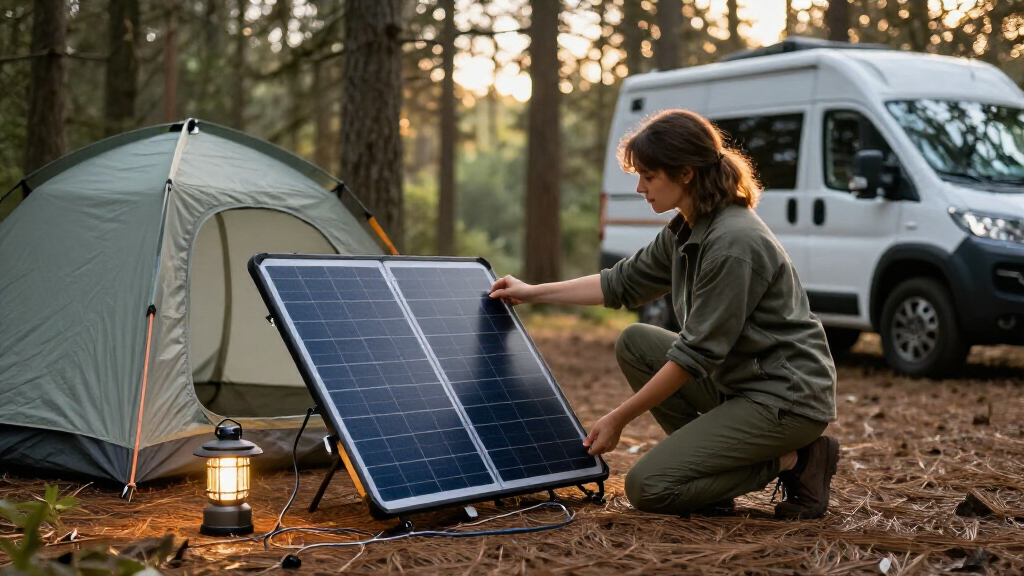
How We Picked
I ranked these options around the needs of campers: how much gear they can plausibly support, how manageable the panel is to transport and position, and how readily it fits into a usable charging setup. The listed wattage, output types, stated efficiency, weather protection, and whether a battery is included all shaped the comparison. A high-wattage panel can be useful at a car campsite, but it does not automatically make sense for someone carrying gear on foot.
The ranking favors practical fit over the biggest headline number. That puts the Renogy 200W near the top as a versatile standalone panel, gives compact USB chargers a distinct role for small devices, and reserves the largest panels for campers with greater power demands and room to deploy them. I also weighed setup complexity and compatibility: a panel alone is not a complete power system, while a bundled generator can be simpler but ties the buyer to that package. Product names and listed specifications inform this comparison; performance can vary with sunlight, shading, angle, and connected equipment.
Factors to Consider When Choosing Portable Solar Panels For Camping
I’d choose a panel only after deciding what needs power and how the trip is organized. These points help avoid paying for capacity you cannot deploy—or arriving with a panel that has nowhere to send its electricity.
Match Panel Output to Your Actual Camp Loads
List the devices you plan to charge and how often you will use them, rather than choosing wattage by appearance. Phones, headlamps, and small USB devices may be served by a compact charger, while a power station used for laptops or appliances calls for a higher-output panel and suitable input. A panel’s rated wattage is a lab-style maximum, not a promise of that output throughout a day. Shade, cloud, season, panel angle, and short daylight hours can all cut collection. If you need reliable overnight power, size the battery as well as the panel. Buying a large panel without enough storage can leave surplus energy unusable.
Choose for Your Campsite and How You Travel
Car campers can usually accept more folded bulk and a slower setup than backpackers, who feel every extra pound and packed dimension. Check the folded size and carrying method alongside the panel’s weight; “portable” may mean manageable from a vehicle, not comfortable on a long trail. A larger panel also needs clear ground or a stable surface pointed toward the sun. At crowded sites, the best sunny spot may be away from your tent or vehicle, so cable reach and safe placement matter. For frequent moves or quick overnight stops, a smaller panel can be more useful even if it gathers less energy. Do not plan around deploying a large panel if your itinerary leaves little time in camp.
Confirm Connectors and Power-Station Compatibility
Before buying a standalone panel, check the input type, voltage range, connector, and maximum solar input supported by your power station. A panel’s MC4 output or USB ports do not guarantee direct compatibility with every battery. An adapter may solve a connector mismatch, but it cannot fix an electrical rating mismatch. Check whether the panel includes the cable you need and whether it supports charging your devices directly or only through a separate power station. Bundles reduce the guesswork by pairing components, but they limit flexibility if you already own a battery. I’d verify the exact model specifications and connection requirements before packing the system for a trip.
Treat Efficiency and Weather Ratings as Part of the Picture
Efficiency describes how well a panel converts sunlight within its available surface area; it does not tell you how much energy you will collect at a shaded campsite. A higher stated efficiency can be useful when space is limited, but orientation and uninterrupted sun still matter. Waterproof or water-resistance claims can help with changing conditions, yet they do not mean a panel should be left exposed to storms or submerged. Check the manufacturer’s care guidance, especially for connectors and seams. Keep panels clear of dirt, avoid sharp bends, and dry them before storage to reduce wear. For camping, robust handling and sensible weather protection are often more useful than pursuing a single impressive specification.
Decide Whether a Bundle Is Worth the Simpler Setup
A panel-only purchase can be a better fit if you already own a compatible power station or want to choose storage separately. If you are building a system from scratch, a bundle can simplify matching the panel, battery, and charging inputs. Compare what is actually included: a solar panel does not store energy, and a generator bundle may still need cables or accessories for your intended use. Consider how much power you need after sunset, since solar collection usually happens during daylight while many camp loads continue at night. A bundle can cost you flexibility in component choice, while separate parts demand more research. Pick the route that suits your existing gear and comfort with setup, not just the box contents.
Plan for Real-World Sun and Daily Routine
Solar charging works best when the panel can stay in direct sun and be repositioned as the sun moves. A shaded campsite can sharply limit collection, even when the panel has a high wattage rating. Decide whether you are willing to adjust the angle during the day or would rather set a panel near camp and leave it. Keep charging electronics out of direct heat and protect cables from foot traffic and vehicle movement. If your itinerary includes dense forest, short winter days, or frequent relocations, carry a battery with enough reserve or maintain another charging plan. A flexible plan beats assuming that every camping day will bring clear skies and ideal panel placement.
Frequently Asked Questions
Do I need a power station to use a portable solar panel at camp?
Not always: some compact panels, such as USB-focused chargers, can connect directly to compatible devices. Larger panels are commonly used to recharge a power station, which stores energy for nighttime or cloudy periods. Check the panel’s outputs and the device’s charging requirements before relying on direct charging. A standalone panel does not provide stored power after sunset. If you need to run several devices or appliances, a compatible battery is usually part of the plan.
Is a 200W panel enough for a weekend camping trip?
It can be enough for a modest setup, but the answer depends on your devices, sunlight, and battery capacity. Charging phones and small electronics is a lighter demand than replenishing a power station used for a laptop or appliances. A 200W rating is a peak figure, and shade or poor panel angle can reduce collection. Estimate your daily energy use and compare it with the battery’s capacity and the panel’s expected charging conditions. If your trip is short and your battery starts full, you may need less solar capacity than you think.
Should I choose one large panel or a smaller panel for camping?
A large panel makes more sense when you camp by vehicle, need to refill a sizeable battery, and have room to set it in direct sun. A smaller panel is easier to carry and position, and may better suit short trips or basic device charging. Larger output can be wasted if the campsite stays shaded or your battery cannot accept the energy. Compare folded dimensions and weight as carefully as wattage. The right size is the one you can deploy reliably and connect to gear that can use its output.
Can a portable solar panel charge my phone without a battery?
Some panels with direct USB outputs can charge compatible phones, but charging may slow or pause when sunlight changes. A small power bank can buffer that uneven supply and charge your phone later, away from the panel. Before a trip, check that the panel provides an output your phone supports and bring suitable cables. Avoid depending on direct solar charging as your only option if you need a phone for safety or navigation. A charged power bank or battery offers a more predictable reserve.
Is a solar-generator bundle a better choice than buying the panel separately?
A bundle is often simpler for a first solar setup because the panel and battery are sold as a coordinated system. It can be a poor fit if you already own a power station, need a different capacity, or prefer to choose components independently. Confirm the bundle’s battery size, solar input limits, included cables, and whether its panel can be used with other equipment. A panel-only option may give you more flexibility but requires checking compatibility yourself. Choose based on your current gear and how much setup research you want to do.
Conclusion
For most car campers, I’d choose the Renogy 200W as the best overall balance of capacity and general-purpose use. The BigBlue 28W is my best value-style fit for campers who only need to top up small devices, while the Jackery Solar Generator 1000 v2 bundle is the best premium route for buyers who want a coordinated panel-and-battery setup. For beginners, I’d lean toward the Jackery bundle if its capacity and connections suit their gear; it removes some component-matching work. For larger base-camp loads, compare the CTOLITY and Twelseavan 400W panels, and consider the ZOUPW 480W for a high-output setup with room to deploy it. Choose the FlexSolar 100W or BigBlue for lighter charging needs, and favor a standalone 200W panel if you already own a compatible power station.