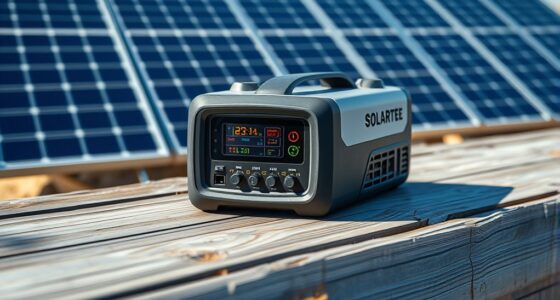
Your solar generator’s charging speed depends on several factors. Higher panel efficiency means it captures more sunlight, even on cloudy days, speeding up the process. Battery capacity also matters: larger batteries take longer to charge fully, especially under less-than-ideal conditions. Weather, sunlight intensity, and how you position your panels further influence recharge times. If you keep exploring, you’ll discover how to optimize these elements for faster, more reliable charging.

Get backup power and energy gear delivered free with Prime
- Fast, free delivery on millions of items
- Prime Video, Amazon Music and more included
- Member-only deals all year
Key Takeaways
- Solar panel efficiency influences how quickly energy is captured and converted into power for charging.
- Larger battery capacities require longer sunlight exposure to reach full charge.
- Weather conditions like cloud cover reduce sunlight intensity, slowing recharge times.
- Proper panel placement and tilt maximize sunlight absorption and speed up charging.
- Advanced solar technology, such as MPPT, optimizes power extraction for faster system recharge.

When you’re relying on a solar generator for backup power or off-grid activities, understanding its charging times is vital. The speed at which your solar generator recharges depends heavily on several key factors, primarily solar panel efficiency and battery capacity. Solar panel efficiency determines how much sunlight your panels can convert into usable electricity. Higher-efficiency panels capture more sunlight and generate more power even on cloudy days or when sunlight isn’t directly overhead. This means that with more efficient panels, your generator can start charging sooner and reach full capacity faster, especially in conditions where sunlight isn’t ideal. Conversely, lower-efficiency panels will take longer to produce the same amount of energy, extending your charging times.
Efficient solar panels speed up your generator’s recharge, even on cloudy days.
Battery capacity also plays a fundamental role. A larger capacity battery can store more energy, but it also requires more time to fully charge. If your generator has a high-capacity battery, you might need several hours of ideal sunlight to reach full charge, particularly if the solar panels aren’t highly efficient. Smaller batteries, on the other hand, will charge more quickly, but they might not provide as much power backup or run time once charged. It’s a balancing act: you want enough battery capacity to meet your power needs, but also a system that can recharge swiftly when sunlight conditions are favorable.
Another important factor to consider is the quality of solar components, which can significantly influence overall charging efficiency and time. The actual charging time can vary greatly depending on external factors like sunlight intensity, weather conditions, and the angle of your solar panels. Direct sunlight maximizes efficiency, but overcast skies or frequent cloud cover can reduce the energy your panels produce, prolonging recharge times. Angle and placement matter too; panels tilted toward the sun at the right angle will absorb more sunlight and improve efficiency, speeding up the process. If you’re using a portable solar generator with foldable panels, adjusting the angle during the day can maximize charging speed.
Additionally, the type of solar charger and technology used can influence charging times. Some advanced systems incorporate MPPT (Maximum Power Point Tracking) technology, which optimizes power extraction from the panels, leading to faster and more efficient charging. Overall, understanding the interplay between solar panel efficiency and battery capacity helps you better estimate charging times and plan your off-grid or backup power needs accordingly. By choosing the right combination, you guarantee your solar generator charges efficiently and reliably when you need it most.
Products Worth Considering

Levoit Core 300S-P Smart WiFi Air Purifier

LG 55-Inch QNED73B Mini LED 4K Smart TV (2026)

Philips Hue Amarant Outdoor Smart Light Bar, Black
As an affiliate, we earn on qualifying purchases.
Frequently Asked Questions
Do Solar Generators Charge Faster in Direct Sunlight?
Yes, solar generators charge faster in direct sunlight. Proper solar panel positioning is key; make certain panels face the sun directly without shading effects from nearby objects. When panels are angled correctly and free from shadows, they absorb maximum sunlight, which boosts charging speed. Avoid shading effects like trees or buildings blocking sunlight, as these greatly slow down the charging process. So, for quicker charging, optimize your panel placement and keep it unobstructed.
How Does Temperature Affect Solar Generator Charging Speed?
Think of your solar generator as a race car; when the engine’s temperature is just right, it performs best. When temperatures are too hot or cold, temperature regulation becomes tricky, reducing thermal efficiency. This slows down charging because the solar panels and internal components can’t operate effectively. In extreme temperatures, you might notice slower charging times, so keeping your generator in a moderate climate helps it recharge faster and more efficiently.
Can Multiple Solar Panels Increase Charging Efficiency?
Yes, using multiple solar panels can increase charging efficiency if they’re compatible with your generator. Make sure the solar panel compatibility matches your device’s input specifications. Also, using high-quality charging cables helps reduce power loss and improves overall efficiency. Connecting panels properly in series or parallel can maximize sunlight exposure, but always double-check your generator’s capacity and cable quality to safely and effectively boost your charging speed.
What Is the Impact of Battery Age on Charging Times?
Sure, your battery’s age plays a starring role in slowing things down. As it ages, battery degradation causes capacity loss, meaning your solar generator takes longer to charge because it can’t hold as much power. Fundamentally, the older your battery gets, the more it drags its feet, making charging a marathon rather than a sprint. So, don’t be surprised if your once speedy setup starts acting sluggish over time.
Do Different Solar Panel Brands Affect Charging Speed?
Yes, different solar panel brands can affect your solar generator’s charging speed. Panel brand variations often include differences in efficiency, build quality, and technology, which influence how quickly your system charges. Making sure your solar panel is compatible with your generator is essential, as incompatible panels may not optimize charging times. Opt for reputable brands known for high efficiency and compatibility to guarantee faster, more reliable charging.
Conclusion
So, next time you’re charging your solar generator, remember that factors like sunlight, panel quality, and battery capacity play a bigger role than you might think. It’s funny how a clear, sunny day can make all the difference, almost like nature’s little coincidence. By understanding these factors, you can optimize your setup and save time. After all, the right conditions could turn a sluggish charge into a quick power boost when you least expect it.