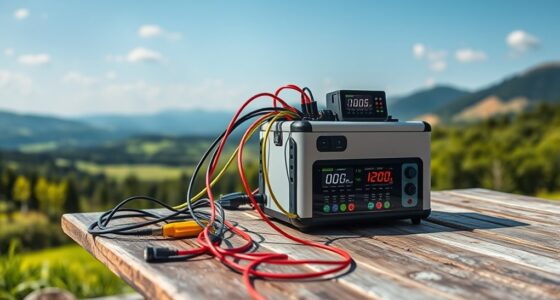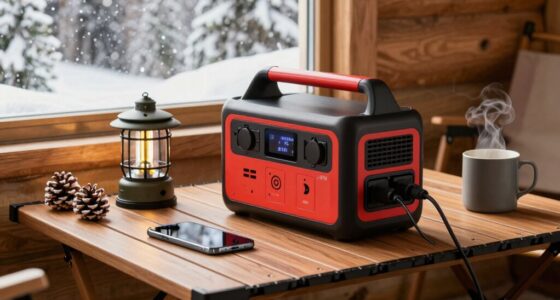
To use a portable power station for short-term refrigerator backup, plug your fridge directly into the station’s AC outlet, ensuring the power station has enough capacity (300-500 Wh for brief outages). Check the refrigerator’s startup wattage and confirm the station’s surge capacity can handle it. Keep the fridge door closed to conserve power, monitor the battery levels, and recharge the station promptly when needed. For detailed tips on safe and effective use, keep exploring the options available.

Get backup power and energy gear delivered free with Prime
- Fast, free delivery on millions of items
- Prime Video, Amazon Music and more included
- Member-only deals all year
Key Takeaways
- Ensure the power station has sufficient capacity (300-500 Wh) for short-term refrigerator backup needs.
- Connect the refrigerator directly to the power station’s AC outlet, ensuring compatibility and proper grounding.
- Verify the refrigerator’s startup wattage and confirm the power station can handle surge demands.
- Keep the refrigerator door closed to conserve energy and maintain temperature during outage.
- Monitor battery levels and recharge the power station promptly after use to ensure readiness for future outages.
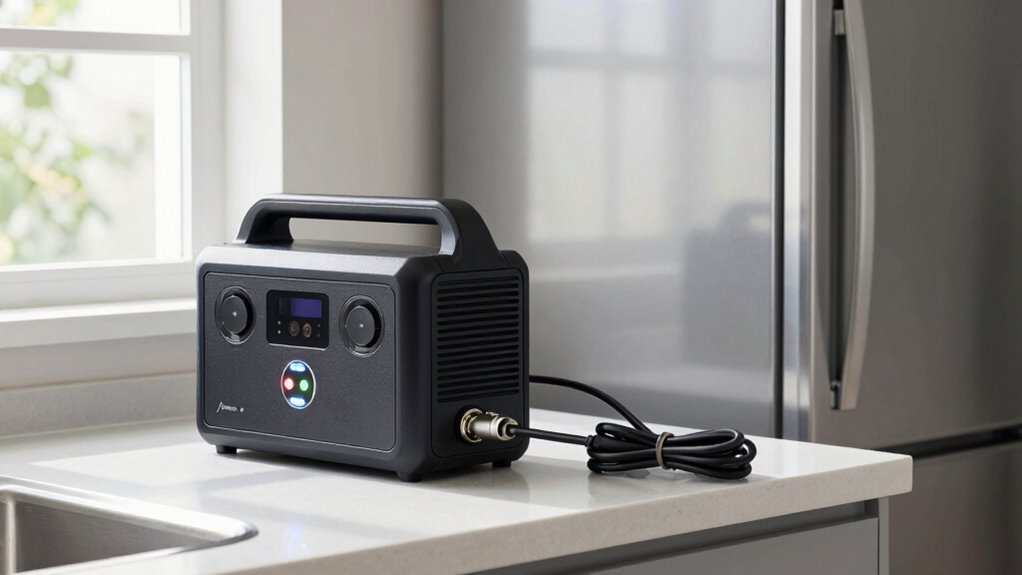
When a power outage strikes, your refrigerator can quickly become a source of stress and inconvenience. To keep your food safe and minimize waste, a portable power station offers a practical backup solution. But to use it effectively, you need to understand some basics, like battery capacity and power outlet types. Battery capacity, measured in watt-hours (Wh), determines how long your power station can run your refrigerator. The higher the capacity, the longer it can keep your fridge running during an outage. For short-term backup, a unit with at least 300 to 500 Wh should suffice, but if you want extended operation, consider one with 1,000 Wh or more.
A portable power station with sufficient watt-hours can keep your refrigerator running during power outages.
Next, you need to check the power outlet types on your portable power station. Most units feature AC outlets, which are ideal for running your refrigerator, especially if it has a standard household plug. Some models also include DC or USB outputs, but these are less relevant for refrigerators. Before connecting your appliance, ensure that the power station’s AC outlets are compatible with your fridge’s plug. If your refrigerator has a three-prong plug, confirm that the power station provides a grounded outlet for safety and proper operation. Understanding the power requirements of your appliance is essential for safe and effective backup use. Being aware of power surges and how they can impact your refrigerator can help you take precautions to protect your appliance.
Once you’ve chosen a power station with sufficient battery capacity and compatible outlet types, it’s time to prepare for the outage. Start by plugging your refrigerator directly into the power station’s AC outlet, making sure the connection is secure. Turn on the power station and verify that it’s providing power. Keep in mind that refrigerators are surge devices—they draw more power when starting up, so your power station needs to handle the initial surge. Check your refrigerator’s specifications for the startup wattage, and compare it with the power station’s surge capacity to ensure compatibility. Additionally, knowing the derating factors, such as altitude or temperature, can help you select a unit that maintains reliable performance under various conditions. Being aware of load management techniques can further optimize the backup duration and efficiency.
During operation, monitor both the power station and your refrigerator. Keep an eye on the remaining battery capacity, especially if you plan to use the backup for an extended period. Avoid opening the fridge door frequently to conserve energy and maintain a stable temperature. When the power outage ends, or if the power station’s battery runs low, disconnect your refrigerator and recharge the portable power station as soon as possible. Proper planning ensures your food stays cold and safe until power is restored, giving you peace of mind during unexpected outages.
portable power station for refrigerator backup
As an affiliate, we earn on qualifying purchases.
As an affiliate, we earn on qualifying purchases.
Frequently Asked Questions
How Long Can a Portable Power Station Run a Refrigerator?
You can run a refrigerator with a portable power station for several hours, depending on its battery capacity and the refrigerator’s power consumption. Typically, a station with a higher capacity (like 1500Wh) can power a small fridge for 8-12 hours. Keep in mind, the more energy-efficient your refrigerator, the longer it will run on the same power station. Monitoring power usage helps maximize runtime during short-term outages.
Can I Charge the Power Station While It’s Powering the Fridge?
Like Icarus aiming too high, you might wonder if you can charge your power station while it runs your fridge. Yes, you can, but keep battery capacity and charging safety in mind. Make certain your power station supports pass-through charging, and avoid overloading circuits to prevent damage. Always follow manufacturer instructions to safely recharge and operate simultaneously, so your fridge stays cool without risking your power station’s lifespan.
What Size Power Station Is Suitable for a Standard Refrigerator?
For a standard refrigerator, a power station with a battery capacity of at least 1,000Wh is suitable to guarantee reliable backup. Consider one with high power efficiency to handle startup surges, which often require more energy. This size provides enough runtime during outages without overloading the system. Always check your fridge’s power requirements and choose a power station that comfortably exceeds those needs for consistent performance.
Are Portable Power Stations Safe to Use With Refrigerators?
You can trust portable power stations to keep your fridge humming safely, like a gentle guardian. Their battery capacity guarantees enough juice, while power stability maintains a steady flow, preventing sudden surges or drops. As long as you select a reliable model suited for your refrigerator’s needs, these stations are safe to use. Just make certain to follow manufacturer guidelines, and your fridge stays cool and secure during power interruptions.
How Often Should I Recharge the Power Station During Backup?
You should recharge your power station based on its battery capacity and your refrigerator’s energy needs. Typically, check the battery level every few hours to guarantee it doesn’t drop below 20%. Adjust the charging frequency accordingly, especially if the power station runs low quickly. Keeping an eye on the battery capacity helps you maintain a reliable backup, so recharge it as needed to avoid interruptions during a power outage.
As an affiliate, we earn on qualifying purchases.
Conclusion
Now that you know how to use a portable power station for your refrigerator backup, you’re prepared for unexpected outages. Just remember to keep your power station charged and ready—think of it as your modern-day Ark. With a little planning, you can keep your food fresh and your cool running, no matter if the power’s out longer than a Victorian inventor’s wildest dream. Stay prepared, and you’ll be the hero of your household when the lights go out.
AC outlet portable generator for fridge
As an affiliate, we earn on qualifying purchases.
As an affiliate, we earn on qualifying purchases.
high surge capacity portable power station
As an affiliate, we earn on qualifying purchases.
As an affiliate, we earn on qualifying purchases.
Halloween Picks
halloween
As an affiliate, we earn on qualifying purchases.