Silicon and perovskite are two popular photovoltaic materials with distinct advantages. Silicon, the industry standard, offers proven durability and high efficiency but involves energy-intensive manufacturing, leading to a larger carbon footprint. Perovskite, on the other hand, can be produced more simply and cheaply, with the potential for lightweight, flexible solar panels, though it faces challenges like environmental concerns from lead content and stability. If you’re curious to explore how these differences impact solar technology, you’ll find more insights ahead.

Get backup power and energy gear delivered free with Prime
- Fast, free delivery on millions of items
- Prime Video, Amazon Music and more included
- Member-only deals all year
Key Takeaways
- Silicon is a highly durable, proven photovoltaic material with established manufacturing processes but has a high energy footprint.
- Perovskite offers simpler, less energy-intensive production, with potential for lightweight, flexible panels, but faces stability and environmental challenges.
- Silicon panels are more mature and reliable, while perovskite technology is still evolving with ongoing research into improving durability.
- Environmental impacts differ: silicon production is energy-heavy with waste concerns, whereas perovskite offers eco-friendliness but may involve lead-related risks.
- Material choice depends on balancing efficiency, manufacturing costs, environmental impact, and long-term performance considerations.
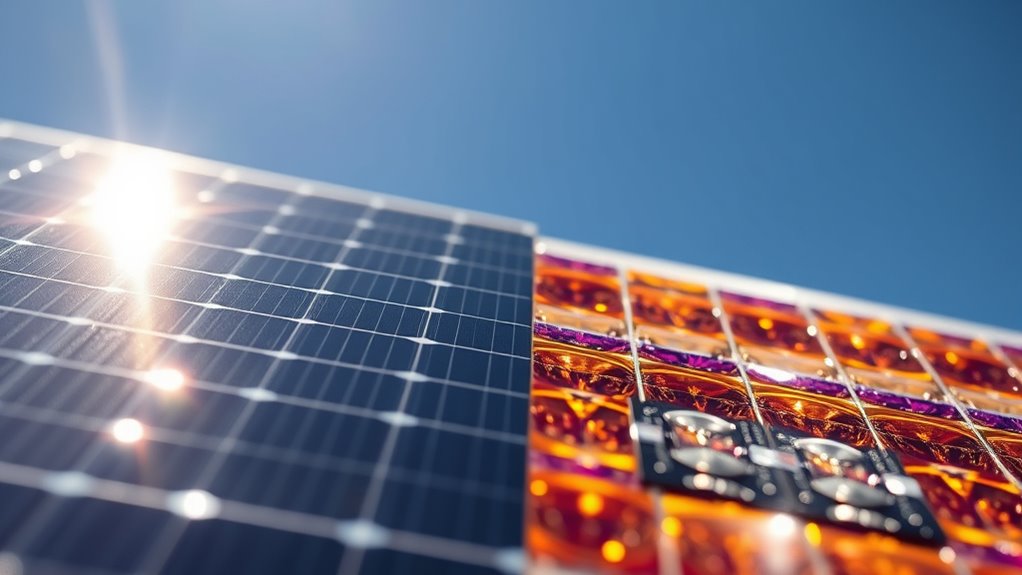
Have you ever wondered what makes solar panels work? At the heart of their function are photovoltaic materials, which convert sunlight into electricity. When comparing silicon and perovskite, understanding their manufacturing processes and environmental impact is vital. Silicon, the most common photovoltaic material, involves a complex manufacturing process. It starts with mining quartz, which is then purified into high-grade silicon. This silicon is melted at extremely high temperatures and then crystallized into ingots, which are sliced into thin wafers. These wafers are then doped with impurities to create the p-n junctions essential for electricity generation. This process demands significant energy input, often from fossil fuels, contributing to a substantial carbon footprint. Additionally, the manufacturing of silicon panels produces waste and involves hazardous chemicals, raising environmental concerns. Despite these challenges, silicon panels benefit from well-established production methods, high durability, and long-term performance, making them the industry standard. Furthermore, innovations in recycling technologies are helping to reduce waste and environmental impact associated with silicon panels.
Perovskite photovoltaic materials, on the other hand, are relatively new and present a different set of manufacturing processes. Typically, perovskite layers are deposited using solution-based techniques like spin-coating or printing, which are simpler and require lower temperatures. This means manufacturing can be faster, less energy-intensive, and potentially more scalable than silicon production. However, the environmental impact of perovskite production is still being studied. Although they involve fewer hazardous chemicals, issues like the use of lead in many perovskite formulations pose environmental risks if not properly managed. Researchers are actively seeking lead-free alternatives to mitigate these concerns. The simplified manufacturing process of perovskite materials also opens the door for cheaper, lightweight, and flexible solar panels, which could revolutionize the industry. Yet, these materials still face challenges related to stability and long-term durability, which are vital for widespread adoption.
Both silicon and perovskite materials have distinct manufacturing processes that influence their environmental impact. Silicon’s energy-intensive production results in a larger carbon footprint and waste concerns, despite its proven longevity. Perovskites, while promising in terms of manufacturing simplicity and potential eco-friendliness, require careful handling of chemical components to minimize environmental risks. As you explore solar energy options, it’s essential to weigh these factors—production complexity, environmental footprint, and long-term sustainability—when choosing between silicon and perovskite photovoltaic materials. This understanding helps you make informed decisions that balance efficiency, cost, and environmental responsibility.
Frequently Asked Questions
How Do Environmental Impacts Differ Between Silicon and Perovskite Production?
You’ll find that the environmental footprint of silicon production is larger due to energy-intensive processes and high resource consumption, impacting resource sustainability. In contrast, perovskite fabrication generally has a smaller environmental impact, as it uses less energy and fewer rare materials. However, concerns about perovskite stability and potential toxicity can influence its overall sustainability. Overall, silicon’s environmental footprint tends to be higher, but both materials require careful resource management.
What Are the Challenges in Commercializing Perovskite Solar Cells?
You face challenges in commercializing perovskite solar cells mainly due to manufacturing scalability and material durability issues. Scaling up production while maintaining high quality proves difficult, and the materials often degrade over time, reducing efficiency. To succeed, you’ll need to develop cost-effective, large-scale manufacturing processes and improve the stability of perovskite materials, ensuring they withstand environmental conditions and last longer in real-world applications.
How Does Long-Term Stability Compare Between Silicon and Perovskite Materials?
Imagine two marathon runners—silicon and perovskite—facing different weather conditions. Silicon’s material longevity and resistance to degradation mechanisms help it run steadily over decades. Perovskite, however, is like a sprinter with bursts of speed but struggles with long-term stability due to faster degradation mechanisms. While silicon wins in durability, perovskite’s rapid advancements could someday bridge the gap, but right now, stability remains its Achilles’ heel.
Are There Any Health Risks Associated With Perovskite Materials?
You should be aware that perovskite materials can pose health concerns due to toxicity risks. Some perovskites contain lead, which could be harmful if it leaches into the environment or comes into contact with skin. While processing and disposal are key periods for exposure, it’s important to handle these materials with proper safety measures. Overall, managing health concerns involves careful regulation and safe handling to minimize potential toxicity risks.
What Are the Cost Implications of Scaling up Perovskite Manufacturing?
Scaling up perovskite manufacturing can lower your costs considerably, but you’ll face scalability challenges that may increase initial expenses. Manufacturing costs depend on developing efficient, stable production processes, which are still evolving. As you improve fabrication techniques and supply chain logistics, these costs should decrease. However, overcoming scalability challenges requires investment in research and infrastructure, so expect some upfront costs before perovskite solar cells become more economically competitive.
Conclusion
Think of photovoltaic materials as the engines powering solar energy’s journey. Silicon has been the steady, reliable workhorse, like a classic car that’s stood the test of time. Perovskites, on the other hand, are the exciting new sports car, promising speed and innovation. As you explore their strengths, remember that both can drive us toward a brighter, cleaner future—each steering us closer to harnessing the sun’s power with passion and precision.
Columbus Day / Indigenous Peoples' Day Picks
long weekend sales
As an affiliate, we earn on qualifying purchases.