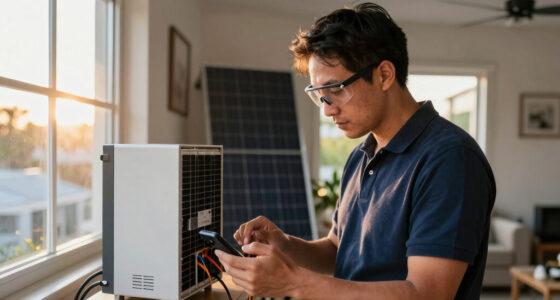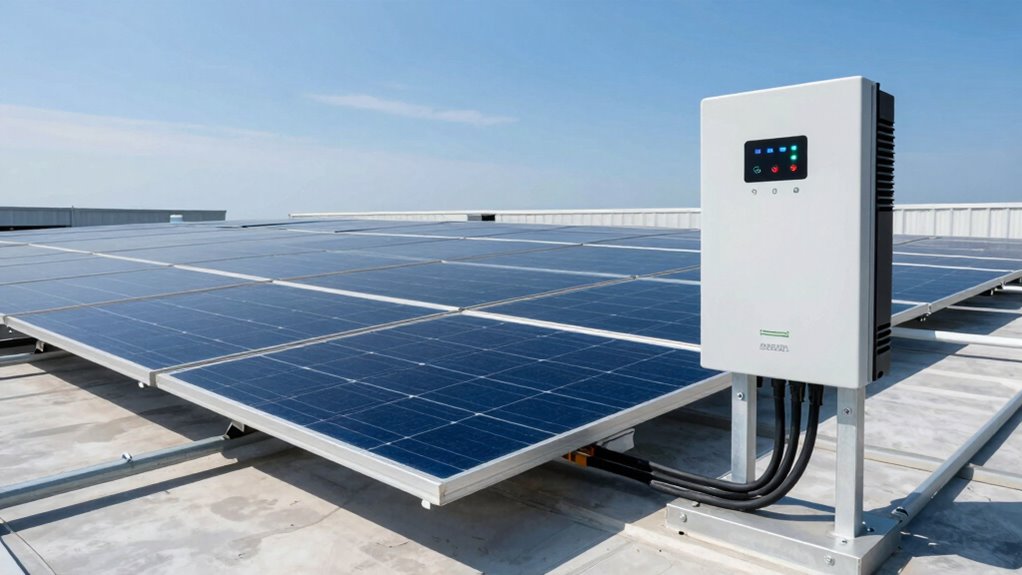

To match your solar input limits to your charging setup, start by understanding the maximum power your panels can produce in ideal conditions. Guarantee your inverter’s input ratings match or exceed this output without overload risks. Pick batteries suited to your system’s voltage and charge rates, considering their chemistry. Calculate your panel array size to align with inverter capacity, and regularly monitor performance to adjust for shading and weather changes. Continuing will reveal how to optimize your entire solar system safely and efficiently.

Get backup power and energy gear delivered free with Prime
- Fast, free delivery on millions of items
- Prime Video, Amazon Music and more included
- Member-only deals all year
Key Takeaways
- Determine the maximum power output of your solar panels under ideal conditions.
- Ensure your inverter’s maximum input wattage or current rating matches or exceeds your panels’ output.
- Match battery chemistry and capacity to handle the charge rates from your solar array safely.
- Calculate the total wattage of your solar panels and compare it with your system’s inverter capacity.
- Regularly monitor system performance and adjust component sizes or configurations as needed.

When setting up a solar charging system, matching your solar input limits to your equipment is vital for efficiency and safety. The first step is understanding the capabilities of your solar panels and verifying they align with the requirements of your entire system. Solar input limits are determined by the maximum power your panels can produce under ideal conditions, so you need to confirm your system can handle this without overloading. Ignoring this can lead to inefficiencies, potential damage to your components, or safety hazards.
Start by examining your inverter specifications. The inverter acts as the bridge between your solar panels and your batteries or household appliances. It’s imperative to select an inverter that can handle your maximum solar input. Check the inverter’s maximum input wattage or current ratings, and verify that they match or exceed your panels’ maximum output. This prevents your inverter from being overwhelmed during peak sunlight hours. An undersized inverter can cause clipping, where the inverter limits the power output, reducing overall efficiency. An oversized inverter, while more flexible, might be more costly and unnecessary if your input limits are lower.
Next, consider your battery chemistry, as it influences how much power your batteries can safely store and handle. Different chemistries, like lithium-ion, lead-acid, or AGM, have different charge and discharge characteristics. For example, lithium-ion batteries can typically handle higher charge rates safely compared to traditional lead-acid batteries. Knowing your battery chemistry helps you determine the appropriate charge current and voltage limits, making sure you don’t push your batteries beyond their safe operating range. Proper matching prevents premature battery degradation and maximizes lifespan. Additionally, understanding system compatibility ensures all components work harmoniously and safely. It’s also essential to consider the system’s overall capacity to prevent bottlenecks and optimize energy flow.
Furthermore, regularly reviewing performance metrics can help identify if your system is operating within safe parameters and allow for timely adjustments. It’s also important to match your solar panel array size with your system’s capacity. Calculate the total wattage of your panels and compare it with your inverter’s maximum input capacity. If your panels produce more power than your inverter can handle, you risk losing energy during peak hours or causing damage. Conversely, if your panels are too small relative to your inverter, you’re not utilizing the full potential of your setup.
Finally, always account for real-world conditions. Solar input limits are based on ideal conditions, but factors like shading, dirt, or weather can reduce actual output. Regularly monitor your system’s performance and make adjustments if you notice consistent underperformance or signs of stress on your components. Properly matching your solar input limits to your equipment will guarantee your system operates safely, efficiently, and with maximum longevity. Understanding your system’s power ratings helps ensure you optimize performance while maintaining safety.
solar panel maximum power output
As an affiliate, we earn on qualifying purchases.
As an affiliate, we earn on qualifying purchases.
Frequently Asked Questions
Can I Change Solar Input Limits After Installation?
Yes, you can change solar input limits after installation, but it depends on your inverter compatibility. Before making adjustments, guarantee proper battery maintenance, as altering input limits might affect battery health. Check your inverter’s specifications; some models allow manual or software-based adjustments, while others do not. It’s best to consult your inverter’s manual or a professional installer to ensure safe, effective changes without compromising your system’s performance.
What Tools Are Needed to Adjust Solar Input Settings?
You’ll need a screwdriver, a multimeter, and possibly a programming tool or app to adjust your solar input settings. Think of these tools as the magic wands that release ultimate control over your solar panel efficiency and battery storage capacity. With them, you can fine-tune your system, ensuring it’s perfectly aligned to maximize energy intake without overloads. Be careful, though—these adjustments can be as powerful as a solar storm!
How Do Weather Conditions Affect Solar Input Limits?
Weather conditions, especially weather variability, directly impact your solar input limits. Overcast skies, rain, or snow reduce solar forecasting accuracy by lowering sunlight exposure, causing your system to receive less energy. Conversely, clear, sunny days maximize input. To optimize your setup, monitor local weather reports, and modify your system’s input limits accordingly. Staying aware of weather variability helps prevent overloading and ensures efficient solar energy harvesting.
Is There a Risk of Damaging My Charger by Adjusting Input Limits?
Adjusting input limits is like tuning a fine instrument—you need to do it carefully to avoid damage. If you set limits too high, you risk affecting charger safety and disrupting proper voltage regulation, which could harm your equipment. Always follow manufacturer guidelines, and consult your charger’s specifications. Properly managing input limits guarantees your system works smoothly without risking damage, keeping everything humming along in perfect harmony.
How Often Should I Review My Solar Input Settings?
You should review your solar input settings regularly, especially when your battery capacity or inverter compatibility changes. Aim for at least once every few months to guarantee peak performance and safety. Monitoring these settings helps prevent overloading your system, extends battery life, and maintains efficiency. Keep an eye on any updates or changes in your equipment to adjust your solar input limits accordingly and keep everything running smoothly.
solar inverter with high input wattage
As an affiliate, we earn on qualifying purchases.
As an affiliate, we earn on qualifying purchases.
Conclusion
Matching your solar input limits to your charging setup guarantees safe and efficient energy use. Did you know that properly matched systems can increase overall efficiency by up to 20%? By paying attention to input limits, you prevent overloads and maximize your solar investment. Remember, a well-balanced system not only protects your equipment but also optimizes power delivery. Take the time to match your solar input limits carefully—you’ll enjoy reliable, sustainable energy for years to come.
lithium-ion deep cycle batteries
As an affiliate, we earn on qualifying purchases.
As an affiliate, we earn on qualifying purchases.
As an affiliate, we earn on qualifying purchases.
Halloween Picks
halloween
As an affiliate, we earn on qualifying purchases.