
TL;DR

Get backup power and energy gear delivered free with Prime
- Fast, free delivery on millions of items
- Prime Video, Amazon Music and more included
- Member-only deals all year
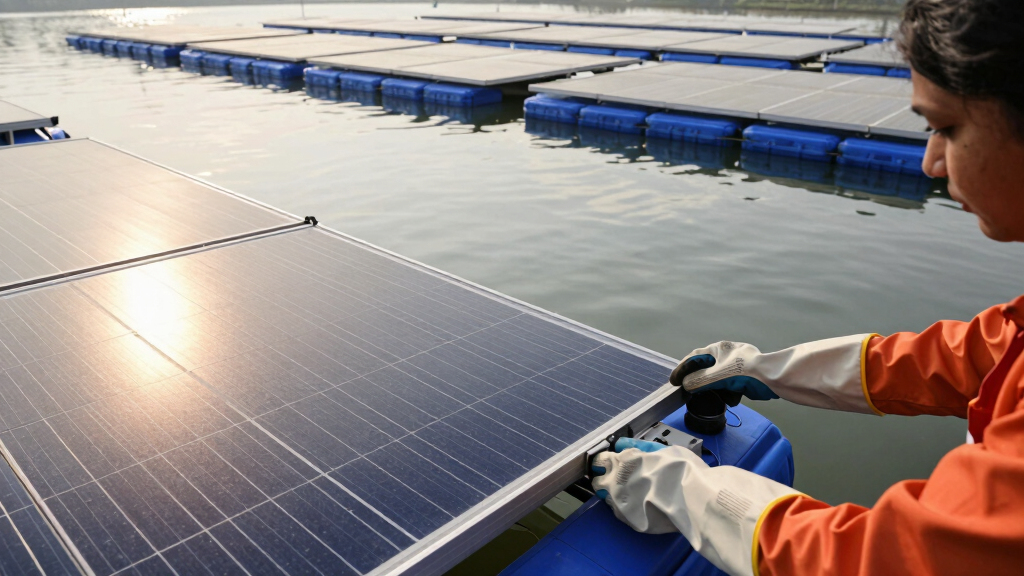
India’s floating solar PV potential is now estimated at over 102 GW, according to a NISE report. This significantly increases the country’s overall solar capacity potential to 3,445 GW. The government plans to accelerate floating solar deployment nationwide.
India’s floating solar PV potential has been estimated at over 102 gigawatts (GW), according to a new report from the National Institute of Solar Energy (NISE), significantly expanding the country’s overall solar capacity potential and prompting government plans for dedicated deployment schemes.
The NISE assessment increases India’s total deployable solar energy potential, now reaching 3,445 GW when combining ground-mounted and floating PV options. The floating solar potential alone is based on a detailed analysis of suitable water bodies across the country, considering size, water availability, depth, and proximity to infrastructure.
To identify feasible sites, NISE applied criteria including a minimum water body area of 10 hectares, water depths between 3 and 30 meters, and a global horizontal irradiation of at least 4.5 kWh/m²/day. The analysis focused on hydro-lake water bodies, excluding smaller or ecologically sensitive sites. Using assumptions of 545 W modules at 21% efficiency and a 5-degree tilt, the institute estimated that 0.019 km² of water surface is needed to deploy 1 MW of floating solar capacity.
Out of 10,725.99 km² of mapped water bodies, 4,546.01 km² were deemed suitable for floating solar development, with a maximum of 20% of each water body’s surface area allocated for installations to limit ecological impact. This yields a national potential of approximately 102 GW, with Maharashtra leading at 16.28 GW, followed by Madhya Pradesh, Karnataka, Odisha, and Telangana.
Implications of the 102 GW Floating Solar Estimate
This new estimate underscores India’s vast potential to expand renewable energy capacity through floating solar projects, which can be deployed on existing water bodies without requiring large land acquisitions. It signals a strategic opportunity for the country to meet its climate commitments and energy needs while optimizing resource use.
The government’s plan to introduce a dedicated scheme for floating solar could accelerate project development, attract investments, and help diversify India’s renewable energy portfolio. The potential also highlights the importance of sustainable water resource management in solar deployment.
Products Worth Considering

eufy Security SoloCam E42 4-Camera Kit, 4K Solar Security Cameras with HomeBase 3

Dyson Ball Animal 3 Upright Vacuum

Philips Hue Smart LED Candle Light Bulb (B39, E12) – 2 Pack
As an affiliate, we earn on qualifying purchases.
Background and Development of India’s Floating Solar Potential
India has been actively expanding its solar capacity, with prior assessments estimating ground-mounted solar potential at around 3,343 GW. The recent NISE report marks a significant shift by quantifying the country’s floating solar potential, which had not been comprehensively assessed before. The move aligns with global trends favoring floating solar as a land-efficient and environmentally adaptable solution.
Previous efforts have seen floating solar projects in India, but the new assessment provides a detailed, nationwide estimate, identifying over 4,500 km² of water bodies suitable for such installations. The government has signaled intentions to promote floating solar, including policy initiatives and pilot projects, to harness this potential efficiently.
“The assessment reveals a substantial opportunity for floating solar in India, which can complement ground-mounted projects and help meet ambitious renewable energy targets.”
— an anonymous researcher
Uncertainties and Limitations of the Assessment
While the assessment provides a comprehensive estimate, actual deployment depends on factors such as ecological considerations, local water management policies, and infrastructure development. The 20% utilization cap aims to minimize ecological impacts but may limit maximum capacity in some water bodies. Additionally, the report assumes certain technical parameters, which could vary with technological advancements or site-specific conditions. It is not yet clear how many of these sites will be developed into operational projects or how quickly deployment will occur.
Next Steps for Floating Solar Expansion in India
The Indian government plans to introduce a dedicated scheme to promote floating solar deployment, aiming to accelerate project development across suitable water bodies. Industry stakeholders and local authorities will likely conduct site-specific feasibility studies, environmental assessments, and infrastructure upgrades. Monitoring and policy support will be critical in translating the estimated potential into actual capacity additions over the coming years.
Key Questions
How does India’s floating solar potential compare globally?
India’s estimated 102 GW potential positions it among the leading countries in floating solar capacity, reflecting its large water bodies and ambitious renewable targets.
What are the main benefits of floating solar over ground-mounted systems?
Floating solar reduces land use conflicts, can improve panel efficiency through cooling effects, and utilizes existing water bodies, making it suitable for land-scarce regions.
When might we see large-scale floating solar projects in India?
With government schemes in development, initial projects could start within the next 1-2 years, but widespread deployment will depend on project approvals and infrastructure readiness.
Yes, ecological impacts are a consideration; the assessment limits installations to 20% of water surface areas to mitigate adverse effects on aquatic ecosystems and fisheries.
Will the assessment lead to policy changes?
Yes, the government has announced plans for a dedicated floating solar scheme, which is expected to facilitate streamlined approvals and incentives for project developers.
Source: PV Magazine