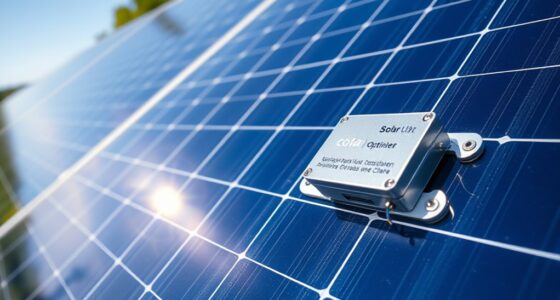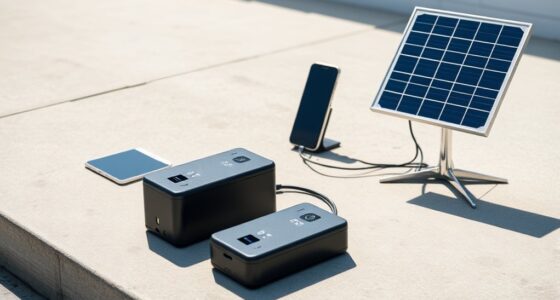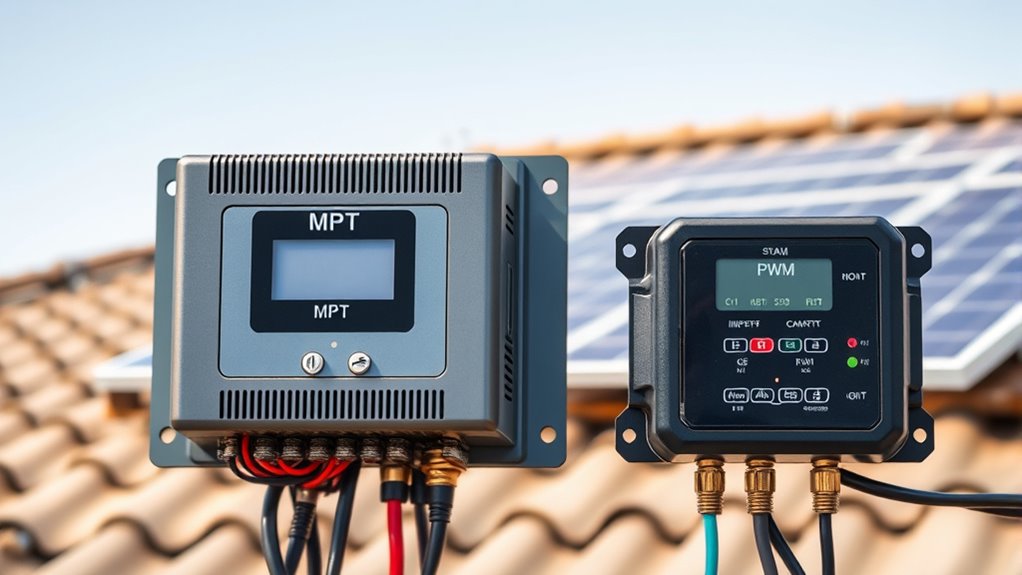

MPPT and PWM charge controllers both help manage solar power, but they work differently. PWM controllers are simpler and cheaper; they connect the panels directly to the batteries, which can reduce efficiency. MPPT controllers are more advanced; they constantly find the best voltage and current to maximize energy flow, especially in varying sunlight. If you want to understand which option fits your system best, there’s more to explore about their features and benefits.
Key Takeaways
- MPPT controllers optimize energy transfer by adjusting input voltage, while PWM controllers match panel voltage directly to the battery.
- MPPT offers higher efficiency and better performance in variable sunlight and larger systems compared to PWM.
- MPPT controllers are more expensive but provide greater long-term energy savings; PWM controllers are cheaper and easier to install.
- MPPT is ideal for high-voltage panels and larger setups, whereas PWM suits small, budget-friendly, low-voltage systems.
- Overall, MPPT delivers superior energy harvesting and battery longevity, making it suitable for more complex or demanding solar systems.

When choosing a charge controller for your solar power system, understanding the differences between MPPT and PWM technologies is crucial. Both types regulate the flow of electricity from your solar panels to your batteries, but they do so in distinct ways that impact your system’s overall performance and cost. One of the key factors to evaluate is battery efficiency. MPPT (Maximum Power Point Tracking) controllers are designed to maximize the power output from your panels by constantly adjusting their input to match the ideal voltage and current. This means they can extract more energy, especially on days with variable sunlight or when panels are connected in challenging configurations. As a result, your batteries receive a higher quality charge, which improves their efficiency and lifespan over time.
In contrast, PWM (Pulse Width Modulation) controllers operate by simply switching the power on and off at a fixed voltage, fundamentally bringing the panel’s voltage down to match the battery’s charging voltage. While they are less sophisticated, PWM controllers are straightforward and typically less expensive upfront. However, their simplicity can lead to lower battery efficiency since they don’t optimize the power transfer as effectively as MPPT units do. This can mean less energy stored from your panels, especially when your system involves higher voltage panels or varying sunlight conditions.
Installation costs are another important factor to weigh. MPPT controllers tend to have higher initial prices because of their advanced technology and complex circuitry. This means you’ll spend more upfront, but the increased efficiency can translate into more energy harvested and quicker returns on your investment. Meanwhile, PWM controllers are cheaper and easier to install, making them attractive for smaller or budget-conscious setups. If your system involves lower voltage panels, or if you’re working with a tight budget, PWM might be sufficient. But if you want to maximize your energy yield and ensure your batteries are charged efficiently, investing in an MPPT controller is often worthwhile.
Ultimately, the decision depends on your specific needs, system size, and budget. If you’re aiming for higher battery efficiency and are willing to pay a bit more for better performance, MPPT controllers are the way to go. They’re especially effective in larger systems or those with varying sunlight conditions. On the other hand, if you’re setting up a small, simple system and want to keep costs down, PWM controllers can still do the job. Understanding these differences helps you select the right controller, ensuring your solar setup is both cost-effective and efficient in the long run. Additionally, understanding solar panel configurations and how they impact charge controller choice can further optimize your system’s performance.

Victron Energy SmartSolar MPPT Solar Charge Controller (Bluetooth) – Charge Controllers for Solar Panels – 100V, 50 amp, 12/24-Volt
SMART SOLAR CHARGE CONTROLLER: Solar charge the smart way with the Victron Energy SmartSolar MPPT charge controller, to…
As an affiliate, we earn on qualifying purchases.
As an affiliate, we earn on qualifying purchases.
Frequently Asked Questions
Can PWM Controllers Handle Large Solar Arrays Effectively?
Yes, PWM controllers can handle large solar arrays, but with some limitations. They are best suited for smaller systems due to their lower solar array compatibility and less efficient performance at higher voltages. If you want to optimize efficiency and manage a large array effectively, consider an MPPT controller. PWM units are simpler and more affordable but may not maximize energy harvest from extensive or complex solar setups.
What Maintenance Is Required for MPPT Versus PWM Controllers?
You need to regularly check both MPPT and PWM controllers for reliable battery health by inspecting connections and cleaning any dirt or corrosion. Keep firmware updates current to guarantee your MPPT controller runs efficiently and benefits from the latest features. For PWM controllers, focus on maintaining clean connections. Regular maintenance helps extend the lifespan of your system, ensures dependable performance, and safeguards your batteries’ health over time.
Are There Specific Environments Where One Type Outperforms the Other?
You might find that MPPT controllers outperform PWM in colder, cloudier climates because they optimize power transfer despite fluctuating conditions. Conversely, PWM controllers excel in hot, stable environments with simple installation needs, making them more practical where climate stability is consistent. The choice hinges on climate adaptability and installation complexity—where one’s efficiency shines in specific environments, the other may fall short, revealing a strategic edge in your solar setup.
How Do Charge Controllers Impact Overall Solar System Lifespan?
Charge controllers substantially impact your solar system’s lifespan by boosting battery efficiency and ensuring system reliability. A high-quality controller prevents overcharging and deep discharges, which can damage batteries over time. By maintaining ideal charging conditions, it reduces wear and tear, extending the life of your batteries and other system components. Regularly using a reliable charge controller helps you avoid costly replacements and keeps your solar setup functioning smoothly longer.
What Are the Initial Cost Differences Between MPPT and PWM Controllers?
You’ll be stunned by the cost comparison—MPPT controllers typically cost twice as much as PWM models upfront. This initial investment analysis shows MPPTs are pricier, but they’re more efficient, especially in variable sunlight conditions. While PWM controllers are budget-friendly, MPPTs offer long-term savings through better energy harvest. So, weigh the higher initial cost against the potential energy gains to decide what best fits your solar setup.
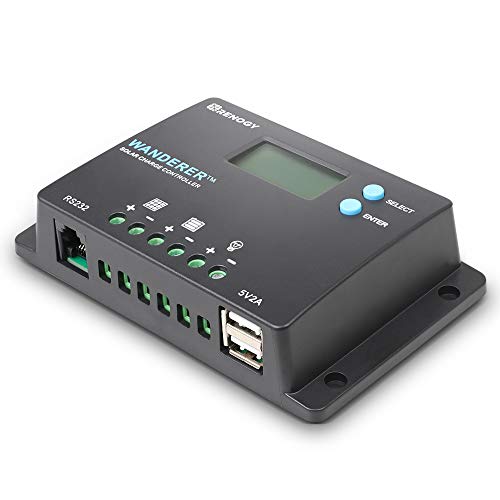
Renogy 10 Amp 12V/24V PWM Negative Ground Solar Charge Controller Compact Design w/LCD Display for AGM, Gel, Flooded and Lithium Battery, Wanderer 10A
𝐒𝐦𝐚𝐫𝐭 𝟒-𝐒𝐭𝐚𝐠𝐞 12V/24V Solar Charge Controller: Renogy charge controller 𝐦𝐚𝐱𝐢𝐦𝐢𝐳𝐞𝐬 𝐁𝐚𝐭𝐭𝐞𝐫𝐲 𝐋𝐢𝐟𝐞 & 𝐒𝐨𝐥𝐚𝐫 𝐄𝐟𝐟𝐢𝐜𝐢𝐞𝐧𝐜𝐲, this advanced pwm…
As an affiliate, we earn on qualifying purchases.
As an affiliate, we earn on qualifying purchases.
Conclusion
Choosing between MPPT and PWM charge controllers depends on your system needs, but did you know that MPPT controllers can be up to 30% more efficient than PWM models? This means you get more power from your solar panels, especially in colder or cloudier conditions. If maximizing energy and efficiency is your goal, MPPT is the way to go. Understanding these differences helps you make smarter decisions and get the most out of your solar investment.
Renogy 10 Amp 12V/24V PWM Negative Ground Solar Charge Controller Compact Design w/LCD Display for AGM, Gel, Flooded and Lithium Battery, Wanderer 10A
𝐒𝐦𝐚𝐫𝐭 𝟒-𝐒𝐭𝐚𝐠𝐞 12V/24V Solar Charge Controller: Renogy charge controller 𝐦𝐚𝐱𝐢𝐦𝐢𝐳𝐞𝐬 𝐁𝐚𝐭𝐭𝐞𝐫𝐲 𝐋𝐢𝐟𝐞 & 𝐒𝐨𝐥𝐚𝐫 𝐄𝐟𝐟𝐢𝐜𝐢𝐞𝐧𝐜𝐲, this advanced pwm…
As an affiliate, we earn on qualifying purchases.
As an affiliate, we earn on qualifying purchases.
Renogy 10 Amp 12V/24V PWM Negative Ground Solar Charge Controller Compact Design w/LCD Display for AGM, Gel, Flooded and Lithium Battery, Wanderer 10A
𝐒𝐦𝐚𝐫𝐭 𝟒-𝐒𝐭𝐚𝐠𝐞 12V/24V Solar Charge Controller: Renogy charge controller 𝐦𝐚𝐱𝐢𝐦𝐢𝐳𝐞𝐬 𝐁𝐚𝐭𝐭𝐞𝐫𝐲 𝐋𝐢𝐟𝐞 & 𝐒𝐨𝐥𝐚𝐫 𝐄𝐟𝐟𝐢𝐜𝐢𝐞𝐧𝐜𝐲, this advanced pwm…
As an affiliate, we earn on qualifying purchases.
As an affiliate, we earn on qualifying purchases.