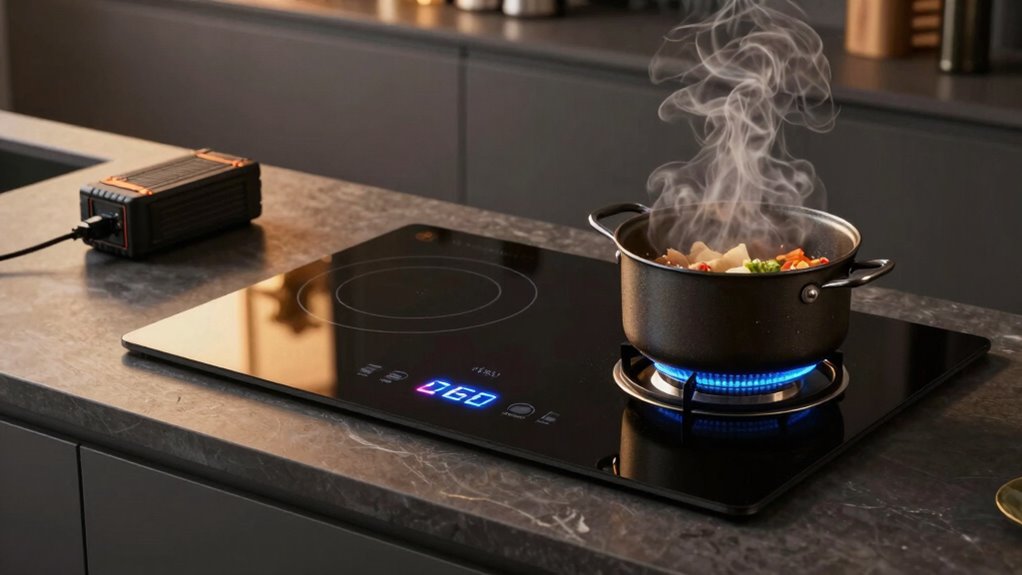

Running an induction cooktop on battery backup might sound appealing, but the math quickly shows why it’s impractical. These stoves need a lot of power, typically 1500 to 3000 watts, which requires large, heavy batteries that are costly and hard to handle. As batteries discharge, efficiency drops, making consistent heating difficult. If you want to understand the real challenges and limitations involved, keep exploring this topic further.

Get backup power and energy gear delivered free with Prime
- Fast, free delivery on millions of items
- Prime Video, Amazon Music and more included
- Member-only deals all year
Key Takeaways
- Induction cooktops require 1500-3000W, demanding large, costly batteries for even short backup durations.
- High-capacity batteries are heavy, expensive, and pose safety risks like overheating or fire hazards.
- Battery voltage drops during discharge reduce heating efficiency and consistency, impacting cooking performance.
- Long backup periods are impractical due to the substantial energy storage and safety considerations involved.
- The technical, economic, and safety challenges make reliable induction cooking backup systems unlikely for most households.

If you rely on induction cooking, you know how essential a steady power supply is for efficient meal preparation. When the power goes out or your main source of electricity fails, having a battery backup sounds like a smart solution. It promises uninterrupted cooking, allowing you to prepare meals without delays. But before you buy into the idea, it’s worth doing the math. While the concept seems straightforward, the reality of powering an induction stove on battery backup involves serious considerations around energy efficiency and safety concerns.
Induction cooktops are known for their energy efficiency—they use electromagnetic fields to directly heat pots and pans, minimizing wasted heat. However, this efficiency can be compromised when trying to run them on batteries. High-powered appliances like induction stoves consume a significant amount of energy, often requiring a large, high-capacity battery system. To keep your stove running for even a short period, you need a battery that can supply hundreds or thousands of watt-hours. That’s not only expensive but also bulky and heavy, making it impractical for most households. Even then, as the battery discharges, its voltage drops, which might lead to inconsistent heating or even system shutdowns, defeating the purpose of having backup power in the first place. Energy storage becomes a critical factor in determining the feasibility of such a setup. Additionally, the power demand of induction stoves can fluctuate significantly during operation, further complicating battery sizing.
Safety concerns also come into play. High-capacity batteries carry risks of overheating, fire, or explosion if not managed properly. When working with powerful electrical systems, you need appropriate safeguards, such as specialized inverters and battery management systems. If these aren’t in place, you could face dangerous situations. Additionally, improper installation might cause electrical faults or short circuits, especially when dealing with high currents required by induction stoves. Safety isn’t just about preventing accidents; it’s also about ensuring your backup system reliably provides power without risking damage to your appliances or household.
Doing the math reveals just how much energy a typical induction cooktop consumes—often around 1500 to 3000 watts. Running it continuously for an hour could require around 1.5 to 3 kilowatt-hours of energy. To sustain that with a battery system, you’d need a sizable bank of batteries, which quickly becomes costly and complex. You also need to consider how long you want the backup to last. If you only want to power your stove for a few minutes during an outage, small batteries might suffice. But for longer cooking sessions, the math shows that the required capacity becomes impractical and economically unfeasible. Additionally, the energy efficiency of the entire system can decrease as the battery discharges, further complicating reliable operation. Moreover, the environmental impact of large-scale battery storage should be factored into the decision-making process.
In conclusion, the power requirements of induction cooking make backup solutions challenging from both a technical and economic standpoint. While the idea is attractive, the practical limitations highlight the importance of understanding energy consumption and safety considerations before attempting such an upgrade.
induction cooktop battery backup
As an affiliate, we earn on qualifying purchases.
As an affiliate, we earn on qualifying purchases.
Frequently Asked Questions
How Long Can a Battery Realistically Power Induction Cooking?
You can realistically power induction cooking with a battery for only a short period, often just 30 minutes to an hour, depending on the battery’s capacity. This limits cooking safety because continuous use strains the battery and reduces its lifespan. To verify safety and efficiency, consider using high-capacity batteries designed for appliances, but remember, frequent use may shorten the battery’s overall lifespan.
What Are the Most Efficient Battery Types for This Purpose?
Think of batteries as the heart of power storage—your best allies for efficient energy. Lithium-ion batteries lead the pack, thanks to their high energy density and longevity, making them ideal for induction cooking. Their chemistry allows for rapid charging and discharging, maximizing power output. While other types like nickel-metal hydride or lead-acid exist, they fall short on capacity and weight, making lithium-ion the top choice for sustained, efficient cooking on battery backup.
How Does Battery Capacity Impact Cooking Time?
Your battery capacity directly affects cooking time; higher capacity means longer use before recharging. A bigger battery offers more cooking power, but also impacts battery lifespan and charging efficiency. Smaller capacities may drain quickly, limiting your cooking sessions. To maximize efficiency, choose a battery size that balances capacity with lifespan, ensuring you get consistent performance without rapid wear or frequent recharges. This way, you get reliable cooking time with ideal battery health.
Are There Safety Concerns With Battery-Powered Induction Cooking?
Yes, there are safety concerns with battery-powered induction cooking. You should watch out for safety hazards like battery overheating, which can lead to fires or explosions if not properly managed. Make certain your battery system has adequate cooling and safety features. Always follow manufacturer instructions and avoid overloading the battery, as this can increase risks. Proper handling and maintenance are essential to keep your cooking safe and efficient.
What Are the Cost Comparisons Between Battery Backup Systems?
Think of a battery backup as a silent guardian—initial costs seem manageable, but over time, expenses pile up like a mountain. Battery lifespan varies, making replacements inevitable, and power stability depends on the quality of the system. You’ll find that upfront costs are high, but long-term expenses for maintenance and replacements can make these systems pricier than traditional setups. Budget wisely, considering both initial investment and ongoing costs.
high capacity battery for induction stove
As an affiliate, we earn on qualifying purchases.
As an affiliate, we earn on qualifying purchases.
Conclusion
So, before you start dreaming of a future where your induction stove runs on battery backup, do the math first. It’s not quite the fantasy of a jetpack or a hoverboard just yet. You might find yourself feeling like a modern-day Marie Antoinette, waiting for her bread while your tech fails to keep up. Until batteries get a serious upgrade, it’s probably best to stick with the tried-and-true power source—unless you’re ready for a bit of a Wild West showdown.
As an affiliate, we earn on qualifying purchases.
As an affiliate, we earn on qualifying purchases.
Fall Picks
fall essentials
As an affiliate, we earn on qualifying purchases.