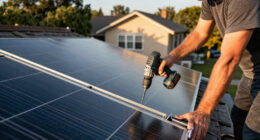
Choosing among solar panel cleaning robots comes down to how much of the work you want the machine to do, and what your roof or array can safely support. The 130 cm tracked robot is my coverage-focused pick: it combines a wide brush with edge detection and automatic turning, but its 53 kg weight and 15° slope limit narrow where it fits. The 80 cm tracked robot is a more compact remote-controlled option with a stated 20° climbing limit, though its 35 kg weight still calls for careful handling. For smaller or ground-level jobs, the electric telescopic brush avoids placing a heavy robot on the panels, at the cost of requiring mains power and hands-on control.

Get backup power and energy gear delivered free with Prime
- Fast, free delivery on millions of items
- Prime Video, Amazon Music and more included
- Member-only deals all year
I rank these by practical fit rather than brush width alone. Array access, slope, safe handling, runtime and water setup can matter more than maximum coverage. The best choice is the one that suits the panel layout and work area—not simply the machine with the largest brush.
Key Takeaways
- Pick the 130 cm tracked robot for broad, accessible arrays where its 53 kg frame can be positioned safely and the panel slope stays at or below 15°.
- Choose the 80 cm tracked robot when remote control and a stated 20° slope limit matter more than maximum brush width; its listed capacity lacks a time period.
- Choose the telescopic electric brush for smaller or ground-level cleaning if you prefer to control the brush from a pole and have access to mains power.
- All three offer dry and wet cleaning, but wet operation needs a water source and hose or pump setup; the tracked robots add more equipment to handle.
- Check the complete work area before buying: weight, slope, panel gaps, edge geometry, cord or hose reach, and safe access are as important as brush speed.
| Solar Panel Cleaning Robot with 130 cm Brush, Remote Control, Battery, and 100 m Hose |  | Best Overall for Broad, Suitable Arrays | Cleaning width: 130 cm | Cleaning speed: 20 m/min | Cleaning capacity: 1,170 m²/h stated | VIEW LATEST PRICE | See Our Full Breakdown |
| Tracked Solar Panel Cleaning Robot with Remote Control and 80 cm Brush |  | Best for a Higher Stated Slope Limit | Brush width: 80 cm | Brush speed: 150–300 RPM | Walking speed: 10–20 m/min | VIEW LATEST PRICE | See Our Full Breakdown |
| Electric Solar Panel Cleaning Brush with Telescopic Pole |  | Best Value-Style Choice for Ground-Guided Cleaning | Cleaning width: 600 mm | Brush speed: 150–300 RPM | Pole lengths: 3.5 m, 5.5 m or 7.5 m | VIEW LATEST PRICE | See Our Full Breakdown |
| solar panel cleaning robot | Cleaning width | Movement | Battery | Slope limit |
|---|---|---|---|---|
| Solar Panel Cleaning Robot wit | 130 cm | Tracked; remote control, edge detection and 90° automatic turning | 24 V, 45 Ah lithium; 4–5 hours stated runtime | 15° maximum inclination |
| Tracked Solar Panel Cleaning R | — | Tracked; remote control | 24 V, 30 A rechargeable; up to 4 hours stated | 20° maximum |
| Electric Solar Panel Cleaning | 600 mm | — | — | — |
More Details on Our Top Picks
Solar Panel Cleaning Robot with 130 cm Brush, Remote Control, Battery, and 100 m Hose
The 130 cm brush gives this tracked model the strongest coverage case in the group. A wide rotating brush can sweep more panel surface per pass than the 80 cm brush on the Xoiasth, which may reduce the number of passes across a large, continuous array. The listed cleaning speed is 20 m/min, and the stated capacity is 1,170 m²/h. Those figures make this the lineup’s clearest option for buyers prioritizing throughput, although actual performance will depend on array layout, soiling, operating conditions, and the route the robot can take.
Its strongest differentiator is the combination of remote control, edge detection and 90° automatic turning. These features are intended to help it move across panels and change direction without relying on an operator to steer every turn. They are not a substitute for checking panel edges, gaps, and the machine’s operating limits. The robot weighs 53 kg and is specified for slopes no steeper than 15°. The listing also says it is not intended for gaps wider than 20 cm or suspended surfaces. That makes it a specialized choice for an accessible, compatible array—not a universal answer for every rooftop.
Compared with the 80 cm tracked robot, this model offers a much wider brush and a more detailed list of movement features, but it is heavier and has a lower stated slope limit. The 80 cm model lists a 20° maximum slope and weighs about 35 kg; it may be easier to handle and may suit some steeper layouts within its stated limit. Compared with the telescopic electric brush, the 130 cm robot reduces the need to guide a brush head along each panel from a pole, but it brings more weight, a battery, remote-control operation, and a water system to set up.
Wet and dry modes give buyers flexibility, while the included 100 m hose, pump, scraper, and rechargeable battery form a substantial working kit. Its 24 V, 45 Ah battery is rated for 4–5 hours, a useful planning figure for a work session, though charging and positioning still need to be managed. I would make this my first choice only after confirming that the array’s slope, gaps, edges, and access route match the stated limits. Buyers with narrow rows, suspended panels, steep surfaces, or no safe way to position a 53 kg machine should choose another approach.
Pros:- 130 cm rotating brush offers the widest stated cleaning path in this comparison.
- Edge detection and 90° automatic turning add movement assistance beyond the 80 cm model.
- Includes remote control, pump, scraper, battery and 100 m hose.
- Battery runtime is specified at 4–5 hours, and both dry and wet cleaning are supported.
Cons:- At 53 kg, it is the heaviest option and may be difficult to transport or position.
- The stated maximum inclination is 15°, below the 80 cm tracked model’s 20° limit.
- The listing excludes gaps wider than 20 cm and suspended surfaces.
Best for: Owners or maintenance teams with large, continuous panel arrays at slopes of 15° or less, suitable gaps, and a safe way to position a 53 kg tracked machine.
Not ideal for: Buyers with slopes above 15°, gaps wider than 20 cm, suspended panels, narrow or fragmented layouts, or limited equipment-handling access.
- Cleaning width:130 cm
- Cleaning speed:20 m/min
- Cleaning capacity:1,170 m²/h stated
- Movement:Tracked; remote control, edge detection and 90° automatic turning
- Battery:24 V, 45 Ah lithium; 4–5 hours stated runtime
- Slope limit:15° maximum inclination
- Water setup:45–60 L/min stated flow; 100 m hose included
- Weight:53 kg
Our verdict“I rank it first for broad, compatible arrays because its 130 cm brush and assisted turning provide the most coverage-focused package, provided its weight and 15° slope limit suit the site.”
Tracked Solar Panel Cleaning Robot with Remote Control and 80 cm Brush
This Xoiasth model takes the tracked, remote-controlled approach but scales the brush down to 80 cm. That is narrower than the 130 cm machine’s cleaning path, so buyers covering a large, uninterrupted array may need more passes. In exchange, its listed maximum slope is 20°, five degrees above the 130 cm robot’s stated limit. For a site where that difference matches the actual panel angle, the smaller-brush model may be the more suitable tracked choice. I would still confirm the manufacturer’s conditions for slope measurement and operation before relying on that limit.
The 24 V rechargeable battery is rated for up to four hours, and the machine supports both dry brushing and water-fed cleaning. Its remote control and tracked movement let the operator guide the machine without standing directly on the panels, which distinguishes it from the telescopic brush. The kit lists a 100 m water hose, pump, stainless-steel inlet pipe, scraper, and 80 cm brush. Wet cleaning can be useful when dry brushing is not the preferred method, but it adds a hose and water supply to manage around the array.
At approximately 35 kg including the brush, it is lighter than the 53 kg 130 cm model, though it remains heavy equipment rather than a simple hand tool. That weight affects carrying, loading, deployment, and recovery. The listing describes a cleaning capacity of 1,000–2,000 m², but does not specify the period. I would not compare that figure directly with the 130 cm model’s stated hourly capacity. The walking speed is listed at 10–20 m/min, which gives a more transparent movement figure, but cleaning results depend on more than travel speed.
Compared with the 130 cm robot, this is the more slope-tolerant-on-paper and lighter tracked alternative, not the wider or more feature-detailed machine. Compared with the telescopic brush, it can move across compatible panel surfaces remotely and has a much longer supplied water hose, but it requires careful positioning and has a substantial weight. It makes the most sense for buyers who specifically want a tracked robot, value the stated 20° limit, and can accommodate an 80 cm brush. Skip it if you need clearly documented hourly capacity, a very light device, or a machine for slopes beyond its stated rating.
Pros:- The stated 20° slope limit is higher than the 130 cm tracked model’s 15° limit.
- Remote control and tracked movement support operation without standing on panels.
- Dry and water-fed modes, a pump, scraper and 100 m hose are included.
- Its approximate 35 kg weight is lower than the 130 cm robot’s 53 kg.
Cons:- The 80 cm brush covers less width per pass than the 130 cm model.
- The stated 1,000–2,000 m² cleaning capacity does not identify a time period.
- At about 35 kg, it still requires a safe plan for transport and positioning.
Best for: Buyers seeking a remote-controlled tracked cleaner for glass panels who value its stated 20° slope limit and can work with an 80 cm brush.
Not ideal for: Buyers who need a clearly stated time-based capacity, a very light machine, a brush wider than 80 cm, or operation on slopes steeper than 20°.
- Brush width:80 cm
- Brush speed:150–300 RPM
- Walking speed:10–20 m/min
- Movement:Tracked; remote control
- Battery:24 V, 30 A rechargeable; up to 4 hours stated
- Slope limit:20° maximum
- Water setup:7–8 m lift stated; 100 m hose included
- Weight:Approximately 35 kg including brush
Our verdict“I would choose this tracked model over the wider robot when its stated 20° slope limit better matches the site, while accepting less brush coverage and an unclear capacity period.”
Electric Solar Panel Cleaning Brush with Telescopic Pole
This option is not a tracked robot, and that difference is central to whether it belongs in a buyer’s shortlist. It is an electric rotating brush on a telescopic pole, guided by the operator rather than driven across the array. For ground-mounted panels or jobs where a pole can reach from a safe working position, that setup avoids placing a 35 kg or 53 kg robot on the panels. It also gives the operator direct control over where the brush goes. The tradeoff is that cleaning remains hands-on: this is not the remote-operated, tracked approach offered by the other two products.
The 600 mm cleaning width is narrower than either tracked robot’s brush—80 cm on the Xoiasth and 130 cm on the wider machine. That means more deliberate passes across a broad array, but it can be easier to manage when working on smaller areas or around localized dirt. The brush rotates at 150–300 RPM and supports dry cleaning or water washing. Its nylon bristles are described as suitable for panel surfaces, though I would follow the supplier’s care guidance and avoid pressing hard enough to risk scratching or stressing a panel.
The aluminum telescopic pole is offered in 3.5 m, 5.5 m, or 7.5 m lengths, so the buyer can match reach to the work area. That choice is useful, but it has to be made at purchase rather than adjusted across all three listed lengths. The kit includes a pump, hoses, converters, plugs, and an 8 m power cord. Compared with the battery-powered tracked robots, the mains-powered brush avoids planning a battery runtime, but it needs an appropriate power source and cord reach. The 8 m cord may constrain where the operator can work unless the site has a suitable outlet and setup.
This is my pick for buyers who want powered brushing without a tracked machine, particularly for ground-level arrays or reachable panels. It is also the clearest choice here for someone who prefers a pole tool and can manage its cord and water equipment. It is not the right substitute for remote cleaning over a large, steep roof: the brush is narrower, the operator controls it manually, and the corded power arrangement may complicate access. For hands-off coverage, compare it with the tracked robots; for simpler, ground-guided work, its lighter operational format may be a better fit than handling a heavy robot.
Pros:- Pole-guided operation avoids deploying a 35–53 kg tracked robot across panels.
- Dry brushing and water washing are both supported.
- Three pole-length choices accommodate different reach needs.
- The 600 mm brush and rotating head suit targeted cleaning on accessible surfaces.
Cons:- Mains power and an 8 m cord can restrict where it can be used.
- The 600 mm cleaning width is narrower than both tracked robots’ brushes.
- The pole length must be selected from the three offered options.
Best for: Owners of ground-mounted or safely reachable panels who want an electric rotating brush, adjustable pole length and wet or dry cleaning without putting a tracked machine on the array.
Not ideal for: Buyers seeking remote-controlled, self-propelled cleaning, wide-area automated coverage, cordless operation, or a tool for panels beyond safe pole reach.
- Cleaning width:600 mm
- Brush speed:150–300 RPM
- Pole lengths:3.5 m, 5.5 m or 7.5 m
- Power:100–240 V; 8 m power cord
- Cleaning modes:Dry cleaning or water washing
- Water pump:24 V DC; 7–8 m lift; 45–60 L flow stated
- Brush material:Nylon bristles
- Pole material:Aluminum alloy
Our verdict“I recommend this pole brush for accessible, smaller-scale cleaning where operator control matters more than remote movement or the wider coverage of a tracked robot.”
How We Picked
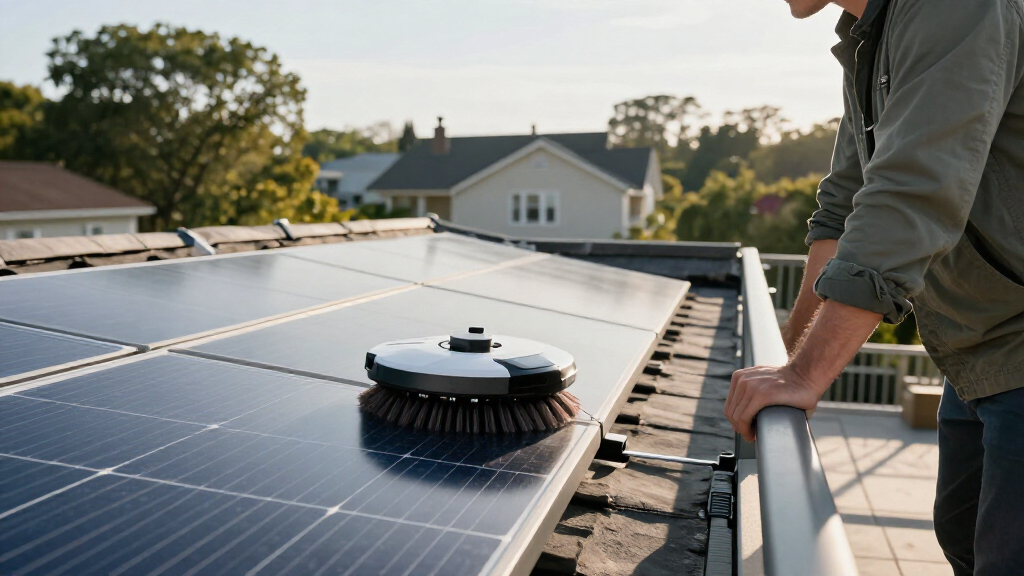
I compared these three options as tools for cleaning photovoltaic panels, not as general-purpose outdoor brushes. I focused on the factors that change a purchase decision: how the machine moves, how much panel width it covers, how it is powered, what cleaning modes it supports, and what physical limits its specifications disclose. The products represent two different approaches. The telescopic brush is guided by an operator from the ground or another safe position, while the two tracked models move across the panel array under remote control.
My ranking puts the 130 cm tracked robot first for buyers with a large, suitable array because it lists the broadest cleaning width and adds edge detection and automatic turning. Those features make its intended operating style more self-directed than the other options, but they do not remove the need to check slope, gaps, edge conditions, and handling safety. The 80 cm tracked robot comes second: it has a smaller brush, but its stated 20° maximum slope is higher than the 130 cm model’s 15° limit. The telescopic brush ranks third as a robot alternative rather than a less capable version of one; it suits buyers who need a powered brush but do not want a 35–53 kg tracked machine on the panels.
I also treated unclear or restrictive specifications as real tradeoffs. For example, the 80 cm model lists a cleaning capacity of 1,000–2,000 m² without defining the period, so I do not use it as a dependable hourly comparison. The 130 cm model gives a capacity of 1,170 m²/h, but that figure should still be read alongside its stated slope and use limits. Neither a broad brush nor remote operation is proof that a particular roof is safe for the machine. Before purchase, I would verify compatibility with the manufacturer and plan how to move, secure, supply, and retrieve the equipment.
| solar panel cleaning robot | Movement |
|---|---|
| Solar Panel Cleaning Robot wit | Tracked; remote control, edge detection and 90° automatic turning |
| Tracked Solar Panel Cleaning R | Tracked; remote control |
| Electric Solar Panel Cleaning | — |
Factors to Consider When Choosing Solar Panel Cleaning Robots
I would begin with the array and work area, then choose a cleaning format. A brush width or advertised capacity is only useful if the machine can reach the panels, move across their layout, and be handled safely. These three products split into two tracked robots and one pole-guided electric brush, so the first decision is whether you need remote movement or direct operator control.
Choose between a tracked robot and a pole brush
The two tracked models are designed to move over compatible panels under remote control. That can reduce the need for an operator to guide a brush head by hand, but it introduces a heavy machine that must be placed, monitored, and retrieved. The Xoiasth weighs about 35 kg; the 130 cm model weighs 53 kg. Think through how the equipment will be transported to the array and how it can be recovered if it stops or reaches a difficult part of the layout.
The telescopic brush takes the opposite approach. The operator guides its rotating head using a pole, so it is better suited to ground-mounted or safely reachable panels than an array where remote movement is needed. Its 600 mm brush is narrower than either robot’s, but avoiding a heavy tracked device can be a meaningful advantage. I would not treat it as a robot simply because the brush is powered; the labor and control method are different.
Match brush width to array layout
Brush width can affect the number of passes required. The 130 cm unit has the widest stated brush, followed by the 80 cm Xoiasth and the 600 mm pole brush. A wide brush may suit large, continuous panel runs, while a narrower head can be easier to guide around smaller sections or a more segmented layout. Coverage width alone does not tell you whether the device can turn or travel between rows.
Check panel dimensions, row spacing, obstructions, gaps, and edge shape. The 130 cm robot is listed as unsuitable for gaps wider than 20 cm and suspended surfaces. The pole brush does not cross panel rows on its own, while the tracked models need a workable route. Layout compatibility matters more than the largest number on a spec sheet; ask the seller to confirm the exact array arrangement before ordering.
Read slope limits as boundaries, not targets
The 80 cm tracked robot lists a maximum slope of 20°, while the 130 cm model lists 15°. That makes the smaller robot the higher-rated choice on the supplied figures, but neither figure should be treated as a promise for every surface condition. Panel angle, wetness, surface condition, wind, and the machine’s operating instructions can affect safe use. The telescopic brush has no corresponding tracked slope rating in the supplied specifications because it is guided by an operator rather than climbing across the panels.
I would verify the site’s actual inclination and ask the manufacturer what the limit means for the intended cleaning mode. Do not assume that a robot rated for a particular angle is safe on a roof with difficult edges or an uncertain support surface. If your array exceeds the stated limit, rule that model out rather than trying to make a wider brush or higher capacity compensate.
Compare power, runtime and reach
The two tracked robots use rechargeable batteries. The 80 cm model lists up to four hours per charge, and the 130 cm model lists 4–5 hours. Those runtime figures help with planning, but the actual work session also depends on travel, setup, cleaning conditions, and charging arrangements. Both tracked kits include water equipment, and both list a 100 m hose. A long hose can support a larger work area, but it still needs a suitable water source and a route that will not interfere with operation.
The pole brush uses a 100–240 V power supply and includes an 8 m cord. It does not list a battery runtime, but it ties operation to mains power and cord reach. Its pump and hoses add wet-cleaning options, while dry brushing avoids the water connection. Before choosing, map the distance from the power or water source to the whole work area. Reach is a practical limit: a machine can have the right brush and cleaning mode yet still be awkward to use if its cord or hose cannot be routed safely.
Decide whether dry or wet cleaning suits the job
All three options list dry and wet cleaning. Dry brushing avoids connecting a water supply, while water-fed cleaning may better suit jobs where an operator wants to rinse as part of the process. The product details do not establish that one mode is best for every kind of dirt, panel coating, or local water condition. Follow the panel and equipment manufacturers’ instructions, and use a cleaning method suitable for the surface.
The tracked robots include pumps and long hoses, while the pole brush includes a pump and associated pipework. Wet operation adds setup and hose management to the job; dry operation is simpler to supply but may not match every cleaning need. Consider water access, drainage, and how the hose will lie around the array. Choose the mode you can use safely and consistently, rather than assuming that having both modes makes every site suitable.
Treat capacity figures with care
The 130 cm model lists a cleaning capacity of 1,170 m²/h, and the 80 cm robot lists 1,000–2,000 m² without a stated period. These figures are not directly comparable: one is explicitly hourly and the other does not define its time basis. A capacity claim also cannot describe every array, since turns, panel gaps, dirt, water setup, and operating conditions change the pace of work.
The pole brush does not provide a comparable area-per-hour figure in the supplied details. I would use brush width, movement method, and site layout to estimate whether each option fits the job, then ask the manufacturer how capacity was measured. Do not rank these models by capacity alone, especially when one listing leaves the time period unspecified.
Plan transport and safe operation before purchase
The tracked machines are heavy enough that handling deserves as much attention as the cleaning mechanism. A 35 kg robot is lighter than a 53 kg one, but both may need more than one person or suitable lifting and transport arrangements, depending on the site. Consider access paths, ladders or other equipment, loading, panel-edge risks, and how the unit can be removed after work. Remote control does not make deployment or retrieval remote.
The pole brush avoids moving a tracked robot onto the panels, but the pole’s selected length, cord, water pipes, and operator position still matter. Check that the work can be done without unsafe leaning or reaching. For any product, read the manual and confirm that the panel type, layout, and operating conditions are supported. If safe access is uncertain, pause the purchase decision and get qualified guidance on a suitable cleaning plan.
Frequently Asked Questions
Which of these products is actually a solar panel cleaning robot?
The 80 cm and 130 cm options are tracked, remote-controlled cleaning robots. The Electric Solar Panel Cleaning Brush is a powered brush on a telescopic pole, guided directly by the operator. I include it as a useful alternative for panel cleaning, but it does not move over the array under its own control. Buyers who want remote movement should compare the tracked models; buyers who need a ground-guided tool should look at the pole brush.
Which tracked model covers the most panel width?
The 130 cm tracked robot has the widest stated brush, ahead of the 80 cm Xoiasth. A wider brush may reduce passes on a large, continuous array, but it does not automatically make the robot the better choice. Its 53 kg weight, 15° maximum inclination, and restrictions around gaps and suspended surfaces are important limits. The 80 cm model has a lower stated weight and a 20° slope limit, so I would match brush width to the site rather than choosing by width alone.
Can I use these cleaners on a steep roof?
The supplied specifications list a maximum slope of 20° for the 80 cm tracked robot and 15° for the 130 cm model. Those are limits to check against the actual surface, not a guarantee that a machine will be suitable on every roof at that angle. The telescopic brush is not described with a tracked slope rating, since it is controlled by an operator. Confirm the intended conditions with the manufacturer, follow the manual, and do not use a model beyond its stated limit.
Do the robots need water to clean panels?
No. Both tracked robots list dry and wet cleaning modes, and the telescopic brush also supports dry brushing or water washing. Wet cleaning requires a suitable water supply and management of the included hose and pump equipment. Dry cleaning avoids that water setup, but the appropriate method depends on the panel maker’s guidance and the type of dirt. I would check those instructions before selecting a mode or using any brush on the surface.
What should I verify before buying a tracked cleaner?
Check the panel slope, surface and row layout, edges, gaps, safe route, and whether the machine’s weight can be transported and positioned safely. The 130 cm model is listed as unsuitable for gaps wider than 20 cm and suspended surfaces; the 80 cm model lists a 20° slope limit. Also confirm battery and water arrangements, hose reach, control range, panel compatibility, and the manufacturer’s operating instructions. I would get explicit confirmation for your array rather than assuming that a general product description covers your installation.
Conclusion
For large, continuous arrays with slopes of 15° or less, I would start with the 130 cm tracked robot if its 53 kg weight, gap restrictions, and handling demands fit the site. If the higher listed slope limit is more useful and an 80 cm brush is sufficient, the Xoiasth is the more sensible tracked alternative; its capacity figure needs clarification because no time period is given. For ground-mounted or safely reachable panels, the telescopic electric brush avoids putting a heavy robot on the array, but it requires direct operator control, mains power, and a suitable cord route.
My final choice depends on the work area, not on a single specification. Confirm slope, gaps, access, power or water reach, and safe positioning before ordering. If those conditions do not clearly fit a tracked robot, the pole-guided brush—or a different cleaning plan—may be the safer match.
Black Friday Picks

Sonos Era 100 SL Wireless Speakers, Black, Pack of 2
As an affiliate, we earn on qualifying purchases.