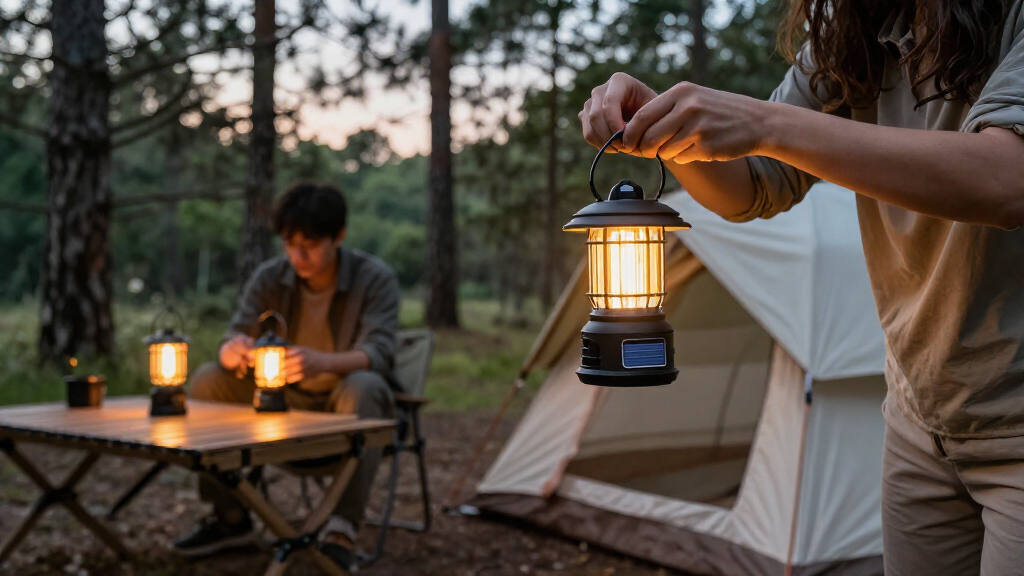
Solar-powered camping lanterns range from lightweight inflatable lights to brighter rechargeable models and multi-packs for group campsites. I’d put the Westinghouse 1000-Lumen Solar Camping Lantern first for its stated brightness and five lighting modes, while the LuminAID Nova stands out for compact inflatable portability and the Raynic for backup hand-crank charging. The main tradeoff is between dependable brightness and charging flexibility: solar input can be slow or weather-dependent, while USB or hand-crank options add resilience but may bring extra bulk. Multi-packs can spread light around camp, though they may offer fewer individual features than a single premium lantern. Read on for the full comparison, buying criteria, and recommendations by camping style.

Get backup power and energy gear delivered free with Prime
- Fast, free delivery on millions of items
- Prime Video, Amazon Music and more included
- Member-only deals all year
Key Takeaways
- The Westinghouse is the brightness-led pick: its stated 1000 lumens and five modes make it the clearest option for buyers prioritizing broad campsite illumination.
- The LuminAID Nova favors packability: its inflatable design stores flat, while the larger LuminAID Max adds phone-charging capability for buyers willing to carry a bigger unit.
- Solar should be treated as a supplemental charging method: several models also support USB charging, and the Raynic adds a hand crank for situations where sunlight and outlet access are limited.
- Multipacks solve a different problem than premium singles: DIBMS, Mesqool, XTAUTO, and LETMY bundles can distribute lights across tents and shared areas, but buyers should compare per-lantern features and power options.
- Published specs are not a complete runtime comparison: brightness, mode, battery condition, and available sunlight affect real use, so buyers should check runtime and charging details before relying on a lantern for extended trips.
| LuminAID Nova Inflatable Solar LED Lantern |  | Best Compact, Weatherproof Pick | Maximum light output: 75 lumens | Battery runtime: Up to 24 hours | Recharge methods: Solar or micro-USB | VIEW LATEST PRICE | See Our Full Breakdown |
| Rechargeable Solar Camping Lantern, 5200mAh, 1000 Lumens, 6 Brightness Levels, IPX5 |  | Best for Lighting Modes and Emergency Backup | Maximum light output: 1000 lumens | Battery capacity: 5200mAh | Brightness levels: 6 | VIEW LATEST PRICE | See Our Full Breakdown |
| Raynic Rechargeable LED Camping Lantern with Hand Crank and Solar Charging |  | Best for Off-Grid Charging Flexibility | Maximum light output: 650 lumens | Runtime: Up to 200 hours at 50 lumens | Battery capacity: 6000mAh | VIEW LATEST PRICE | See Our Full Breakdown |
| Westinghouse 1000-Lumen Solar Camping Lantern with 5 Lighting Modes |  | Best for USB-C Charging and Bright Area Light | Maximum light output: 1000 lumens | Color temperature: 5000 K | Lighting modes: High, medium, low, and SOS | VIEW LATEST PRICE | See Our Full Breakdown |
| LuminAID Max Inflatable Solar LED Camping Lantern and Phone Charger |  | Best Solar Lantern and Phone-Charging Combo | Maximum light output: 200 lumens | Brightness: Adjustable, with Turbo mode | Recharge methods: Solar or USB | VIEW LATEST PRICE | See Our Full Breakdown |
| DIBMS 4-Pack Solar Camping Lanterns with Collapsible Flashlight |  | Best Multi-Light Value | Pack count: 4 | Maximum lantern output: 300 lumens | Light sources: 6 lantern LEDs and 1 flashlight LED | VIEW LATEST PRICE | See Our Full Breakdown |
| Mesqool Rechargeable Solar Camping Lanterns with Flashlight, 4-Pack |  | Best Four-Pack for Extended Runtime | Pack quantity: 4 | Maximum light output: 350 lumens | Beam angle: 360 degrees | VIEW LATEST PRICE | See Our Full Breakdown |
| Solar Camping Lantern Rechargeable 5000mAh LED with 5 Light Modes IP65 Waterproof |  | Best High-Output Emergency Lantern | Maximum brightness: 2,000 lumens | Battery capacity: 5,000 mAh | Charging: USB fast charging; no built-in solar panel | VIEW LATEST PRICE | See Our Full Breakdown |
| XTAUTO Collapsible Solar and USB Rechargeable LED Camping Lantern, 4-Pack |  | Best Simple, Compact Four-Pack | Pack size: 4 | Light source: 7 LEDs | Battery capacity: 1,600 mAh | VIEW LATEST PRICE | See Our Full Breakdown |
| Glocusent 400H Rechargeable Camping Lantern with Solar Charging |  | Best Overall for Solar-Assist Versatility | Maximum stated light output: 1,200 lumens | Listed brightness range: 15–250 lumens | Battery capacity: 5,000 mAh | VIEW LATEST PRICE | See Our Full Breakdown |
| XTAUTO 2-Pack Collapsible Solar and USB Rechargeable Camping Lanterns |  | Best for Simple Two-Person Camps | Pack count: 2 lanterns | Light source: LED | Battery capacity: 1,600 mAh per lantern | VIEW LATEST PRICE | See Our Full Breakdown |
| DIBMS 2-Pack Collapsible Solar Camping Lanterns with Flashlights |  | Best for Predictable Recharging | Pack count: 2 lanterns | Maximum light output: 300 lumens | Battery capacity: 1,600 mAh per lantern | VIEW LATEST PRICE | See Our Full Breakdown |
| LETMY 4-Pack Rechargeable Solar Camping Lanterns with USB and AA Battery Power |  | Best Multi-Source Backup Set | Pack count: 4 lanterns | Light source: COB LED | Maximum light output: 600 lumens | VIEW LATEST PRICE | See Our Full Breakdown |
| solar powered camping lantern | Water resistance | Battery capacity | Maximum light output | Weight |
|---|---|---|---|---|
| LuminAID Nova Inflatable Solar | IP67 waterproof | — | 75 lumens | 5.3 ounces |
| Rechargeable Solar Camping Lan | IPX5 | 5200mAh | 1000 lumens | 293 g |
| Raynic Rechargeable LED Campin | IPX4 | 6000mAh | 650 lumens | 13.28 ounces |
| Westinghouse 1000-Lumen Solar | IPX4 | 4000mAh | 1000 lumens | — |
| LuminAID Max Inflatable Solar | IP67 waterproof and dustproof | — | 200 lumens | — |
| DIBMS 4-Pack Solar Camping Lan | IPX4 | 1,600 mAh per light | — | 8.02 oz |
| Mesqool Rechargeable Solar Cam | Waterproof | 1,600 mAh per light | 350 lumens | — |
| Solar Camping Lantern Recharge | IP65 | 5,000 mAh | — | 250 g |
| XTAUTO Collapsible Solar and U | Waterproof | 1,600 mAh | — | — |
| Glocusent 400H Rechargeable Ca | — | 5,000 mAh | — | 153 g (5.4 oz) |
| XTAUTO 2-Pack Collapsible Sola | Described as waterproof | 1,600 mAh per lantern | — | — |
| DIBMS 2-Pack Collapsible Solar | IPX4 | 1,600 mAh per lantern | 300 lumens | 8.02 oz |
| LETMY 4-Pack Rechargeable Sola | Described as water-resistant | — | 600 lumens | — |
More Details on Our Top Picks
LuminAID Nova Inflatable Solar LED Lantern
The LuminAID Nova earns this spot for campers who value a small, tough light over maximum brightness. At 5.3 ounces, it packs down for a daypack, while its inflatable body avoids the rigid shape of the Westinghouse 1000-Lumen lantern. Its IP67 waterproof, dustproof, and shatterproof construction is also better suited to wet or dusty campsites than the IPX4 Raynic. Output tops out at 75 lumens, though, so it is best for close-up camp tasks and tent lighting—not illuminating a large group area. Solar charging takes about 10 hours of direct sun, and USB charging uses micro-USB. I’d choose it for compactness and protection, but skip it if you need strong area lighting or a current charging connector.
Pros:- Lightweight inflatable design packs easily and resists shattering.
- IP67 protection suits wet, dusty outdoor conditions.
- Offers both solar and micro-USB recharging.
- Can run for up to 24 hours per charge.
Cons:- 75 lumens is limited for lighting a broad campsite.
- Solar recharge takes approximately 10 hours in direct sunlight.
- Uses micro-USB rather than USB-C.
Best for: Backpackers and minimalist campers who need a lightweight, weatherproof lantern for tent or personal-area lighting.
Not ideal for: Campers lighting a large shared site or anyone who needs high output; its 75-lumen ceiling is far below the Westinghouse and SAMUUN lanterns.
- Maximum light output:75 lumens
- Battery runtime:Up to 24 hours
- Recharge methods:Solar or micro-USB
- Solar recharge time:Approximately 10 hours in direct sunlight
- USB recharge time:1–2 hours
- Water resistance:IP67 waterproof
- Weight:5.3 ounces
- Dimensions:4.75 × 4.75 × 4.75 inches
Our verdict“Choose the Nova for a light, packable lantern with strong weather protection, but pick a brighter model for group use.”
Rechargeable Solar Camping Lantern, 5200mAh, 1000 Lumens, 6 Brightness Levels, IPX5
The SAMUUN C30 is the most adaptable choice here when one lantern needs to cover several jobs. It combines up to 1000 lumens with six brightness levels and white, warm, cool, red, and SOS settings, giving it more lighting variety than the Westinghouse, whose listed modes omit red light. Its 5200mAh battery and phone-charging function add emergency utility, while a collapsible handle makes it easy to carry or hang. The tradeoff is less confidence in wet conditions: IPX5 means water resistance, not submersion protection like the LuminAID Nova’s IP67 rating. The product data also makes an implausible battery-life claim, so I would not rely on that figure. This suits campers who want flexible modes and backup power more than a proven waterproof build.
Pros:- Six brightness levels and several color modes, including red and SOS.
- Up to 1000 lumens for broader campsite lighting.
- 5200mAh battery supports emergency phone charging.
- Solar and USB charging with a compact collapsible handle.
Cons:- IPX5 water resistance does not make it suitable for submersion.
- Solar charging performance and recharge time are not specified.
- The supplied battery-life claim is not a dependable basis for planning.
Best for: Car campers and emergency-kit owners who want bright adjustable light, red/SOS modes, and a phone-charging option in one lantern.
Not ideal for: Campers expecting submersion protection or those who want dependable, clearly stated runtime figures.
- Maximum light output:1000 lumens
- Battery capacity:5200mAh
- Brightness levels:6
- Lighting modes:Natural white, warm, cool white, red, SOS red
- Charging:Solar and USB
- Water resistance:IPX5
- Dimensions:100 × 100 × 45 mm
- Weight:293 g
Our verdict“Pick the SAMUUN for versatile light modes and emergency phone backup, but choose the Nova if stronger water protection matters more.”
Raynic Rechargeable LED Camping Lantern with Hand Crank and Solar Charging
The Raynic lantern stands apart by offering three charging routes: Micro USB, solar, and a hand crank. That makes it a sensible backup for trips where access to a power bank or reliable sunlight is uncertain, although the listing describes solar and crank charging as ways to maintain power rather than fast recharging. Its dimmable range reaches 650 lumens, and the stated runtime of up to 200 hours applies at just 50 lumens, a useful low setting for overnight use but not a promise at full brightness. Compared with the SAMUUN C30, it has a lower peak output and fewer listed lighting modes, but adds the hand crank and a battery indicator. Its IPX4 rating is also less protective than the Nova’s IP67 construction.
Pros:- Solar, hand-crank, and Micro USB charging provide multiple backup options.
- Dimmable output ranges up to 650 lumens.
- Stated runtime reaches 200 hours at 50 lumens.
- Battery indicator and phone-charging function add emergency utility.
Cons:- Solar and hand-crank charging are backup methods, not quick primary charging options.
- IPX4 protection is limited to splashes and light water exposure.
- Uses Micro USB and has fewer listed lighting modes than the SAMUUN C30.
Best for: Off-grid campers and emergency-preparedness buyers who want a hand-crank backup alongside solar and USB charging.
Not ideal for: Campers needing strong rain or submersion protection, or a lantern with modern USB-C charging and multiple color modes.
- Maximum light output:650 lumens
- Runtime:Up to 200 hours at 50 lumens
- Battery capacity:6000mAh
- Charging methods:5V 2A Micro USB, solar, and hand crank
- Color temperature:2700 K
- Water resistance:IPX4
- Dimensions:6.42 × 4.09 × 4.09 inches
- Weight:13.28 ounces
Our verdict“Choose the Raynic when charging redundancy matters more than high output, modern connectors, or stronger water protection.”
Westinghouse 1000-Lumen Solar Camping Lantern with 5 Lighting Modes
The Westinghouse 1000-Lumen lantern is a straightforward pick for campers who want a bright, familiar lantern with USB-C charging. Its 1000-lumen maximum matches the SAMUUN C30, while the Westinghouse uses a simpler set of high, medium, low, and SOS modes rather than the SAMUUN’s broader color choices. That makes it easier to treat as an area light, but less versatile for red-light use around camp. The 4000mAh battery is smaller than the SAMUUN’s 5200mAh capacity, and IPX4 protection only covers splashes and light rain—well short of the LuminAID Nova’s IP67 rating. Its integrated handle and included USB cable make it practical for tabletop or hanging use, but solar recharge timing and runtime are not provided.
Pros:- Up to 1000 lumens for lighting a shared campsite.
- Solar and USB-C charging give a practical choice of power sources.
- SOS mode and integrated handle support camping and emergency use.
- IPX4 protection handles light rain and splashes.
Cons:- IPX4 does not indicate protection against submersion.
- No separate red-light mode is listed, unlike the SAMUUN C30.
- Runtime and solar recharge time are not specified.
Best for: Car campers who want a bright, simple area lantern and prefer USB-C charging for routine recharging.
Not ideal for: Backpackers seeking a very light, collapsible design or campers who need red light, submersion protection, or stated runtime information.
- Maximum light output:1000 lumens
- Color temperature:5000 K
- Lighting modes:High, medium, low, and SOS
- Power sources:Solar and USB-C
- Battery capacity:4000mAh
- Water resistance:IPX4
- Dimensions:4.54 × 4.04 × 7.95 inches
- Warranty:1-year limited
Our verdict“Pick the Westinghouse for bright, simple lighting with USB-C, but choose the SAMUUN for more color modes or the Nova for better water protection.”
LuminAID Max Inflatable Solar LED Camping Lantern and Phone Charger
The LuminAID Max is the lineup’s clearest choice for campers who want a lantern that can also provide backup phone power. Its 5V, 2.1A output adds a practical second job that the Nova does not offer, and the inflatable body packs to just one inch thick. At up to 200 lumens, it is brighter than the Nova’s 75-lumen output but falls well short of the 1000-lumen Westinghouse and SAMUUN models for lighting a group campsite. Its IP67 waterproof, dustproof, and floating design favors wet-weather or waterside trips, though solar charging takes 16–20 hours of direct sunlight—longer than the Nova’s stated solar time. I’d treat its phone-charging feature as backup, since performance varies by phone, not as a substitute for a dedicated power bank.
Pros:- Combines lantern lighting with a 5V, 2.1A phone-charging output.
- Packs to one inch thick and weighs 10 ounces.
- IP67 waterproof and dustproof construction; the inflated lantern floats.
- Adjustable brightness includes a Turbo mode.
Cons:- Solar recharge takes 16–20 hours of direct sunlight.
- Maximum output of 200 lumens is limited for group-area lighting.
- Phone-charging speed and results vary by phone.
Best for: Kayakers, beach campers, and minimalist travelers who want a pack-flat lantern with weather protection and emergency phone charging.
Not ideal for: Campers who need bright area lighting or expect solar charging to quickly replenish the lantern or a phone.
- Maximum light output:200 lumens
- Brightness:Adjustable, with Turbo mode
- Recharge methods:Solar or USB
- Solar recharge time:16–20 hours in direct sunlight
- USB recharge time:1–2 hours
- Phone charging output:5V, 2.1A
- Water resistance:IP67 waterproof and dustproof
- Weight and packed thickness:10 ounces; 1 inch
Our verdict“Choose the LuminAID Max for a pack-flat, water-ready lantern with emergency phone power, not for maximum campsite brightness.”
DIBMS 4-Pack Solar Camping Lanterns with Collapsible Flashlight
For buyers who want several lights for a group campsite, the DIBMS four-pack pairs a collapsible lantern with a separate flashlight mode in each unit. Its USB and solar charging give you options when sunlight is limited, while the 300-lumen maximum and adjustable brightness suit tent interiors and nearby camp tasks better than lighting a large area. Compared with the Glocusent 400H, DIBMS gives you four independent lights rather than one feature-rich lantern, but each battery is smaller and its listed runtime is only 6–11 hours. Solar charging takes about nine hours in direct sun, so I would treat it as a way to top up between outings, not a dependable quick recharge. The IPX4 rating handles splashes, though it offers less protection than the more weather-sealed options in this lineup.
Pros:- Four separate lights make it easy to outfit multiple tents or keep a spare nearby.
- Each unit switches between lantern and focused flashlight use.
- USB and solar charging provide two ways to replenish the battery.
- Lightweight body, folding hook, and IPX4 water resistance suit basic campsite use.
Cons:- The 1,600 mAh battery is rated for only 6–11 hours of lighting.
- Solar charging takes about nine hours in direct sunlight.
- IPX4 splash resistance is less protective than the IPX5-rated Glocusent 400H.
Best for: Families or small groups who want four lightweight lantern-and-flashlight units for separate tents and shared camp areas.
Not ideal for: Campers who need long runtimes, high-output area lighting, or dependable charging from solar alone.
- Pack count:4
- Maximum lantern output:300 lumens
- Light sources:6 lantern LEDs and 1 flashlight LED
- Battery capacity:1,600 mAh per light
- Charging:USB and solar
- Runtime:6–11 hours per full charge
- Water resistance:IPX4
- Weight:8.02 oz
Our verdict“Choose the DIBMS set if you value four versatile camp lights more than long runtime or strong weather protection.”
Mesqool Rechargeable Solar Camping Lanterns with Flashlight, 4-Pack
The Mesqool four-pack stands out for its stated runtime of up to 35 hours, a substantial advantage over the DIBMS set’s 6–11-hour range. Each collapsible light provides 360-degree lantern illumination as well as a focused flashlight mode, so one unit can light a tent or help with a walk away from camp. USB-C and solar charging are both available, but the product recommends USB-C as the primary method; solar is better treated as supplemental charging because its performance depends on sun and panel angle. The 1,600 mAh battery is modest, and the maximum runtime should not be read as full brightness for 35 hours. Compared with the Glocusent 400H, Mesqool gives you four lights and a longer stated maximum runtime, while the Glocusent offers finer brightness and color-temperature adjustment in one lantern.
Pros:- Four lights can be distributed across tents, a cooking area, and a vehicle.
- 360-degree lantern lighting and a focused flashlight mode cover different tasks.
- USB-C charging is paired with solar charging for more flexibility.
- The stated maximum runtime is up to 35 hours, and the set includes a two-year warranty.
Cons:- USB-C is recommended as the primary charging method, limiting the appeal for solar-only users.
- The 35-hour figure is a maximum runtime and does not specify brightness conditions.
- The ABS plastic construction and 1,600 mAh battery offer less premium durability and capacity than the Glocusent 400H.
Best for: Campers who want four shared lanterns with flashlight capability and a long low-power runtime for extended trips.
Not ideal for: Buyers who need solar to be the main charging source or want a clearly specified runtime at maximum brightness.
- Pack quantity:4
- Maximum light output:350 lumens
- Beam angle:360 degrees
- Battery capacity:1,600 mAh per light
- Charging:USB-C and solar
- Maximum runtime:Up to 35 hours
- Water resistance:Waterproof
- Warranty:2 years
Our verdict“Pick Mesqool when you need four lantern-and-flashlight units and value extended low-power use over solar-first charging.”
Solar Camping Lantern Rechargeable 5000mAh LED with 5 Light Modes IP65 Waterproof
This lantern’s strongest case is its 2,000-lumen maximum output, which far exceeds the 300-lumen DIBMS and 350-lumen Mesqool lights. Five modes, including warm and red SOS lighting, give it a broader job range than a basic campsite lantern, while the 5,000 mAh battery is listed for up to 96 hours in eco mode. The IP65 rating and stated drop resistance also make it a sturdier choice for rougher conditions. There is a major catch for this solar-powered roundup: despite “Solar” in the product name, the supplied information says no built-in solar panel is provided. It charges by USB fast charging, so it is not a fit for shoppers who want sunlight to replenish it at camp. Compared with the Glocusent 400H, it claims higher output and longer eco runtime, but lacks the Glocusent’s specified auxiliary solar charging and phone-charging feature.
Pros:- Maximum output of 2,000 lumens suits larger areas and emergency use.
- Five modes include white, warm, natural, red, and SOS strobe lighting.
- The 5,000 mAh battery is rated for up to 96 hours in eco mode.
- IP65 protection and stated 1.5-meter drop resistance add resilience outdoors.
Cons:- No built-in solar panel is provided, despite the product name.
- Its USB-powered charging makes it less useful for off-grid recharging than the Glocusent 400H.
- The stated 96-hour runtime applies to eco mode, not maximum brightness.
Best for: Campers who prioritize bright, durable emergency lighting and are comfortable charging by USB before a trip.
Not ideal for: Solar-first campers who need an integrated panel to recharge the lantern away from a power source.
- Maximum brightness:2,000 lumens
- Battery capacity:5,000 mAh
- Charging:USB fast charging; no built-in solar panel
- Light modes:White, warm, natural, red, and red SOS strobe
- Dimming levels:5
- Maximum stated runtime:Up to 96 hours in eco mode
- Water resistance:IP65
- Weight:250 g
Our verdict“Choose this lantern for high output and rugged emergency use only if USB charging works for your camping routine.”
XTAUTO Collapsible Solar and USB Rechargeable LED Camping Lantern, 4-Pack
The XTAUTO four-pack keeps the design straightforward: extend each lantern for 360-degree light, collapse it for storage, or use its flashlight mode when a focused beam is more useful. That makes it a practical choice for campers who want four compact lights without managing separate lantern and flashlight devices. Unlike the DIBMS set, brightness is adjusted by pulling the lantern open rather than with a separate control, so fine-tuning is less direct. The product lists up to 25 hours of battery life, longer than DIBMS’s 6–11 hours, but it does not specify a charging time or whether a USB cable is included. Both solar and USB charging are supported, though the supplied information does not establish how quickly the solar panel can replenish the battery. This is a more basic pick than the feature-rich Glocusent 400H, traded for multiple simple lights in one set.
Pros:- Four collapsible units are easy to pack and distribute around camp.
- 360-degree lantern illumination also converts to flashlight use.
- Solar and USB charging provide more than one recharge option.
- A folding handle supports hanging in a tent or from a nearby branch.
Cons:- Brightness changes by extending or collapsing the body rather than using a separate control.
- The charging time and inclusion of a USB cable are not specified.
- The 1,600 mAh battery and up-to-25-hour life offer less capacity detail than the Glocusent 400H.
Best for: Campers who want an easy-to-pack four-pack for tent lighting, basic flashlight use, and occasional solar charging.
Not ideal for: Buyers who want precise brightness controls, a clearly stated charging time, or a high-output lantern for a large camp area.
- Pack size:4
- Light source:7 LEDs
- Battery capacity:1,600 mAh
- Battery type:Nickel-metal hydride
- Charging:Solar and USB
- Maximum stated battery life:Up to 25 hours
- Beam angle:360 degrees
- Water resistance:Waterproof
Our verdict“Choose XTAUTO for a simple, packable set of four lights, but skip it if precise controls or clear charging details matter most.”
Glocusent 400H Rechargeable Camping Lantern with Solar Charging
The Glocusent 400H earns my top spot among these five for buyers who want a capable standalone lantern with solar as a genuine, if slow, backup. Its 5,000 mAh battery, USB-C charging, three color temperatures, five brightness levels, and red SOS mode give it more control than the simpler DIBMS and XTAUTO four-packs. The output range is listed as 15–250 lumens, with a separate maximum figure of 1,200 lumens; since those specifications do not align, I would check the manufacturer’s mode details before buying based on peak brightness. Solar charging takes 40 hours, so the top-mounted panel is best for gradual topping up, not a fast refill. Compared with the USB-only 5,000 mAh lantern in this lineup, the Glocusent adds auxiliary solar charging and a phone power-bank function. Its compact form, IPX5 rating, and 1-meter drop protection make it the most balanced single-light option here.
Pros:- USB-C charging and auxiliary solar charging provide two ways to replenish the 5,000 mAh battery.
- Three color temperatures, five brightness levels, and red SOS mode suit varied campsite needs.
- Can charge phones and other devices as an emergency power bank.
- Lightweight body, hanging hook, IPX5 water resistance, and 1-meter drop protection support outdoor use.
Cons:- Solar charging takes 40 hours, so it is a backup rather than a fast primary charging method.
- The listed output range of 15–250 lumens conflicts with a separate 1,200-lumen maximum.
- The product information gives two different sets of dimensions.
Best for: Solo campers and small groups who want one adjustable lantern with USB-C charging, emergency solar top-up, and phone-charging capability.
Not ideal for: Solar-only campers who need quick recharging, or buyers who require unambiguous brightness specifications and a four-light set.
- Maximum stated light output:1,200 lumens
- Listed brightness range:15–250 lumens
- Battery capacity:5,000 mAh
- Charging:USB-C and auxiliary solar
- USB-C charging time:3.5 hours
- Solar charging time:40 hours
- Maximum stated runtime:Up to 120 hours
- Water resistance and drop protection:IPX5; 1-meter drop protection
- Weight:153 g (5.4 oz)
Our verdict“Choose the Glocusent 400H for a versatile single lantern with solar backup, but not if you need rapid solar charging or a clear peak-output specification.”
XTAUTO 2-Pack Collapsible Solar and USB Rechargeable Camping Lanterns
The XTAUTO two-pack suits campers who want a pair of lights that pack down and can be recharged by either USB or sunlight. Its collapsible body and folding handle make each lantern easy to stow or hang, while 360-degree illumination covers a shared tent or campsite area. It also works as a flashlight, adding directional light without carrying a separate device. Compared with the DIBMS 2-Pack, XTAUTO lists longer runtime—more than 25 hours versus 6–11 hours—though DIBMS provides stated lumen output and charging times that make planning easier. The tradeoff here is limited charging detail: no charge time is provided, and the listed 220-volt specification may not fit every charging setup. Its six-month warranty is also modest.
Pros:- Two collapsible lanterns provide shared coverage or a spare light.
- 360-degree illumination and flashlight use support both area and directional lighting.
- Solar and USB charging give campers two ways to replenish the battery.
- Folding handles make the lanterns easier to hang and pack.
Cons:- No charging time is specified, making recharge planning difficult.
- The listed 220-volt voltage may not suit every charging setup.
- Brightness is adjustable, but no lumen output is provided for comparison.
Best for: Two-person campers who want compact area lighting, a backup flashlight, and both solar and USB charging.
Not ideal for: Campers who need a clearly specified brightness level, predictable charging times, or verified compatibility with their power setup.
- Pack count:2 lanterns
- Light source:LED
- Battery capacity:1,600 mAh per lantern
- Charging methods:Solar and USB
- Stated battery life:More than 25 hours when fully charged
- Lighting coverage:360 degrees
- Material:ABS
- Water resistance:Described as waterproof
- Dimensions:3.54 x 3.54 x 7.68 inches
Our verdict“Choose this pair for portable, dual-purpose camp lighting with a stated long runtime, but skip it if you need precise output and charging details.”
DIBMS 2-Pack Collapsible Solar Camping Lanterns with Flashlights
The DIBMS 2-Pack stands out for campers who want a compact solar lantern pair and clearer charging expectations. The stated four-hour USB charge is far easier to plan around than the XTAUTO two-pack’s unspecified charging time; solar charging is also quantified at about nine hours in direct sunlight. Each lantern combines 360-degree area lighting with a separate flashlight, and its folding hook supports hanging or tabletop use. The tradeoff is runtime: its stated 6–11 hours is shorter than XTAUTO’s claim of more than 25 hours, so it is less suited to extended use between charges. At up to 300 lumens, it also offers a defined but moderate output. IPX4 protection is useful for splashes, not a promise of waterproofing.
Pros:- USB charging time is specified at about four hours.
- Solar charging time is stated at about nine hours in direct sunlight.
- Combines 360-degree lantern lighting with a separate flashlight.
- Lightweight 8.02-ounce design and folding hook support carrying and hanging.
Cons:- Stated runtime of 6–11 hours is shorter than the XTAUTO pair’s listed runtime.
- Solar charging requires prolonged direct sunlight.
- IPX4 covers splashes, not immersion or heavy exposure to water.
Best for: Backpackers and occasional campers who value lightweight lanterns with stated USB and solar charging times.
Not ideal for: Campers who need long runtime between charges or stronger weather protection than splash resistance.
- Pack count:2 lanterns
- Maximum light output:300 lumens
- Battery capacity:1,600 mAh per lantern
- Charging methods:USB and solar
- USB charging time:About 4 hours
- Solar charging time:About 9 hours in direct sunlight
- Lighting duration:6–11 hours per full charge
- Water resistance:IPX4
- Weight:8.02 oz
Our verdict“Pick DIBMS if defined charging times and a light carry matter more than extended runtime or stronger water protection.”
LETMY 4-Pack Rechargeable Solar Camping Lanterns with USB and AA Battery Power
For group camps or emergency kits, the LETMY four-pack offers the broadest backup-power choice in this batch: each lantern can use its rechargeable battery, solar charging, or three AA batteries. That flexibility matters when sunlight is poor or USB charging is unavailable, although the AA cells are not included. Its stated maximum of 600 lumens is higher than the DIBMS pair’s 300-lumen output, making LETMY the stronger choice when brighter light is the priority. The compromise is uncertainty: the product data lists battery life as both two hours and up to 12-plus hours, so I would not plan around the longer figure without confirmation. The four collapsible lights also mean more units to store, and water resistance is not given an IP rating.
Pros:- Four lanterns can cover a group or be split between camp and an emergency kit.
- Three power options include rechargeable battery, solar, and three AA batteries per lantern.
- Stated maximum output of 600 lumens exceeds the DIBMS pair’s 300-lumen rating.
- Collapsible ABS bodies are compact for storage and are described as water-resistant.
Cons:- Battery-life information conflicts, listing both two hours and up to 12-plus hours.
- AA batteries are not included, adding a separate supply requirement.
- No IP water-resistance rating is provided.
Best for: Families, group campers, and emergency-kit planners who want four lanterns with AA batteries as a backup power option.
Not ideal for: Buyers who need dependable runtime estimates, a documented water-resistance rating, or a small two-light setup.
- Pack count:4 lanterns
- Light source:COB LED
- Maximum light output:600 lumens
- Power sources:Rechargeable battery, solar, or 3 AA batteries per lantern
- AA batteries:Not included
- Battery life:Conflicting listing: 2 hours in product information and up to 12+ hours in description
- Material:ABS
- Water resistance:Described as water-resistant
- Included accessory:USB cable
Our verdict“Choose LETMY for a group-ready set with AA backup power, but skip it if consistent runtime data is a must.”
How We Picked
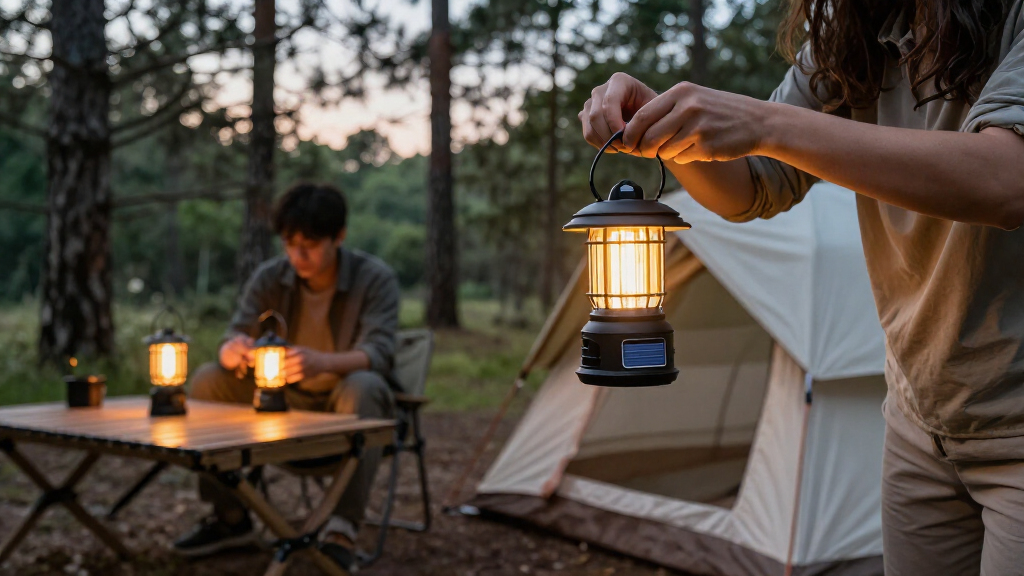
I ranked these solar-powered camping lanterns by how well their stated features address common camp needs: useful illumination, multiple charging paths, portability, weather protection, and practical versatility. I gave extra weight to models with clear differentiators, such as a stated 1000-lumen output, inflatable pack-flat construction, a hand crank, or phone-charging capability. Multi-packs were judged for their ability to spread light across a group, rather than treated as equivalent to a feature-rich single lantern.
The order reflects usefulness across more situations, not a claim that every model will outperform another in every setting. Product details supplied here do not establish comparable runtime, solar recharge time, or brightness at each mode, so I avoid treating those as verified head-to-head results. Buyers should confirm those specifications, battery details, and weather ratings for the exact model before purchase. A lantern with a strong backup charging option may rank ahead for resilience, while a compact or bundled design may be a better fit for a narrower use case.
Factors to Consider When Choosing Solar Powered Camping Lanterns
Choosing a solar lantern means deciding what should happen when the sun is not available. I’d start with your expected lighting area and trip length, then compare charging backups, portability, and how many lights your group needs. The following factors help separate useful flexibility from features that may add little to your setup.
Match Brightness to the Area You Need to Light
A lantern for reading inside a tent has a different job from one meant to light a cooking area or shared campsite. A high maximum lumen figure can help with broader illumination, but it may drain a battery faster and feel harsh in a small tent. Check whether the lantern offers lower settings so you can balance useful light with longer use. Look for runtime figures tied to specific brightness levels rather than relying on a single maximum-runtime claim. A common mistake is buying the brightest option without considering glare, light direction, or whether several modest lights would distribute illumination better. For a group site, multiple lanterns can create more even coverage than one very bright light.
Treat Solar as One Charging Route, Not a Guarantee
Solar charging depends on sunlight, panel size, panel orientation, and weather, so it can be unreliable as the only way to replenish a lantern on a short or cloudy trip. USB charging is useful before departure and when a power bank or vehicle outlet is available. A hand crank provides a separate fallback, though it is generally a manual emergency option rather than a convenient routine charging method. Check whether the product lists solar charging time and whether its panel can be positioned toward the sun while the lantern remains usable. Avoid assuming that leaving a lantern in a tent or shaded campsite will meaningfully recharge it. For trips with limited sun, prioritize battery capacity and a charging backup you can actually access.
Read Battery and Runtime Details Together
A capacity figure such as 5000mAh describes stored charge, but it does not tell you how long the lantern will run at a given brightness. Runtime also depends on LED efficiency, selected mode, battery age, and whether the lantern is powering another device. If you plan to charge a phone from a lantern, expect that use to draw from the same stored energy needed for lighting. Check for separate runtime estimates by mode and note whether the manufacturer explains testing conditions. A larger battery may add weight without helping much if the charging setup cannot replenish it between outings. For longer trips, carry a separate power bank or backup light rather than relying on one lantern for every task.
Choose Portability Around Your Packing Style
Inflatable lanterns can pack flat, which is useful when space is tight or a lantern must fit into a small day bag. Collapsible designs can also save space and may combine lantern and flashlight use, but their folded size and opening mechanism deserve a close look. Larger, rigid lanterns may be easier to handle around a campsite but can take up more room. Consider how you will hang or place the light: a handle, hook, or stable base can matter more than a long list of modes. For car camping, a bulkier model may be an easy trade for stronger output or a larger battery. For backpacking, weigh the complete packed setup rather than judging by the lantern’s open size alone.
Check Weather Protection and Construction
Water resistance ratings help compare products, but they do not make a lantern suitable for every storm or immersion. IPX5 and IP65 labels indicate different protection classifications, so check the manufacturer’s explanation and use the lantern within its stated limits. Pay attention to exposed charging ports, seams, switches, and inflatable materials, since those areas may affect care and durability. A collapsible unit has moving or folding parts that should be packed without forcing them, while inflatable models need protection from punctures. Dry the lantern before storage and follow any care instructions for the battery and solar panel. If wet-weather reliability is a priority, select a clearly rated model and keep a separate backup light in a waterproof bag.
Decide Whether a Multi-Pack Beats a Feature-Rich Single
Bundles can make sense when several people need independent lights or when you want separate illumination for a tent, table, and campsite path. Compare the number of lanterns with each unit’s brightness, battery, charging methods, and included functions; a four-pack is not automatically better value for every trip. A single lantern with phone charging or a hand crank may be more useful to a solo camper who prioritizes backup power. Multi-packs also create more units to charge, store, and keep track of between trips. If you camp with a group, place lights around the site rather than relying on one central beam. For occasional solo use, choose based on the features you will use regularly, not the bundle size alone.
Frequently Asked Questions
Can a solar camping lantern be my only light on a multi-day trip?
I would not make one solar lantern the only light source on a multi-day trip. Sun exposure and weather can limit charging, and using high brightness or phone-charging features can shorten the time between charges. Check the lantern’s runtime at the mode you expect to use and bring a backup light or power source. A model with USB charging or a hand crank offers more flexibility, but those options still depend on carrying the needed equipment or spending time charging manually. For remote trips, separate lighting and power backups reduce the risk of being left without illumination.
Is a 1000-lumen lantern a better choice than a compact inflatable one?
Not automatically: the better fit depends on how much area you need to light and how much space you have. A lantern with a stated 1000-lumen output is aimed at buyers who want strong campsite illumination, while an inflatable model such as the LuminAID Nova puts more emphasis on pack-flat storage. High output can be excessive in a small tent and may reduce runtime when used at full power. Check for lower brightness settings and compare packed dimensions before choosing. If you need both broad area lighting and a small backup, carrying two complementary lights may make more sense than asking one lantern to do everything.
Should I choose a multi-pack or one lantern with phone charging?
Choose a multi-pack if your main need is to place lights in several locations or give each person a separate lantern. A single lantern with phone-charging capability, such as the LuminAID Max, suits buyers who value a combined lighting and device-power option. Phone charging draws on the lantern’s battery, so it can reduce the charge available for lighting. Bundles may provide more coverage but do not necessarily match a premium single’s functions or charging flexibility. Compare what each individual unit can do, not just the total number included.
What should I check before relying on the solar panel?
Look for a stated solar recharge time, the conditions used to estimate it, and whether the panel can face direct sunlight while the lantern is positioned safely. A small panel or cloudy conditions may make solar charging slower than your trip schedule allows. Confirm whether USB charging is also available and plan to charge the lantern before leaving home. Avoid assuming that placing the lantern behind a tent window or in partial shade will provide a useful recharge. If sunlight is uncertain, treat solar as a way to extend charge rather than the sole way to restore it.
Do IPX5 or IP65 ratings mean I can leave a lantern outside in any weather?
No. Those ratings describe specific levels of protection, not immunity to every kind of weather, prolonged exposure, or immersion. Check the product’s own instructions for how it handles rain and whether charging-port covers need to be closed. Even a rated lantern can be affected by damaged seals, wear, or water entering through an open port. For overnight rain, place the lantern under shelter when practical and keep a backup light protected from moisture. Follow the exact rating and care guidance for the model you choose.
Conclusion
For the broadest campsite illumination among these listings, I’d choose the Westinghouse 1000-Lumen Solar Camping Lantern as the best overall, while checking its runtime at the brightness setting you plan to use. The best value for group coverage is a multi-pack such as the DIBMS, Mesqool, or XTAUTO bundles; compare each lantern’s functions and charging details before choosing pack size. For a premium-style feature set, the LuminAID Max is the standout option when phone charging and inflatable portability matter more than carrying the smallest light. The best pick for beginners is the straightforward LuminAID Nova if compact storage is the priority, or the Westinghouse if a brighter, mode-based lantern better fits your campsite. For specific needs, choose the Raynic for hand-crank backup, the XTAUTO or DIBMS bundles for distributing collapsible lights, and the LETMY pack if AA battery compatibility is useful. My final check before buying would be the exact runtime, solar recharge information, and weather guidance for the model you plan to take outdoors.