TL;DR

Get backup power and energy gear delivered free with Prime
- Fast, free delivery on millions of items
- Prime Video, Amazon Music and more included
- Member-only deals all year
New York regulators approved two utility-scale thermal energy networks, in Haverstraw and Buffalo, with a combined planned cost of $111.5 million. The projects will test whether utilities can use underground and recovered wastewater heat to provide cleaner heating while limiting customer costs and preserving utility-sector jobs. Nine other proposals were rejected.
New York’s Public Service Commission has approved two utility-scale thermal energy network projects in Haverstraw and Buffalo, authorizing a combined $111.5 million in planned utility spending to test alternatives to fossil-fuel heating. The projects are the state’s first two of this kind and are expected to receive $93 million in state funding to reduce costs for utility customers.
In Haverstraw, Orange & Rockland plans to spend $50 million on a network serving as many as 30 buildings, including homes, commercial and government buildings, and an elementary school. The system is planned to draw heat from borefields drilled on municipal land and from wastewater in the local sewer network.
In Buffalo, National Fuel Gas plans to invest $61 million in a project serving low-income multifamily housing and displacing part of the fossil-gas-fired boiler use in the city’s existing downtown district heating system. Its proposed heat sources include water from boreholes and wastewater heat recovery, alongside the existing steam system.
The commission rejected nine other proposals, including projects in New York City and upstate communities. According to the source report, the approved projects will draw on $93 million in state funds from a $150 million commitment for thermal networks. The combined project spending is $111.5 million; the source does not provide a detailed breakdown of how all costs will be shared beyond the state support intended to offset customer costs.
Testing Clean Heat at Utility Scale
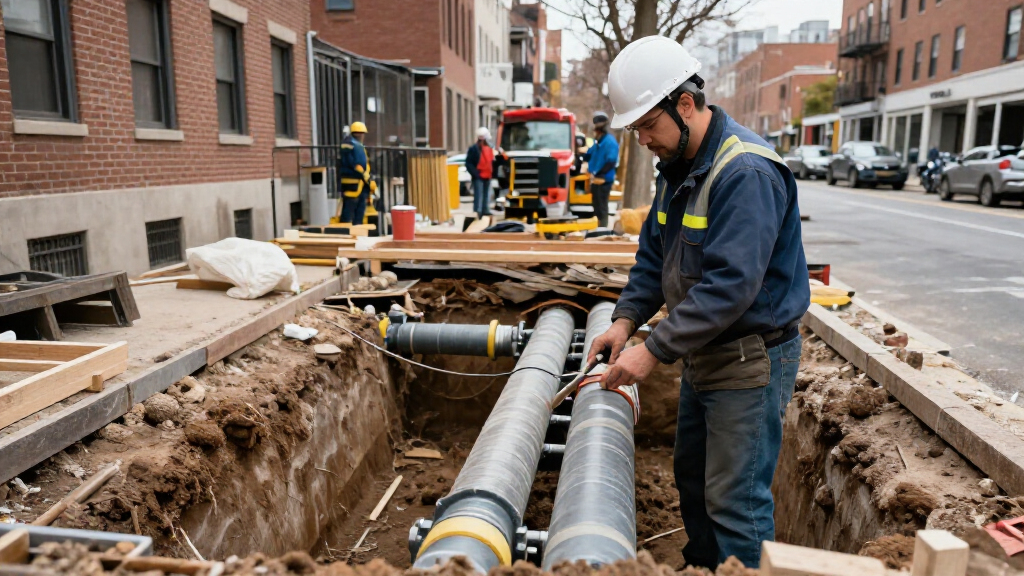
The two projects will test whether utilities can shift from delivering fossil gas to operating networks that supply heat through electric heat pumps, while retaining roles for utility workers and making use of existing infrastructure. Thermal networks circulate water or other fluids through pipes to collect steady heat from underground or recover heat from sources such as sewers and industrial systems. Heat pumps then use that thermal energy to heat buildings, and can also provide cooling.
The outcome matters to customers and state climate policy because New York must weigh the cost of building and running these systems against potential emissions reductions and other customer benefits. The projects also offer a practical test of a labor-focused approach to decarbonization: the UpgradeNY coalition argues that utility workers and infrastructure investments can be part of a shift away from fossil fuels rather than discarded. Whether that approach is affordable and replicable remains to be demonstrated.
electric heat pump for home heating
As an affiliate, we earn on qualifying purchases.
As an affiliate, we earn on qualifying purchases.
A Limited Approval After Four Years
For four years, the UpgradeNY coalition of clean-energy, environmental and labor organizations has urged state regulators to approve projects that could move neighborhoods from fossil-gas heating to electric systems. The proposals are intended to preserve jobs for workers such as pipefitters, steamfitters and plumbers while changing what utility networks deliver.
The commission’s decision is a partial approval, rather than a broad rollout: it approved two projects and declined nine. Building the rejected proposals would have required utilities to collect about $1 billion from customers, according to the source report. State support for the two approved projects is meant to limit the burden on customers, who are already facing rising energy costs.
Thermal networks already serve campuses, industrial areas and cities in several parts of the world. In the United States, some existing district energy systems still rely on fossil fuels. Buffalo’s proposal would test conversion of part of a legacy system, while Haverstraw’s plan would combine underground heat and wastewater recovery for a mix of building types.
“From a workers’ rights and environmental justice standpoint, it’s a win-win.”
— Theodore Moore, executive director of The Alliance for a Greater New York and a member of UpgradeNY
As an affiliate, we earn on qualifying purchases.
Costs and Results Still Unproven
The approved plans have not yet established whether thermal networks can deliver enough customer and climate benefits to justify their construction and operating costs. The source report says the projects are moving into further design, but does not provide construction schedules, expected completion dates, projected emissions reductions, customer bill estimates or the number of workers expected to be retained or employed.
It is also unclear how the state funding and remaining project costs will ultimately be allocated among utilities, customers and other sources. The commission’s decision to reject nine proposals leaves unanswered whether the projects were declined because of cost, design, readiness or other factors; the source report does not give project-by-project reasons. Results from Haverstraw and Buffalo will be important, but the two sites may not establish that the same approach works in other communities.
As an affiliate, we earn on qualifying purchases.
Design Work Sets the Next Stage
Orange & Rockland and National Fuel Gas are to advance their projects through the next stages of design. That work will need to refine the network layouts, heat-recovery systems, building connections and cost plans before construction and performance can be assessed. The source report does not state when construction is expected to begin or when either network could start serving buildings.
As plans develop, customers and local stakeholders will be watching for clearer information about bills, service arrangements and the projects’ expected emissions benefits. The utilities’ eventual performance data should help regulators judge whether the networks can be expanded or adapted elsewhere. For now, approval marks the start of two demonstration projects, not proof that utility-scale thermal networks are a cost-effective replacement for gas heating statewide.
As an affiliate, we earn on qualifying purchases.
Key Questions
Where will New York’s two approved thermal networks be built?
The projects are planned for Haverstraw in the Hudson Valley and downtown Buffalo. Haverstraw’s proposal covers up to 30 buildings; Buffalo’s is designed to serve low-income multifamily housing and displace some gas-fired boiler use in an existing district heating system.
How much will the projects cost?
The utilities plan to spend a combined $111.5 million: $50 million for Haverstraw and $61 million for Buffalo. The commission’s order is also expected to use $93 million in state funds to offset costs to utility customers. The final allocation of all project costs has not been provided.
How do thermal energy networks provide heat?
They circulate water or another fluid through pipes to gather heat from sources such as underground borefields or wastewater systems. Electric heat pumps use that heat to warm buildings and may also provide cooling.
Did New York approve all the proposed projects?
No. The Public Service Commission approved two projects and rejected nine others, including proposals in New York City and upstate communities.
When will the networks be built?
The projects are moving into further design, but the available source does not give construction start dates or expected completion dates. Their schedules remain unclear.
Source: rss
Fall Picks
fall essentials
As an affiliate, we earn on qualifying purchases.