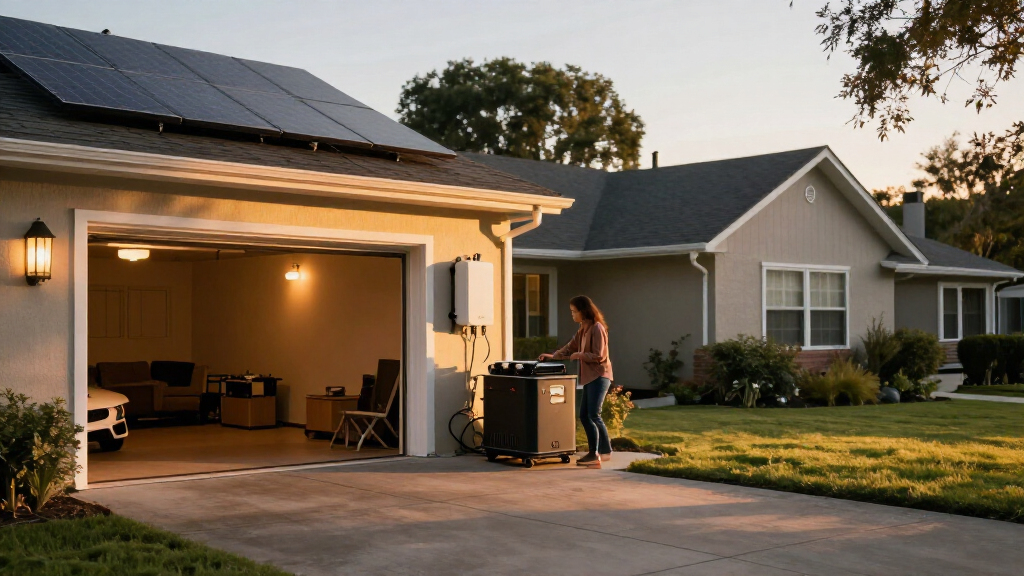
For whole-house backup, I would start with the EcoFlow DELTA Pro Ultra for its 120V/240V output, near-instant UPS response, and expansion path, then compare it with the ECO-WORTHY 10 kW kit if you want a more installation-oriented package with a large battery and panels included. The OSCAL PowerMax 6000 is the portable middle ground: it provides dual-voltage output and ships with solar panels, but its battery is much smaller than either home-focused system.

Get backup power and energy gear delivered free with Prime
- Fast, free delivery on millions of items
- Prime Video, Amazon Music and more included
- Member-only deals all year
These products do not offer the same kind of whole-house backup. Some are portable power stations that can support selected appliances or circuits; the ECO-WORTHY is an off-grid kit intended for a more involved setup. The main tradeoffs are 240V capability, usable stored energy, solar recharge potential, installation complexity, and expansion. I rank them by how well their stated features support a practical home-backup plan, not by treating a large wattage number as proof that a system can power every circuit in a house.
Complete the kit


Key Takeaways
- The EcoFlow DELTA Pro Ultra is the strongest fit here for a home backup plan that may grow: it supports 120V/240V, offers a 7,200W inverter, and lists expansion up to 90kWh.
- The ECO-WORTHY kit has the largest stated included battery at 16.1kWh and a 10,000W split-phase inverter, but it calls for professional installation and truck delivery access.
- The OSCAL PowerMax 6000 combines 6,000W output, dual-voltage support, and three included 200W panels; its 3,600Wh battery suits shorter backup periods better than extended outages.
- The Jackery HomePower 3000 is a portable 120V option with a 3,072Wh battery and a 3,600W output, not a direct substitute for a split-phase home system.
- A generator’s output rating does not tell you how long it can run your home: compare battery energy, essential-circuit loads, solar conditions, transfer behavior, and installation needs.
| EcoFlow DELTA Pro Ultra 12kWh Power Station with Extra Battery |  | Best Overall for Expandable Home Backup | Inverter output: 7,200W | Voltage: 120V and 240V | Battery capacity: 6,144Wh per battery | VIEW LATEST PRICE | See Our Full Breakdown |
| ECO-WORTHY 10 kW Off-Grid Solar Panel Kit with 16.1 kWh Battery |  | Best Integrated Off-Grid Kit | Solar panels: 5 × 590W; 2,950W total | Inverter output: 10,000W continuous; 20,000W peak | Output voltage: 120V/240V split-phase | VIEW LATEST PRICE | See Our Full Breakdown |
| OSCAL PowerMax 6000 Solar Generator with Three 200W Solar Panels |  | Best Portable Dual-Voltage Bundle | Battery capacity: 3,600Wh | Battery type: LiFePO₄ | Output: 6,000W; 9,000W surge | VIEW LATEST PRICE | See Our Full Breakdown |
| Jackery HomePower 3000 Portable Power Station with Two 200W Solar Panels |  | Best for Essential 120V Loads | Battery capacity: 3,072Wh | Battery type: LiFePO₄ | AC output: 3,600W; 7,200W surge | VIEW LATEST PRICE | See Our Full Breakdown |
| whole house solar generator | Battery capacity | Voltage | Weight | Inverter output |
|---|---|---|---|---|
| EcoFlow DELTA Pro Ultra 12kWh | 6,144Wh per battery | 120V and 240V | 293.6 lbs | 7,200W |
| ECO-WORTHY 10 kW Off-Grid Sola | 16.1kWh | — | — | 10,000W continuous; 20,000W peak |
| OSCAL PowerMax 6000 Solar Gene | 3,600Wh | 120V/240V dual voltage | 45.5kg | — |
| Jackery HomePower 3000 Portabl | 3,072Wh | 120V | 59.5 lbs | — |
More Details on Our Top Picks
EcoFlow DELTA Pro Ultra 12kWh Power Station with Extra Battery
I put the EcoFlow DELTA Pro Ultra first because its combination of 120V/240V output, a 7,200W inverter, and a stated expansion path to 90kWh gives it the clearest route from essential-circuit backup toward broader residential coverage. Its listed 0ms UPS transfer time is also a useful distinction for connected equipment that should not lose power during a switchover. That does not mean the unit automatically backs up a whole house: the intended loads, electrical connection, and system configuration still matter.
Compared with the ECO-WORTHY kit, the DELTA Pro Ultra is more flexible as a modular power station. ECO-WORTHY includes a 16.1kWh battery and panels as part of a single off-grid kit, while EcoFlow’s strongest case is its expandability and multiple charging options, including solar, wall power, generators, and EV charging equipment. Buyers who expect to add battery storage over time may prefer that route. Buyers who want a larger included battery-and-panel package from the outset may find the ECO-WORTHY configuration more appealing.
The tradeoff is physical and logistical. The listed system weight is 293.6 pounds, and the inverter and battery arrive in separate packages, so this is not a casual carry-in power station. Its six outlets also do not by themselves establish how many household circuits it can feed; a home integration plan is part of the purchase decision. I would choose this model for a flexible backup system, not for someone who expects to plug it in and immediately power every circuit.
Pros:- 120V and 240V output with a 7,200W inverter
- Battery system can expand from 6,144Wh per battery up to a stated 90kWh
- Accepts solar, wall, generator, and EV charging equipment inputs
- Listed 0ms UPS transfer time for connected devices
Cons:- Listed system weight is 293.6 pounds, limiting portability
- Inverter and battery arrive in separate packages, and home integration needs planning
Best for: Homeowners planning staged backup expansion who need 120V/240V support, multiple charging methods, and fast UPS response for connected equipment.
Not ideal for: Buyers seeking a lightweight portable unit, a simple panel-included starter bundle, or whole-home wiring without separate installation planning.
- Inverter output:7,200W
- Voltage:120V and 240V
- Battery capacity:6,144Wh per battery
- Expandable capacity:Up to 90kWh
- Maximum output with three inverters:21.6kW AC
- UPS transfer time:0ms
- Weight:293.6 lbs
Our verdict“I rank the DELTA Pro Ultra first for its residential voltage support and unusually broad expansion path, provided you are prepared for a heavy, modular installation.”
ECO-WORTHY 10 kW Off-Grid Solar Panel Kit with 16.1 kWh Battery
The ECO-WORTHY 10 kW kit takes a different approach from the portable power stations in this list: it bundles five 590W panels, a split-phase inverter, and a 16.1kWh LiFePO₄ battery for an off-grid installation. Its 10,000W continuous inverter output and 120V/240V support make it the most explicitly home-system-oriented package here. The battery is also the largest stated included capacity among these four products, which gives buyers more stored energy to work with before adding extra batteries.
Compared with EcoFlow, ECO-WORTHY offers a larger battery in the listed package and includes the solar panels and inverter, but it does not present the same stated expansion ceiling in the supplied description. Its five panels total 2,950W, and the claimed daily solar generation of up to 11.8kWh depends on optimal conditions. That figure should not be treated as guaranteed daily energy: location, season, shade, orientation, and household consumption all affect whether the array can replenish the battery.
This kit’s main advantage—its complete, home-oriented collection of components—is also the reason it is less approachable than OSCAL or Jackery. Professional installation is recommended, and the panels and battery arrive by truck on a pallet, so the delivery location needs suitable access. This is not a portable outage box or a quick plug-in solution. I would shortlist it for a planned off-grid or backup installation; I would skip it if a lightweight unit or a simple temporary setup is the priority.
Pros:- Includes five 590W panels, a 10,000W inverter, and a 16.1kWh battery
- 120V/240V split-phase output with 20,000W peak output
- Battery supports parallel expansion, with Wi-Fi monitoring and multiple inverter charging modes
- Battery-free operation is listed as supported
Cons:- Professional installation is recommended for a fixed home system
- Panels and battery ship on a pallet by truck, requiring suitable delivery access
- Daily solar generation depends on optimal conditions and actual site factors
Best for: Homeowners planning an off-grid or fixed backup installation who want split-phase output, a large included battery, and panels in the same kit.
Not ideal for: Renters, buyers without pallet delivery access, or anyone seeking a portable power station that needs little installation work.
- Solar panels:5 × 590W; 2,950W total
- Inverter output:10,000W continuous; 20,000W peak
- Output voltage:120V/240V split-phase
- Battery:48V, 314Ah LiFePO₄
- Battery capacity:16.1kWh
- Listed daily solar generation:Up to 11.8kWh under optimal conditions
- Parallel support:Up to 15 batteries and 6 inverters
Our verdict“I recommend the ECO-WORTHY kit for buyers ready to plan a fixed off-grid installation, not for households expecting a portable, ready-to-use backup station.”
OSCAL PowerMax 6000 Solar Generator with Three 200W Solar Panels
The OSCAL PowerMax 6000 is the most balanced portable bundle for buyers who want dual-voltage capability without stepping up to a fixed solar installation. It pairs 6,000W output with a 3,600Wh LiFePO₄ battery and supports both 120V and 240V. Three included 200W panels give it a more complete solar starting point than the Jackery bundle, which includes two 200W panels. Its 14 outlets and app control add flexibility for distributing power among individual devices.
Against the EcoFlow DELTA Pro Ultra, OSCAL is easier to position as a self-contained portable purchase, but its battery capacity and expansion information do not match the EcoFlow’s residential-scale growth story. Against ECO-WORTHY, it asks far less of the buyer in installation terms, yet its included 3,600Wh battery is much smaller than ECO-WORTHY’s 16.1kWh battery. The 5–8ms EPS switchover is fast, though it is not the listed 0ms response of the EcoFlow UPS.
The limitation is runtime, not simply output. A 6,000W rating describes how much power the inverter can deliver under its operating conditions; it does not mean the 3,600Wh battery can sustain that draw for long. The included array totals 600W, and solar recharge time varies with sunlight and conditions. At 45.5kg, the unit is also heavy for something described as portable. I see it as a practical choice for selected household loads and flexible backup, rather than a complete whole-house solution for prolonged outages.
Pros:- 6,000W output with 120V/240V dual-voltage support
- 3,600Wh LiFePO₄ battery with a listed 9,000W surge rating
- Includes three 200W solar panels and provides 2,400W maximum solar charging input
- 14 outlets, app control, and 5–8ms EPS switchover
Cons:- At 45.5kg, it is heavy to move or reposition
- The 600W included panel array may not keep up with sustained household consumption
- Solar recharge time varies with sunlight and site conditions
Best for: Buyers seeking a portable station with 120V/240V output, a substantial inverter rating, and solar panels included for selected loads.
Not ideal for: Households needing long-duration whole-house backup, a lightweight unit, or a larger included battery and fixed installation package.
- Battery capacity:3,600Wh
- Battery type:LiFePO₄
- Output:6,000W; 9,000W surge
- Voltage:120V/240V dual voltage
- Solar panels included:3 × 200W
- Maximum solar input:2,400W
- EPS switchover:5–8ms
- Weight:45.5kg
Our verdict“I would choose OSCAL when dual-voltage portability and an included starter solar array matter more than long-duration storage or a fixed home installation.”
Jackery HomePower 3000 Portable Power Station with Two 200W Solar Panels
The Jackery HomePower 3000 is the most straightforward pick here for buyers who want portable backup for essential 120V appliances and electronics. Its 3,072Wh LiFePO₄ battery and 3,600W AC output provide a useful combination for selected loads, while the listed UPS response of 20ms or less can suit connected devices where a brief transfer interval is acceptable. Two 100W USB-C PD ports, USB-A, DC, and a TT-30 RV outlet make it useful beyond home outage duty.
Compared with OSCAL, Jackery has slightly less battery capacity and output, includes one fewer 200W panel, and does not list 240V output. Its advantage is a clearly portable 120V-oriented format with several charging paths, including AC, hybrid AC and DC, solar, a car charger, and a gas generator. Compared with the EcoFlow and ECO-WORTHY systems, it is much less suited to a split-phase residential setup; its role is to keep a chosen group of compatible appliances running rather than feed broad household circuits.
The battery is rated for 4,000 cycles while retaining 70% capacity, which gives buyers a useful stated longevity benchmark. However, the supplied solar-recharge figure is a reminder that the included two-panel array is not a rapid replenishment source: reaching 80% takes nine hours under the stated conditions. The power station and panels also ship separately. I would not choose this model for 240V loads or an entire-house plan, but it makes more sense than the larger systems when portability and versatile 120V use come first.
Pros:- 3,072Wh LiFePO₄ battery and 3,600W AC output
- Battery rated for 4,000 cycles while retaining 70% capacity
- Multiple charging options, including solar, car charging, and gas generator input
- Includes two 200W panels and has a TT-30 RV outlet
Cons:- 120V output does not match the listed 120V/240V systems for split-phase loads
- Included panels take a stated nine hours to recharge the station to 80%
- Power station and panels ship separately
Best for: Households looking for a portable 120V backup station for selected appliances, electronics, and RV use, with multiple charging options.
Not ideal for: Buyers who need 240V split-phase output, broad household circuit support, or faster solar replenishment from the included panels.
- Battery capacity:3,072Wh
- Battery type:LiFePO₄
- AC output:3,600W; 7,200W surge
- Voltage:120V
- UPS transfer time:20ms or less
- Solar panels included:2 × 200W
- AC recharge time:2.2 hours
- Weight:59.5 lbs
Our verdict“I recommend the Jackery for portable backup of selected 120V loads, while steering whole-house and 240V buyers toward EcoFlow or ECO-WORTHY.”

How We Picked
I ranked these four options by their relevance to whole-house or essential-circuit backup, rather than by portability or panel count alone. A system that can support 240V loads and provide a credible route to more stored energy earns more consideration for residential use than a compact 120V power station, even when that smaller unit is easier to move or set up.
I compared continuous output and voltage first, since those determine which loads can be supported and whether a system is suitable for split-phase household circuits. Next, I looked at battery capacity and whether the product supports expansion. A powerful inverter can run more equipment at once, but it cannot make a modest battery last longer; energy capacity and load demand set the runtime.
I also weighed the included solar equipment and charging flexibility. Panels bundled with a generator help make a package more ready for solar charging, though actual harvest depends on sunlight, panel placement, weather, and system limits. The ECO-WORTHY kit includes more substantial home-oriented components, while the EcoFlow advertises several charging paths and a high expansion ceiling. OSCAL and Jackery offer solar-inclusive portable bundles, but their listed panel arrays are comparatively small for sustained household loads.
Finally, I factored in the practical costs of ownership that the supplied specifications reveal: weight, delivery, installation, UPS response, and voltage limitations. I do not infer whole-home coverage from wattage alone, and I do not assume any system is wired to a home’s electrical panel out of the box. Buyers should confirm compatibility, transfer equipment, permitting, and installation details with the manufacturer and a qualified electrician. This ranking reflects the information supplied for these exact configurations; it is not a claim of hands-on testing.
Factors to Consider When Choosing Whole House Solar Generators
I would choose a whole-house solar generator by working backward from the circuits and outage duration I need to cover. These four products range from a fixed off-grid package to portable stations, so the label alone is less useful than their voltage, stored energy, connection requirements, and solar input.Start with essential loads, not the house label
Write down the appliances you want to run during an outage, then separate loads that must operate at the same time from those you can use one after another. Refrigerators, lighting, communications equipment, and some electronics create a different plan from a house that also expects to run electric cooking, heating, cooling, or a well pump. Check each appliance’s running and startup demand, especially for motors. The inverter needs enough output for simultaneous use and short startup surges, while the battery needs enough energy for the number of hours you want to run those loads.
This is why I do not rank a generator as a whole-house winner on wattage alone. The DELTA Pro Ultra and ECO-WORTHY list 120V/240V output, while OSCAL also lists dual voltage. Jackery’s supplied specs list 120V output. That makes Jackery a more limited match for a home requiring split-phase 240V loads. Actual connection to household circuits may require transfer equipment and electrical work; confirm the complete setup with a qualified electrician.
Match inverter output to loads and voltage
Continuous output is a guide to the power a unit can deliver at once; peak or surge output describes a short-term allowance for startup loads. In this group, ECO-WORTHY lists 10,000W continuous and 20,000W peak, EcoFlow lists a 7,200W inverter, OSCAL lists 6,000W with a 9,000W surge rating, and Jackery lists 3,600W with a 7,200W surge. Those figures help compare capability, but they do not prove that every appliance combination will work together. Check the manufacturer’s operating limits and your home’s load requirements.
For a home with split-phase circuits, confirm that the system supports the required 120V and 240V output and that its transfer or connection method is compatible. A portable unit with many outlets may still be unable to supply a wired panel without appropriate equipment. Conversely, a split-phase inverter is not a guarantee of whole-home coverage: load capacity, circuit selection, and installation determine what it can actually run.
Use battery capacity to estimate runtime
Battery capacity, shown here in Wh or kWh, indicates stored energy; it is not the same as inverter output. The Jackery’s 3,072Wh, OSCAL’s 3,600Wh, EcoFlow’s stated 6,144Wh per battery, and ECO-WORTHY’s 16.1kWh represent very different amounts of stored energy. A larger battery can support a longer run at a given load, but real runtime also depends on conversion losses, temperature, battery reserve settings, and what is connected.
For a rough planning exercise, add the wattage of the loads you expect to use and estimate the hours of operation. A low, steady load can last far longer than a group of high-demand appliances. Do not assume you can run a 6,000W load for an hour simply because a station has a 6,000W inverter; its battery may not have enough energy to sustain that draw. When the outage plan involves more than a few essentials, the EcoFlow expansion option and ECO-WORTHY’s larger included battery deserve closer attention.
Check the solar array against your energy use
Panels can replenish a battery in daylight, but their rated output is not a promise of constant generation. The OSCAL bundle includes three 200W panels, and the Jackery bundle includes two 200W panels. ECO-WORTHY includes five 590W panels for 2,950W total, with a listed daily generation figure of up to 11.8kWh under optimal conditions. EcoFlow supports solar charging, though the supplied configuration details do not state a bundled panel array. Compare the panel wattage with the generator’s solar input limit and your likely daily consumption.
Actual solar harvest changes with season, cloud cover, shade, panel angle, and daylight hours. A small array may be enough to extend backup for communications and modest loads, but it may not replenish the battery while a home draws high power. Ask how many panels you can connect, which connectors and limits apply, and whether there is room for proper placement. Treat claims framed around optimal conditions as an upper scenario rather than a daily guarantee.
Account for installation, delivery, and transfer behavior
The portable OSCAL and Jackery are more naturally suited to powering chosen devices from their outlets, though their size and weight still affect placement. EcoFlow is also a heavy system, with its inverter and battery supplied separately. ECO-WORTHY is the most installation-oriented choice: its panels and battery ship by truck on a pallet, and professional installation is recommended. Before ordering a large kit, verify site access, mounting plans, electrical requirements, local rules, and who will perform the work.
Transfer behavior matters for equipment that cannot tolerate an interruption. EcoFlow lists a 0ms UPS transfer time, OSCAL lists 5–8ms EPS switchover, and Jackery lists 20ms or less. Those specifications apply to supported setups and should not be read as a blanket promise for every circuit or device. Confirm whether the product’s transfer feature fits your intended use and whether it requires a particular connection arrangement. A properly planned installation is more important than assuming that a short transfer specification covers the whole home.
Choose expansion and charging paths for the outage you expect
If you expect to start with a few circuits and add storage later, EcoFlow’s stated expansion up to 90kWh sets it apart from the more limited portable packages in this lineup. ECO-WORTHY supports parallel batteries and inverters, but buyers should confirm the exact configuration and compatibility before planning a system around expansion. OSCAL and Jackery offer a more portable bundle approach; the supplied details do not describe a comparable residential expansion path.
Charging flexibility also changes how resilient a setup can be. EcoFlow lists solar, wall outlets, generators, and EV charging equipment. Jackery lists AC, hybrid AC and DC, solar, car charging, and generator charging. OSCAL supports AC and solar charging, while ECO-WORTHY describes multiple inverter charging modes. If cloudy days or overnight power use are part of your plan, consider how you will recharge when solar is unavailable and whether a backup generator or grid input fits the system.
Frequently Asked Questions
Can any of these systems power an entire house?
None should be assumed to power every home circuit automatically. The ECO-WORTHY kit and EcoFlow have the clearest residential features here, including 120V/240V support, but actual coverage depends on inverter output, battery energy, circuit selection, transfer equipment, and installation. OSCAL also lists dual-voltage output, while Jackery’s listed 120V output makes it a better fit for selected loads than a split-phase whole-house plan. I would ask an electrician to map the intended loads and confirm the connection method before choosing.
Which model has the most included battery capacity?
The ECO-WORTHY kit lists a 16.1kWh battery, the largest stated included capacity among these four configurations. EcoFlow lists 6,144Wh per battery and a much larger expansion ceiling, so it may suit a buyer who wants to add storage over time. OSCAL lists 3,600Wh, and Jackery lists 3,072Wh. Capacity is only one part of runtime: the power draw of connected appliances and system losses determine how long stored energy lasts.
Do the included solar panels guarantee daily recharging?
No. Panel ratings describe their rated power under specified conditions, not a guaranteed amount of energy each day. The Jackery bundle includes two 200W panels, OSCAL includes three 200W panels, and ECO-WORTHY includes five 590W panels; the ECO-WORTHY generation figure is stated as up to 11.8kWh under optimal conditions. Weather, season, shade, placement, and household use all affect harvest. I would plan for lower output than an ideal-condition figure when estimating backup duration.
Which system is easiest to move?
The Jackery is the lightest by the supplied figures at 59.5 pounds, while OSCAL weighs 45.5kg and EcoFlow’s listed system weight is 293.6 pounds. The ECO-WORTHY kit includes large panels and a battery intended for an installation, with truck delivery on a pallet. Weight alone does not describe how easy a unit is to handle, so check dimensions, handles, lifting needs, and where it will be stored. For frequent movement, I would prioritize a genuinely portable setup over a fixed home kit.
What should I check before connecting a solar generator to my home’s wiring?
Confirm the generator’s voltage, output limits, transfer equipment requirements, compatible circuits, and permitted connection method. Never assume that plugging a power station into a household outlet safely powers a panel; backfeeding can create serious hazards. Ask a qualified electrician about an approved transfer switch or other compatible setup, local permitting, and whether your planned loads fit the system. Also check how the generator behaves during transfer if you intend to protect sensitive equipment.
Conclusion
For a homeowner who wants a system that can grow, I would start with the EcoFlow DELTA Pro Ultra: its 120V/240V support, multiple charging paths, and stated expansion to 90kWh make it the most adaptable pick in this group, though its weight and separate packages call for planning. For a buyer arranging a fixed off-grid installation and seeking the largest included battery plus panels, the ECO-WORTHY kit is the better match, provided pallet delivery and professional installation are workable.
If I wanted a portable bundle with dual-voltage output and panels in the box for selected loads, I would compare the OSCAL PowerMax 6000 against my runtime needs; its 3,600Wh battery is not the same as long-duration whole-house storage. For portable 120V essentials, RV use, or electronics, the Jackery HomePower 3000 is the most focused choice, but I would not buy it expecting 240V household coverage. Before selecting any of them, I would list the circuits I need, estimate their running and startup demand, and confirm the wiring plan with an electrician.