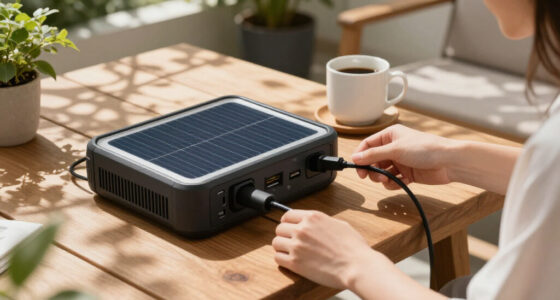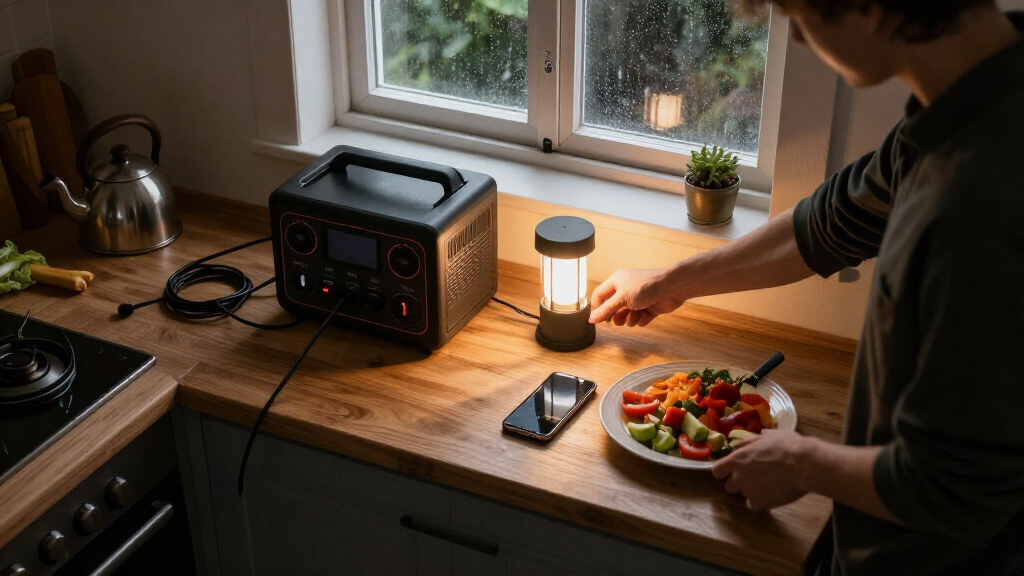

For most households, I’d start with the BLUETTI AC180: its 1,152Wh LiFePO4 battery and 1,800W output offer a useful balance for several essentials without moving up to a very large unit. The Jackery Explorer 2000 v2 and Anker SOLIX S2000 are stronger candidates for longer outages or higher-power devices, while compact picks such as the Jackery Explorer 300 suit phones, routers, and lights. The main tradeoff is straightforward: more capacity and output can keep more running for longer, but bring greater weight and storage demands. Smaller stations are easier to move and store, but need careful load prioritization and may run out quickly. Read on for how all 15 options compare and which one fits your outage plan.

Get backup power and energy gear delivered free with Prime
- Fast, free delivery on millions of items
- Prime Video, Amazon Music and more included
- Member-only deals all year
Complete the kit


Key Takeaways
- BLUETTI AC180 is the balance pick: Its 1,152Wh capacity and 1,800W output make it more versatile for household essentials than the sub-300Wh models, without reaching the scale of the largest stations.
- The two largest-capacity options serve different needs: Jackery Explorer 2000 v2 lists 2,042Wh and 2,200W, while Anker SOLIX S2000 lists 2,010Wh and 1,500W; buyers should match inverter output to appliance startup and running demands, not capacity alone.
- Compact units are best for prioritized loads: The 88Wh MARBERO M82 and 192Wh-class models are easier to reserve for communications, lights, and small electronics than for household appliances.
- Battery chemistry is not the whole decision: Several smaller choices list LiFePO4 batteries, but low capacity or output can still limit outage usefulness; compare usable energy and device demands together.
- The 519.48Wh and 640Wh options fill a middle ground: They offer more stored energy than most compact picks, but buyers still need to check output limits before planning to run high-draw equipment.
| Westinghouse iGen400s Portable Power Station, 400W Peak, 183Wh |  | Best Lightweight Essentials Backup | Battery capacity: 183Wh (description also states 184Wh) | Running output: 200W | Peak output: 400W | VIEW LATEST PRICE | See Our Full Breakdown |
| DaranEner Portable Power Station, 192Wh LiFePO4 Battery, 300W |  | Best for Long-Cycle Small-Device Backup | Battery capacity: 192Wh | Battery type: LiFePO4 | AC output: 300W, 600W surge | VIEW LATEST PRICE | See Our Full Breakdown |
| Portable Power Station, 500W, 519.48Wh |  | Best Mid-Size Capacity for Mixed Devices | Battery capacity: 519.48Wh (140,400mAh) | AC output: 500W; 2 pure sine wave 110V outlets | USB-A output: 3 QC3.0 ports, up to 18W each | VIEW LATEST PRICE | See Our Full Breakdown |
| BLUETTI Elite 30 V2 Portable Power Station, 288Wh, 600W |  | Best Compact UPS-Style Backup | Battery capacity: 288Wh | Continuous output: 600W | Peak output: 1,500W in Power Lifting Mode | VIEW LATEST PRICE | See Our Full Breakdown |
| Jackery Explorer 2000 v2 Portable Power Station, 2042Wh, 2200W |  | Best for Extended Home Backup | Battery capacity: 2,042Wh | Battery type: LiFePO4 | AC output: 2,200W | VIEW LATEST PRICE | See Our Full Breakdown |
| LIBRIDS 640Wh Portable Power Station with 600W Output |  | Best for Fast-Switch Backup | Battery capacity: 640Wh | Battery type: LiFePO₄ | Running output: 600W | VIEW LATEST PRICE | See Our Full Breakdown |
| Core 300W Portable Power Station, 192Wh |  | Best for Small-Device Backup | Battery capacity: 192Wh | Surge output: 600W | Battery chemistry: LiFePO₄ | VIEW LATEST PRICE | See Our Full Breakdown |
| Akiisolo GO10Y Portable Power Station, 192Wh LiFePO4 Battery, 100W Output |  | Best Lightweight Emergency Companion | Battery capacity: 192Wh | Battery type: LiFePO₄ | Surge output: 200W | VIEW LATEST PRICE | See Our Full Breakdown |
| Jackery Explorer 300 Portable Power Station, 292Wh |  | Best Compact Capacity Upgrade | Battery capacity: 292Wh | Battery chemistry: LiFePO₄ | Peak output: 600W | VIEW LATEST PRICE | See Our Full Breakdown |
| BLUETTI AC180 Portable Power Station, 1152Wh LiFePO₄ Battery |  | Best for Higher-Power Home Backup | Battery capacity: 1152Wh | Battery type: LiFePO₄ | Running output: 1800W | VIEW LATEST PRICE | See Our Full Breakdown |
| MARBERO M82 Portable Power Station, 88Wh |  | Best for Emergency Lighting and Small Devices | Capacity: 88Wh | Battery capacity: 24,000mAh | Output / surge power: 80W / 120W | VIEW LATEST PRICE | See Our Full Breakdown |
| ALLWEI 300W Portable Power Station with 256Wh LiFePO4 Battery |  | Best Lightweight LiFePO4 Value | Battery capacity and type: 256Wh LiFePO4 | Continuous / peak output: 300W / 600W | Output ports: 6: 1 AC, 2 DC5521, 1 car, 1 USB-A, 1 USB-C PD | VIEW LATEST PRICE | See Our Full Breakdown |
| Anker SOLIX S2000 Portable Power Station, 2,010Wh, 1,500W |  | Best for Extended Home Backup | Battery capacity and type: 2,010Wh LiFePO4 | Battery capacity: 314Ah | Continuous / peak output: 1,500W / 3,000W | VIEW LATEST PRICE | See Our Full Breakdown |
| Anker SOLIX C300 Portable Power Station, 288Wh |  | Best Compact Multi-Port Pick | Battery capacity and type: 288Wh LiFePO4 | Running / surge output: 300W / 600W | Ports: 8: 3 AC, 1 car socket, 3 USB-C, 1 USB-A | VIEW LATEST PRICE | See Our Full Breakdown |
| Jackery Explorer 1000 v2 Portable Power Station |  | Best Mid-Size Appliance Backup | Battery capacity and type: 1,070Wh LFP | AC output / surge peak: 1,500W / 3,000W | Voltage: 120V | VIEW LATEST PRICE | See Our Full Breakdown |
| portable power stations for power outage | Battery capacity | Weight |
|---|---|---|
| Westinghouse iGen400s Portable | 183Wh (description also states 184Wh) | 5 lb |
| DaranEner Portable Power Stati | 192Wh | 5.73 lb |
| Portable Power Station | 519.48Wh (140,400mAh) | 18 lb |
| BLUETTI Elite 30 V2 Portable P | 288Wh | — |
| Jackery Explorer 2000 v2 Porta | 2,042Wh | — |
| LIBRIDS 640Wh Portable Power S | 640Wh | — |
| Core 300W Portable Power Stati | 192Wh | 8.8 lb |
| Akiisolo GO10Y Portable Power | 192Wh | 3.9 lb |
| Jackery Explorer 300 Portable | 292Wh | 7.1–7.5 lb, depending on the listed specification |
| BLUETTI AC180 Portable Power S | 1152Wh | 37.4 lb |
| MARBERO M82 Portable Power Sta | 24,000mAh | 3.2 lb |
| ALLWEI 300W Portable Power Sta | — | 6.4 lb |
| Anker SOLIX S2000 Portable Pow | 314Ah | 35.7 lb |
| Anker SOLIX C300 Portable Powe | — | 4.13 kg |
| Jackery Explorer 1000 v2 Porta | — | 23.8 lb |
More Details on Our Top Picks
Westinghouse iGen400s Portable Power Station, 400W Peak, 183Wh
The Westinghouse iGen400s is best for keeping phones, tablets, and other small electronics running when an outage interrupts normal charging. At 5 pounds, it is easier to move between rooms or take in a car than the 18-pound, 519.48Wh Portable Power Station in this lineup. Its 183Wh battery and 200W running output, though, leave little room for sustained appliance use; the 400W figure is peak output, not continuous power. The many USB ports help a household charge several devices, while the display and three-mode flashlight add useful outage features. One catch is setup: the AC adapter and solar panel are not included, so buyers need to source charging gear separately. Choose it for portability and small-device backup, not long runtimes.
Pros:- Weighs 5 pounds and has a carrying handle for easy room-to-room moves
- Two AC outlets plus USB-C, USB-A, and 12V DC ports support a mix of small devices
- Built-in display and tri-mode flashlight are useful during an outage
- Quiet, fume-free operation suits indoor use
Cons:- Only 200W of running output limits the appliances it can support
- AC power adapter is not included
- Solar panel is not included
Best for: People who want a lightweight station for phones, tablets, and other low-draw devices during short outages, and who can supply a compatible AC adapter.
Not ideal for: Households that need to run appliances or keep several devices powered for long periods; its 183Wh capacity and 200W running output are limited.
- Battery capacity:183Wh (description also states 184Wh)
- Running output:200W
- Peak output:400W
- Ports:2 AC outlets, 4 USB-C ports, 2 USB-A ports, 1 12V DC port
- AC charging:Up to 80% in 2 hours with a 120V outlet and 100W AC adapter
- Weight:5 lb
- Dimensions:9.4 × 4.5 × 5.9 in
- Warranty:2-year limited warranty
Our verdict“Choose the iGen400s for portable backup of small electronics, but pick the larger 519.48Wh Portable Power Station if longer runtimes matter more than low weight.”
DaranEner Portable Power Station, 192Wh LiFePO4 Battery, 300W
The DaranEner suits buyers who prioritize battery longevity and flexible recharging over running appliances. Its 192Wh LiFePO4 battery is rated for 3,500+ cycles, a useful fit for someone who expects to use the station regularly rather than only during rare outages. Compared with the Westinghouse iGen400s, it offers a 300W AC output instead of 200W running output and adds a stated 600W surge capacity, but it weighs slightly more and still has modest storage. It can recharge from AC, a car, or a compatible solar panel, giving it more ways to replenish power during a prolonged outage; the solar panel and car charging cables are not included. The 60W USB-C PD port and four-mode SOS light add practical touches, while the 300W ceiling rules out many household appliances.
Pros:- LiFePO4 battery is rated for 3,500+ cycles
- 300W AC output with 600W surge capacity exceeds the Westinghouse iGen400s running output
- Can recharge from AC, a car charger, or a compatible solar panel
- Ports can support charging up to six devices, with a built-in SOS light
Cons:- 192Wh capacity limits how long it can supply devices during an extended outage
- 300W output is unsuitable for high-power appliances such as hair dryers and rice cookers
- Solar panel and car charging cables are not included
Best for: Frequent campers or outage-prone households seeking a small station for electronics, with a LiFePO4 battery and multiple recharge options.
Not ideal for: Buyers who need to power high-wattage appliances or want a ready-to-use solar setup without buying additional equipment.
- Battery capacity:192Wh
- Battery type:LiFePO4
- AC output:300W, 600W surge
- AC outlets:2
- USB-C output:60W PD
- Recharge options:AC up to 100W, car charger, compatible solar panel up to 60W DC input
- Battery cycle life:3,500+ cycles
- Weight:5.73 lb
Our verdict“Pick the DaranEner for long-cycle, multi-device backup and flexible recharging, but skip it if your outage plan depends on appliances above 300W.”
Portable Power Station, 500W, 519.48Wh
With 519.48Wh of capacity and 500W AC output, this station occupies the useful middle ground between the small Westinghouse iGen400s and the much larger Jackery Explorer 2000 v2. That extra storage can stretch charging time for phones, laptops, lights, and other modest loads, while ten output ports let several devices connect at once. Its pure sine wave outlets and built-in battery protections are relevant for sensitive electronics, though the 500W limit still excludes many demanding appliances. Recharging from a wall outlet, car, or compatible solar panel gives it more options than a wall-only setup, but a full wall recharge takes a stated six to seven hours and the solar panel is separate. Buyers should also switch off AC output when idle, since it can drain the battery without a load.
Pros:- 519.48Wh capacity provides more stored energy than the Westinghouse iGen400s
- Ten output ports include AC, USB-A, USB-C, DC, car, and wireless charging
- Pure sine wave AC output and built-in battery protections support sensitive electronics
- Can recharge from a wall outlet, car charger, or compatible solar panel
Cons:- 500W output limits use with high-power appliances
- At 18 pounds, it is heavier than the compact stations in this roundup
- AC output can drain the battery when left on without a load
Best for: Households wanting more runtime for electronics and small devices than a compact station provides, without carrying a 2kWh-class unit.
Not ideal for: People who need to run high-wattage appliances, want the lightest carry, or expect to leave AC output on between uses.
- Battery capacity:519.48Wh (140,400mAh)
- AC output:500W; 2 pure sine wave 110V outlets
- USB-A output:3 QC3.0 ports, up to 18W each
- USB-C output:PD, up to 60W
- Other outputs:2 DC ports (12V/5A), 1 car port (12V/10A), 1 wireless charger (10W)
- Recharge time:6–7 hours by wall outlet; 7–8 hours by car; 6–9 hours with a 100W solar panel in full sun
- Weight:18 lb
- Dimensions:11.57 × 7.95 × 7.95 in
Our verdict“Choose this model for a balance of moderate capacity and multiple device connections, but move up to the Jackery Explorer 2000 v2 for appliance-level backup and longer runtimes.”
BLUETTI Elite 30 V2 Portable Power Station, 288Wh, 600W
The BLUETTI Elite 30 V2 is the compact pick here for keeping a critical device supplied through a brief outage. Its UPS transfer time of up to 10ms can help connected equipment stay powered when the grid drops, a feature the Westinghouse iGen400s and the 519.48Wh station do not list. The 600W continuous output also gives it more headroom than either, although its 288Wh capacity means that higher draw can empty the battery quickly. Power Lifting Mode reaches 1,500W, but that is not the same as continuous 1,500W appliance support. At 9.5 pounds, it remains manageable to move, and rapid wall charging can restore it quickly between interruptions. For longer outages, the larger Jackery Explorer 2000 v2 is a stronger fit, but far less compact.
Pros:- UPS transfer time of up to 10ms can help maintain power to connected equipment
- 600W continuous output is higher than the compact Westinghouse iGen400s
- Adjustable wall charging supports fast replenishment
- AC, solar, car, lead-acid, and generator charging options offer flexibility
Cons:- 288Wh capacity can run down quickly with higher-power devices
- The 1,500W Power Lifting Mode figure is above its 600W continuous rating
- Fast wall charging depends on access to a suitable AC source
Best for: People who want a compact station with UPS-style switching for a compatible critical device and enough output headroom for moderate loads.
Not ideal for: Households seeking long appliance runtimes or planning to draw near 600W for extended periods; its 288Wh capacity is limited.
- Battery capacity:288Wh
- Continuous output:600W
- Peak output:1,500W in Power Lifting Mode
- Total outlets:9
- Wall charging:Up to 380W, adjustable
- Charging time:0–80% in 45 minutes; 0–100% in 70 minutes
- UPS transfer time:≤10ms
- Weight and dimensions:9.5 lb; 9.8 × 7 × 6.6 in
Our verdict“Choose the Elite 30 V2 for compact UPS-style backup and stronger output, but choose the Jackery Explorer 2000 v2 when outage duration and stored energy matter more.”
Jackery Explorer 2000 v2 Portable Power Station, 2042Wh, 2200W
For buyers preparing for a longer outage, the Jackery Explorer 2000 v2 brings a different level of capacity and appliance support from the smaller stations in this group. Its 2,042Wh LiFePO4 battery and 2,200W AC output are substantially beyond the BLUETTI Elite 30 V2’s 288Wh and 600W continuous rating, making the Jackery a better fit for larger loads and longer use—within the limits of each appliance’s draw. Three AC ports and a 100W USB-C PD port cover common household electronics, while 20ms backup switching supports connected equipment during a grid interruption. The tradeoff is portability: at 39.5 pounds, it is far heavier than the compact options. Fast AC charging and optional solar help replenish it, but solar panels are not included, and listed runtime is only 1 hour and 7 minutes.
Pros:- 2,042Wh battery and 2,200W AC output exceed the smaller stations in this roundup
- LiFePO4 battery is listed with a lifespan of up to 10 years
- AC fast charging reaches 80% in 66 minutes
- 20ms backup switching and quiet charging below 30dB support home use
Cons:- At 39.5 pounds, it is much less convenient to carry than compact options
- Solar panels are optional and may need to be purchased separately
- Listed runtime is 1 hour and 7 minutes, so actual runtime depends heavily on the connected load
Best for: Households or small businesses seeking substantial stored energy and high AC output for outage backup, with space to store a 39.5-pound unit.
Not ideal for: People who need a lightweight station for frequent carrying or expect one charge to run high-draw equipment for many hours.
- Battery capacity:2,042Wh
- Battery type:LiFePO4
- AC output:2,200W
- AC ports:3
- USB-C output:100W USB-C PD
- AC fast charging:0–80% in 66 minutes
- Solar charging:As little as 6 hours with 400W panels
- Weight and dimensions:39.5 lb; 13.2 × 10.4 × 11.5 in
Our verdict“Pick the Explorer 2000 v2 for higher-output, longer-duration home backup, but choose a smaller station such as the Elite 30 V2 if easy carrying is the priority.”
LIBRIDS 640Wh Portable Power Station with 600W Output
The LIBRIDS H1008 is a strong fit for outages where keeping a router, laptop, or other essential electronics running matters more than powering large appliances. Its 10ms UPS switching is the clearest differentiator here: compared with the BLUETTI AC180’s 20ms response, it switches faster, though neither figure alone guarantees compatibility with every device. The 640Wh LiFePO₄ battery also offers substantially more stored energy than the 192Wh Core 300, while its 600W running limit still rules out many high-draw appliances. Four AC outlets and eight total ports make it easier to keep several small devices connected. Fast 1.5-hour AC charging helps restore capacity between interruptions. The tradeoff is a narrower use case than the AC180, and this unit must stay dry; it is not suited to an exposed, rainy setup.
Pros:- 10ms UPS switching supports rapid backup for compatible essential electronics.
- 640Wh LiFePO₄ capacity exceeds the Core 300’s 192Wh for longer device runtime.
- Four AC outlets and eight total ports allow multiple devices to connect.
- AC charging takes a stated 1.5 hours, and the battery is rated for 4,000+ cycles.
Cons:- 600W running output limits appliance choices compared with the 1800W BLUETTI AC180.
- Must be kept dry and protected from rain and moisture.
- The 640Wh capacity is still modest for extended whole-home backup.
Best for: Households seeking quick-switch backup for a router, computers, and other modest-power essentials, with several devices connected at once.
Not ideal for: Buyers who need to run high-wattage appliances or place a power station outdoors where rain or moisture may reach it.
- Battery capacity:640Wh
- Battery type:LiFePO₄
- Running output:600W
- Surge output:1200W
- UPS switching time:10ms
- Ports:8 total, including 4 AC outlets
- AC charging time:1.5 hours
- Dimensions:8.3 × 6.9 × 8.2 in
- Use conditions:Indoor or dry, well-ventilated outdoor environments; keep away from water and moisture
Our verdict“Choose the LIBRIDS H1008 for quick-switch backup of several modest-power essentials, not for high-wattage appliances or wet outdoor conditions.”
Core 300W Portable Power Station, 192Wh
The Core 300 suits outage plans built around phones, a laptop, a router, and a light rather than household appliances. Its 300W rated output and 192Wh capacity are a step up in power delivery from the Akiisolo GO10Y’s 100W limit, but the two stations share the same small-capacity class, so neither is a long-running home backup source. The Core adds two AC outlets, a 65W USB-C port, and a car outlet, giving it more connection flexibility than the Akiisolo’s single AC outlet. A UPS switch of up to 10ms may help compatible electronics ride through an outage, and the SOS-capable light adds an emergency-use feature. Its main limitation is clear: anything requiring over 300W is out, and the car charger and solar panel must be sourced separately.
Pros:- Two AC outlets and four additional port types support several small devices.
- UPS switching is specified at up to 10ms for compatible electronics.
- LiFePO₄ battery is rated for 4,000+ cycles.
- Multi-mode LED light includes an SOS mode.
Cons:- 192Wh capacity limits how long it can support multiple devices during an extended outage.
- 300W rated output excludes appliances requiring more power.
- Car charger is not included, and solar charging requires an optional panel.
Best for: People assembling a compact outage kit for phones, a laptop, a router, and lighting who want multiple port types and a UPS feature.
Not ideal for: Households needing long runtimes or power for appliances above 300W, and buyers expecting solar or car charging accessories in the box.
- Battery capacity:192Wh
- Surge output:600W
- Battery chemistry:LiFePO₄
- Ports:2 AC, 1 USB-C PD (65W), 2 USB-A, 1 car outlet
- UPS switch time:Up to 10ms
- Weight:8.8 lb
- Recharging:AC, car charger (not included), or optional solar panel
Our verdict“Pick the Core 300 for a small, multi-device electronics backup kit, but skip it if you need appliance power or longer runtimes.”
Akiisolo GO10Y Portable Power Station, 192Wh LiFePO4 Battery, 100W Output
At 3.9 lb, the Akiisolo GO10Y is the easiest option in this group to carry between rooms or keep ready in a small emergency kit. It is better understood as a backup for phones, tablets, and other low-draw electronics than as an appliance power source: its 100W rated output is far below the Core 300’s 300W and the LIBRIDS H1008’s 600W. The 192Wh battery gives it the same stated capacity as the Core 300, but the Akiisolo trades output flexibility for a lighter, smaller package. Two USB-C ports, two USB-A ports, and two DC ports serve several small devices, while the single AC outlet limits simultaneous plug-in equipment. UPS functionality and an SOS light are useful additions, but the one-year warranty is shorter than the five years stated for the LIBRIDS.
Pros:- At 3.9 lb, it is substantially lighter than the Core 300 and BLUETTI AC180.
- Two USB-C, two USB-A, and two DC ports support a range of small devices.
- LiFePO₄ battery is stated to support over 3,000 charging cycles.
- Includes UPS functionality and an SOS LED light.
Cons:- 100W rated output limits it to low-power devices.
- Only one AC outlet restricts how many plug-in devices can connect.
- One-year warranty is shorter than the five-year coverage stated for the LIBRIDS and BLUETTI.
Best for: People who want a very light outage kit for phones and other low-power electronics, especially if they need to carry it by hand.
Not ideal for: Buyers who need to power appliances, run several AC devices, or want the longer stated warranty offered by the LIBRIDS or BLUETTI.
- Battery capacity:192Wh
- Battery type:LiFePO₄
- Surge output:200W
- Ports:1 AC, 2 USB-C, 2 USB-A, 2 DC
- Weight:3.9 lb
- Dimensions:4.6 × 4.6 × 7 in
- Warranty:1 year
Our verdict“Choose the GO10Y when low weight matters more than appliance power, multiple AC outlets, or a longer warranty.”
Jackery Explorer 300 Portable Power Station, 292Wh
The Jackery Explorer 300 offers a useful middle ground for outage kits: its 292Wh capacity is greater than the Core 300 and Akiisolo GO10Y at 192Wh, while its 300W rated output remains firmly in small-device territory. That extra stored energy can extend charging time for essentials, but it does not turn the unit into a refrigerator or high-wattage appliance backup. Two AC outlets, a 100W USB-C PD port, two USB-A ports, and a car port make it more versatile for mixed devices than the Akiisolo’s single AC outlet. At about 7.5 lb, it stays portable, though the listed weight varies between 7.1 and 7.5 lb. Solar charging is supported, with a stated roughly 2.8-hour charge to 80% using a 100W panel; the panel is not included. Unlike the Core 300, the supplied accessories include an AC adapter and car charging cable.
Pros:- 292Wh capacity exceeds the 192Wh Core 300 and Akiisolo GO10Y.
- Two AC outlets and a 100W USB-C PD port support a useful mix of devices.
- LiFePO₄ battery is rated for over 4,000 cycles to 70% capacity.
- Supports solar charging and includes an AC adapter and car charging cable.
Cons:- 300W rated output rules out many household appliances.
- Solar panel is sold separately.
- Listed weight differs between the description and specifications.
Best for: Buyers wanting more energy than a 192Wh compact station can provide while keeping a portable unit for phones, computers, and other modest loads.
Not ideal for: People who need to run appliances above 300W or expect a solar panel to be included with the station.
- Battery capacity:292Wh
- Battery chemistry:LiFePO₄
- Peak output:600W
- Ports:2 AC, 1 USB-C PD (100W), 2 USB-A, 1 car port (120W)
- Weight:7.1–7.5 lb, depending on the listed specification
- Solar charging:About 80% in 2.8 hours with a 100W panel; panel not included
Our verdict“Choose the Explorer 300 for a portable step up in stored energy over 192Wh stations, as long as your outage needs stay below 300W.”
BLUETTI AC180 Portable Power Station, 1152Wh LiFePO₄ Battery
The BLUETTI AC180 is the clear choice in this group when an outage plan calls for more than phones and laptops. Its 1152Wh battery and 1800W running output sit well above the LIBRIDS H1008’s 640Wh and 600W, giving it a broader range of potential loads and more stored energy for longer interruptions. Eleven outlets add connection options, and AC or solar charging supports replenishment when grid power returns or a compatible panel is available. The tradeoffs are practical: at 37.4 lb, it is much less convenient to carry than the Jackery Explorer 300, and its 20ms UPS response is slower on paper than the 10ms figures listed for the LIBRIDS and Core 300. Its 2700W peak output also should not be mistaken for continuous output. This is substantial portable backup, not a lightweight grab-and-go unit.
Pros:- 1152Wh capacity is the largest among these five products.
- 1800W running output supports more demanding loads than the LIBRIDS H1008 or compact stations.
- Eleven outlets and AC and solar charging provide flexible setup options.
- Five-year warranty and LiFePO₄ chemistry suit repeated backup use.
Cons:- At 37.4 lb, it is far less portable than the Jackery Explorer 300 or Akiisolo GO10Y.
- 20ms UPS response is slower than the 10ms figures listed for the LIBRIDS and Core 300.
- Solar charging time is listed as 2.8–3.3 hours.
Best for: Households seeking a higher-output portable station for a broader mix of outage loads and willing to handle a 37.4 lb unit.
Not ideal for: Buyers prioritizing easy carrying, or those who need the fastest listed UPS response for compatible sensitive electronics.
- Battery capacity:1152Wh
- Battery type:LiFePO₄
- Running output:1800W
- Peak output:2700W
- Total power outlets:11
- UPS response time:20ms
- Charging inputs:AC input up to 1440W; solar input up to 500W
- Weight:37.4 lb
- Warranty:5 years
Our verdict“Choose the AC180 for higher-power outage coverage and greater stored energy, but not if light weight or the fastest listed UPS response is your priority.”
MARBERO M82 Portable Power Station, 88Wh
The MARBERO M82 is the lightest, smallest-capacity choice in this group, so I’d treat it as a way to keep phones, a small light, or other modest electronics going—not as a household backup battery. Its 88Wh capacity and 80W output limit both how long it can run devices and which appliances it can handle. Compared with the ALLWEI 300W, it gives up capacity and power, but is easier to tuck into an emergency kit and carry when the power is out. Eight output ports make it practical for several small devices, while the built-in SOS light adds a useful outage feature. It can recharge by AC, battery, or compatible solar, though solar requires a separate MARBERO panel. I’d skip it if you need to run anything with a substantial power draw.
Pros:- Compact 3.2 lb design with an ergonomic handle for easy storage and carrying
- Eight ports allow several small devices to connect at once
- AC, battery, and compatible solar charging options
- Built-in LED light has three brightness levels and an SOS mode
Cons:- 88Wh capacity provides limited backup time
- 80W output rules out most larger appliances
- Solar charging requires a compatible MARBERO panel
Best for: Apartment dwellers or emergency-kit planners who want a lightweight source for phones, small electronics, and backup lighting.
Not ideal for: Households that need extended runtime or want to power refrigerators, kettles, or other high-wattage appliances; its 88Wh capacity and 80W output are too limited.
- Capacity:88Wh
- Battery capacity:24,000mAh
- Output / surge power:80W / 120W
- Output ports:8
- Weight:3.2 lb
- Dimensions:6.5 × 4.6 × 3.1 in
- Charging options:AC, battery, and compatible solar
- LED light:3 brightness levels and SOS mode
Our verdict“Choose the MARBERO M82 for portable lighting and small-device backup, not for keeping household appliances running.”
ALLWEI 300W Portable Power Station with 256Wh LiFePO4 Battery
The ALLWEI 300W fills the middle ground between tiny emergency packs and heavier home-backup stations. Its 256Wh LiFePO4 battery and 300W continuous output can support more than the MARBERO M82’s small-device role, while the 6.4 lb body remains easy to move or store. That extra capacity still does not make it an appliance workhorse: 300W output excludes many high-draw devices, and runtime depends on what is connected. Six ports include 60W USB-C PD, useful for charging compatible laptops, and four charging methods include AC plus solar at the same time. The stated 3,000-cycle rating and five-year warranty suit buyers planning repeated use. Compared with the Anker SOLIX C300, it offers less capacity, but its compact, light format and charging flexibility make it a sensible small-backup option. The solar panel is sold separately.
Pros:- LiFePO4 battery rated for 3,000 charge-discharge cycles
- Six outputs include a 60W USB-C PD port
- Supports AC, car, solar, and combined AC-plus-solar charging
- 6.4 lb weight and SOS-capable LED light suit portable emergency use
Cons:- 300W continuous output cannot run many household appliances
- Solar panel is sold separately
- 256Wh capacity is limited for extended outages
Best for: Buyers who want a lightweight outage and travel station for phones, laptops, lights, and other devices within a 300W load.
Not ideal for: Households seeking long appliance runtimes or backup for high-wattage equipment; its capacity and continuous output are modest.
- Battery capacity and type:256Wh LiFePO4
- Continuous / peak output:300W / 600W
- Output ports:6: 1 AC, 2 DC5521, 1 car, 1 USB-A, 1 USB-C PD
- USB-C output:60W PD
- Charging methods:AC, 12V car, solar, or AC plus solar
- AC charging time:3.5–4 hours
- Weight:6.4 lb
- Warranty:5 years
Our verdict“Pick the ALLWEI if you want a light, versatile station for small electronics and modest loads rather than long-duration household backup.”
Anker SOLIX S2000 Portable Power Station, 2,010Wh, 1,500W
For an outage that may last beyond a few hours, the Anker SOLIX S2000’s 2,010Wh LiFePO4 battery gives it a clear advantage over the smaller ALLWEI 300W and Anker SOLIX C300. Its 1,500W continuous output also opens the door to a wider range of household devices, though buyers still need to check each appliance’s running and startup draw. Eight outlets reduce the need to take turns charging several devices, and solar input up to 400W offers a way to replenish the battery when grid power is unavailable. The stated UPS switchover of less than 10 ms may suit equipment that needs a quick handoff. This is a much heavier 35.7 lb unit than the compact picks, and it has no 12V DC port. Runtime is usage-dependent, so I wouldn’t treat the stated maximum as a guarantee for a particular appliance.
Pros:- 2,010Wh LiFePO4 capacity offers far more stored energy than the compact options
- 1,500W continuous and 3,000W peak output support a broader range of devices
- Eight outlets and several recharge methods support flexible backup setups
- Solar input supports up to 400W, with UPS switchover under 10 ms
Cons:- At 35.7 lb, it is less convenient to carry than the smaller stations
- No 12V DC port
- Actual runtime varies with connected devices and conditions
Best for: Households that want substantial battery capacity, multiple outlets, and solar-recharge potential for a longer outage.
Not ideal for: People prioritizing a small carry-on emergency station or needing a dedicated 12V DC port; the unit is heavier and lacks that output.
- Battery capacity and type:2,010Wh LiFePO4
- Battery capacity:314Ah
- Continuous / peak output:1,500W / 3,000W
- Total outlets:8
- Maximum solar input:400W
- UPS switchover:Less than 10 ms
- Weight:35.7 lb
- Warranty:5 years
Our verdict“Choose the S2000 when outage capacity and household-oriented output matter more than low weight and easy carrying.”
Anker SOLIX C300 Portable Power Station, 288Wh
The Anker SOLIX C300 is a better fit than the MARBERO M82 when an outage kit needs more stored energy and a wider range of device connections, but it remains a compact station rather than a whole-home solution. Its 288Wh LiFePO4 battery and 300W output suit phones, laptops, lights, and other modest loads; the three AC outlets and three USB-C ports make it unusually flexible for its size. Wall charging can reach 80% in 50 minutes, a useful advantage when grid power is available before or between outages. The tradeoff is that its capacity is still far below the Anker SOLIX S2000, and 300W limits appliance choices. Solar and the shoulder strap are not included, and panel compatibility is restricted. At 4.13 kg, it is portable, though not as light as the M82.
Pros:- 288Wh LiFePO4 battery is suited to repeated portable use
- Eight total outlets include three AC outlets and three USB-C ports
- Wall charging reaches 80% in 50 minutes
- Can recharge by wall outlet, solar, car, or USB-C
Cons:- 300W running output limits the appliances it can power
- Solar panel and shoulder strap are sold separately
- Not compatible with several Anker panels, including PS30, PS200, and PS400
Best for: People building a compact outage kit who need several AC and USB-C connections for personal electronics and low-power devices.
Not ideal for: Buyers who need to run high-wattage appliances for long periods or want a solar-ready package without sourcing a compatible panel separately.
- Battery capacity and type:288Wh LiFePO4
- Running / surge output:300W / 600W
- Ports:8: 3 AC, 1 car socket, 3 USB-C, 1 USB-A
- USB-C output:2 ports at 140W each; 1 port at 15W
- Car socket output:120W
- Wall recharge:80% in 50 minutes
- Weight:4.13 kg
- Battery cycle life:3,000 cycles
Our verdict“The C300 suits buyers who value compact size and port variety for electronics, but not those seeking extended appliance backup.”
Jackery Explorer 1000 v2 Portable Power Station
The Jackery Explorer 1000 v2 offers a practical step up from the Anker SOLIX C300 for outages where a small-device station is not enough. Its 1,070Wh LFP battery and 1,500W AC output provide substantially more capacity and appliance headroom, while its 23.8 lb weight is easier to manage than the 35.7 lb Anker SOLIX S2000. That balance makes it a strong choice for powering several household essentials, provided their combined draw stays within its limits. It has seven total outlets, including three AC and two USB-C, and the LFP battery is rated to retain over 70% capacity after 4,000 cycles. The one-hour emergency recharge requires enabling a mode in the app; default charging takes 1.7 hours. Solar panels are separate and limited to Jackery models, which narrows expansion options.
Pros:- 1,070Wh LFP battery paired with 1,500W AC output
- 3,000W surge peak can accommodate some higher startup draws
- Seven outlets include three AC, two USB-C, USB-A, and a DC car port
- Battery is rated to retain over 70% capacity after 4,000 cycles
Cons:- Solar panels are not included and charging is compatible only with Jackery panels
- One-hour charging requires emergency mode to be enabled in the app
- At 23.8 lb, it is heavier than compact stations such as the Anker SOLIX C300
Best for: Households wanting a carryable station for essential devices and moderate appliance loads, with more capacity than compact 300W models.
Not ideal for: Buyers who want brand-neutral solar compatibility or a lighter personal-electronics backup; panels are Jackery-only and the station weighs 23.8 lb.
- Battery capacity and type:1,070Wh LFP
- AC output / surge peak:1,500W / 3,000W
- Voltage:120V
- Outlets:7 total: 3 AC, 2 USB-C, 1 USB-A, 1 DC car port
- USB-C charging:Up to 100W
- Charging time:1 hour with emergency mode; 1.7 hours default
- Weight:23.8 lb
- Solar compatibility:Jackery solar panels only; panel not included
Our verdict“Choose the Explorer 1000 v2 for a useful middle ground between compact electronics backup and a heavier, higher-capacity station.”
How We Picked
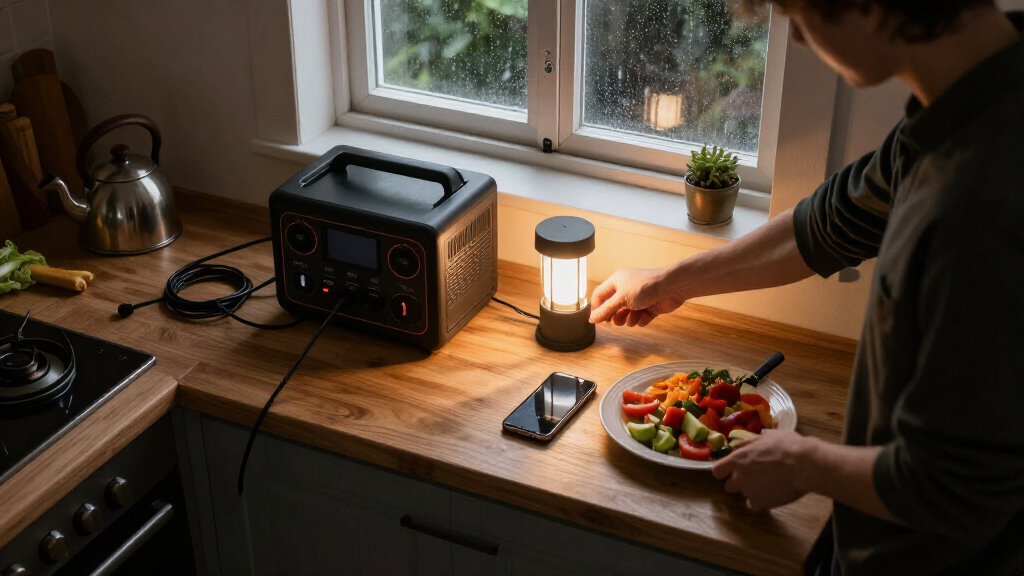
I ranked these stations around the job they need to do during an outage: keep essential devices powered safely and predictably. The main criteria were stated battery capacity, continuous output, battery chemistry where specified, and how well those figures align with common backup loads such as phones, lights, routers, and selected small appliances. I also weighed usability factors that affect real outage planning, including portability, the ability to prioritize loads, and whether a model’s published capacity and output support a clear use case. Product names and specifications supplied for this roundup do not establish runtime, recharge speed, outlet count, or transfer-switch capability, so I avoid treating those details as confirmed.
The order favors options with a useful balance of energy storage and output for more than one kind of essential load, then separates compact, budget-oriented, and high-capacity roles. The BLUETTI AC180 leads for its mid-to-large capacity and stronger output balance; the Jackery Explorer 2000 v2 and Anker SOLIX S2000 follow as larger backup choices with different output ceilings. Smaller units rank lower for whole-home outage coverage, not because they lack value, but because their listed capacities are better matched to a short list of low-draw devices. Where supplied details are sparse, I keep the recommendation narrower rather than inferring performance.
Factors to Consider When Choosing Portable Power Stations For Power Outages
I’d size an outage station around the appliances and devices you intend to keep running, rather than choosing by the largest capacity figure alone. These checks can help prevent a station that looks capable on paper from being mismatched to your actual backup plan.
Start With a Load List, Not a Capacity Number
Write down the devices you want powered and the watts each uses while running. Add the loads you may need at the same time, since a station’s output limit applies to the combined draw. Motors and compressors can need extra power at startup, so a refrigerator or pump may demand more than its normal running figure. A capacity figure in watt-hours estimates stored energy, while output in watts describes how much power the station can supply at once; the numbers answer different questions. A common mistake is buying a large battery with an inverter that cannot handle the appliance. If you cannot confirm a device’s startup demand, plan a test under safe conditions or choose a station with more output headroom.
Estimate Runtime With a Realistic Energy Budget
Use device wattage multiplied by hours of use to estimate energy needs, then add room for conversion losses and uncertainty. For example, a low-wattage router running continuously can consume more over a day than a briefly used higher-wattage device. Published capacity is not the same as energy delivered to every outlet, so treat simple calculations as planning estimates rather than guarantees. Decide which loads get priority and which can be switched off when the battery is low. This makes a compact station more useful for communications and lighting, while a larger model may support a broader plan. Avoid assuming that any listed capacity will run a refrigerator for a fixed number of hours without checking its actual draw and cycling pattern.
Match Battery Chemistry to How Often You’ll Use It
LiFePO4 batteries are listed for several models here, including the DaranEner, BLUETTI Elite 30 V2, BLUETTI AC180, and ALLWEI 300W. Battery chemistry can affect service life and weight, but it does not replace checking capacity, output, warranty terms, and storage guidance. If the station will sit unused between emergencies, follow the maker’s instructions for charge level, inspection, and storage temperature. A chemistry label alone does not tell you how long the unit will power your specific loads. For occasional backup, ease of storage and readiness may matter as much as cycle-life claims. Compare the maker’s care guidance before choosing a unit you expect to keep as emergency equipment.
Plan for Recharging During a Multi-Day Outage
A station’s stored energy is only one part of a longer outage plan; you also need to know how you will replenish it. Check the exact model’s supported AC, vehicle, or solar charging methods and the corresponding input limits before relying on any one source. Solar availability changes with weather, season, roof or yard placement, and daylight, so it should not be treated as guaranteed daily recharge. A vehicle can provide another route, but charging may take time and use fuel. If a station cannot be replenished during the outage, rationing matters more than the headline capacity. Keep charging cables and compatible panels with the unit if they form part of your plan.
Account for Weight, Placement, and Safe Use
Higher-capacity units can support more loads, but they are generally less convenient to move and store than compact stations. Choose a location where the unit can sit on a stable surface with the ventilation and clearance the manufacturer specifies. Keep it dry, away from heat sources, and clear of exits; never run a fuel-burning generator indoors to charge or supplement a power station. During an outage, avoid overloading outlets or daisy-chaining power strips unless the manual permits that setup. If the station must move between floors or rooms, portability is a real part of the backup plan, not a minor convenience. Check the product’s actual dimensions and weight before buying, since those details are not provided for every model in this roundup.
Choose Backup Scope Before Paying for More Capacity
Decide whether you need emergency communications and lighting, a few small appliances, or a wider set of household essentials. Moving up in capacity can reduce how often you ration, but it does not make a station a whole-home backup system by itself. High-draw equipment may exceed the inverter limit even when plenty of energy remains in the battery. If you want to power home circuits, check whether the exact station supports that setup and whether installation by a qualified electrician is needed. For a focused kit, a small unit may be easier to store and carry than a larger one whose extra capacity you rarely use. Spend more only when the added output, energy, or supported charging options address a specific outage need.
Frequently Asked Questions
Can a portable power station run my refrigerator during an outage?
It may, but the station needs both enough stored energy for the desired runtime and enough output to handle the refrigerator’s running and startup demands. Check the appliance label or manual for wattage, then look for its surge requirement if listed. The 1,152Wh BLUETTI AC180 and the larger Jackery and Anker options offer more capacity than the compact models, but capacity alone does not confirm compatibility. Refrigerators cycle on and off, so actual energy use varies with the unit, room temperature, and how often the door opens. Treat any runtime estimate as provisional unless it is based on your refrigerator’s measured consumption.
Is a 192Wh or 288Wh station enough for a power outage?
That range can work for a limited backup kit, such as phones, a small light, or other low-draw electronics, especially when use is intermittent. It is usually a poor fit for running multiple household appliances or providing long-duration backup without recharging. The models in this range also differ in output, so compare the watt limit as well as the battery capacity. Decide how many hours each device must run and estimate its energy use before choosing. If communications and lighting are your only priorities, a compact station can be easier to handle than a larger unit.
Should I choose the Jackery Explorer 2000 v2 or the Anker SOLIX S2000?
The listed figures are close in capacity: 2,042Wh for the Jackery and 2,010Wh for the Anker. Their stated output differs, with the Jackery at 2,200W and the Anker at 1,500W, so the Jackery may suit loads that need more inverter output, subject to each device’s startup needs and the station’s exact specifications. If your planned devices stay below the Anker’s limit, that output difference may matter less than other details such as charging options, ports, dimensions, warranty, and support. The supplied information does not settle those factors. Choose by checking the exact model documentation against your load list rather than assuming near-equal capacity means identical use.
Can I recharge a power station with solar panels during an outage?
Many portable stations support solar charging, but compatibility and charging speed vary by model, panel, and input limit. Confirm the station’s supported voltage and connector requirements, and do not assume any panel will work just because it is marketed for portable power. Solar output can drop sharply with clouds, shade, short winter days, or poor placement, so it may not replace the energy you use each day. For multi-day backup, plan a reduced-load routine and keep another charging method available if possible. Check whether panels and cables are included or need to be purchased separately for the exact model.
Do I need a transfer switch to power household circuits?
A transfer switch or another approved connection method may be needed to supply home circuits, and requirements depend on the station, panel, and local electrical rules. Do not connect a power station to a wall outlet or attempt to energize household wiring through an improvised setup; that can create a serious backfeed hazard. Most buyers using portable stations should connect compatible devices directly to the station unless the manufacturer supports a specific home integration method. Ask a qualified electrician about circuit-level backup and confirm the station’s manual describes the intended setup. None of the model names and specifications provided here confirm transfer-switch support.
Conclusion
For a broad mix of outage essentials, I’d choose the BLUETTI AC180 as the best overall because its 1,152Wh capacity and 1,800W output balance energy storage with a useful output ceiling. The best premium choices are the Jackery Explorer 2000 v2 for buyers who need its higher listed output, or the Anker SOLIX S2000 if its 1,500W limit fits their load plan and its model-specific features check out. For best value, I’d compare the mid-capacity LIBRIDS 640Wh and 519.48Wh option against your device list, since their stated energy stores exceed those of most compact picks without reaching the largest units. Beginners with modest needs can start by prioritizing a compact 288Wh-class station such as the Jackery Explorer 300 or Anker SOLIX C300 for communications and lights. For specific low-draw needs, the MARBERO M82 is a small option for a tightly limited kit, while buyers who need more runtime should move up in capacity and verify output before purchase. My final choice would come from matching measured device loads, desired outage hours, and a credible recharge plan—not from capacity alone.
Halloween Picks
halloween
As an affiliate, we earn on qualifying purchases.