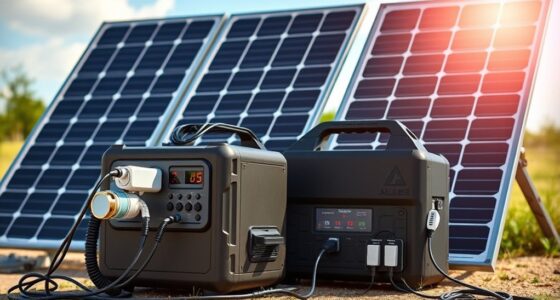
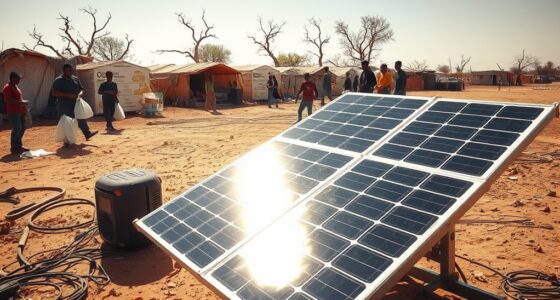
Spend any time around the clean-energy world and you notice a strange gap. On one side, the story is glossy: turbines going up on ridgelines, solar farms spreading across former farmland, charging corridors stitching highways together. On the other side, the actual work of building those projects is stubbornly unglamorous — mud, weather, subcontractors rotating through on two-week stints, and an endless stream of details that somebody has to write down, photograph, and file before the next crew arrives.

Get backup power and energy gear delivered free — and shop member deals
- Fast, free delivery on millions of items
- Access to Prime Big Deal Days deals on October 6–7
- Prime Video, Amazon Music and more included
What Counts Is What’s Proven
Renewable builds fail quietly first: something happens on a remote turbine position, nobody captures it, and weeks later two parties argue from memory. Gewerkton — a voice-first documentation and defect-management platform, now in beta — is betting that wind farms and renewables are exactly where that gap hurts most.
A wind farm happens in dozens of places at once — turbine positions spread across a wide area, each with its own foundations, access roads, cabling runs and acceptance walks.
Connectivity is the exception, not the norm. Field’s answer: offline capture, synced later — the record is made on the spot, not reconstructed at a hotel desk.
Specialized teams rotate through on short stints. One shared record means the incoming crew inherits the site as captured, not as recalled.
Gewerkton Field
Voice-first site app: dictate in the moment, and speech becomes structured evidence — defects, daywork reports, takt planning, portal. Built to work where the grid doesn’t.
Gewerkton Studio
Browser workspace for plans and models. The pragmatic fallback: where no model exists — common on retrofits and repowering — the site team builds one in the browser.
Gewerkton Cloud
The operations layer coordinating models and data between Field, Studio and third parties — keeping evidence, plans and the outside world in sync.
“On site, what counts is what’s proven.”
Gewerkton’s marketing line — born in the German market, with GAEB, REB, XRechnung and DATEV depth carried into its international push.Source: own reporting · gewerkton.com
That second part rarely makes the brochure. But ask anyone who has watched a renewable project slip a milestone, and the story usually involves the same villain: something happened on site, nobody captured it properly, and weeks later two parties are arguing from memory about what was agreed, what was damaged, and who signed off on what.
This is the problem a young platform called Gewerkton is going after — and it has picked wind farms and renewables as one of its home-turf deployment fields. The company’s marketing line is blunt: “On site, what counts is what’s proven.” For a sector that increasingly has to prove its promises — to investors, to regulators, to communities, and to the eco-conscious public — that line lands close to home.
voice-activated site documentation tools
As an affiliate, we earn on qualifying purchases.
As an affiliate, we earn on qualifying purchases.
The renewable build-out has a paper-trail problem
Wind and renewable energy construction is unlike most building work. A housing development happens in one place. A wind farm happens in dozens of places at once — individual turbine positions scattered across a wide area, each with its own foundations, access roads, cabling runs, and acceptance walks. The crews are rarely the same from week to week. Specialized teams rotate through, do their piece, and hand over to the next trade.
Now add one more complication that anyone who has visited a rural turbine site will recognize immediately: connectivity. Dead zones are the norm, not the exception. And yet the documentation still has to happen — the defect spotted during a walk-through, the photo that anchors a claim, the daywork report that records what actually got done before the weather turned. If your tooling depends on a live connection, your record of the project develops holes exactly where the work is most remote.
Multiply that across a portfolio of projects and the stakes get serious. Renewable energy doesn’t just have to be built; it has to be built verifiably. Sustainability claims, warranties, handover documentation, dispute resolution — all of it rests on the quality of the record created while the work was happening. A gap in that record isn’t an administrative nuisance. It’s a financial and reputational risk.
renewable energy site defect management software
As an affiliate, we earn on qualifying purchases.
As an affiliate, we earn on qualifying purchases.
Meet Gewerkton: one brand, three product lines
Gewerkton is a voice-first construction documentation and defect management platform built for global markets. It was born in the German market — which matters, because Germany’s construction industry runs on some of the most formalized commercial standards anywhere — and it carries that depth of integration into its international push: GAEB, REB, XRechnung, and DATEV are all part of the picture, alongside 27 content languages and a choice of regional AI providers spanning the EU, the US, and Asia, including mainland China.
One thing to state plainly up front: Gewerkton is in beta right now, with a public beta planned for fall 2026. This is a young product, and the company says so itself. What’s interesting is how much of the architecture is already thought through.
The platform is a branded house with three product lines, each covering a distinct part of the documentation problem:
- Gewerkton Field — the voice-first construction site app, covering everything from dictation to evidence, defects, daywork reports, takt planning, and the portal.
- Gewerkton Studio — the browser workspace for plans and models. Notably, where no model exists for a site, the site team can create one themselves, directly in the browser.
- Gewerkton Cloud — the operations layer, handling model and data coordination between Field, Studio, and third parties.
For renewable energy projects specifically, the story runs through Field — so let’s start there.
field data capture devices for wind farms
As an affiliate, we earn on qualifying purchases.
As an affiliate, we earn on qualifying purchases.
Gewerkton Field: documentation that works where the grid doesn’t
The core idea behind Gewerkton Field is simple to describe and hard to execute: the people doing the work should be able to create the record by talking, not typing.
Anyone who has worn gloves on a cold turbine site understands why. Typing on a phone in the field is miserable. So the entry gets postponed to the evening, then to the weekend, then it happens from memory — and memory is exactly what a documentation record is supposed to replace. Field flips the sequence: dictate in the moment, on the spot, and let the platform turn speech into structured evidence.
That dictation flows into the artifacts site management actually runs on: defects with their evidence attached, daywork reports, takt planning, and the portal that keeps the broader team aligned. The point isn’t voice for voice’s sake. It’s that the friction between “I noticed something” and “it’s on the record” drops to near zero — which is what makes the record complete.
Offline capture, synced later
For wind farms and other distributed renewable sites, the feature that matters most may be the least glamorous one: offline capture. In the dead zones that come standard with rural turbine positions, documentation still has to happen — so Field captures it offline and syncs it later, when connectivity returns.
This sounds like a small thing until you’ve lived the alternative. The alternative is a supervisor finishing a long day of acceptance walks with a camera roll full of unsorted photos and a head full of half-remembered observations, reconstructing the day at a hotel desk. Every hour between the event and the record degrades the record. Offline capture closes that gap at the moment it opens.

Rotating crews, one continuous record
The other defining condition of renewables construction is crew rotation. Trades cycle through distributed sites in sequence, and each handover is a chance for context to evaporate. What did the previous crew actually finish? Which defects were already logged, and which are new? What was agreed on the last acceptance walk?
When meetings and defects stay documented across dozens of turbine positions — in a single, shared record rather than scattered across personal notebooks and inboxes — the handover stops being a lossy ritual. The incoming crew inherits the truth of the site as captured, not as recalled. That’s the difference between documentation as a compliance chore and documentation as operational infrastructure.
As an affiliate, we earn on qualifying purchases.
Studio and Cloud: the other two legs
Field is where the evidence originates, but a record alone isn’t a workflow. That’s where the rest of the house comes in.
Gewerkton Studio is the browser-based workspace for plans and models — the place where the spatial side of a project lives. The detail worth pausing on is the fallback: where no model exists, the site team creates one in the browser. On renewable projects, especially retrofits, repowering work, or smaller distributed installations, a tidy pre-existing model is often a fantasy. Studio’s answer is pragmatic — don’t wait for one; build what you need where you stand.
Gewerkton Cloud, meanwhile, handles operations and the coordination of models and data between Field, Studio, and third parties. If Field is the senses and Studio is the map, Cloud is the connective tissue — the layer that keeps the evidence, the plans, and the outside world in sync.
Six deployment fields, one pattern
Wind farms and renewables are one of six deployment fields Gewerkton describes, and the pattern that makes it work there repeats across the others:
- Data centers and industrial plants — many trades working in parallel under tight deadlines, where meeting decisions become trade-sorted task lists instead of evaporating after the call.
- Housing and building construction — defects captured with photo and deadline, daywork reports dictated rather than typed, and a signature collected on device at handover.
- Infrastructure and tunnels — long project durations and many change orders, with instructions backed by the original audio they were dictated from.
- Cross-border teams — EU, US, and APAC crews on the same project, each working in their own language, while the evidence original stays unambiguous.
- Projects in Asia — Chinese, Korean, and Vietnamese crews supported multilingually from capture to report, with data residency chosen by the customer.
Two of these deserve an extra word from this desk. First, the EV-adjacent angle: the same distributed-site logic that fits wind farms applies directly to charging-infrastructure construction. Charging networks are, by design, spread across large geographies — corridors, depots, destination sites — built by mobile crews under deadline pressure. The documentation challenges are essentially identical: many small sites, many handovers, and a record that has to be complete everywhere, not just where the connectivity is good.
Second, the cross-border point is more consequential than it might look. Renewable development is an international business. The developer, the turbine supplier, the civil contractor, and the grid operator may all be headquartered in different countries, with crews to match. When each participant can capture and read in their own language while the underlying evidence original stays unambiguous, you remove one of the quietest sources of dispute in international construction: the argument about what the record actually says.
Why verification is the green economy’s currency
Here’s the part of the story that matters most to readers of this site. The clean-energy transition is increasingly a claims business. Developers claim sustainability. Builders claim quality. Operators claim compliance. Financiers and insurers price risk based on all of those claims — and increasingly, so does public trust.
A claim without a record is marketing. A claim with a complete, timestamped, photo-anchored, audio-backed record is something else: verifiable. Documentation discipline is what turns “we built this sustainably” from an assertion into something a third party can actually check. In that sense, tooling like this isn’t really about construction administration at all. It’s about the evidentiary backbone that lets the green economy’s promises be audited — and believed.
That’s a framing eco-minded readers should care about. The faster the build-out accelerates, the more the bottleneck shifts from technology to trust. Wind turbines and solar arrays are proven hardware. What’s scarce is the disciplined record that proves each specific project was built the way its backers said it would be.

Your AI, your region, your infrastructure
Construction documentation is sensitive. It contains commercially loaded evidence — the kind of material that surfaces in warranty disputes and change-order negotiations — so where that data lives and which AI processes it are legitimate deal-breakers, not IT trivia.
Gewerkton’s answer is a bring-your-own-AI model: 13 AI providers are supported, customers bring their own keys, and the region is selectable — EU, US, or Asia, including mainland China. The explicit pitch is no vendor lock-in. On the storage side, data residency is likewise the customer’s call: EU cloud or your own infrastructure.
For cross-border renewable portfolios, this flexibility is doing real work. A European developer with strict residency expectations and an Asian project with local providers don’t have to be forced into a single compromise. The platform adapts to the project’s jurisdiction rather than the other way around.
There’s a small but telling detail on the marketing side, too: the company’s own website runs in 27 languages with zero trackers, no cookie banner, and what it describes as a fully egress-free architecture. Companies reveal their real relationship to data in how they treat their own visitors, and that choice is consistent with the story they tell customers.
Built by one person and a fleet of agents
The origin story is unusual enough to be worth reporting carefully, using the company’s own account: Gewerkton is built by a solo founder directing a fleet of coding agents — Codex and Claude. In one night, according to the company, that fleet shipped 21 software packages, verified with negative controls and mutation tests.
Skepticism is healthy here, and the honest caveats apply: this is a beta product from a very small operation, and the public beta isn’t planned until fall 2026. The verification discipline the company describes — negative controls and mutation tests — is at least the right vocabulary for taking agent-generated code seriously. The company also maintains a media bank of more than 51 self-produced clips and posters, which suggests the one-person operation is investing in explaining itself, not just shipping.
Whether a solo founder with an agent fleet can support enterprise construction documentation at scale is exactly the kind of question a beta period exists to answer. But it would be a mistake to dismiss the approach out of hand; the economics of small teams building serious software have clearly shifted, and Gewerkton is a case study in how far that shift has gone.
The bottom line for the renewable sector
The clean-energy build-out doesn’t fail on turbine efficiency curves or panel wattage. It fails, when it fails, in the seams between trades, sites, and languages — in the undocumented defect, the disputed handover, the claim nobody can substantiate. Distributed renewable projects, with their scattered sites and rotating crews and connectivity dead zones, are where those seams are widest.
Gewerkton’s bet is that voice-first capture, offline tolerance, and a verification-first philosophy are the right tools for that environment — and that what works across dozens of turbine positions will also work across charging corridors, data centers, tunnels, and cross-border megaprojects. The product is in beta now, with a public beta planned for fall 2026, so the verdict is still out. But the problem it has chosen is real, and the framing is the right one for an industry that increasingly has to prove what it promises.
If your world touches renewable construction — development, contracting, operations, or the growing charging-infrastructure build-out — the place to start is the product line built for the mud and the dead zones: Gewerkton Field. Because on site, what counts is what’s proven.
Fall Picks
fall essentials
As an affiliate, we earn on qualifying purchases.