
In a portable power station, connecting batteries in series boosts the voltage, making it suitable for high-voltage devices, while connecting them in parallel increases capacity, providing longer runtime. Series wiring adds voltages together but keeps capacity the same, whereas parallel wiring multiplies capacity without changing voltage. Choosing the right method depends on your power needs. To optimize performance and avoid damage, understanding these differences is essential—keep exploring to learn how to make the best setup.
Key Takeaways
- Series connection increases voltage, suitable for high-voltage applications; capacity remains the same.
- Parallel connection boosts capacity (runtime), while voltage stays constant, ideal for longer device operation.
- Proper wiring depends on specific power needs; series for voltage, parallel for capacity extension.
- Mixing series and parallel requires careful design to prevent battery damage and ensure safety.
- Understanding these differences optimizes power station performance and safe, efficient energy management.
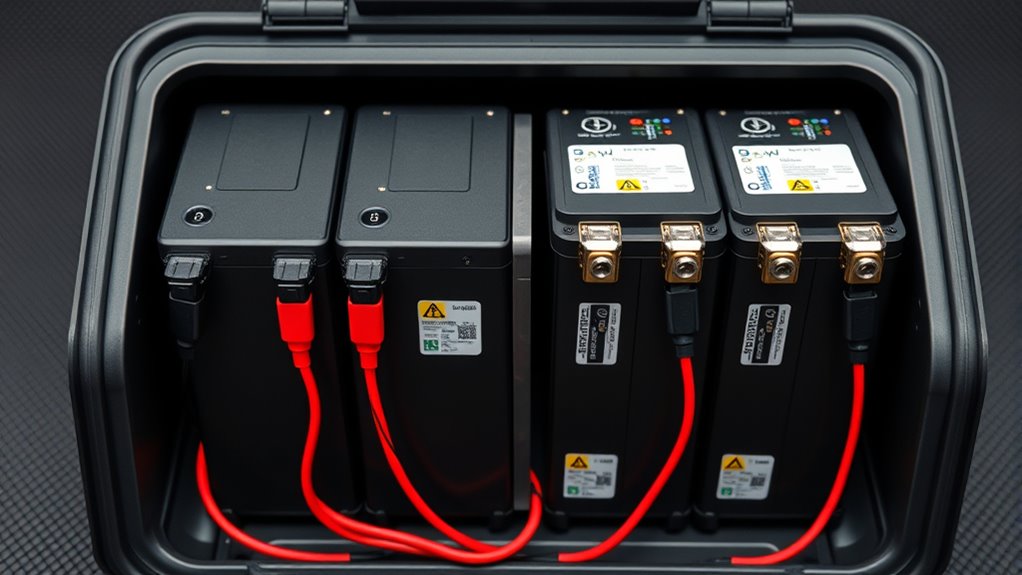
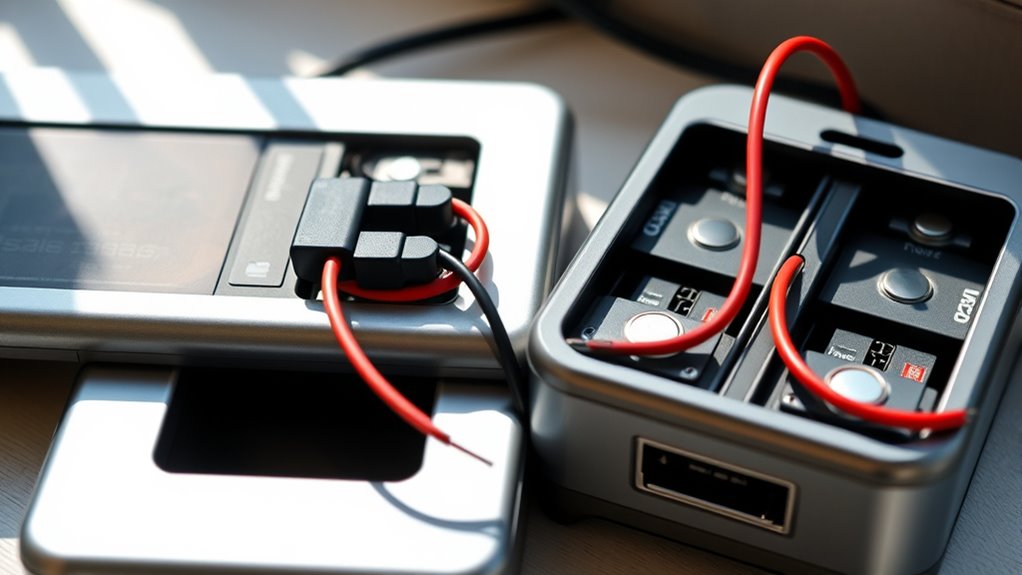
Have you ever wondered how connecting batteries differently affects their performance? When you change the way batteries are wired, it can markedly impact the overall voltage and capacity of your portable power station. This is especially important if you’re trying to optimize power output for your devices. In a series connection, you connect the positive terminal of one battery to the negative terminal of the next. This setup results in a voltage increase; fundamentally, the voltages of each battery add up, giving you a higher total voltage. If each battery supplies 12 volts, connecting four in series will give you 48 volts, which can be useful for powering high-voltage devices or systems that require a specific voltage level. However, the capacity—meaning how much energy the system can hold—remains the same as that of a single battery. So, while you get a higher voltage, the total capacity doesn’t increase in a series setup.
On the other hand, when you connect batteries in parallel, you link all the positive terminals together and all the negative terminals together. This arrangement doesn’t boost the voltage; it keeps it the same as a single battery’s voltage. But what it does do is enhance capacity. Because you’re effectively stacking the batteries’ capacities, the total capacity of the system increases proportionally to the number of batteries connected. For example, if each battery has a capacity of 100Ah, connecting two in parallel results in a system with 200Ah capacity, doubling your runtime for devices that draw a steady current. This makes parallel connections ideal when you need longer run times rather than higher voltages.
Understanding these differences helps you decide how to set up your portable power station based on your needs. If you want more voltage to power specialized equipment, series wiring is the way to go. But if you’re aiming for longer-lasting power without changing the voltage, parallel connections are your best bet. Keep in mind that mixing the two methods can be tricky and may damage your batteries if not done correctly. It’s always best to plan your configuration carefully, considering both voltage increase and capacity enhancement, to ensure your power setup works safely and efficiently. By knowing how these connections influence performance, you can tailor your portable power station to meet your specific power demands more effectively.

BLAVOR Solar Power Bank 20000mAh Built-in Cables, Wireless Charger for Phones & Apple Watch, 20W Fast Charging Battery Pack with USB C, Flashlight, Solar Charger for iPhone, iPad, iWatch, Samsung
- Simultaneously Charge 6 Devices: Multiple cables and ports for 6 devices
- High Capacity & Fast Charging: 20000mAh battery with 20W USB-C fast charge
- Wireless Charging for Phones & Apple Watch: Built-in wireless charger for convenience
As an affiliate, we earn on qualifying purchases.
Frequently Asked Questions
How Does Temperature Affect Series and Parallel Battery Performance?
Temperature impacts both series and parallel battery performance by affecting thermal stability and heat dissipation. When temperatures rise, batteries may overheat, reducing efficiency and lifespan. In a series connection, heat can cause voltage inconsistencies, while in parallel, uneven heat dissipation might lead to imbalanced charging. Keeping batteries cool ensures peak thermal stability, improves heat dissipation, and maintains consistent power output, regardless of the connection type.
Can Mixed Series and Parallel Configurations Optimize Power Station Efficiency?
Yes, hybrid configurations can optimize your power station’s efficiency by combining series and parallel setups. This approach allows you to balance voltage and capacity, ensuring better performance and longevity. You benefit from improved voltage balancing, which reduces stress on individual batteries, and increased overall power output. By strategically mixing series and parallel connections, you can tailor your power station to meet specific energy needs more effectively and reliably.
What Safety Considerations Are Unique to Each Wiring Method?
Think of wiring like a tightrope walk—you need balance and safety. In series connections, guarantee battery insulation is intact to prevent short circuits, and use proper circuit protection to handle higher voltage risks. For parallel setups, focus on equalizing battery capacities and safeguarding against overcurrent. Always verify insulation integrity and install circuit protection devices to prevent hazards, keeping your power station safe and reliable in any configuration you choose.
How Do Maintenance Requirements Differ Between Series and Parallel Setups?
You need to regularly check and maintain your batteries in both setups. In a series connection, monitor for uneven charging and perform battery balancing to guarantee all cells stay equal, preventing damage. In parallel setups, watch for corrosion at terminals and connections, cleaning them promptly. Proper maintenance extends battery life, so consistently inspect, balance, and prevent corrosion to keep your portable power station functioning safely and efficiently.
Are There Specific Battery Chemistries Better Suited for Each Configuration?
You’ll find that lithium-ion batteries are best suited for both series and parallel configurations because they offer longer battery lifespan and flexible charging methods. For series setups, guarantee balanced charging to prevent overcharging, which can harm the batteries. Parallel connections benefit from uniform charging, extending lifespan. Overall, lithium-ion chemistry handles both configurations well, maintaining efficiency and safety without sacrificing longevity.

SOARAISE Solar Power Bank 48000mAh Wireless Portable Charger with 4 Cables
- High-Efficiency Solar Panels: 4 premium solar panels for faster charging
- Large Capacity Battery: 48000mAh lithium-polymer battery for extended use
- Multi-Device Charging: Supports 7 devices simultaneously with multiple ports
As an affiliate, we earn on qualifying purchases.
Conclusion
Choosing between series and parallel battery connections depends on what you need. If you want higher voltage, series is your go-to; for more capacity, parallel’s the way to go. Just remember, there’s no one-size-fits-all answer—it’s all about your specific power needs. Don’t put all your eggs in one basket, so weigh your options carefully. By understanding the differences, you’ll be better equipped to power up your portable station without a hitch.

Jackery Explorer 300 Portable Power Station,292Wh
- Lightweight Design: Only 7.5 lbs with 292Wh capacity
- Easy to Carry: Integrated handle for portability
- Multiple Device Charging: 2 AC outlets, USB-C, USB-A, car port
As an affiliate, we earn on qualifying purchases.

Jackery Solar Generator 1000 v2 and 200W Solar Panel,1070Wh,1500W AC
- Powerful AC Output: 1500W continuous, 3000W surge
- Lightweight & Portable: 23.8 lbs with foldable handle
- Fast Charging: Full charge in 1 hour via app
As an affiliate, we earn on qualifying purchases.