Finding the right solar generator for travel can be challenging, as you balance portability, power capacity, and affordability. The Westinghouse iGen400s stands out as the best overall due to its reliable performance and compact size. The Jackery Explorer 300 offers a great balance of weight and power for most travelers, while the Jackery Solar Generator 1000 V2 provides ample capacity for longer trips or outdoor work. Travelers face tradeoffs between size, weight, and power output—choosing a model that fits your specific needs can make all the difference. Continue reading to see the full breakdown of these options and what makes each one unique.

Get backup power and energy gear delivered free with Prime
- Fast, free delivery on millions of items
- Prime Video, Amazon Music and more included
- Member-only deals all year
Complete the kit


Key Takeaways
- Top picks balance portability with sufficient power for typical travel needs.
- Battery capacity varies significantly; larger capacity often means increased weight and size.
- Solar input wattage impacts how quickly the generator recharges, especially important for extended trips.
- Build quality and durability are crucial for outdoor use, with many models featuring rugged designs.
- Price range reflects differences in capacity, features, and brand reputation, so prioritize your specific needs over cost alone.




| solar generator for travel | Wattage | Capacity | Weight |
|---|---|---|---|
| Westinghouse iGen400s 400 Watt | — | 183Wh | Lightweight (exact weight not specified) |
| Jackery Explorer 300 Portable | — | 292Wh | 7.5 lbs |
| Portable Solar Generator 300W | 300W | — | — |
| Portable Solar Generator 300W | 300W | — | — |
| Takki Solar Generator 120W Pea | 88.8Wh | — | — |
| Jackery Solar Generator 1000 V | 1500 watts | 1070Wh | 23.8 pounds |
| Jackery Solar Generator 300 wi | 300W | 292Wh | 12.9 pounds |
| EnginStar 296Wh Portable Solar | 300W | 296Wh | — |
| EnginStar Portable Power Stati | 300W | 296Wh | — |
| MARBERO 237Wh Solar Generator | 300W | 237Wh | — |
| 1000W Portable Power Station 1 | 1000 watts | 1024Wh | 27.73 lbs |
| Jackery HomePower 3600 Plus Po | — | 3584Wh | 77.2 pounds |
| Portable Solar Generator with | 300 watts | — | 5 lbs |
More Details on Our Top Picks
Westinghouse iGen400s 400 Watt Portable Power Station and Solar Generator
The Westinghouse iGen400s stands out for its lightweight, weather-resistant design, making it a top pick for those who need reliable power both indoors and outdoors. Compared with the Jackery Explorer 300, it offers a higher peak power of 400W, which can handle a broader range of devices, though its capacity of 183Wh limits longer use. Its multiple outlets, including USB-C and 12V DC, provide flexibility for charging various gadgets simultaneously. The absence of a solar panel is a drawback, but its fast 80% charge in just 2 hours makes it convenient for quick top-ups. The main tradeoff is its limited capacity, making it less suitable for high-wattage appliances or extended off-grid stays. Overall, this pick makes the most sense for campers or emergency kits needing portable, quiet power with quick recharge capabilities.
Pros:- Lightweight and weather-resistant shell for outdoor durability
- Multiple outlets including USB-C and 12V DC for versatile device charging
- Fast charging with 80% in 2 hours for quick top-ups
Cons:- AC power adapter not included, adding extra cost
- Limited capacity restricts use with larger appliances
- Solar panel not included, requiring separate purchase
Best for: Travelers who want a compact, durable power station for camping, emergencies, or indoor use with quick recharge needs
Not ideal for: Those needing to run high-wattage appliances or long-term off-grid power, due to its limited capacity
- Capacity:183Wh
- Peak Power:400W
- Running Power:200W
- Outlets:2 120V AC, 3 USB-C 30W, 2 USB-A, 1 USB-C 100W, 1 12V DC
- Charge Time:80% in 2 hours
- Weight:Lightweight (exact weight not specified)
Our verdict“This power station is ideal for travelers seeking portable, reliable backup power for camping or emergencies without high energy demands.”
Jackery Explorer 300 Portable Power Station, 292Wh
The Jackery Explorer 300 balances portability with long-lasting performance, making it a favorite for those who prioritize longevity and versatility. Its lightweight design at just 7.5 lbs makes it easy to carry, comparable to the Takki 88.8Wh but with nearly three times the capacity. The LiFePO4 battery ensures over 4,000 charge cycles, translating into years of reliable use, especially compared to the smaller Takki unit. It offers a broad set of outlets, including USB-C PD and a car port, suitable for a variety of devices. Its 4-hour charge time via solar or wall outlet provides flexibility, although it’s limited to a 300W rated output, which restricts use with high-wattage appliances. Still, this makes it an excellent choice for campers or travelers who need dependable power that lasts, with the drawback of no included solar panel.
Pros:- Lightweight and highly portable design
- Long lifespan with over 4,000 charge cycles thanks to LiFePO4 batteries
- Multiple versatile outlets including USB-C PD and car port
Cons:- Limited to 300W output, unsuitable for high-wattage devices
- Does not include solar panel, requiring separate purchase
Best for: Travelers and campers seeking a durable, long-lasting power station with multiple charging options for small to medium devices
Not ideal for: People needing to power high-wattage appliances or larger electronics, due to its 300W rated output
- Weight:7.5 lbs
- Capacity:292Wh
- Outlets:2 AC, 1 USB-C PD, 2 USB-A, 1 Car port
- Rated Output:300W
- Charge Cycles:4000+
- Dimensions:9.1 x 5.2 x 7.8 inches
Our verdict“This pick suits travelers needing a reliable, long-lasting power source for small devices and outdoor adventures, with some limitations on high-power appliances.”
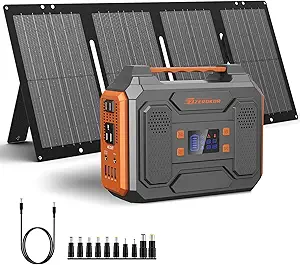
Portable Solar Generator 300W Power Station with 60W Foldable Solar Panel
The Portable Solar Generator 300W with 60W Solar Panel emphasizes renewable energy, making it well-suited for eco-conscious travelers. Its 300W capacity with a 296Wh battery provides enough power for smartphones, laptops, and small appliances, aligning with the needs of outdoor enthusiasts. The included foldable 60W solar panel allows recharging in sunlight, offering independence from wall outlets—a key advantage over the Jackery Explorer 300, which requires an external panel. Its multiple output ports, including AC, USB-A, and USB-C, support versatile device charging. Still, its limited 300W output restricts powering larger appliances, and reliance on sunlight means recharging can be slow or unreliable in low-light conditions. It’s best for daytime outdoor use where sunlight is available, but less so for extended off-grid stays without supplemental power sources.
Pros:- Includes a foldable 60W solar panel for eco-friendly recharging
- Multiple output options support various devices
- Built-in safety protections and battery management system
Cons:- Solar panel not included in main package, sold separately
- Limited to 300W, not suitable for larger appliances
Best for: Eco-minded travelers needing portable, renewable power sources for small devices and outdoor activities
Not ideal for: Users needing to power high-wattage appliances or for use in low sunlight conditions, due to its reliance on solar recharging
- Wattage:300W
- Battery Capacity:296Wh
- Solar Panel Power:60W
- Output Ports:2 AC, 2 USB-A, 1 USB-C, 12V/24V DC
- Charging Methods:Solar panel, wall outlet, car 12V socket
- Conversion Efficiency:23%
Our verdict“This generator makes sense for eco-conscious travelers who want renewable energy options for small electronics during outdoor trips, with some recharging limitations.”
Portable Solar Generator 300W with 60W Solar Panel
The Portable Solar Generator 300W with 60W Solar Panel is designed for outdoor safety and emergency preparedness, featuring a built-in SOS flashlight and multiple charging outlets. Its 300W power capacity and 296Wh battery make it suitable for small appliances and devices up to 80W, comparable to the Takki 88.8Wh but with substantially more output capability. The inclusion of a 60W foldable solar panel allows recharging in sunlight, but performance may decline if not regularly maintained or exposed to consistent sunlight. Its safety features, such as overload and short-circuit protection, are essential for outdoor use, though the junction box isn’t waterproof, which complicates wet conditions. It’s well-suited for camping or emergency kits, but not for powering larger appliances or frequent heavy use, especially in cloudy weather.
Pros:- Includes a foldable 60W solar panel for renewable recharging
- Built-in SOS flashlight and safety features
- Multiple outlets including AC, USB, and DC ports
Cons:- Performance can decline if not regularly charged in sunlight
- Devices over 300W risk damaging the unit
- Junction box is not waterproof, requiring dry storage
Best for: Outdoor enthusiasts and emergency preppers needing portable, safe power with solar recharging capabilities
Not ideal for: Power users requiring high wattage or consistent solar recharging in low-light conditions, due to its limited capacity and performance variability
- Wattage:300W
- Power Source:Battery, Solar, AC/DC
- Voltage:110V
- Output Wattage:300W
- Included Solar Panel:60W
- Additional Features:Overload/Short Circuit Protection, Built-in BMS
Our verdict“This generator fits outdoor adventurers and emergency planners looking for a portable, safety-focused power source with solar recharging, but with some limitations in adverse weather.”
Takki Solar Generator 120W Peak Portable Power Station with 21W Solar Panel and 88.8Wh Battery
The Takki Solar Generator prioritizes portability, with a tiny 88.8Wh battery and a lightweight design, making it perfect for quick, small power needs on outdoor trips. Its 21W foldable solar panel is ideal for daytime recharging, but with a runtime of only about 2 hours for devices up to 80W, it’s best suited for brief use rather than extended off-grid living. Its multiple charging options, including USB, USB-C, and AC outlets, support a variety of small devices. The compact size and built-in LED flashlight with SOS mode enhance its utility in emergencies, but the limited capacity and slow solar recharging time mean it can’t handle larger or prolonged power demands. This is ideal for ultra-light backpackers or short-term emergency kits, but not for more intensive power needs.
Pros:- Extremely lightweight and portable
- Multiple charging options including USB and AC
- Built-in LED flashlight with SOS mode for safety
Cons:- Limited to powering devices up to 80W
- Slow solar recharging, taking 5-7 hours in good sunlight
- Not suitable for continuous or high-power use
Best for: Ultra-light travelers or emergency kits needing small, quick-charging power sources
Not ideal for: Those requiring sustained power for multiple devices or larger appliances, given its limited capacity
- Wattage:88.8Wh
- Power Source:Solar
- Voltage:110V AC
- Output Wattage:80W
- Total Power Outlets:2
- Runtime:2 hours
Our verdict“This tiny power station suits travelers needing a lightweight backup for small devices during short trips or emergencies, with limited capacity for ongoing use.”
Jackery Solar Generator 1000 V2 with 200W Solar Panel, 1070Wh, 1500W AC
This model stands out for its substantial 1070Wh capacity and 1500W AC output, making it capable of powering multiple devices simultaneously—something the Jackery Explorer 300 can’t match. Its fast-charging feature and durable battery life over 10 years position it as a reliable choice for those seeking long-term outdoor power. However, the solar panel ships separately, adding setup complexity, and its 2-hour runtime at full load limits continuous operation without recharging. The app-based fast charging feature is a plus but requires setup. This pick is ideal for campers or emergency prepppers who need robust, dependable power on the go.
Pros:- High 1070Wh capacity supports multiple appliances
- Powerful 1500W AC output covers most device needs
- Fast charging and over 10-year battery lifespan
Cons:- Solar panel sold separately, increasing initial cost
- Limited runtime of 2 hours at full load
Best for: Outdoor enthusiasts or emergency kits needing high capacity and reliable long-term power
Not ideal for: Lightweight travelers or day hikers who prioritize minimal weight and quick setups
- Wattage:1500 watts
- Capacity:1070Wh
- Weight:23.8 pounds
- Output Voltage:120 volts
- Run Time:2 hours
- Additional Features:Fast Charging, Durable Battery
Our verdict“Best suited for those who prioritize capacity and durability over portability for outdoor and emergency use.”
Jackery Solar Generator 300 with 40W Solar Panel, 292Wh, 300W AC
The Jackery Explorer 300 offers a portable solution with 292Wh capacity and 300W AC output, making it a solid choice for weekend camping or short outdoor stays. Its lightweight design, at just under 13 pounds, surpasses the heavier alternatives like the Jackery 1000 V2 for portability. It includes multiple outlets—USB-C, USB-A, and car port—making it versatile for charging various devices. Compared with the EnginStar 296Wh, it provides more power and outlets but requires a separate solar panel purchase, which could be a hassle. This device is best for travelers who want easy-to-carry power for smaller devices but don’t need to run high-wattage appliances continuously.
Pros:- Lightweight at 12.9 pounds for easy transport
- Multiple charging options including USB-C and car port
- Long-lasting LiFePO4 battery with over 4,000 cycles
Cons:- Requires separate purchase of solar panel
- Limited to 300W continuous power, not for high-wattage appliances
Best for: Hikers and campers needing a lightweight, all-in-one power station for small devices
Not ideal for: Users requiring high wattage or longer runtime for larger appliances
- Capacity:292Wh
- Wattage:300W
- Weight:12.9 pounds
- Outlets:Multiple including USB-C
- Charge Cycles:Over 4,000
- Additional Features:Fast solar charging
Our verdict“Ideal for lightweight travelers needing reliable portable power for small devices on outdoor adventures.”
EnginStar 296Wh Portable Solar Generator, Pure Sine Wave Power Station
The EnginStar 296Wh generator offers pure sine wave power, a key feature for sensitive electronics, with a compact and lightweight design ideal for camping or emergency use. Its size surpasses the EnginStar 300W for portability, and it includes multiple ports, LED lights, and a smart protection system for safety. While its 7-hour charging time with a wall adapter is longer than the Jackery models, it compensates with a smaller size and a focus on safe, stable power. Compared to the larger Jackery 1000 V2, it sacrifices capacity but excels in portability and safe operation, making it suitable for travelers with sensitive devices or short-term needs.
Pros:- Pure sine wave output safe for sensitive electronics
- Compact and lightweight for portability
- Built-in LED flashlight and smart safety features
Cons:- Supports devices under 300Wh, limiting for larger loads
- Longer charging time of about 7 hours
Best for: Travelers needing a compact, safe power source for sensitive electronics and small devices
Not ideal for: Those requiring high power or extended runtime for larger appliances
- Capacity:296Wh
- Wattage:300W
- Size:2.8″L x 2.8″W x 4.3″H
- Output Type:Pure sine wave
- Charge Time:7 hours
- Additional Features:LED flashlight, safety system
Our verdict“Best suited for travelers who prioritize safe, stable power for sensitive electronics in a small package.”
EnginStar Portable Power Station 300W 296Wh Solar Generator
This compact EnginStar model provides 296Wh and 300W output, aligning closely with the EnginStar 296Wh but with a slightly more traditional form factor. Its multiple output ports and fast charging options make it versatile for camping or emergency scenarios. While it lacks included solar panels, it offers reliable, safe power for devices up to 300W. Compared to the larger Jackery Explorer 300, it is more portable but offers similar capacity and power output. Its small size and safety features make it suitable for quick, reliable power in tight spaces or emergencies, though its limited capacity might require frequent recharging for longer trips.
Pros:- Small, lightweight, easy to carry
- Multiple charging options including solar, AC, and car
- Built-in safety features for device protection
Cons:- Battery capacity may be insufficient for extended use
- No included solar panel, additional purchase needed
Best for: Emergency preparedness or short outdoor excursions requiring quick, reliable power
Not ideal for: Those needing to power high-wattage appliances or long-duration power supply
- Capacity:296Wh
- Wattage:300W
- Size:9.1″L x 5″W x 7″H
- Output Power:300W
- Additional Features:Digital display, safety system
Our verdict“Ideal for emergency or short-term outdoor use where portability and safety are priorities.”
MARBERO 237Wh Solar Generator with Solar Panel Included Portable Power Station 300W Pure Sine Wave for Camping and Outdoor Use
The MARBERO 237Wh unit, combined with its foldable 60W solar panel, offers a complete off-grid power solution for small devices and emergency needs. Its 300W pure sine wave output ensures safe operation for sensitive electronics, similar to EnginStar’s safety features but with a slightly lower capacity. The included solar panel simplifies setup, unlike the Jackery models, which require separate panels. Its runtime of about 1 hour limits continuous use but makes it perfect for quick charges during outdoor activities. Compared with the Jackery Explorer 300, it offers a more integrated solar setup but less capacity. This option is best for users focused on complete portability and integrated solar charging for small-scale needs.
Pros:- Includes foldable solar panel for easy setup
- Multiple USB, AC, and DC ports for versatility
- Compact design with built-in LED flashlight
Cons:- Limited runtime (~1 hour at full load)
- Supports devices only under 300W
Best for: Campers and outdoor users seeking an all-in-one, portable power station with solar included
Not ideal for: People needing to power larger appliances or sustain longer use without recharging
- Capacity:237Wh
- Wattage:300W
- Solar Panel:60W foldable
- Runtime:1 hour
- Additional Features:LED flashlight, built-in solar panel
Our verdict“Best for off-grid users wanting an all-in-one portable power kit with integrated solar for small devices.”
1000W Portable Power Station 1024Wh LiFePO4 for Outdoor & Home
This power station stands out for its robust 1000W continuous output and long-lasting LiFePO4 battery, making it well-suited for powering multiple devices during extended off-grid trips or emergencies. Compared with the Jackery HomePower 3600 Plus, it offers a more portable weight and faster charging times, but lacks the massive capacity and expandable features of the larger unit. Its 1024Wh battery supports essential appliances like mini fridges and routers, but its weight at nearly 28 pounds can be a hurdle for frequent travelers. The inclusion of multiple fast-charging ports enhances versatility, yet runtime at full load is limited to about 2 minutes without solar input. This pick makes the most sense for users needing reliable backup power in a portable form.
Pros:- Powerful 1000W output suitable for multiple devices simultaneously
- Long-lasting LiFePO4 battery with over 3000 cycles
- Supports solar charging, perfect for off-grid use
- Relatively lightweight for its capacity
Cons:- Heavy at nearly 28 pounds, less portable for frequent carrying
- Limited runtime of only 2 minutes at full load without solar input
Best for: Backcountry campers or emergency preppers who need dependable, high-capacity power without the bulk of larger generators.
Not ideal for: Lightweight hikers or casual travelers, as its weight and size may be cumbersome for frequent carry or compact travel.
- Wattage:1000 watts
- Capacity:1024Wh
- Battery Type:LiFePO4
- Power Source:Electric, Solar
- Output Voltage:110 volts
- Additional Outlets:2×110V AC, 1×60W PD USB-C, 2×USB-A
- Weight:27.73 lbs
- Charging Time:6-8 hours with 200W solar panel
Our verdict“This option is ideal for those needing reliable, portable power for extended outdoor stays or emergency backup, accepting some weight for capacity.”
Jackery HomePower 3600 Plus Portable Power Station with 2 Solar Panels
The Jackery HomePower 3600 Plus makes the list for its substantial 3600W output and 3584Wh capacity, which can power larger appliances and support extended outages. Compared with the 1000W portable model, it offers significantly more power and expandability, but its weight of over 77 pounds makes mobility challenging—more suited for stationary use. Its high cycle count of 6,000 ensures durability over years of repeated use, and multiple charging options—AC, DC, solar, or even gas—add flexibility. However, solar panels are sold separately, and this unit’s size means it’s less practical for frequent travel. It’s better suited for users who prioritize power capacity and durability over portability, like emergency prepper households or semi-permanent setups.
Pros:- High 3600W continuous output for large appliances
- Expandable capacity up to 21kWh for long-term backup
- Durable 6,000 cycle lifespan with 10-year expected durability
- Multiple charging options including solar and gas
Cons:- Solar panels are not included, increasing initial cost
- Heavy weight and size limit portability for frequent travel
- Higher upfront investment compared to smaller units
Best for: Homeowners or emergency responders needing a portable yet powerful backup system for extended outages or off-grid living.
Not ideal for: Active travelers or backpackers who require lightweight, compact solutions for short trips, due to its weight and size.
- Output Wattage:3600W
- Capacity:3584Wh
- Expandable Capacity:up to 21kWh
- Charging Options:AC, DC, Solar, Gas generator
- Weight:77.2 pounds
- Dimensions:15.2 x 12.2 x 19.3 inches
- Number of Outlets:4
Our verdict“This model is best for those who need serious power capacity for home backup or emergency scenarios, accepting reduced portability.”
Portable Solar Generator with 300W Power Station and 40W Solar Panel
This compact solar generator earns its place for outdoor enthusiasts seeking lightweight, portable power. Compared to the larger models, such as the Jackery HomePower 3600 Plus, it offers only 300W of continuous power and a 220Wh battery, but at a fraction of the weight—just 5 pounds. Its 40W solar panel performs well in low-light conditions, making it ideal for short camping trips or emergency kit inclusion. The multiple output ports support a variety of small devices, and the bright LED floodlight adds outdoor convenience. However, its limited runtime—roughly 6-8 hours for small devices—makes it less suitable for extended power needs or high-demand appliances. This pick is perfect for ultralight outdoor use, but not for powering larger devices over long periods.
Pros:- Extremely lightweight at only 5 pounds
- Multiple output ports for versatile device charging
- High-efficiency solar panel performs well in low-light
- Bright LED floodlight for outdoor visibility
Cons:- Limited runtime of about 6-8 hours for small devices
- Maximum continuous power of only 300W may not handle high-demand appliances
- Small battery capacity restricts prolonged use
Best for: Lightweight campers, backpackers, or emergency kits where portability outweighs high capacity or runtime.
Not ideal for: Users needing to power larger devices or sustain power for many hours, due to its small battery capacity and wattage limits.
- Wattage:300 watts
- Battery Capacity:220Wh (60000mAh)
- Dimensions:8.5 x 6.7 x 4.1 inches
- Weight:5 lbs
- Input Power:40W solar panel
- Output Ports:2 AC, 3 USB-A, 2 USB-C, 1 DC carport
- Runtime:Up to 6-8 hours
- Protection Features:Overcharge, over-discharge, over-current, short-circuit
Our verdict“This compact solar generator excels for lightweight outdoor adventures or emergency preparedness, trading off capacity for portability.”

How We Picked
I evaluated these solar generators based on a combination of performance, portability, and usability tailored for travel. Priority was given to models that strike a balance between weight and power capacity, ensuring they are manageable to carry while providing enough juice for essential devices. Durability and build quality were also key, especially for outdoor environments. Cost-effectiveness was considered, but not at the expense of core features like fast solar recharge or multiple output options. The ranking reflects the overall value and suitability for different types of travelers.Factors to Consider When Choosing Solar Generator For Travel
Choosing a solar generator for travel requires understanding how different features align with your typical adventures. Consider your power needs, how much weight you’re willing to carry, and how quickly the generator can recharge via solar panels. Beyond specs, think about ease of use, durability, and whether the device can handle your specific devices. Making the right choice involves balancing these factors to match your travel style and expectations.Power Capacity and Output
Assess your essential device list—laptops, phones, small appliances—and determine the total wattage needed. A higher capacity unit will support more devices or longer use, but often comes with added weight and size. Look for models with adjustable power outlets and pure sine wave inverters for sensitive electronics. Overestimating your needs can lead to unnecessary bulk, so match capacity carefully to your typical power consumption.
Portability and Weight
For travel, weight and size are paramount. Smaller units are easier to carry, but may lack the capacity to power larger devices or multiple gadgets. Consider whether a compact, lightweight model can meet your needs without sacrificing too much power. Also, check for ergonomic handles, rugged casing, and modular designs that facilitate packing and transport—key features that make outdoor use practical.
Solar Input and Recharging Speed
Fast recharging from solar panels is vital for extended trips, especially when access to grid power is limited. Check the solar input wattage—higher wattage means quicker recharge times, reducing downtime between uses. Keep in mind that real-world solar efficiency depends on weather and panel quality. If you plan to rely heavily on solar recharging, opt for models with higher input capacity and compatible, portable solar panels.
Build Quality and Durability
Travel environments can be tough—look for models with rugged casings, shock resistance, and weatherproof features. Durable units are less likely to sustain damage during transport or outdoor use. Even the most portable units benefit from features like rubberized corners or sealed ports, which help withstand accidental drops and exposure to elements. Investing in quality build can extend the lifespan and reliability of your generator.
Price and Value
While budget models can serve light needs, investing in a slightly more expensive unit often yields better durability, faster charging, and higher capacity. Consider your typical usage—if you often camp or spend days away from power sources, a premium model might save you frustration. Conversely, if your trips are short and light, a more affordable, smaller unit may be sufficient. Focus on the core features that match your travel frequency and device needs.
Frequently Asked Questions
How long does a solar generator typically take to recharge fully?
The recharge time depends on the solar input wattage and the capacity of the generator. Smaller units with 100-300Wh capacity can often recharge within 4-8 hours under ideal sunlight, while larger models with 1000Wh or more may take 8-12 hours or longer, especially if solar input is limited. Factors like panel efficiency, weather conditions, and whether you’re using multiple panels also play a role. For trips requiring frequent recharges, choosing a generator with higher solar input capacity can significantly reduce downtime.
Is a pure sine wave inverter necessary for travel use?
Yes, a pure sine wave inverter is highly recommended if you plan to power sensitive electronics like laptops, cameras, or medical devices. It provides clean, stable power that mimics household AC power, preventing potential damage or malfunctions. Modified sine wave units are cheaper but can cause noise, overheating, or damage to certain appliances over time. For reliable operation and device safety, prioritize models with pure sine wave output for travel scenarios.
How much capacity do I need for basic travel use?
For most travelers who mainly charge phones, tablets, and small devices, a generator with 200-400Wh capacity is usually sufficient. It can power multiple devices over a day or two, especially if recharged daily with sunlight. If you want to run small appliances or longer-lasting power, consider models in the 600-1000Wh range. Be mindful that larger capacities come with increased weight and size, so balance your power needs with portability.
Can I rely solely on solar panels to recharge my generator during trips?
While solar panels are a great renewable source, relying solely on solar energy depends heavily on weather and sunlight availability. In sunny conditions, you can recharge fairly quickly, but cloudy or rainy days will slow the process. Having a backup charging method, like AC wall outlets or car adapters, is advisable for consistent power access. For extended trips in variable weather, selecting a generator with higher capacity and solar input can help maintain power without constant reliance on sunlight.
What’s the best way to carry and store my solar generator when traveling?
Look for models with integrated handles, lightweight designs, and rugged exteriors that can withstand outdoor conditions. Carrying a smaller, compact unit reduces strain, especially if you’re hiking or camping. Storage should be dry, cool, and protected from impacts. Using protective cases or carrying bags designed for portable power stations can extend the lifespan and keep your device safe during transport. Consider your mode of travel—backpacking, car trips, or RV—when choosing the most suitable form factor.
Conclusion
For most travelers, the Westinghouse iGen400s offers a reliable, balanced choice as the best overall option. If you’re seeking the best value, the Jackery Explorer 300 provides solid performance without a hefty price tag. For those needing extended capacity or longer trips, the Jackery Solar Generator 1000 V2 stands out as a premium pick. Beginners or casual campers will find smaller, lightweight models like the Takki Solar Generator a good starting point. Ultimately, your decision should align with your typical trip length, device needs, and how much weight you’re willing to carry.