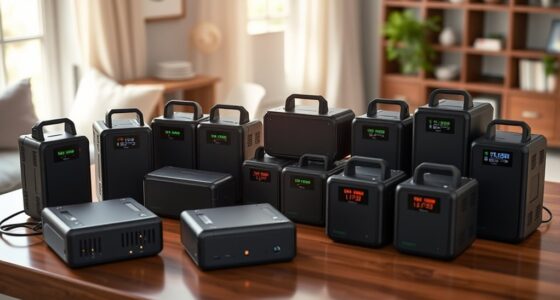
The best home energy storage system overall in this roundup is the ECO-WORTHY PowerMega 48V system, pairing a 10kW hybrid inverter with a 314Ah battery for a substantial home backup setup. The ECO-WORTHY 32 kWh system stands out for households prioritizing stored energy, while the AFERIY portable power station suits smaller backup needs and simpler use. The main tradeoff is between a portable unit that is easier to place and larger systems that can support more circuits but demand careful planning around wiring, installation, and solar compatibility. Battery capacity alone does not tell you which appliances a system can run or for how long. Read on for the full comparison and guidance on matching a system to your home.

Get backup power and energy gear delivered free with Prime
- Fast, free delivery on millions of items
- Prime Video, Amazon Music and more included
- Member-only deals all year
Complete the kit


Key Takeaways
- PowerMega is the most balanced large-system pick: its 10kW hybrid inverter and 48V, 314Ah battery combine meaningful output with an integrated system design.
- The 32 kWh ECO-WORTHY setup favors longer backup: its large stated storage capacity suits buyers focused on energy reserves, provided the system’s output and installation fit their home.
- AFERIY is the simplest scale of use: its 1024Wh portable format can serve small loads, but it is not a substitute for whole-home storage.
- The Cubix100 options scale through battery quantity: the two-pack is a more contained rack-battery configuration, while the four-pack offers more stored energy and greater space and integration demands.
- A solar kit and a battery system solve different problems: the 10kW off-grid kit bundles panels, battery storage, and system components, while standalone storage choices require buyers to check what else their installation needs.
| AFERIY Portable Power Station, 1024Wh, Expandable to 5120Wh |  | Best for Flexible Backup | Battery capacity: 1,024Wh, expandable to 5,120Wh | Battery chemistry: LiFePO4 | Battery cycle life: Over 4,000 cycles | VIEW LATEST PRICE | See Our Full Breakdown |
| ECO-WORTHY 32 kWh Solar Panel and LiFePO4 Home Backup System |  | Best Complete Solar Backup Package | Usable energy: 30kWh+ | Battery capacity: 2 × 48V 314Ah LiFePO4 batteries | Solar panels: 6 × 590W N-type monocrystalline panels | VIEW LATEST PRICE | See Our Full Breakdown |
| ECO-WORTHY PowerMega 48V 314Ah LiFePO4 Energy Storage System with 10kW Hybrid Inverter |  | Best Storage-Focused System | Usable energy: 16.1kWh | Battery: 51.2V, 314Ah LiFePO4 | Inverter power: 10kW | VIEW LATEST PRICE | See Our Full Breakdown |
| ECO-WORTHY Cubix100 48V 200Ah LiFePO4 Server Rack Battery, 2-Pack |  | Best Expandable Rack Battery | Battery chemistry: LiFePO4 | Nominal voltage: 51.2V | Capacity listing: 200Ah overall; listing also states 48V 100Ah | VIEW LATEST PRICE | See Our Full Breakdown |
| ECO-WORTHY 10kW Off-Grid Solar Panel Kit with 16.1kWh LiFePO₄ Battery |  | Best Off-Grid Solar Kit | Inverter continuous output: 10,000W | Inverter peak output: 20,000W | Solar panels: 5 × 590W monocrystalline panels | VIEW LATEST PRICE | See Our Full Breakdown |
| ECO-WORTHY Cubix100 48V 400Ah LiFePO4 Server Rack Battery, 4-Pack |  | Best Expandable Rack Battery Bank | Chemistry: LiFePO4 | Voltage: 51.2V (48V nominal) | Capacity: 400Ah total (4 × 100Ah) | VIEW LATEST PRICE | See Our Full Breakdown |
| home energy storage system | Battery cycle life | Warranty |
|---|---|---|
| AFERIY Portable Power Station | Over 4,000 cycles | — |
| ECO-WORTHY 32 kWh Solar Panel | 9,000+ cycles at 80% DoD | — |
| ECO-WORTHY PowerMega 48V 314Ah | 9,000+ cycles at 80% DoD | 10 years |
| ECO-WORTHY Cubix100 48V 200Ah | — | 10-year limited warranty |
| ECO-WORTHY 10kW Off-Grid Solar | — | — |
| ECO-WORTHY Cubix100 48V 400Ah | — | Description lists a 3-year product warranty and a 10-year limited warranty |
More Details on Our Top Picks
AFERIY Portable Power Station, 1024Wh, Expandable to 5120Wh
AFERIY’s portable format suits households that want backup they can move between rooms or take outdoors. Its 1,024Wh battery is smaller than the ECO-WORTHY PowerMega’s 16.1kWh, but expansion to 5,120Wh gives buyers a way to add storage without starting with a large fixed system. The under-10ms UPS switchover can help keep connected electronics running through an outage, while AC, solar, car, and combined charging offer more ways to replenish it. Fourteen output ports also make it useful for several devices at once. The tradeoff is capacity: running larger household loads for long periods calls for additional batteries, which are not included. I’d choose this for flexible, smaller-scale backup, not as a whole-home system.
Pros:- Expandable from 1,024Wh to 5,120Wh with additional batteries
- Under-10ms UPS switchover helps connected electronics ride through interruptions
- LiFePO4 battery rated for over 4,000 cycles
- AC, solar, car outlet, and combined AC-plus-solar charging with 14 output ports
Cons:- Included 1,024Wh capacity is modest beside the ECO-WORTHY PowerMega and larger home systems
- Reaching the maximum stated capacity requires separately purchased expansion batteries
Best for: Households that want portable outage backup for electronics and selected appliances, with the option to add capacity later
Not ideal for: Buyers seeking long-duration whole-home storage out of the box; the included battery holds 1,024Wh and expansion requires additional batteries
- Battery capacity:1,024Wh, expandable to 5,120Wh
- Battery chemistry:LiFePO4
- Battery cycle life:Over 4,000 cycles
- AC output:1,800W
- Peak output:3,600W
- UPS switchover:Under 10ms
- Output ports:14
- Charging options:AC, solar, car outlet, or combined AC and solar
Our verdict“Choose AFERIY for portable, expandable backup for selected loads; choose a larger ECO-WORTHY system for longer household coverage.”
ECO-WORTHY 32 kWh Solar Panel and LiFePO4 Home Backup System
This package brings panels, batteries, inverter, and cables together, making it the most complete solar-to-storage setup in this group. Its 30kWh-plus usable energy and 10kW hybrid inverter give it a larger storage reserve than the ECO-WORTHY PowerMega, while included solar panels can replenish that reserve when conditions allow. The inverter’s 120V and 240V output suits buyers planning for a broader mix of household circuits, and app monitoring plus RS485, CAN, and RS232 support provide useful visibility and system communication. The scale comes with practical demands: six nearly 90-inch panels and a large shipment call for room, freight access, and installation planning. The inverter exterior version is selected randomly, too. I’d shortlist it for a substantial solar-backed installation, not a small or easily moved backup setup.
Pros:- Combines solar panels, batteries, a hybrid inverter, and cables in one package
- Over 30kWh of usable energy provides a larger reserve than the ECO-WORTHY PowerMega
- 10kW inverter supports both 120V and 240V output
- App monitoring and RS485, CAN, and RS232 battery communication
Cons:- Large panels and system shipment require space and truck delivery access
- Inverter exterior version is selected randomly
- The included panels require suitable installation space and solar conditions to contribute as described
Best for: Homeowners planning a substantial solar installation who want panels, batteries, and a hybrid inverter in one system
Not ideal for: Apartment residents or buyers without panel space, freight delivery access, or a plan for professional system installation
- Usable energy:30kWh+
- Battery capacity:2 × 48V 314Ah LiFePO4 batteries
- Solar panels:6 × 590W N-type monocrystalline panels
- Hybrid inverter:10kW
- Output voltage:120V and 240V
- Battery cycle life:9,000+ cycles at 80% DoD
- MPPT tracking efficiency:99.9%
- Monitoring:Bluetooth, Wi-Fi, and LCD screen
Our verdict“Pick this package for a large, integrated solar-and-storage installation; the ECO-WORTHY PowerMega is a smaller storage-focused alternative.”
ECO-WORTHY PowerMega 48V 314Ah LiFePO4 Energy Storage System with 10kW Hybrid Inverter
The PowerMega pairs substantial storage with a 10kW inverter without bundling solar panels, which makes it a more focused choice than the ECO-WORTHY 32kWh package. Its 16.1kWh of usable energy is enough to build a home backup or off-grid system around, while the inverter supports 120V single-phase and 240V split-phase loads. The battery’s 9,000-plus-cycle rating at 80% depth of discharge, active-balancing BMS, and listed safety features add useful detail for buyers planning regular use. Wi-Fi and Bluetooth monitoring also make status easier to check. In return, buyers must source panels separately if they want solar charging, and the 293.2-pound unit demands a suitable delivery and installation plan. Compared with the portable AFERIY, this is a stationary system built for much larger loads.
Pros:- 16.1kWh usable energy paired with a 10kW hybrid inverter
- Supports 120V single-phase and 240V split-phase output
- Battery rated for 9,000+ cycles at 80% DoD
- Wi-Fi and Bluetooth monitoring with active-balancing BMS and listed safety features
Cons:- Solar panels are not included, unlike the ECO-WORTHY 32kWh package
- 293.2-pound battery requires careful freight and installation planning
- Inverter exterior version is selected randomly
Best for: Homeowners assembling a stationary backup or off-grid setup who already have, or plan to source, solar panels separately
Not ideal for: Buyers seeking an all-in-one kit with panels or a light, portable unit; the battery weighs 293.2 pounds
- Usable energy:16.1kWh
- Battery:51.2V, 314Ah LiFePO4
- Inverter power:10kW
- Output:240V split-phase and 120V single-phase
- Battery cycle life:9,000+ cycles at 80% DoD
- MPPT efficiency:Up to 99.9%
- Weight:293.2 lbs
- Warranty:10 years
Our verdict“Choose the PowerMega for substantial stationary storage when you want to source solar panels separately.”
ECO-WORTHY Cubix100 48V 200Ah LiFePO4 Server Rack Battery, 2-Pack
The Cubix100 is a battery pair for a larger system build, rather than a complete backup package: buyers will need compatible inverter equipment and a plan for charging. Its 51.2V LiFePO4 design, CAN and RS485 communication, and Bluetooth and Wi-Fi monitoring suit a rack-based solar or off-grid installation. Expansion by paralleling up to 32 units gives it a growth path the AFERIY portable station does not offer at the same system scale. Listed UL9540, UL1973, and CEC standards are useful specification points for buyers checking system compatibility. There is a significant information gap, though: the listing describes the capacity as 200Ah overall and also as 48V 100Ah, so I would confirm the exact configuration before planning storage around it. At 206 pounds, the pair also needs a sturdy installation location.
Pros:- Can be expanded by paralleling up to 32 units
- Supports CAN and RS485 communication plus Bluetooth and Wi-Fi monitoring
- Listed to UL9540, UL1973, and CEC standards
- Designed for home backup, solar storage, and off-grid use
Cons:- Capacity description conflicts between 200Ah overall and 48V 100Ah; confirm the configuration before sizing
- The two-battery system weighs 206 pounds
- Requires compatible inverter and charging equipment, unlike the ECO-WORTHY complete solar packages
Best for: Solar and off-grid system builders who need rack-style batteries, compatible equipment, and a path to add units over time
Not ideal for: Buyers who want a complete system or need unambiguous capacity figures before sizing their installation
- Battery chemistry:LiFePO4
- Nominal voltage:51.2V
- Capacity listing:200Ah overall; listing also states 48V 100Ah
- Certifications:UL9540, UL1973, CEC
- Communication:CAN, RS485, Bluetooth, and Wi-Fi
- Maximum parallel units:32
- Combined weight:206 lbs
- Warranty:10-year limited warranty
Our verdict“Choose the Cubix100 pair for an expandable rack-based build after confirming its stated capacity and inverter compatibility.”
ECO-WORTHY 10kW Off-Grid Solar Panel Kit with 16.1kWh LiFePO₄ Battery
This kit combines panels, a 10kW split-phase inverter, and 16.1kWh of battery storage for buyers building an off-grid setup around solar generation. Five 590W panels provide 2,950W of PV capacity, while dual MPPT controllers and several charging modes give the inverter flexibility as the system is configured. Its 120V/240V output supports a wider mix of loads than the portable AFERIY, and the battery’s wheels may make on-site positioning easier. The system also supports battery expansion and monitoring through Wi-Fi, Bluetooth, a 7-inch display, and PC connectivity. Compared with the ECO-WORTHY 32kWh package, though, it has fewer panels and less stated usable energy. Professional installation is recommended, and pallet freight means delivery needs planning.
Pros:- Includes five solar panels, a 10kW inverter, a battery, and cables
- 10kW inverter supports 120V and 120V/240V split-phase output
- Battery supports parallel expansion, with a stated capacity of up to 241kWh
- Dual MPPT controllers and Wi-Fi, Bluetooth, display, and PC monitoring
Cons:- Professional installation is recommended
- Panels and battery ship on a pallet by truck, requiring suitable receiving access
- The 2,950W panel array and 16.1kWh battery offer less stated capacity than the ECO-WORTHY 32kWh system
Best for: Off-grid homeowners who want panels, split-phase power, and 16.1kWh of storage in one kit and can arrange professional installation
Not ideal for: Buyers who need the larger storage reserve of the 32kWh ECO-WORTHY package or a compact, plug-in backup unit
- Inverter continuous output:10,000W
- Inverter peak output:20,000W
- Solar panels:5 × 590W monocrystalline panels
- Total PV capacity:2,950W
- Battery:48V 314Ah LiFePO4
- Battery energy capacity:16.076kWh
- Battery parallel capacity:Up to 15 units, up to 241kWh
- Monitoring:Wi-Fi, Bluetooth, 7-inch display, and PC connectivity
Our verdict“Choose this kit for a bundled off-grid solar build with split-phase output; choose the ECO-WORTHY 32kWh package for a larger storage reserve.”
ECO-WORTHY Cubix100 48V 400Ah LiFePO4 Server Rack Battery, 4-Pack
The four-battery Cubix100 bank suits homeowners building a substantial 48V backup system who want capacity in modular units. Its 20.48kWh total storage is double the 2-pack ECO-WORTHY Cubix100 48V 200Ah battery, giving a larger starting reserve without requiring the 32 kWh solar-and-battery kit. CAN and RS485 support wired system communication, while Bluetooth and Wi-Fi provide app monitoring. The stated ability to parallel up to 32 units leaves room to grow, though adding batteries also means planning for compatible equipment and installation. This is a battery bank, not a complete system with an inverter or solar panels. I’d also verify the warranty with the seller: the supplied description lists both a three-year product warranty and a ten-year limited warranty. Multiple packages may arrive separately.
Pros:- 20.48kWh of LiFePO4 storage across four batteries
- Supports CAN and RS485 communication plus Bluetooth and Wi-Fi monitoring
- Can be expanded by paralleling up to 32 units
- Installation and communication accessories are included
Cons:- Requires a compatible inverter and other system components; it is not a complete solar backup kit
- The product description gives conflicting warranty periods
- The four batteries ship in multiple packages that may arrive at different times
Best for: Homeowners with a compatible 48V inverter who want more backup storage than the 2-pack Cubix100 and plan to expand their battery bank.
Not ideal for: Buyers seeking an all-in-one solar backup kit, or those who need a clearly stated warranty before choosing a system.
- Chemistry:LiFePO4
- Voltage:51.2V (48V nominal)
- Capacity:400Ah total (4 × 100Ah)
- Total energy:20.48kWh
- Communication:CAN, RS485, Bluetooth, Wi-Fi
- Maximum parallel units:32
- Certifications:UL9540, UL1973, CEC listed
- Warranty:Description lists a 3-year product warranty and a 10-year limited warranty
Our verdict“Choose this four-pack if you have a compatible 48V setup and want a sizeable, expandable battery bank; choose a complete kit if you need the inverter and solar equipment included.”

How We Picked
I compared the six options by how well their stated capacity, inverter or output details, and system components match common home backup needs. I also weighed usability and installation scope: a portable power station asks less of a home setup, while a 48V rack battery or off-grid kit requires more attention to compatibility, wiring, and placement. Capacity matters, but it cannot stand in for usable output, circuit coverage, or runtime under a household’s actual loads.
The ranking favors options that present a coherent path to home storage, with the PowerMega first for its stated 10kW hybrid inverter and substantial battery capacity. The 32 kWh system ranks strongly for buyers who prioritize stored energy, and the solar kit for those seeking a bundled off-grid configuration. The AFERIY and Cubix100 configurations address narrower needs: portable backup at modest scale, or modular rack storage for buyers prepared to build around it. I treat missing details such as transfer equipment, expansion limits, and installation requirements as items buyers should verify before choosing.
Factors to Consider When Choosing Best Home Energy Storage Systems
Choosing storage starts with the loads you need to keep running and the way your home gets power. These broader checks can prevent a large battery from becoming an expensive mismatch.
Size for essential loads, not the whole-house label
List the appliances and circuits you want during an outage, then estimate their running wattage and how long you need them powered. Refrigerators, pumps, heating equipment, and air conditioning can have high startup demands that exceed their everyday draw. A system’s stored energy indicates how much it may hold, while its inverter rating limits how much it can supply at once. Buyers often focus on capacity and overlook that output ceiling. Ask an installer to check both continuous and surge requirements against your actual equipment. If only a few loads matter, a smaller setup may be more practical than sizing for every circuit.
Check what the system includes
A battery, inverter, solar panels, and backup switching equipment are separate parts of a working home system, even when a product listing groups some of them together. Confirm which components are included and which must be sourced separately. A hybrid inverter can manage solar and battery power, but its presence does not automatically mean a particular system can connect to every panel array or home electrical panel. Ask for a component list, wiring diagram, and compatibility guidance before purchase. Also check whether the system can isolate selected circuits during an outage. That detail affects both installation scope and what stays powered.
Match backup duration to your outage pattern
Stored energy is only useful if it covers the length and timing of the outages you face. A short outage may call for enough reserve to keep essentials running, while multi-day outages make solar recharge capability and conservation plans more important. Estimate daily use for backup circuits rather than relying on the battery’s headline capacity. Solar generation varies with weather, season, shading, and panel direction, so it may not refill a battery at the rate you expect. Consider whether you need a generator or another charging option during extended cloudy periods. This helps avoid paying for storage that cannot meet the duration you actually need.
Plan for installation, space, and service
Rack batteries and high-output inverters need suitable indoor or protected space, safe clearances, and compatible electrical equipment. Portable units avoid much of that fixed installation work, but they usually cover fewer household loads. Before ordering a larger system, confirm the mounting method, cable requirements, ventilation guidance, and whether local permitting or a qualified electrician is required. Battery chemistry and built-in protection matter, yet buyers should also understand warranty terms and who handles service. A neat component package may still require substantial labor and balance-of-system parts. Include those practical needs in the decision from the start.
Choose between a bundled kit and modular storage
A bundled solar kit can simplify sourcing because panels and storage are presented as one system, but its included components may constrain later upgrades. Modular rack batteries can offer a clearer path to adding capacity, provided the inverter supports the battery configuration and communication protocol. Do not assume that two systems with the same nominal voltage can be combined safely. Check the manufacturer’s approved expansion method, maximum battery count, and whether mixing battery ages or models is allowed. If future expansion matters, get the limits in writing before buying. If you want a fixed setup, prioritize a complete compatibility plan over theoretical expandability.
Frequently Asked Questions
Can a 1,024Wh portable power station run my whole home?
That capacity is generally suited to selected small loads rather than whole-home backup. Runtime depends on the appliance draw, inverter losses, and whether high-startup devices are involved. A refrigerator may use a modest average amount of energy but still require a strong surge when its compressor starts. Make a load list and compare both the unit’s output rating and its stored energy with that list. For essential circuits across a home, a fixed system with appropriate transfer equipment is usually a better fit.
Is more battery capacity always the better choice?
No, because capacity measures stored energy rather than how much power the system can deliver at one time. A large battery paired with an undersized inverter may still fail to run several demanding appliances together. Extra capacity also adds space, installation, and integration requirements. Start with the circuits and outage duration you need to cover, then size the battery and inverter as a pair. Consider expansion only if the system maker supports it and you expect your needs to grow.
Can I connect these batteries to my existing solar panels?
Possibly, but compatibility depends on the inverter, battery voltage, control communications, panel configuration, and electrical protections. A 48V label alone does not confirm that a battery will work with an existing inverter. Check the approved battery list and ask a qualified installer to review your panel and inverter specifications. You may need additional equipment or a different inverter to enable charging and backup operation. Confirm compatibility before buying so the battery does not arrive without a workable connection path.
Should I choose a complete off-grid kit or a battery system?
A complete kit makes more sense when you need panels and storage as part of a coordinated off-grid setup. A battery-focused system may suit a home that already has solar equipment or a clear plan for sourcing compatible panels and controls. Compare the included inverter, panel capacity, battery capacity, mounting hardware, and backup switching equipment rather than judging by the kit name. Also determine whether the system is designed for permanent off-grid use or occasional backup. An installer can identify which missing components would change the total scope of the project.
What should I confirm before buying a multi-battery rack system?
Confirm the supported battery count, inverter compatibility, communication method, and whether the units can share charge and discharge evenly. Ask about installation space, rack dimensions, cabling, protective equipment, and the maker’s rules for mixing units. More batteries raise available stored energy, but they do not automatically increase inverter output or the number of circuits backed up. Check warranty coverage for a multi-unit configuration and who will service the system. These details help distinguish a practical expansion plan from a collection of batteries that cannot be integrated as intended.
Conclusion
For most buyers planning substantial residential backup, I recommend the ECO-WORTHY PowerMega as the best overall choice because its 10kW hybrid inverter and 314Ah battery create a comparatively balanced system. The 32 kWh ECO-WORTHY setup is my pick for buyers who place stored energy and longer reserve high, while the 10kW off-grid kit better suits someone seeking panels and storage in one package. The AFERIY portable station is the most approachable option for beginners with modest backup needs and no immediate whole-home plans. For rack-based storage, choose the Cubix100 two-pack for a more contained configuration or the four-pack when capacity needs and installation space justify the larger setup. Before deciding, match inverter output and system compatibility to the loads you intend to power.
Halloween Picks
halloween
As an affiliate, we earn on qualifying purchases.