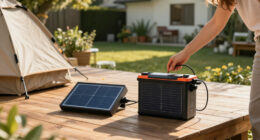
To choose the right solar generator capacity for family travel, start by listing all devices you’ll use and note their wattage and daily usage time. Add up their power needs and include a buffer of 20-30% to guarantee enough capacity. Balance size and weight for portability, opting for a unit that offers the right power without being too bulky. For more tips on matching capacity to your trip’s needs, keep exploring the details.

Get backup power and energy gear delivered free with Prime
- Fast, free delivery on millions of items
- Prime Video, Amazon Music and more included
- Member-only deals all year
Key Takeaways
- List all devices and their wattage to determine total daily energy needs.
- Choose a generator with capacity 20-30% above your estimated usage for buffer.
- Balance capacity with portability, avoiding overly bulky units for family travel convenience.
- Opt for high-quality batteries with long cycle life for reliable, extended off-grid use.
- Prioritize durability and performance to ensure consistent power throughout the entire trip.

Are you wondering how to pick the right solar generator capacity for your family’s travel needs? It’s a common question, especially when balancing the desire for reliable power with the need for portability. The key is understanding how much energy your family consumes during trips and selecting a generator that offers the right mix of portable efficiency and battery longevity. You want a unit that can handle your essential devices without being bulky or cumbersome, but also one that won’t require frequent recharging or replacement.
Start by listing all the devices you plan to use while traveling—phones, tablets, small appliances, maybe a portable fridge. Check their wattage requirements and estimate how long you’ll need each device to run each day. This helps you determine the total power capacity your generator needs to provide. Keep in mind that a larger capacity means more weight and size, which can make portability a challenge, so aim for a balance that suits your travel style. Remember, a generator with higher capacity often offers better portable efficiency because it can handle multiple devices simultaneously without straining, but it must also maintain battery longevity to avoid frequent recharges.
Assess your device wattage needs to find a balanced, portable generator with sufficient capacity and battery life for travel.
Battery longevity is crucial because you want your solar generator to last through your entire trip without frequent recharging, especially if you’re camping off-grid. Opt for a model with a high-quality battery that can endure many charge cycles—this ensures your investment lasts longer. A longer-lasting battery also means you can rely on the generator for extended periods without worrying about degradation or performance drops. Look for units that incorporate smart battery management systems, which protect the battery from overcharging and deep discharges, further extending its lifespan. Additionally, understanding the importance of battery health can help you select a generator that remains reliable over time.
In terms of capacity, consider a generator with a storage capacity that exceeds your daily consumption by at least 20-30%. This buffer provides peace of mind, so you won’t be caught short if solar input drops due to weather or shading. Remember, a higher capacity generator with efficient power management can be more portable than it appears, especially if it combines lightweight materials and compact design features. Choosing the right size isn’t just about raw power; it’s about matching your energy needs with a reliable, portable unit that offers excellent efficiency and durability. This way, you ensure your family’s travel experience remains comfortable, safe, and well-powered without sacrificing convenience.
Products Worth Considering

Samsung 48 4K OLED Smart TV (2026) with WireLogic 8ft Ultra High Speed HDMI Cable

Blueair Blue Pure 211i Max Air Purifier for Large Rooms

Philips Hue Festavia Outdoor Globe String Lights, 8 Bulbs, 22 ft
As an affiliate, we earn on qualifying purchases.
Frequently Asked Questions
Can I Upgrade My Solar Generator Capacity Later?
Yes, you can upgrade your solar generator capacity later, but it depends on the model. Many units have modular designs allowing you to add extra batteries or panels, enhancing capacity. Keep in mind that upgrading might affect portability considerations, so consider battery lifespan and weight when expanding. Before upgrading, check if your generator supports additional modules, and verify the new capacity aligns with your travel needs and power demands.
How Does Climate Affect Solar Generator Efficiency?
Climate substantially affects your solar generator’s efficiency. Cold weather can reduce solar panel output, while high temperatures may cause overheating. Cloudy days and frequent rain decrease sunlight exposure, impacting power generation. Proper solar panel placement, such as maximizing sunlight exposure and shielding from shade, boosts efficiency. Additionally, choosing a weather-resilient solar generator guarantees reliable performance in diverse climates, helping you stay powered during family travels regardless of weather conditions.
What Safety Features Should I Look For?
Did you know that over 80% of solar generator malfunctions are due to safety issues? When choosing one, prioritize safety features like overload protection, short circuit prevention, and automatic shutoff. These features help prolong your battery lifespan and guarantee safe operation. Also, consider portability considerations—compact, lightweight models are easier to carry, especially for family trips. Safety features protect your investment and keep your family safe while enjoying off-grid adventures.
Is a Larger Capacity Always Better?
A larger capacity isn’t always better because it can reduce portability and strain the battery lifespan. If you only need to power small devices, a smaller generator is more convenient for travel. Consider portability considerations like weight and size, which impact ease of transport. Balance your power needs with these factors to choose a capacity that suits your family trip without sacrificing battery health or mobility.
How Do I Calculate My Family’s Total Power Needs?
To calculate your family’s total power needs, list all essential devices and their wattages. Add up their daily usage hours to determine total energy consumption. Keep in mind, a larger capacity guarantees battery lifespan and supports multiple devices longer. Opt for a portable design so you can easily carry it during travel. This way, you’ll guarantee your generator meets your family’s power demands while remaining convenient and durable.
Conclusion
Now that you’ve navigated the solar generator maze, you’re ready to light up your family adventures. Think of your chosen capacity as the heartbeat of your travel plans—pumping energy into memories and moments. With the right size, you’ll sail smoothly through sunny days and starry nights, never losing power or your spark. So, pick wisely, and let your journey shine brighter than ever—powered by the sun’s endless promise.